
Reviewed · CONCENTRATION CAMP MEMORIAL TOURS
Berlin: Sachsenhausen Concentration Camp Bus Tour in English
Sachsenhausen is not a casual sightseeing stop. It is a place of murder, forced labor, disease, medical abuse, and systematic cruelty. This four-hour English-language tour gives you historical guidance before you arrive, then takes you through the former camp with enough structure to understand what you are seeing.
I like the air-conditioned bus, which avoids the long walk from Oranienburg station to the memorial entrance. I also like the guides’ clear, respectful approach. Ariel, Paul, Jamie, Lewis, Nickolai, and others are praised for explaining difficult material carefully and answering questions without turning the visit into a rushed lecture.
The main drawback is time. Two hours inside Sachsenhausen lets you cover the essential areas, but the site is large and emotionally demanding. You will need comfortable shoes, weather-ready clothing, and a willingness to spend much of the day outdoors.
Key points at a glance
- A planned bus transfer from central Berlin: Travel from Friedrichstraße to Sachsenhausen without arranging a regional train, local bus, and long walk.
- A guided look at the camp system: Learn how Sachsenhausen was designed for control, expansion, forced labor, and administrative efficiency.
- Important surviving areas: Visit Tower A, barracks, infirmaries, punishment cells, the crematoria area, gas chamber site, and execution trench.
- Strong guide commentary: Guides including Ariel, Paul, Jamie, Lewis, and Nickolai are noted for clear explanations and respectful storytelling.
- A serious, outdoor visit: Expect walking across a stark memorial site in changing weather, with little comfort or entertainment.
- Good value for limited time: At $49 per person, transport, entry, the memorial donation, a map, and live guiding are included.
Why Sachsenhausen belongs on your Berlin plans
Berlin has no shortage of museums about the Nazi period, but Sachsenhausen gives you something a city museum cannot: the physical layout of a concentration camp. The open ground, remaining barracks, watchtower, punishment areas, and memorial structures make the machinery of imprisonment easier to grasp.
The camp was built near Oranienburg as the first concentration camp designed and constructed from the start according to a planned model. Its triangular layout was intended to give guards control over the prisoners and the camp’s future expansion. That design is part of what makes a guided visit useful. Without context, the wide spaces and partial ruins can seem confusing. With a guide, the arrangement begins to show how surveillance, forced labor, punishment, and administration worked together.
The memorial also asks a difficult question: what did people living nearby know about the camp system? The trip through Oranienburg gives your guide a chance to explain how the camp affected life beyond the fences. That wider setting matters. Sachsenhausen was not an isolated point on a map. It was part of a system that required transport, labor, supplies, guards, offices, and contact with the surrounding population.
I recommend visiting with the right frame of mind. This is not a dramatic attraction or a place for light conversation and quick photographs. You are going to a memorial site where around 35,000 people were murdered or died from disease and brutal conditions. The value comes from careful learning and remembrance.
More Concentration Camp Memorial Tours in Berlin
- Berlin: Sachsenhausen Concentration Camp Tour in English
★ 5.0 · 5,711 reviews - Berlin: Sachsenhausen Concentration Camp Memorial Tour
★ 4.7 · 3,716 reviews - Sachsenhausen Concentration Camp Bus Tour in English from Berlin
★ 5.0 · 1,962 reviews
Meeting at Friedrichstraße and getting to Oranienburg
The standard meeting point is outside Friedrichstraße train station, on the square between the station and the Tränenpalast, also called the Palace of Tears. Look for a guide with a yellow umbrella, blue lanyard, and yellow name tag. The address given for the meeting area is Reichstagufer 17, 10117 Berlin.
Give yourself enough time to find the square rather than arriving at the last minute. Friedrichstraße is a busy transport point, and the guide may not be inside the station building. Hotel pickup is not included for the regular shared tour. Private options may offer pickup, with the guide arriving five minutes before departure.
The bus ride takes about 50 minutes each way. That is more than a simple transfer. Guides use the journey to provide background on Berlin, Oranienburg, the Nazi camp network, and the site you are about to visit. Several guides, including Jamie, Joseph, Lewis, and James, are especially praised for using the bus ride to build context before arrival and answer questions afterward.
The coach is air-conditioned and private to the tour. That makes the trip simpler than traveling independently, especially if you want a guide from the start. It also saves the long walk from Oranienburg’s railway station to the memorial entrance, a practical advantage in rain, wind, heat, or cold.
Oranienburg and the approach to the memorial
As the bus reaches Oranienburg, your guide explains the town’s connection to Sachsenhausen. This is where the visit begins to move from general Nazi history to the local setting of the camp.
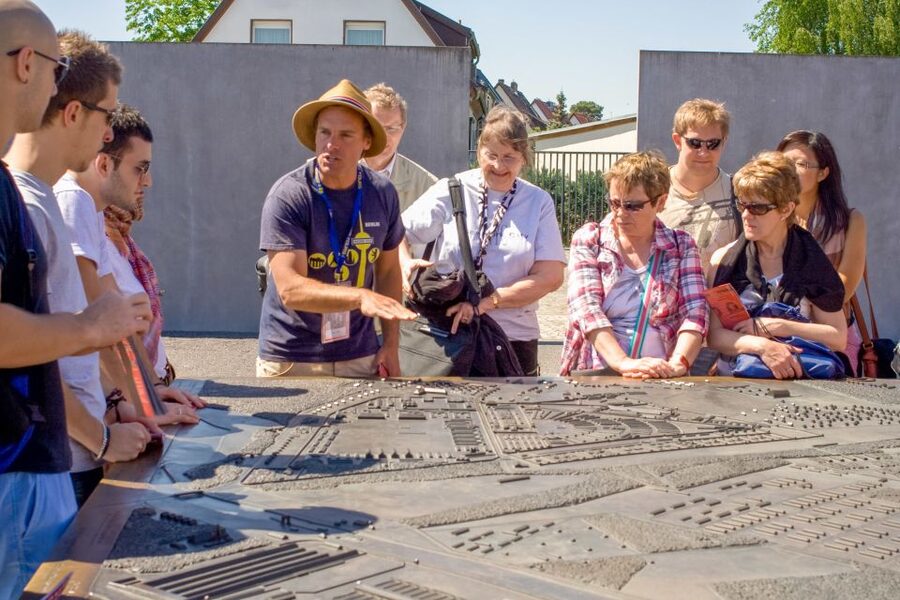
The approach helps you think about the camp as a working institution rather than a sealed-off prison. Inmates were forced to work, and the camp system depended on nearby industry, transport, administration, and labor demands. The route through town gives your guide a chance to explain what prisoners’ lives looked like beyond the central compound and how the camp influenced the surrounding area.
You will probably find the commentary more useful than simply arriving at the gate on your own. Guides such as Paul and Nickolai are praised for connecting the camp to German government, wartime policy, and the wider system of concentration camps. The quality of the day depends partly on the individual guide, but the format gives the guide time to prepare you before you begin walking.
Tower A and the prisoner compound
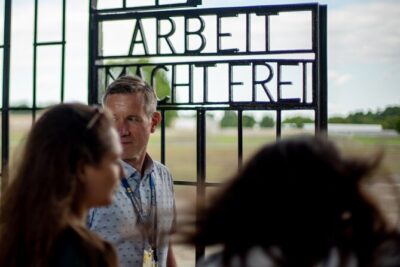
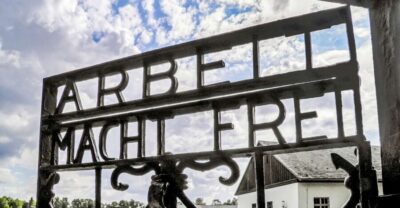
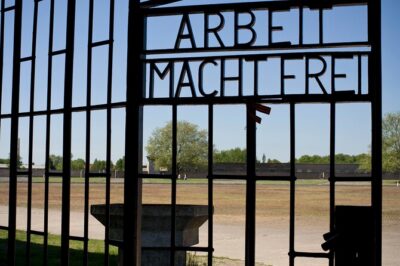
The main entrance is through Tower A, the best-known gateway into Sachsenhausen. The words Arbeit Macht Frei remain above the entrance, a chilling example of the lies used to disguise persecution and forced labor.
Inside, the scale of the compound becomes clearer. The ground is broad and stark, with the original camp plan still visible even where buildings are gone. Your guide explains how prisoners were controlled, how daily routines were imposed, and how punishment was woven into ordinary camp life.
The barracks are among the most important stops. You will see where prisoners were housed and learn about overcrowding, harsh discipline, hunger, forced labor, and disease. The surviving interiors are not presented as a theatrical reconstruction. Their plainness is part of the impact. You are looking at spaces built for confinement, not comfort.
I find a guided explanation especially useful here because the physical remains can be incomplete. Some areas have been reconstructed or marked, while others are open ground. A good guide helps you understand what once occupied each space without pretending that the site can recreate the experience of imprisonment.
Other memorial sites within reach of Berlin:
- Berlin: Sachsenhausen Concentration Camp Tour in English
★ 4.8 · 1,889 reviews - Sachsenhausen Concentration Camp Memorial Tour (Max. 15 Guests)
★ 5.0 · 1,516 reviews - Berlin: Sachsenhausen Concentration Camp and Potsdam Tour
★ 4.6 · 1,334 reviews - Sachsenhausen concentration camp.
★ 5.0 · 1,189 reviews
Infirmaries and medical abuse
The infirmary barracks show another side of Sachsenhausen. These were not simply places where sick prisoners received care. Medical experimentation took place there during the war, and the guides explain how medicine was abused as part of the camp system.
This section can be hard to process because it shows how ordinary professional structures were turned toward cruelty. The lesson is not only about individual acts of violence, but also about administration, compliance, and the misuse of authority.
Allow yourself time to listen rather than rushing through. The walking tour covers a lot of ground, and the subject matter is heavy. Guides praised for their calm delivery, including Ariel, Maria, Rebecca, and Dr. Thomas, help keep the information clear without treating the material as spectacle.
Punishment cells, isolation, and forced control
The punishment cells and isolation areas explain how the camp maintained obedience. The tour covers punishment cells, isolation spaces, and the brutal treatment prisoners faced for breaking rules, resisting, or simply falling outside the camp’s rigid demands.
This is where the camp’s system of control becomes especially clear. Prisoners were not only confined behind fences. They were controlled through work, food deprivation, surveillance, physical punishment, isolation, and threats. The guide’s job is to connect these pieces so you can see how the system operated day after day.
The tour also includes the commandant’s house. Its presence is disturbing because it brings the people who organized the camp’s operation into the picture. The house was part of the administrative world behind the violence. Seeing it helps you consider the separation between ordinary domestic life and the crimes being directed nearby.
Crematoria, the gas chamber site, and the execution trench
The crematoria area, gas chamber site, and execution trench are among the most solemn parts of the visit. These locations mark the camp’s killing operations and the treatment of prisoners after death.
The exact condition of each area can differ because Sachsenhausen is a memorial site with surviving structures, ruins, markers, and reconstructed elements. A guide explains what happened in each location and helps you understand the evidence without turning the place into a list of shocking details.
This part of the tour is not designed for quick photographs. A camera is allowed, but you should use judgment and respect the memorial setting. I would bring one only if you intend to record the site thoughtfully, not to collect dramatic images.
The crematoria and gas chamber section also shows why a visit to Sachsenhausen should not be reduced to the phrase concentration camp tour. The camp was a place of forced labor, imprisonment, disease, punishment, experimentation, executions, and organized murder. The guide fills in the connections between those functions.
Two hours inside: enough, but not generous
The guided visit inside Sachsenhausen lasts about two hours. That is enough to cover the major areas listed in the tour, including the entrance, barracks, infirmaries, commandant’s house, punishment spaces, crematoria area, gas chamber site, and execution trench.
It is not enough for a slow, private study of every surviving building and memorial. If you already know you want hours of quiet reflection or detailed reading, an independent visit may suit you better. The tradeoff is that you would need to arrange the transport and make your own way from Oranienburg station to the memorial.
For a first visit, I think the two-hour format works well. The guide keeps the group moving, explains the site in an order that makes sense, and leaves you with a framework for further reading. The map included with the tour is useful for orienting yourself during and after the visit.
Wear walking shoes. You will be outside for much of the tour, and the weather can change quickly. Bring water and a light snack, since neither is listed as included. You should also dress for rain, wind, heat, or cold rather than assuming the bus will protect you for most of the day.
Guide quality makes the difference
The guide is the most important variable in this experience. The subject requires facts, restraint, emotional awareness, and enough flexibility to answer difficult questions.
Ariel is praised for powerful storytelling, broad historical context, and careful answers. Paul is noted for connecting Sachsenhausen with German history, war, and government. Jamie receives praise for offering useful information both at the memorial and on the bus. Lewis is described as friendly and engaging while treating the day as a serious learning experience.
Nickolai is especially noted for a respectful presentation and sensitivity to the subject. Joseph is valued for helping visitors with wider Berlin questions at the end of the tour, including ideas about what else to see and where to eat. Other named guides include Campbell, Gregory, Mikey, Martin, Shawn, Rebecca, Maria, James, and Dr. Thomas.
You cannot choose a particular guide unless the booking option says so, and the guide lineup may change. Still, the repeated pattern is clear: the tour depends heavily on live commentary, and the provider has a large pool of guides who are expected to handle the material carefully.
English and Spanish tours are available. Private and small-group options are also offered. A smaller group may give you more room to ask questions, while the standard group option keeps the price lower.
Is $49 a fair price?
At $49 per person, the tour offers solid value if you want convenience and interpretation. The price includes a professional licensed guide, the air-conditioned vehicle, driver, Sachsenhausen entry, a $3 donation to the memorial, and a map.
The bus matters most. You are paying to avoid piecing together several transport steps and to receive commentary during the journey. If you are short on time in Berlin, that can be worth more than the basic transport cost alone.
The price is less compelling if you prefer to spend an entire day at the memorial or read every panel independently. You are buying a structured half-day visit, not unlimited time. Food, drinks, and hotel pickup are not included.
Free cancellation up to 24 hours before the tour and reserve-now, pay-later booking add flexibility. Check the exact start time when you book, since departure times vary by date and option.
Who should book this tour?
I would recommend it to you if you want a serious introduction to Sachsenhausen but do not want to manage the journey from Berlin yourself. It suits first-time visitors, people with limited time, and anyone who wants a guide to explain the camp’s layout and place it within the Nazi camp system.
It is also a good choice if you are planning to visit another memorial, such as Auschwitz, and want historical preparation. One guide helped a visitor connect the experience with a planned Auschwitz visit, which is a useful reminder that Sachsenhausen can provide context for other sites.
You should think twice if you want a quiet, unstructured visit with no group pacing. The memorial is emotionally difficult, and two hours can feel full. Families should also consider whether younger children are ready for the subject, since the tour covers murder, disease, experimentation, punishment, and gas chambers.
Final verdict: a practical and respectful half-day visit
I would book this tour if I had four hours in Berlin and wanted a guided visit to Sachsenhausen without the hassle of public transport. The bus saves energy, the route is well organized, and the guide commentary begins before you reach the memorial.
Go for the historical explanation, not entertainment. You will walk through barracks, infirmaries, punishment areas, and killing sites while hearing how the camp operated and how it affected the surrounding area. The experience is sobering, but that is precisely why a careful guide and a clear schedule matter.
Bring water, a snack, comfortable shoes, and weatherproof clothing. Arrive at Friedrichstraße in good time, find the yellow umbrella, and prepare to listen. For $49, this is a strong choice for a focused first visit, provided you accept the limits of a two-hour tour inside a very large memorial.
FAQ
Where does the Sachsenhausen bus tour meet in Berlin?
The regular tour meets outside Friedrichstraße train station, on the square between the station and the Tränenpalast, also called the Palace of Tears. The listed address is Reichstagufer 17, 10117 Berlin.
How do I recognize the guide?
Look for a guide wearing a blue lanyard and yellow name tag, holding a yellow umbrella.
How long does the activity last?
The full activity takes about four hours, including roughly 50 minutes by bus each way and about two hours at Sachsenhausen Memorial.
Is transportation included?
Yes. Transportation is provided by a private air-conditioned vehicle with a driver.
Is hotel pickup included?
Hotel pickup and drop-off are not included in the standard tour. Pickup may be available with private options.
What languages are available?
The live tour guide is available in English and Spanish.
What does the tour include at Sachsenhausen?
The tour includes memorial entry, a $3 donation per person to Sachsenhausen Memorial, a map of the former camp, and guided visits to areas such as the barracks, infirmaries, commandant’s house, punishment cells, crematoria area, gas chamber site, and execution trench.
What should I bring?
Bring comfortable walking shoes, weather-appropriate clothing, a light snack, and a drink. A camera is also listed as something you may bring.
Can I cancel or pay later?
You can cancel up to 24 hours in advance for a full refund. Reserve-now, pay-later booking is also available.
Just added in Berlin
- Berlin: Energizing 2-Hour Morning Segway Tour★ 4.7 · 35 reviews
- Berlin: Thrilling E-Scooter Adventure Tour★ 4.4 · 66 reviews
- Beer Bike & Party Bike: Unforgettable Berlin City Tour incl. pickup★ 5.0 · 5 reviews
- Beelitz-Heilstätten: Baum&Zeit Tree Top Walk Entry Ticket★ 4.9 · 7 reviews
- AXE THROWING EXPERIENCE IN BERLIN★ 4.7 · 24 reviews
- Alternative Berlin / Street art tour – Private group★ 5.0 · 6 reviews
- Berlin: Alternative & Street Art Tour★ 4.5 · 6 reviews
- Berlin: 2.5-Hour Beer & Sunset Sightseeing Boat Cruise★ 4.6 · 61 reviews
Concentration Camp Memorial Tours, compared.
Sachsenhausen Concentration Camp Tour in English
Read our review →
Dachau Concentration Camp Memorial Site Tour from Munich by Train
Read our review →
Sachsenhausen Concentration Camp Memorial Tour
Read our review →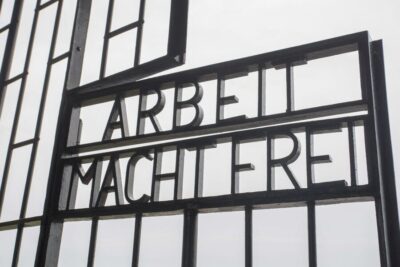
Sachsenhausen Concentration Camp Bus Tour in English from Berlin
Read our review →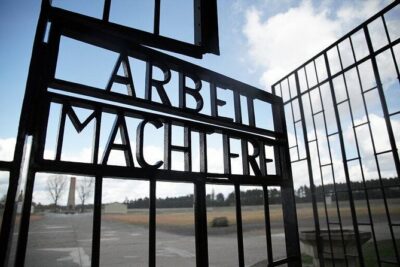
Sachsenhausen Concentration Camp Memorial Tour (Max. 15 Guests)
Read our review →
Sachsenhausen Concentration Camp and Potsdam Tour
Read our review →Browse the lists this tour appears in