Reviewed · TOURS IN BERLIN
Berlin Private Custom 5-Hour Tour by Car
Berlin is a wide, scattered city, and this private car tour solves a real problem: you can see major sights across former East and West Berlin without spending half the day on trains. The guide connects places that can feel unrelated at first, from the Brandenburg Gate and Holocaust Memorial to Kreuzberg and the East Side Gallery.
I like the flexible pickup and departure time, especially if you are arriving by train, staying outside central Mitte, or working around a busy schedule. I also like the human side of the guiding. Thomas, Jan, Winfried, Sven, and other guides are praised for explaining not just what happened, but how Berlin remembers it today.
The tradeoff is price: at $504.59 per person, this is a serious splurge, particularly for one or two people. Five hours also goes quickly, so you will see many places from the vehicle and make short stops rather than tour every museum or interior.
Key points at a glance
- Private five-hour route: Your group rides alone in an air-conditioned minivan and can shape the day around your interests.
- Hotel pickup and drop-off: Pickup is available anywhere in Berlin, with special conditions for airport pickups.
- Berlin from both sides of the Wall: The route links Mitte, Charlottenburg, Kreuzberg, the East Side Gallery, and former West Berlin.
- Strong historical storytelling: Guides such as Thomas and Winfried bring personal and carefully researched context to Berlin’s 20th-century past.
- Photo stops by request: You can ask to stop and explore, though the number of stops depends on your pace.
- Free cancellation deadline: Cancel at least 24 hours before the start time for a full refund.
Why a private car works well in sprawling Berlin
Berlin is not a compact old town where every major sight sits around one square. The Reichstag is near the Brandenburg Gate, but Charlottenburg Palace, the Kurfürstendamm, Kreuzberg, and the East Side Gallery are spread across the city. You can cover them by public transport, but you will spend time changing lines and checking directions.
A private minivan gives you a useful overview early in your stay. You can move from the government district to Potsdamer Platz, cross toward former West Berlin, then return to Mitte and continue east. The driver-guide can keep the route moving while explaining the setting outside the window.
This is not a hop-on, hop-off bus. You are not following a fixed loop with a recorded narration. Your group has the vehicle to itself, and the guide can respond to your questions, slow down for a photo, or adjust the balance between famous sights and neighborhood stops.
The five-hour length is enough for a broad introduction, not a full survey of Berlin. You should expect a mix of driving commentary, brief walks, and photo stops. If you want to visit the Reichstag dome, tour a museum, or spend an hour inside Charlottenburg Palace, you will need separate time.
A few more things to do in Berlin worth a look
- Berlin: Private Reichstag and Glass Dome Tour
★ 4.8 · 2,226 reviews - Berlin Private Complete History All Day Walking Tour
★ 5.0 · 474 reviews - Private Walking Tour Berlin Third Reich Hitler and World War II
★ 5.0 · 360 reviews
Brandenburg Gate, the Reichstag, and the weight of memory
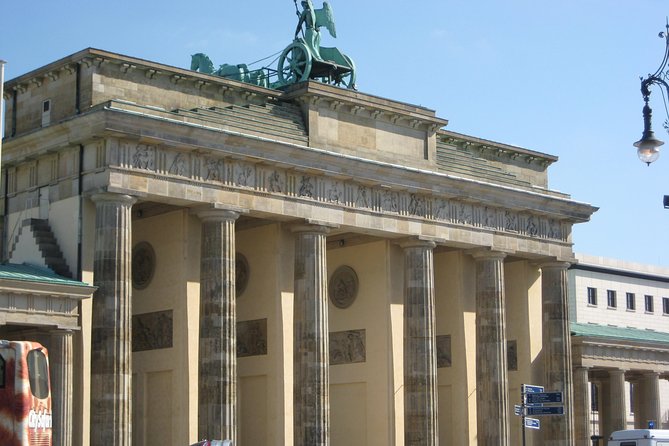
The central portion of the route brings together Berlin’s most important political and historical sights. At the Brandenburg Gate, you are looking at the city’s best-known symbol, a neoclassical gateway built in the late 18th century. Its meaning has changed repeatedly, from a symbol linked with peace to a backdrop for power, division, and finally German unity.
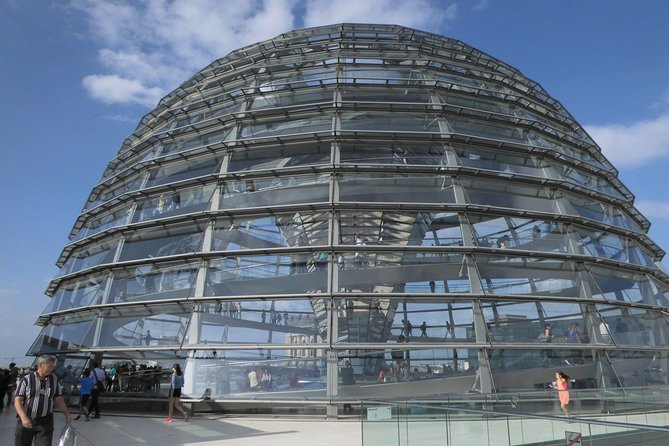
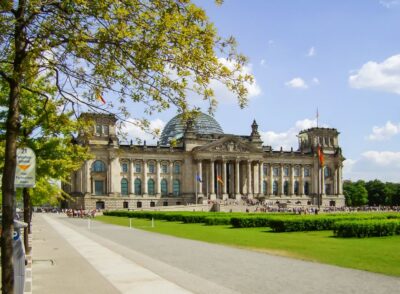
The nearby Reichstag and government district help explain modern Berlin. The glass dome, designed by Norman Foster, is now associated with openness and public access, though the building’s past is far more complicated. Your guide can give the political setting context even though this tour does not include admission to the dome.
The Holocaust Memorial is one of the stops where a good guide matters most. The field of concrete slabs is simple in appearance but unsettling to walk through. Jan has been praised for explaining how the design creates disorientation rather than offering a neat lesson with a beginning and an end. You may also hear about the nearby memorial to gay men persecuted under the Nazis, a detail that broadens the story beyond the most familiar sites.
Potsdamer Platz offers a different kind of history. Once cut through by the Berlin Wall, the area became a major rebuilding project after reunification. You will see modern architecture associated with Renzo Piano and the Sony Center, while the guide can explain why this polished district has prompted debate about Berlin’s changing identity.
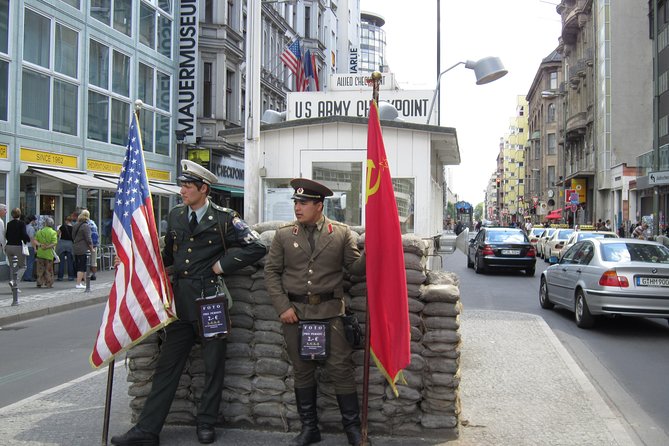
The Topography of Terror, Checkpoint Charlie, and the former Wall route keep the focus on dictatorship and division. Much of the value here comes through spoken explanation. A quick look at a former border crossing means little without the story of the Russian and American tanks that once faced one another there.
Unter den Linden, Museum Island, and Alexanderplatz
Driving along Unter den Linden gives you a sense of Berlin’s imperial center. The boulevard leads toward Museum Island and Alexanderplatz, two places that help show how the city grew and changed.
Museum Island gathers several major museums, but this five-hour tour treats it as part of the city’s wider story rather than a museum visit. You can see how the monumental buildings fit into central Berlin and then return later if one of them deserves a full morning.
Alexanderplatz brings a more modern, East Berlin flavor. It was an important public space in the former German Democratic Republic and remains one of the city’s busiest transport and shopping areas. The route does not promise long time on foot here, so treat it as an orientation stop rather than a chance to explore every corner.
One useful feature of this tour is the way the guide can connect these places. Berlin’s past is not confined to one memorial district. A discussion may move from Frederick the Great’s policies to the former Palace of the Republic, then to the reconstructed royal palace now occupying its site. The point is not to hand you one approved opinion, but to show why Berlin continues to argue about what should be preserved, rebuilt, or removed.
Tiergarten and the Victory Column
Your drive through Tiergarten gives you a break from dense city streets. This large central park is also part of Berlin’s political geography, linking the government quarter with former West Berlin.
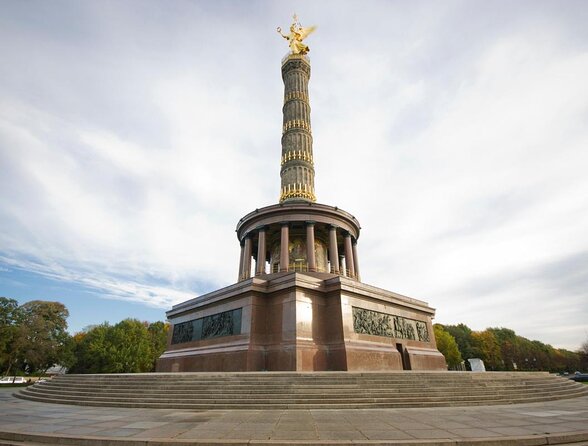
The Victory Column was built in the 1870s and originally stood in front of the Reichstag. It was moved to its current position in the 1930s under Albert Speer. That simple fact is useful because it shows how monuments can be repositioned and given new political meaning.
This is usually a drive-by portion, not a long park walk. If photography is important to you, tell the guide early. The tour allows stops by request, but five hours cannot accommodate every possible pause.
Same base, a different kind of day out:
- Berlin: Reichstag, Dome and Government District Guided Tour
★ 4.7 · 18,288 reviews - Berlin: 1-Hour City Tour by Boat with Guaranteed Seating
★ 4.3 · 16,993 reviews - Berlin: Boat Tour Along the River Spree
★ 4.4 · 11,252 reviews - Discover Berlin Half-Day Walking Tour
★ 5.0 · 9,624 reviews
The Memorial Church and Kurfürstendamm
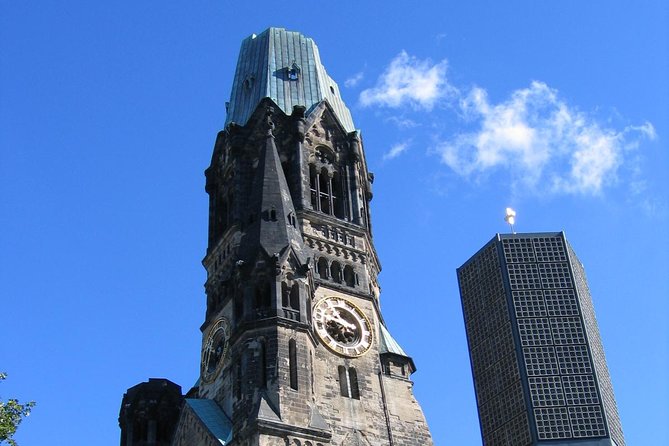
The Kaiser-Friedrich-Gedächtniskirche, better known as the Memorial Church, is a war ruin in the heart of former West Berlin. Its damaged tower was kept as a reminder of the destruction of war. The stop is brief, but its rough, incomplete appearance contrasts with the polished commercial district around it.
Nearby Kurfürstendamm is Berlin’s grand western boulevard, lined with shops, restaurants, theaters, and cafés. The ten-minute stop is enough to see the character of the avenue and understand its role in West Berlin life. It is not enough for shopping, a meal, or a proper look at every side street.
This part of the route is valuable because it prevents Berlin from becoming only a story of Prussia, Nazism, and the Wall. The city also had a distinct western identity, shaped by postwar consumer culture and life on the isolated West Berlin side.
Charlottenburg Palace and the Hohenzollern past
Charlottenburg Palace is the only surviving Berlin palace among the major residences built by the Hohenzollern dynasty during its long reign. From the vehicle, you get a sense of the scale and setting, but the listed stop is only about ten minutes.
That short visit is a clear limitation if you care about royal interiors, gardens, or decorative arts. You will need another visit for the palace itself. Still, including it in the driving route gives you a useful counterpoint to Berlin’s modern political districts and Wall-era neighborhoods.
Ask your guide how much time can be devoted to the palace before booking if this is your main interest. The tour is designed to show many parts of the city, not to provide a detailed palace visit.
Hackescher Markt and Jewish Berlin
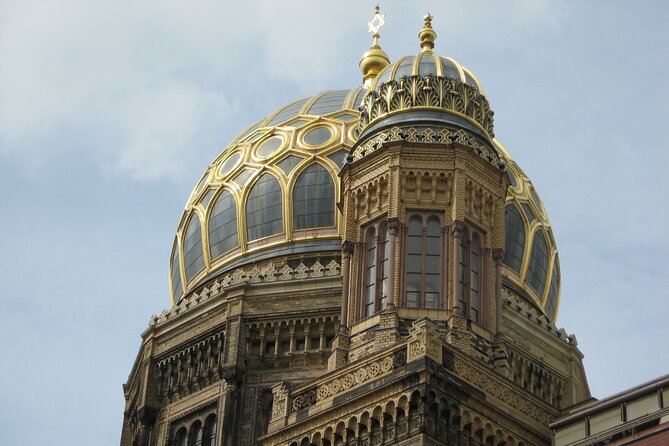
Hackescher Markt sits in Mitte, an area shaped by immigration and Jewish life in the 19th century. The route can include the New Synagogue, the Old Jewish Cemetery, and the Hackesche Höfe, a series of interconnected courtyards known for their architecture and urban character.
This is one of the places where a guide can help you avoid a shallow postcard view. The buildings are attractive, but the setting also points to the lives of Jewish residents from Eastern Europe and the destruction of Jewish communities under Nazism.
The stop is listed at about twenty minutes. That makes it useful for orientation and a short walk, but not for a full exploration of the courtyards, synagogue, or surrounding streets. If you want time for shops, cafés, or a longer visit, ask to trim another part of the route.
East Side Gallery and the former Wall
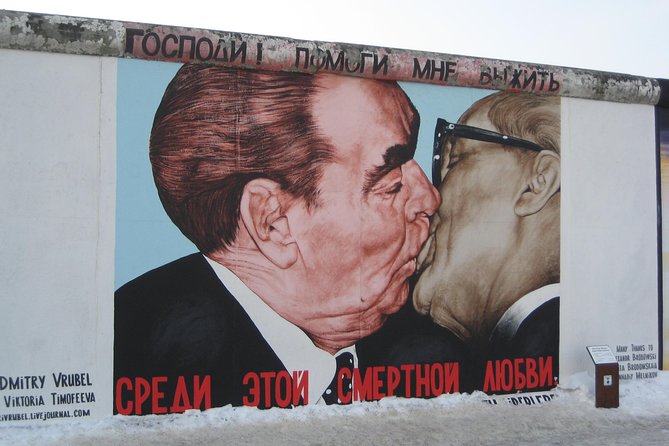
The East Side Gallery is a 1.5-kilometer stretch of the Berlin Wall covered with work by more than 100 artists. It is the city’s largest open-air gallery and one of the clearest places to see how a structure of division became a public canvas.
The fifteen-minute stop gives you a chance to see several paintings and take photographs. It will not allow time to walk the whole length. That is fine for a first look, but plan a separate visit if the murals are a priority.
A private car is particularly useful here because the East Side Gallery sits away from the main Brandenburg Gate and Reichstag cluster. The guide can also place the artwork in the larger story of the Wall’s fall and reunification, rather than treating it as just a colorful photo stop.
Kreuzberg and Oberbaumbrücke
Crossing Oberbaumbrücke into Kreuzberg shifts the mood again. The district became home to many Turkish immigrants during the 20th century and is now known for its mix of communities, cafés, restaurants, bars, and nightclubs.
The fifteen-minute stop offers a glimpse rather than a full neighborhood visit. Kreuzberg rewards wandering, eating, and lingering, so do not expect the short scheduled stop to capture everything. Its purpose is to show how Berlin’s identity grew through migration and change.
This is also a good place to ask questions about present-day Berlin. Guides have discussed housing costs, community gardens, nightlife, graffiti, and the reuse of industrial spaces. Those subjects help connect the city’s past to daily life now.
What the guides add to the five hours
The strongest part of this experience is the guide, but the exact person assigned to you matters. Names associated with the tour include Thomas, Jan or Jon, Winfried, Sven, Jürgen, and Josh. The company may also use a multilingual guide, and English is the listed language.
Thomas is especially well suited to travelers who want a structured account of Berlin’s history. His explanations have covered the main sights, less obvious neighborhoods, and the meaning of living in a divided city. Winfried has shared personal memories of growing up in Berlin and experiencing its changes firsthand.
Jan’s approach is more interpretive. He has connected architecture, memorial design, political choices, and current debates, while still leaving room for lighter details such as Ampelmann souvenirs, candy bombers during the Berlin Airlift, and Berlin’s techno culture.
You cannot choose a particular guide from the information provided, so do not book on the assumption that one named person is guaranteed. You can, however, tell the operator what interests you: Nazi-era history, the Cold War, architecture, Jewish Berlin, modern neighborhoods, or a broad first-day overview.
The language ability has also been a strong point. English is offered, and multilingual guiding may be possible. French and Spanish-language experiences have been provided, but confirm your preferred language when arranging the tour.
Price, comfort, and who gets good value
At $504.59 per person, the price is high for a five-hour city tour. The value improves for a group that wants privacy, door-to-door transport, and a custom route. It is harder to justify for one or two people who are comfortable using Berlin’s excellent public transport and visiting sights independently.
The price includes hotel pickup and drop-off, a private tour, an air-conditioned minivan, the driver-guide, taxes, fees, and handling charges. Food and drinks are extra. Since most stops are free, you are mainly paying for time, transport, planning, and interpretation rather than admission tickets.
I would consider this tour a good fit for:
- A first visit when you want to understand the whole city quickly
- Families or small groups with different interests
- People who find long walks or complicated transfers tiring
- Visitors with only one free day
- Anyone who wants a private guide rather than a large group
- History-minded visitors who value context and conversation
It is less suitable if you want long museum visits, extensive walking, nightlife, or a slow neighborhood food tour. The short stops are a strength for coverage but a weakness for close exploration.
Timing, weather, and practical planning
Pickup is available at your Berlin hotel or residence, and departure time can be adjusted to your schedule. Airport pickup may be possible, but special conditions apply, so ask before booking.
The tour operates in all weather. Wear clothing suited to the forecast, since you may step out for photos and short walks. On a cold or rainy day, the vehicle offers welcome shelter, but poor weather can reduce the pleasure of outdoor stops. One guide has been praised for keeping a chilly, wet day enjoyable, yet you should still bring a coat and comfortable shoes.
The tour is private, so only your group participates. Most people can take part, but the supplied details do not describe specific vehicle accessibility features. Ask the operator directly if you need mobility accommodations.
Because the day can pass quickly, choose your priorities before pickup. If you want every major sight, accept short stops. If you want serious time at the Holocaust Memorial, East Side Gallery, or Hackesche Höfe, reduce the number of neighborhoods.
Free cancellation is available when you cancel at least 24 hours before the local start time. Cancellations or changes made within 24 hours are not refunded or accepted.
Should you book this Berlin tour?
Book it if you want a fast but thoughtful introduction to a very spread-out city, especially when private transport and personal commentary matter more than keeping costs low. The guide can turn a long list of sights into a connected story about monarchy, dictatorship, division, reunification, migration, and Berlin today.
Think twice if the $504.59 per-person price strains your budget or if you prefer to explore at walking pace. You will see many places, but several stops are brief and no museum admission is included.
For a first day in Berlin, I find the route especially useful. Use it to learn where the city’s major districts are, note the places you want to revisit, and ask the guide for suggestions about food and follow-up visits. If Thomas, Jan, Winfried, or another strong guide brings the same care and detail described here, the five hours can give you much more than a checklist of landmarks.
FAQ
How long does the private Berlin tour last?
The tour lasts approximately five hours.
Is hotel pickup and drop-off included?
Yes. Pickup and drop-off are included at hotels or residences anywhere in Berlin. Airport pickup may be possible, but special conditions apply.
Is the tour private?
Yes. Only your group participates in the activity.
What language is the tour offered in?
English is offered. The tour may also be operated by a multilingual guide, so ask about your preferred language when booking.
Are food and drinks included?
No. Food and drinks are not included in the tour price.
Can I cancel for a full refund?
Yes, if you cancel at least 24 hours before the experience start time. Cancellations or changes made less than 24 hours before the start are not refunded or accepted.
Just added in Berlin
- Private One way Airport Transfer Berlin Airport To Berlin★ 3.5 · 17 reviews
- Private Walking Tour: Berlin Wall, Cold War and Checkpoint Charlie★ 5.0 · 37 reviews
- Modern Berlin Private Walking Tour: Diverse, Vibrant and Exciting German Capital★ 5.0 · 13 reviews
- Private Day Trip to Potsdam from Berlin by Train★ 4.5 · 27 reviews
- City Explorer: Potsdam Private Day Trip★ 4.5 · 10 reviews
- Private Half-Day Sightseeing Tour in Berlin★ 3.5 · 6 reviews
- Berlin Private Custom Tour in a Minivan, East and West★ 5.0 · 123 reviews
- Private Day Tour of Wannsee and Potsdam from Berlin★ 5.0 · 21 reviews
Tours in Berlin, compared.
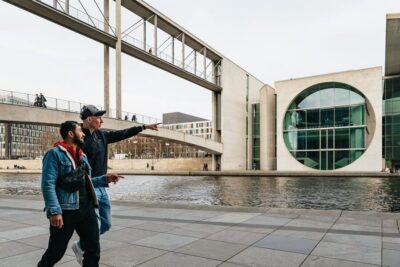
Reichstag, Dome and Government District Guided Tour
Read our review →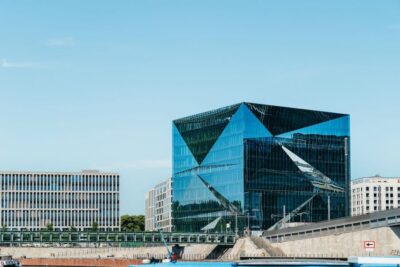
1-Hour City Tour by Boat with Guaranteed Seating
Read our review →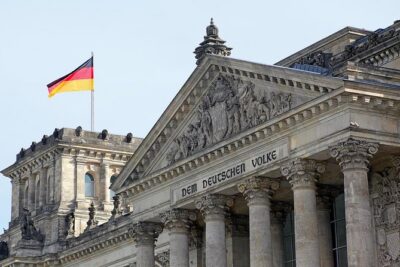
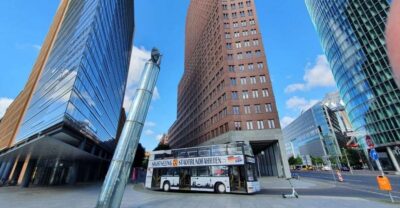
Reichstag, Plenary Chamber, Cupola & Government Tour
Read our review →