
Reviewed · THIRD REICH & WWII TOURS
Berlin: Private Bike Tour of the Berlin Wall and Third Reich
Berlin’s past becomes easier to grasp when you ride through it rather than hop between scattered sights. This private tour links the Berlin Wall, Nazi architecture, Holocaust memorials, and Cold War flashpoints in about three hours, with stops at places such as Mauerpark, the Reichstag, and Checkpoint Charlie.
I like the flexible route, since your guide can spend more time on the subjects your group cares about. I also like the practical speed of the bicycle, which lets you cover far more ground than a walking tour. The main drawback is that three hours is tight for so many serious sites, and the tour requires a minimum of four people.
Key points
- See Berlin’s Wall in several forms: Visit the main Wall memorial, Mauerpark, the Günter Litfin Memorial, and Invalidenfriedhof to understand both the border system and the people caught by it.
- Connect Nazi history with modern Berlin: The route covers the Humboldthain flak tower, Hitler’s bunker site, the Reichstag, Albert Speer’s plans, and the Holocaust Memorial.
- Ride a private route: Only your group takes part, and the guide can shape the tour around your interests.
- Cover ground quickly: A bicycle makes it practical to connect central Berlin’s historic sites in a single morning or afternoon.
- Expect strong English instruction: The tour is offered in English and German, with Dutch, French, and Spanish possible on request.
- Plan for an outdoor experience: Bikes and helmets are provided, but the tour operates in all weather, so dress for the forecast.
Why a bicycle works for Berlin’s divided history
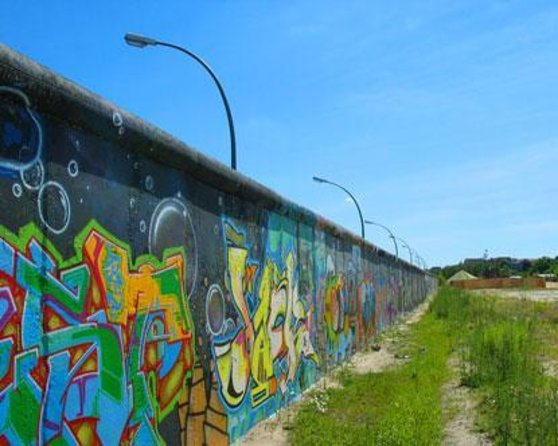
The best feature here is not simply the bicycle. It is the way the bike connects sites that can feel unrelated when visited one at a time.
Berlin’s Wall history is spread across the city. A walking tour can explain one stretch well, but covering the central Wall sites, the former government district, Checkpoint Charlie, and the Nazi-era locations on foot would take much longer. On a bicycle, you can move between them while seeing how the city’s former divisions fit together.
The private format matters. Your group is not tied to a fixed public-tour script, and each guide designs a route of their own. That gives the experience a personal quality, though it also means the exact order and balance of stops can vary.
The tour costs $107.42 per person and lasts about three hours. Since at least four people are required, the practical minimum is roughly $429.68 for the group before any group discount. That is not the cheapest way to see Berlin, but it can be good value if you want a private guide, bicycles, helmets, and a focused history lesson without arranging several separate visits.
More Third Reich and WWII Tours in Berlin
- Berlin: Third Reich and Cold War 2 Hour Walking Tour
★ 4.9 · 6,830 reviews - Berlin’s Best: 2 Hour Walking Tour Third Reich and the Cold War
★ 5.0 · 5,486 reviews - Third Reich Berlin: Hitler and WWII Walking Tour
★ 5.0 · 3,301 reviews
Starting at Nikolaiviertel, Berlin’s old core
The tour begins at Poststraße 11, near Nikolaiviertel. This quarter is presented as Berlin’s only real old town, but the important catch is that much of what you see is not untouched medieval Berlin.
World War II bombing destroyed large parts of the city, and Nikolaiviertel’s appearance reflects rebuilding as well as older city history. That makes it a useful opening stop: before discussing the Wall and the Third Reich, you get a reminder that Berlin has repeatedly been damaged, rebuilt, and politically reshaped.
The stop is scheduled for about 10 minutes. That is enough for an introduction and orientation, not a full architectural tour. Arrive ready to ride, since the meeting point is also the return point at the end.
The New Synagogue and a story of civil courage
At the New Synagogue, or Stiftung Neue Synagoge Berlin, the guide tells the story of a police officer who helped protect the building during Kristallnacht, the Night of Broken Glass.
The stop lasts only about five minutes, so expect a concise account rather than an extended visit inside. Its value is the human scale of the story. Berlin’s history is often told through governments, armies, and borders. This stop focuses on one act of courage during a period when public resistance carried real danger.
The tour’s central Berlin route also includes memorials connected with deportation and the Holocaust. Some of these are less prominent than the large memorial near Brandenburg Gate, and their GDR-era design offers a different way to think about how East Germany remembered, framed, or avoided difficult parts of the past.
Understanding the Wall at Bernauer Strasse
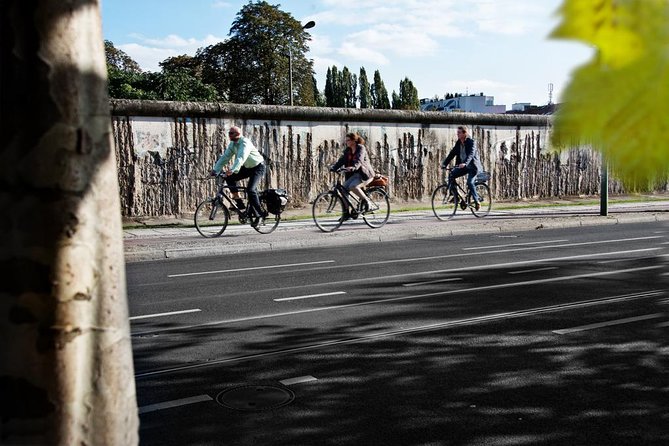
The Berlin Wall Memorial is one of the most important stops. Here, the Wall is not reduced to a colorful slab of concrete or a photo backdrop. The site helps you understand how the border worked and what it did to streets, homes, families, and daily life.
The stop is planned for about 10 minutes, which is short considering the importance of the place. Still, the bicycle makes it possible to see this section alongside other Wall sites rather than spending the entire tour in one location.
This is where the tour’s phrase about the Wall being still alive makes sense. You can get a clearer physical idea of the barriers and the space around them than you would from a single painted fragment elsewhere in the city. If Wall history is your main reason for booking, pay close attention here and tell your guide you would like the fullest possible explanation at this stop.
Other trips into the same period in Berlin:
- Berlin: Third Reich, Hitler, and WWII Walking Tour
★ 4.9 · 1,133 reviews - Berlin Third Reich Sites: Half-Day Walking Tour
★ 5.0 · 835 reviews - Berlin: Guided Bike Tour of the Berlin Wall and Third Reich
★ 4.7 · 499 reviews - Hitler’s Germany: Berlin During the Third Reich & WWII
★ 4.8 · 476 reviews
Mauerpark and the changing border
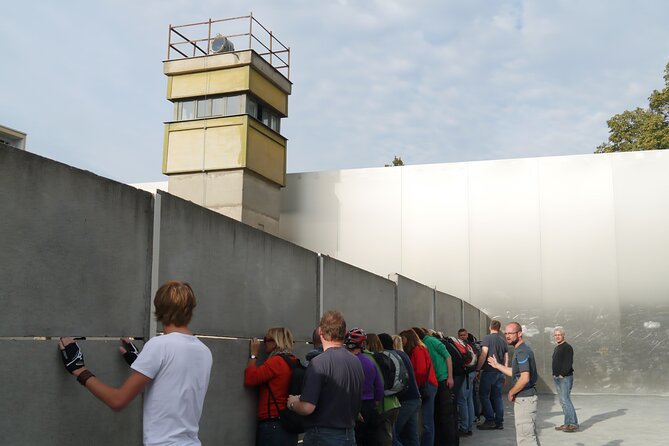
Mauerpark is now associated with a Sunday flea market, but its history is more severe. The area illustrates repeated efforts by East Germany’s rulers to create what they viewed as a perfect border.
That contrast is useful. Modern Berlin can make the Wall feel remote, especially in areas filled with cafés, markets, and new construction. Mauerpark shows how an ordinary city space was turned into a controlled frontier.
The stop lasts about 10 minutes. If you visit on a Sunday, the market may add noise and activity, but the tour’s historical purpose remains the same. The experience does not depend on shopping or entertainment here. It depends on understanding how the border was designed and maintained.
Humboldthain’s flak tower and Nazi construction
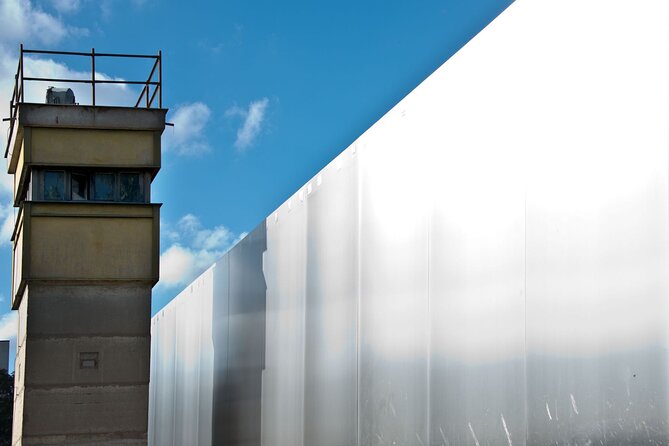
The Humboldthain flak tower is one of the more unusual stops. Built as a giant fortress and air-raid shelter, it gives you a look at Nazi-era military construction that is different from the better-known ceremonial buildings in central Berlin.
The site also offers a panoramic view. That makes it a natural pause in a bicycle tour, since you can take in the city from above while discussing the structure’s original purpose and the ideology behind monumental Nazi building projects.
The stop lasts about 10 minutes. Do not expect a long interior visit or a separate climb to dominate the tour. The point is to connect the physical remains with Nazi architecture and wartime Berlin.
Remembering Günter Litfin at the preserved tower
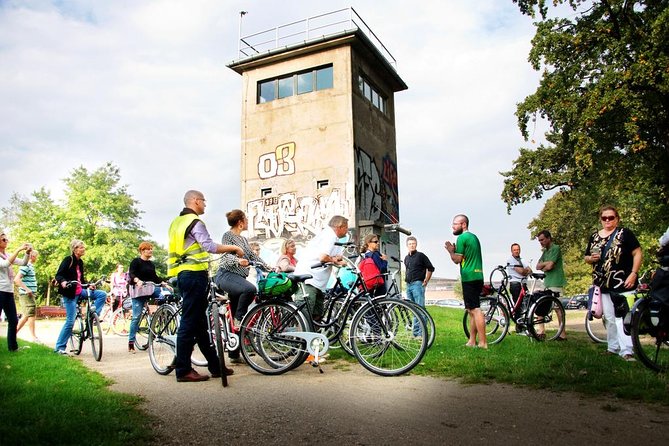
At the Günter Litfin Memorial, an original watchtower has been preserved in memory of Günter Litfin, described here as the first person shot at the Wall.
This is a more personal Wall stop than the broad memorial at Bernauer Strasse. The tower gives the story a specific location and a name. Instead of considering the Wall only as a political boundary, you are reminded that attempts to cross it could end in death.
The visit takes about 10 minutes. Because the tour covers several memorials, the guide’s explanation is especially important. You will get more from the stop if you listen for how the border system affected individual choices, not only how it divided the city on a map.
Invalidenfriedhof and a divided cemetery
Invalidenfriedhof was created for figures associated with German military history. The Berlin Wall later cut through the burial ground, damaging the cemetery and dividing it physically.
That makes this an unusually layered stop. You are looking at a place connected with military honor, political memory, wartime destruction, and Cold War division all at once. The guide also addresses why some of the people buried there may deserve remembrance without deserving admiration.
The planned visit is about 10 minutes. It is a good example of the tour’s willingness to handle uncomfortable parts of German history rather than offering only polished monuments.
Spreebogenpark and Albert Speer’s unrealized Berlin
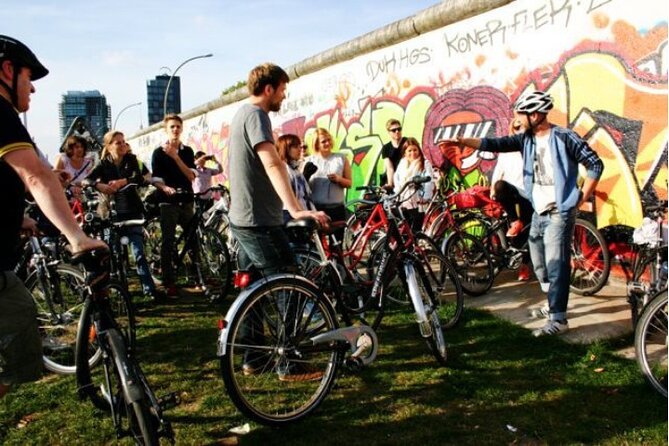
At Spreebogenpark, you get a broad view of Germany’s present government district. From there, the guide discusses Albert Speer’s plans for Hitler’s Berlin and the proposed Great Hall, a building intended to hold 180,000 people.
The power of this stop comes from the contrast between what you see and what Nazi planners imagined. Today’s government district is linked to a democratic Germany. Speer’s vision was built around authoritarian power and monumental scale.
The stop lasts about 15 minutes, the longest pause on the route. That extra time is useful because the guide can explain both the modern buildings and the unrealized Nazi plans. You do not need to enter any government building for the discussion to work.
The Reichstag and Germany’s democratic turn
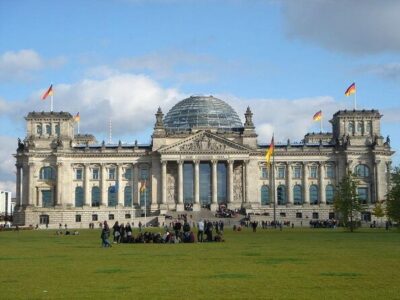
Outside the Reichstag, the guide explains Hitler’s seizure of power and Germany’s democratic history. You do not have time to go inside, so this is an exterior stop lasting roughly five minutes.
That limitation is worth noting. If you want the Reichstag dome or an interior visit, this tour does not provide it. The benefit is that the building becomes part of a larger historical sequence: democratic government, authoritarian takeover, dictatorship, war, division, and later reunification.
The short stop works best if you see the Reichstag as one chapter in the route rather than the main attraction. The tour is about connections across Berlin, not extended entry visits.
Holocaust memorials and difficult public memory
The route includes several memorials linked to major victim groups of the Holocaust, culminating at the Memorial to the Murdered Jews of Europe near Brandenburg Gate.
The main Holocaust Memorial is given about 10 minutes. Its field of concrete stelae is large, stark, and deliberately unsettling. The experience is not built around a long list of objects or displays. Its design creates a physical response, and the guide helps place it within the history of Nazi persecution and genocide.
The tour also points out other memorials, including one designed during the GDR period. That comparison is valuable because memorials do not only remember the dead. They also reveal how different governments chose to represent the past.
You should expect these stops to be serious and compact. The timetable includes many locations, so you will not have extended time at every memorial. If you want to read every inscription or visit an indoor exhibit, plan a separate visit later.
The Führerbunker site and the value of an empty space
At the Führerbunker site, you see a parking area. That may sound anticlimactic, but the absence is the point.
Hitler spent the final weeks of the war there and died by suicide in 1945. The site was later left without a grand memorial or reconstructed entrance. Your guide explains why the place looks ordinary today and how that decision relates to the danger of turning a site of dictatorship into a shrine.
The stop takes about 10 minutes. It is a strong example of how this tour uses what is missing as part of the story. You are not visiting a dramatic ruin. You are learning why an unmarked or low-key location can be a deliberate choice.
Checkpoint Charlie and the Cold War standoff
Checkpoint Charlie is included on the English version of the tour. It was the best-known border crossing associated with the Cold War and the only crossing shared by the United States and the Soviet Union, according to the tour’s historical presentation.
The guide discusses the moment when tensions there came close to triggering a third world war. That gives the site weight beyond its famous name and photo opportunities.
The stop lasts about 10 minutes. The area is one of central Berlin’s most visited locations, and its modern commercial setting can make the history feel packaged. A private guide helps put the checkpoint into political context, but you should still expect a busy urban stop rather than a preserved border crossing in its original form.
If your tour is in German, confirm the route in advance, since Checkpoint Charlie is specifically listed for the English version.
How much history fits into three hours
This is an ambitious route. The schedule includes more than a dozen points, with most stops lasting five to 10 minutes and one longer pause at Spreebogenpark.
That pace is the main tradeoff. You will see an impressive range of sites, but you will not study each one at museum length. I would choose this tour to build a strong mental map of Berlin, then return independently to the places that catch your attention.
The bicycle is what makes the schedule workable. A past participant specifically valued being able to cover the attractions quickly, noting that seeing them on foot would have taken about twice as long. That is the clearest reason to choose this format.
The tour is private, so you can ask for more focus on the Wall, Nazi Germany, Jewish history, or Cold War Berlin. The route remains guide-designed, but the stated flexibility gives your group room to shape the emphasis.
Practical details before you book
Bikes and helmets are included, along with a professional guide. Hotel pickup and drop-off are not included, and there is no food or drink provided, so arrive ready for an outdoor activity.
The meeting point is Free Berlin Bike Tours and Rental at Poststraße 11, 10178 Berlin. The ride returns there at the end, which makes onward planning simple.
Children are welcome, and infant seats can be provided on request. Children must be accompanied by an adult. Most people can take part, though you should be comfortable spending about three hours on a bicycle.
The tour operates in all weather. Berlin weather can shift, so bring suitable layers and rain protection when needed. Since this is a bicycle tour, poor weather can affect comfort even if it does not cancel the activity.
English and German are available. Dutch, French, and Spanish may be arranged on request. The tour is offered at several departure times, and confirmation is provided at booking. Free cancellation is available up to 24 hours before the start time. Changes or cancellations inside that window are not accepted for a refund.
Who should book this private Berlin bike tour
I would recommend it most strongly to a group of at least four people with a serious interest in 20th-century history. Families can also benefit, especially if children are old enough to follow a fast-moving outdoor lesson and enjoy riding between sites.
It is less suitable if you want long indoor visits, extensive museum time, or a relaxed ride with only a few stops. The route asks you to shift quickly from a synagogue to a Wall memorial, from a cemetery to a government district, and from a Holocaust memorial to Checkpoint Charlie.
At $107.42 per person, the value depends on how much you want from a private guide. For a group that would otherwise book separate walks, taxis, or transit trips between distant historic points, the price can make sense. For a solo visitor or couple, the four-person minimum is a serious consideration.
Should you book it?
Book this tour if you want to cover Berlin’s major 20th-century themes in one private outing and prefer a guide-led route to piecing the city together on your own. The bicycles save time, the route reaches several less obvious sites, and the private format lets you ask for more attention to the subjects that matter most to you.
Skip it if you want to linger at each memorial or go inside the Reichstag and museums. For the right group, though, this is an efficient, thoughtful way to see how Berlin’s Nazi past, divided city, and democratic present occupy the same streets.
FAQ
How long does the private bike tour last?
The tour lasts approximately three hours.
What is the price of the experience?
The listed price is $107.42 per person. Group discounts are available.
How many people are required to operate the tour?
The tour operates for groups of at least four people.
Is the tour private?
Yes. Only your group participates in the activity.
Are bicycles and helmets included?
Yes. Bicycle use and helmet use are included.
Where does the tour begin and end?
The tour starts at Free Berlin Bike Tours & Rental, Poststraße 11, 10178 Berlin, Germany, and ends back at the same meeting point.
Which languages are available?
The tour is offered in English and German. Dutch, French, and Spanish may be possible on request.
Is Checkpoint Charlie included on every version of the tour?
Checkpoint Charlie is included on the English version of the tour. Confirm the route if you are booking another language.
Can children take part?
Yes. Children are welcome, but they must be accompanied by an adult. Infant seats can be provided on request.
More bike rides around Berlin
- Berlin: Sights and Highlights Bike Tour with a Local Guide
★ 4.8 · 2,698 reviews - Berlin Highlights 3-Hour Bike Tour
★ 5.0 · 948 reviews - Berlin City Bike Tour with Beer Garden Stop
★ 5.0 · 917 reviews - Berlin Highlights: 3-Hour Bike Tour
★ 4.9 · 809 reviews
More Berlin Wall and Cold War tours in Berlin
- Skip-the-Line: Berlin Wall Museum at Checkpoint Charlie
★ 4.1 · 2,041 reviews - Cold War, Berlin Wall, Spies and the East Side Gallery
★ 5.0 · 1,024 reviews - Berlin: Cold War Walking Tour on Berlin Wall Route
★ 4.8 · 437 reviews - Berlin: Cold War Era History Guided Bike Tour
★ 4.8 · 413 reviews
Just added in Berlin
- Private One way Airport Transfer Berlin Airport To Berlin★ 3.5 · 17 reviews
- Private Walking Tour: Berlin Wall, Cold War and Checkpoint Charlie★ 5.0 · 37 reviews
- Modern Berlin Private Walking Tour: Diverse, Vibrant and Exciting German Capital★ 5.0 · 13 reviews
- Private Day Trip to Potsdam from Berlin by Train★ 4.5 · 27 reviews
- City Explorer: Potsdam Private Day Trip★ 4.5 · 10 reviews
- Berlin Private Custom 5-Hour Tour by Car★ 5.0 · 30 reviews
- Private Half-Day Sightseeing Tour in Berlin★ 3.5 · 6 reviews
- Berlin Private Custom Tour in a Minivan, East and West★ 5.0 · 123 reviews
Third Reich & WWII Tours, compared.

Third Reich Berlin: Hitler and WWII Walking Tour
Read our review →
Walking Tour of Former Nazi Party Rally Grounds
Read our review →
Berlin Third Reich Sites: Half-Day Walking Tour
Read our review →
Birthplace of the Third Reich Guided Walking Tour
Read our review →Browse the lists this tour appears in