
Reviewed · THIRD REICH & WWII TOURS
Third Reich Berlin: Hitler and WWII Walking Tour
Berlin’s Nazi past is not tucked away in one museum. It is spread across ordinary streets, government buildings, memorials, and empty patches of ground. This three-hour walking tour brings those pieces together, leading you from Friedrichstrasse to the Reichstag, Hitler’s bunker site, the Holocaust Memorial, and the Topography of Terror.
I like two things here. First, the route connects the rise, crimes, and collapse of the Third Reich rather than treating WWII as a string of disconnected facts. Second, you see places you could easily miss alone, including the former Air Ministry, Goebbels’ propaganda headquarters, and the site of the New Reich Chancellery.
The main consideration is simple: this is an outdoor walking tour. You cover roughly 5,000 steps at a brisk pace, and Berlin weather can be harsh. Bring warm layers, comfortable shoes, and a drink. A three-hour history lesson in freezing rain takes commitment.
Key points to know before booking
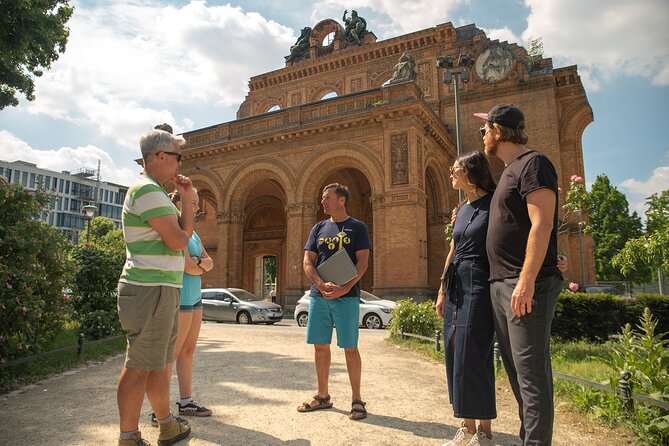
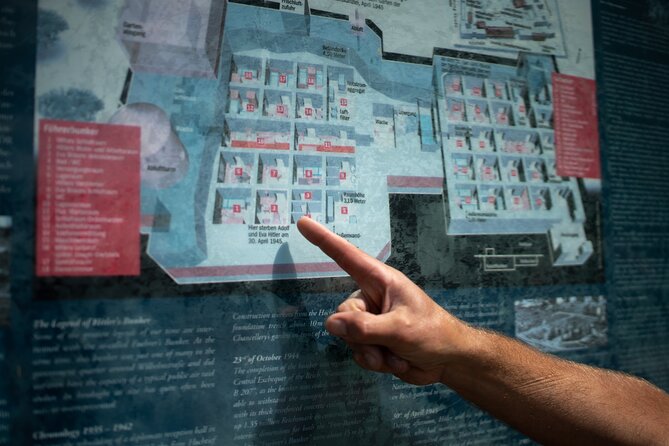
- The bunker site is an empty patch of ground: You stand above the location where Hitler spent his final days, not inside a preserved bunker.
- The route links major Nazi sites: See the Reichstag, Wilhelmstrasse, the former Air Ministry, the Soviet War Memorial, and the Topography of Terror.
- The tour handles difficult history directly: Expect discussion of dictatorship, persecution, the Holocaust, war, resistance, and daily life under Nazi rule.
- Guides make the difference: Past guide names include Maria, Paul, Ru, Chris, Ciarán, Ru, Tina, Jamie, Hannah, and Thomas. Guide assignments vary.
- Plan for a brisk outdoor walk: The route lasts about three hours, has a maximum of 25 people, and includes several stops without admission fees.
- The price is modest for the coverage: At $24.07 per person, you get a local guide and a connected explanation of central Berlin’s wartime history.
Why this route works better than a map alone
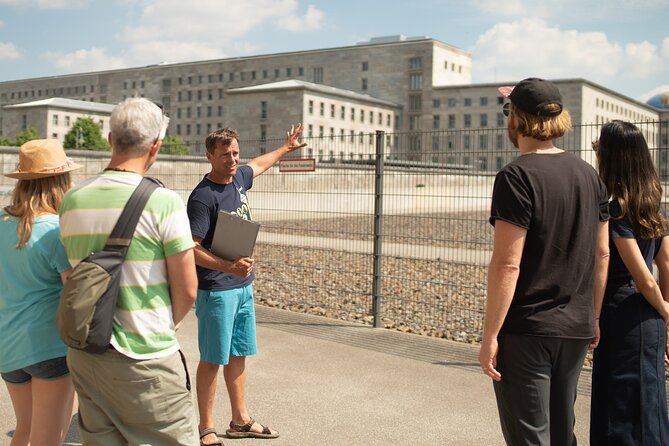
Berlin gives you a strange problem: the most important Nazi sites are often visually unremarkable. Hitler’s bunker is buried beneath a nondescript area near modern apartments. Wilhelmstrasse has been rebuilt. The former Luftwaffe headquarters still functions as a government building. Without context, you may walk past these places without knowing what happened there.
A guide gives the streets a timeline. You begin with Hitler’s rise and the destruction of democracy, move through propaganda and military power, and finish with the Soviet assault and the regime’s defeat. That structure helps you understand how government offices, public symbols, military planning, and terror worked together.
The subject is grim, but the best guides keep the tone serious without turning the tour into a lecture. Paul, Ru, Maria, Chris, and Ciarán are among the guides praised for clear explanations and strong storytelling. Callam was noted for checking that the group understood the material, while Eran used the approach to the bunker site for a particularly effective reveal.
You should not expect a theatrical performance. You should expect a lot of facts, questions, and plain explanations of complex events. That is the right approach for this subject.
More Third Reich and WWII Tours in Berlin
- Berlin: Third Reich and Cold War 2 Hour Walking Tour
★ 4.9 · 6,830 reviews - Berlin’s Best: 2 Hour Walking Tour Third Reich and the Cold War
★ 5.0 · 5,486 reviews - Berlin: Third Reich, Hitler, and WWII Walking Tour
★ 4.9 · 1,133 reviews
Friedrichstrasse and the Trains to Life, Trains to Death memorial
The tour begins near Friedrichstrasse Station, with the published meeting point at Reichstagufer 17. Arrive 15 minutes early. This central location is easy to reach by public transport, but check your confirmation carefully so you know exactly where the guide will meet you.
The opening briefing sets out the route and introduces Berlin during the Third Reich. You hear about Hitler’s rise, the weakening of democratic institutions, the effects of the 1933 Reichstag fire, and what daily life meant for people living under dictatorship and air raids.
Nearby, the Trains to Life, Trains to Death memorial focuses on the deportation of Berlin’s Jewish population to concentration camps. It is a small stop, but an important one. The memorial shifts the story away from government offices and military decisions and toward the people who were forced from their homes.
The short visit lasts about 10 minutes. Do not expect a large exhibition or a long pause for individual study. The value comes from the guide’s explanation and from placing the memorial within the wider route.
The Reichstag and the collapse of democracy
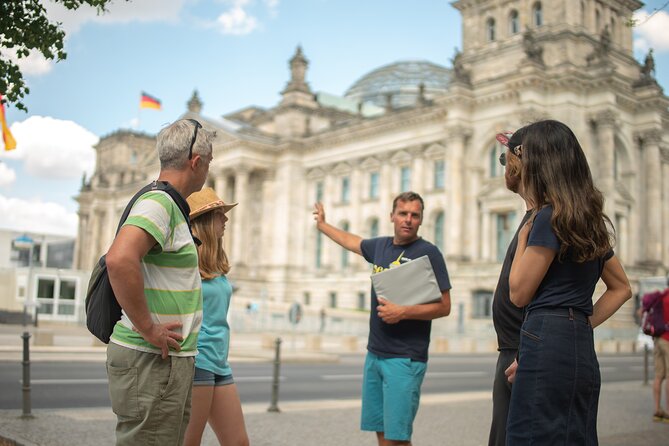
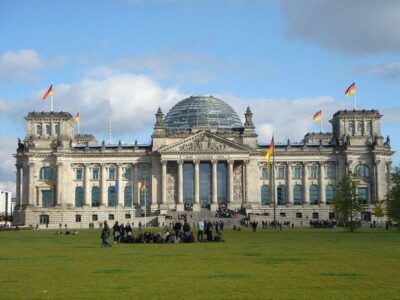
The Reichstag is one of Berlin’s essential history stops. In 1933, a fire damaged the building, and the Nazi government used the event to suspend civil liberties and crush political opposition. The building therefore marks more than an architectural landmark. It helps explain how a democracy can be dismantled through emergency powers and political pressure.
The tour also covers the Reichstag’s role in the final Battle of Berlin. In 1945, Soviet forces raised their flag over the building, making it a powerful symbol of Nazi defeat.
You generally view the building from outside on this walk. Admission is not included, so do not book this tour expecting a visit to the dome or interior. If you want to see the Reichstag inside, treat that as a separate plan.
This stop is especially useful if you are traveling with a teenager or someone who did not study much history in school. The guide connects a familiar building to the chain of decisions that destroyed German democracy.
The Soviet War Memorial in Tiergarten
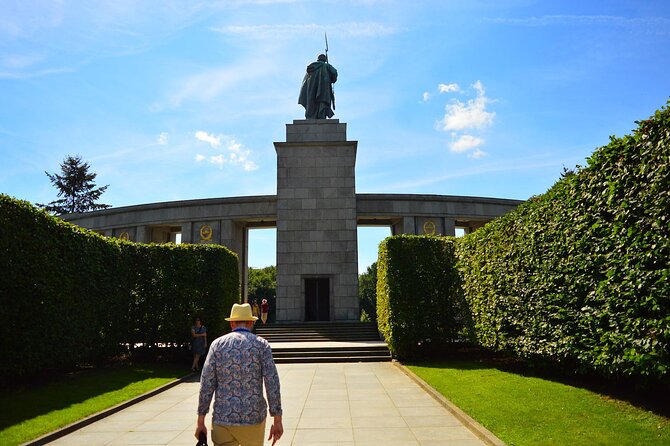
The Soviet War Memorial in Tiergarten honors Red Army soldiers who died during the Battle of Berlin. Its large soldier statue, military setting, and graves make this one of the route’s more imposing locations.
The guide explains the Soviet assault on Berlin and the enormous human cost of the final battle. The memorial also adds balance to a route that otherwise focuses heavily on Nazi institutions. You are reminded that the war ended through military force, with vast losses among soldiers and civilians.
The site is free to enter, and the stop lasts about 15 minutes. It is outdoors and exposed, so cold weather matters here. In winter, the memorial can feel particularly stark. Give yourself enough clothing to listen without constantly thinking about your hands and feet.
Other trips into the same period in Berlin:
- Berlin Third Reich Sites: Half-Day Walking Tour
★ 5.0 · 835 reviews - Berlin: Guided Bike Tour of the Berlin Wall and Third Reich
★ 4.7 · 499 reviews - Hitler’s Germany: Berlin During the Third Reich & WWII
★ 4.8 · 476 reviews - Private Walking Tour Berlin Third Reich Hitler and World War II
★ 5.0 · 360 reviews
Brandenburg Gate and the symbols of power
The Brandenburg Gate is one of Berlin’s most famous sights, but the tour examines it through the lens of political symbolism. Under Hitler, the gate served as a backdrop for propaganda, rallies, and displays of authority. The Nazi regime used familiar national symbols to make its rule appear grand, permanent, and legitimate.
Today, the gate is linked more strongly with German reunification. That contrast is useful. The same monument has carried very different political meanings over time, and the guide explains how public spaces can be repurposed by governments.
This is a short stop, around 10 minutes. It does not offer a long visit or special access. Its strength is the explanation, especially if you have already photographed the gate and want to understand how it functioned during the Nazi period.
Akademie der Künste and art under dictatorship
At the Akademie der Künste, the focus turns to art, architecture, and the cultural side of Nazi power. Albert Speer’s monumental architectural ideas promoted an image of order, strength, and imperial authority. He was Hitler’s chief architect and later Minister of Armaments.
The point is not that the academy itself was simply a Nazi headquarters. The stop opens a broader question: how did artists, architects, and cultural institutions respond to, support, or reckon with the regime?
This is one of the shorter stops, about 10 minutes. It may appeal most to you if you are interested in architecture, propaganda, or the way governments use design to shape public feeling. If your main interest is battlefield history, it is less central than the bunker, Reichstag, or Topography of Terror.
The Holocaust Memorial and Hitler’s bunker site
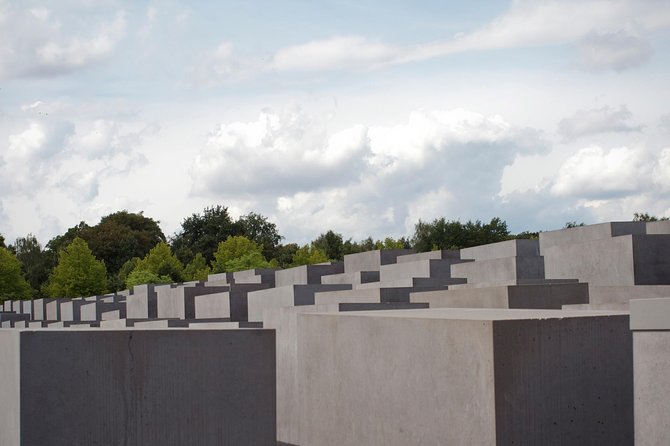
The Memorial to the Murdered Jews of Europe is a field of 2,711 concrete slabs of different heights. Walking among them can feel disorienting and quiet. The design does not offer a simple explanation or a single statue. Instead, it creates a physical setting for reflection on the scale and nature of the Holocaust.
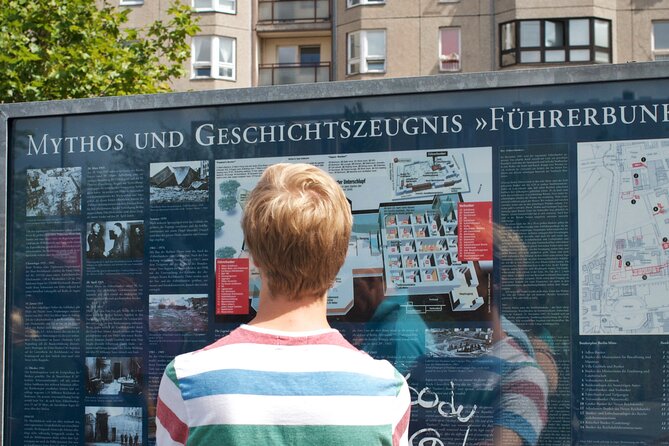
The tour then moves to the site of Hitler’s bunker. This is often the moment people imagine as a dramatic underground visit, but there is no preserved interior open to the public here. You stand above the former bunker location and learn about Hitler’s final days, the collapse of the Nazi government, and his death in April 1945.
The ground-level setting matters. The bunker is not presented as a shrine, and there is no grand ruin to photograph. The ordinary surroundings underline how thoroughly the old power center disappeared from view. A good guide makes the site meaningful through facts rather than spectacle.
The tour also discusses the New Reich Chancellery, designed by Speer, which once occupied the area. You learn how the Nazi leadership imagined its seat of power and how that world ended in the ruins of Berlin.
Wilhelmstrasse and the machinery of Nazi rule
Wilhelmstrasse was the government center of Nazi Berlin. Offices linked to the Foreign Ministry, Reich Chancellery, Propaganda Ministry, and other departments were located here. This is where the tour makes clear that Nazi crimes were not carried out only by a few dramatic figures. They required offices, paperwork, orders, planning, and people who carried out those decisions.
Joseph Goebbels’ propaganda operation is part of this section. The guide explains how speeches, public messaging, and controlled information helped maintain support for the regime and shape attitudes toward war and persecution.
You also hear about Lebensraum, the expansionist doctrine used to justify conquest in Eastern Europe. The discussion links ideology to military action and to the persecution and murder of civilians.
Much of the original Nazi architecture is gone or altered. That can disappoint anyone looking for grand ruins. Yet the absence is part of the lesson. You see how a city can rebuild, rename, and repurpose places without erasing what happened there.
Niederkirchnerstrasse and the former Air Ministry
The former Reich Air Ministry was associated with Hermann Göring and the Luftwaffe, Germany’s air force. The building’s scale and design conveyed the regime’s preferred image of military power and bureaucratic control.
The guide places the building within the wider war, including the Luftwaffe’s role in campaigns such as the Battle of Britain. You are not simply looking at an old office block. You are seeing where military policy and administration were organized.
This stop is brief, around 10 minutes, but it gives the route a strong institutional focus. You move from speeches and symbols to the offices that helped direct war.
Resistance and the Topography of Terror
The walk also recognizes Germans who opposed Hitler. Henning von Tresckow, Hans Oster, and Claus von Stauffenberg are discussed as figures in the resistance movement. Their stories complicate the idea that German society responded to dictatorship in only one way.
The tour ends at the Topography of Terror on Niederkirchnerstrasse, close to Checkpoint Charlie. The museum occupies the former site of the SS and Gestapo headquarters and focuses on the agencies that enforced Nazi terror, persecution, and mass murder.
Admission to the walking tour’s stops is generally free, but the tour price does not include entry to the Reichstag, and you should not assume it includes a full visit inside the Topography of Terror. The tour ends nearby, giving you the option to continue on your own if opening hours and time allow.
This final location is a fitting endpoint because it brings the story back to the machinery of repression. The route has shown you leadership, propaganda, war, resistance, and memory. Here, the role of the SS and Gestapo receives direct attention.
Price, group size, and pace
At $24.07 per person, this is good value if you want a connected explanation rather than a self-guided walk. The tour covers many central sites in three hours, and a local guide can point out locations that are easy to miss.
The group can include up to 25 people. That is small enough for a guide to answer questions, though it is not a private tour. Stay near the guide at busy crossings and listen carefully when the group gathers around a building or memorial.
The pace is brisk. One review calculated about 5,000 steps, which is a useful planning figure. Wear comfortable shoes, and do not schedule a tight appointment immediately afterward. You may also want coffee before starting. One guide sometimes makes a brief café stop, but you should not count on a long break or assume refreshments are included.
The tour is offered in English and includes a mobile ticket. Hotel pickup and drop-off are not included, so you make your own way to central Berlin.
Who should book this Berlin history walk
I would choose this tour if you want to understand how the sites fit together. It suits first-time Berlin visitors, WWII students, history buffs, and families with older children or teenagers who can handle difficult material.
It is also useful for a short stay. Three hours gives you a solid orientation to the government quarter and central memorials without taking a full day.
I would think twice if you dislike outdoor walks, need frequent seating, or want extensive time inside museums. The route is serious and information-heavy. You will get more from it if you are ready to listen, walk, and ask questions.
Guide quality matters, and guide assignments are not guaranteed. Names praised for clear explanations and engaging delivery include Maria, Paul, Ru, Chris, Ciarán, Tom, Tina, Pete, Emma, Callam, and Jamie. The company uses several guides, so book for the route and subject rather than for a particular person.
Should you book it?
Book this tour if you want a clear three-hour framework for Berlin’s Nazi and WWII history, especially if you are not confident navigating the sites alone. The $24.07 price is fair for the number of locations and the help of a live guide.
Skip it if you want long museum visits, a slow stroll, or an indoor activity. For everyone else, bring warm clothes, good shoes, and a willingness to face difficult history plainly. Free cancellation is available up to 24 hours before the start time, which gives you some flexibility when planning.
FAQ
How long is the Third Reich Berlin walking tour?
The tour lasts approximately three hours.
Where does the tour begin?
The published meeting point is Reichstagufer 17, 10117 Berlin, near Friedrichstrasse Station. Arrive 15 minutes before the start time.
Where does the tour end?
The tour ends at the Topography of Terror, Niederkirchnerstrasse 8, 10963 Berlin, very close to Checkpoint Charlie.
Is Hitler’s bunker open to enter?
No. The tour takes you to the location above Hitler’s former bunker and explains his final days there. It is not a preserved bunker interior visit.
Is admission to the Reichstag included?
No. Admission to the Reichstag is not included in the tour.
How many people can join the tour?
The maximum group size is 25 people.
Is the tour suitable for most participants?
Yes. Most people can participate, and the route is near public transportation. You should be comfortable walking for about three hours.
What happens if I need to cancel?
You can cancel up to 24 hours before the experience for a full refund. Cancellations or changes made less than 24 hours before the start time are not refunded.
More walking tours in Berlin
- Discover Berlin Half-Day Walking Tour
★ 5.0 · 9,624 reviews - Berlin: Discover Berlin Walking Tour
★ 4.9 · 5,998 reviews - Berlin: Hidden Backyards Guided Walking Tour
★ 4.8 · 5,360 reviews - Berlin: Alternative Berlin Walking Tour
★ 4.6 · 1,204 reviews
Just added in Berlin
- Berlin: Thrilling E-Scooter Adventure Tour★ 4.4 · 66 reviews
- Berlin: Energizing 2-Hour Morning Segway Tour★ 4.7 · 35 reviews
- Beelitz-Heilstätten: Baum&Zeit Tree Top Walk Entry Ticket★ 4.9 · 7 reviews
- Beer Bike & Party Bike: Unforgettable Berlin City Tour incl. pickup★ 5.0 · 5 reviews
- AXE THROWING EXPERIENCE IN BERLIN★ 4.7 · 24 reviews
- Alternative Berlin / Street art tour – Private group★ 5.0 · 6 reviews
- Berlin: Alternative & Street Art Tour★ 4.5 · 6 reviews
- Berlin: 2.5-Hour Beer & Sunset Sightseeing Boat Cruise★ 4.6 · 61 reviews
Third Reich & WWII Tours, compared.

Walking Tour of Former Nazi Party Rally Grounds
Read our review →
Berlin Third Reich Sites: Half-Day Walking Tour
Read our review →
Birthplace of the Third Reich Guided Walking Tour
Read our review →
Munich World War II Sites Including Dachau Concentration Camp
Read our review →Browse the lists this tour appears in