
Reviewed · THIRD REICH & WWII TOURS
Berlin’s Best: 2 Hour Walking Tour Third Reich and the Cold War
Berlin’s modern story is written across a surprisingly compact stretch of central Berlin. In two hours, this walking tour takes you from the Brandenburg Gate to Checkpoint Charlie, linking Nazi power, wartime destruction, the Berlin Wall, and reunification. It is a useful way to put famous sights into a clear timeline instead of seeing them as disconnected monuments.
I like the route for two reasons: it reaches places buses cannot, and the guides make good use of stories, old photographs, and questions. Guides including Glen, Maggie, Mikey, Peter F., and Jamie S. have been praised for explaining difficult subjects clearly and with care. The main drawback is the pace. You cover a lot of ground outdoors, and the subject matter is often grim, so this is not a light sightseeing stroll.
Key points to know before you book
- A two-hour route with a clear endpoint: Begin at Brandenburg Gate and finish at Checkpoint Charlie.
- Major Nazi and Cold War sites: See the Reichstag, Hitler’s bunker location, the Topography of Terror, the Berlin Wall, and more.
- A useful history lesson on foot: The route connects Berlin’s landmarks to the rise of Nazism, World War II, division, and reunification.
- English only: The tour includes a professional local guide and is offered in English.
- Outdoor planning matters: Wear sensible shoes and warm clothing in winter. Bring gloves if the forecast is cold.
- Good value at $24.07: You get two hours of guiding across central Berlin, with free admission at the listed stops.
From Brandenburg Gate to a divided city
The meeting point is in front of the Tourist Information office on the Pariser Platz side of Brandenburg Gate. Arrive 15 minutes early and look for the guide carrying a pink umbrella. That detail matters in a busy square, especially when several walking tours gather nearby.
The gate is a strong place to begin. It once marked one of Berlin’s old city entrances, but its meaning changed sharply over time. Your guide explains why it became a symbol of a divided city and, later, of German reunification. You get about 15 minutes here, enough to look closely at the monument while setting the main theme of the walk.
From the start, the tour asks you to read Berlin as a political city. The buildings are not just pretty backdrops. They show how power was claimed, lost, divided, and rebuilt.
More Third Reich and WWII Tours in Berlin
- Berlin: Third Reich and Cold War 2 Hour Walking Tour
★ 4.9 · 6,830 reviews - Third Reich Berlin: Hitler and WWII Walking Tour
★ 5.0 · 3,301 reviews - Berlin: Third Reich, Hitler, and WWII Walking Tour
★ 4.9 · 1,133 reviews
The Reichstag and the fire that changed Germany
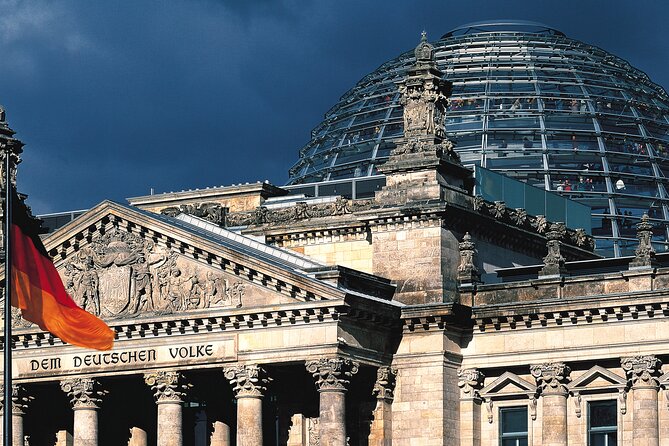
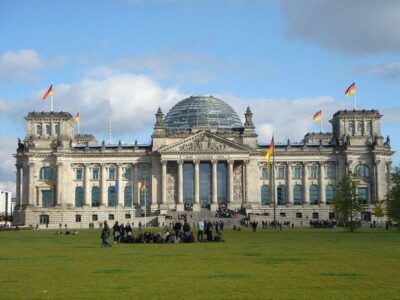
The next stop is the Reichstag Building, home of the German parliament. You spend about 10 minutes hearing how the building reflects the country’s turbulent past over the last century.
The key story here is the Reichstag fire of 1933. Your guide explains how Hitler used the fire as part of the process that destroyed civil liberties and helped secure dictatorship. Seeing the building while hearing that story gives the event a physical setting, rather than leaving it as a date in a textbook.
You do not go inside as part of this walking tour, and no admission fees are listed for the stops. That keeps the route moving, but it also means you should not book this experience expecting museum visits or interior tours. The value comes from the guide’s explanation and the sequence of places outside.
Soviet tanks in the Tiergarten
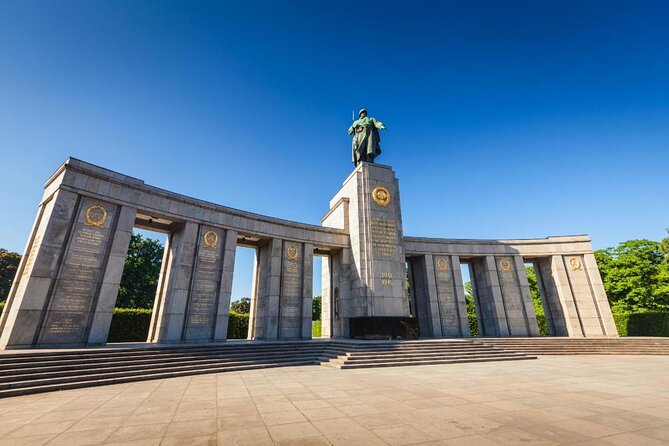
A short stop at the Soviet Memorial in the Tiergarten adds a different view of the war. You see Soviet T-34/76 tanks and field artillery displayed at the memorial, with about seven minutes for the stop.
This is one of the route’s useful contrasts. The earlier stops focus on German institutions and Nazi control. Here, the physical presence of Soviet military equipment points toward the defeat of Nazi Germany and the postwar struggle over Berlin.
The stop is brief, so you will not get a long memorial visit. Still, it gives you something solid to look at while the guide explains the final phase of the war and the Soviet role in Berlin.
Victory Column and the unrealized Germania
The itinerary also includes the Victory Column, known in German as the Siegessäule. The guide explains why Albert Speer moved it from its original location and discusses Speer’s plans for Germania, the vast Nazi vision for a new world capital.
This is a good example of why walking helps. You are not only ticking off a famous monument. You are hearing how Nazi architecture and urban planning were meant to express power. The plans for Germania were tied to a victorious Nazi Germany and to a completely reshaped Berlin.
The Victory Column stop is not given a separate duration, so expect it to be part of the route rather than a long visit. The guide’s explanation is the main reason to pause here.
Other trips into the same period in Berlin:
- Berlin Third Reich Sites: Half-Day Walking Tour
★ 5.0 · 835 reviews - Berlin: Guided Bike Tour of the Berlin Wall and Third Reich
★ 4.7 · 499 reviews - Hitler’s Germany: Berlin During the Third Reich & WWII
★ 4.8 · 476 reviews - Private Walking Tour Berlin Third Reich Hitler and World War II
★ 5.0 · 360 reviews
Walking through the Holocaust Memorial
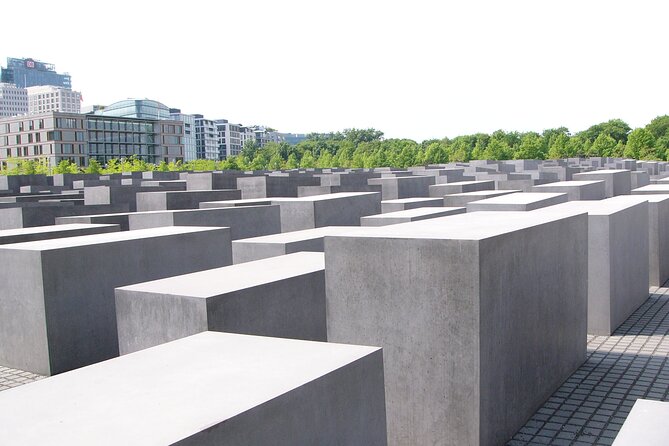
The Memorial to the Murdered Jews of Europe is one of the tour’s most important stops. You walk through the large field of concrete blocks, with about 10 minutes set aside for the memorial.
The layout can feel unsettling and disorienting. That is part of its effect. Instead of presenting a simple statue or plaque, the memorial places you inside a changing space where the ground rises and falls around you. Your guide provides the historical context and discusses the murder of Europe’s Jews under the Nazi regime.
Give this stop the respect it deserves. The tour deals with the subject directly, but the visit is still fairly short. If you want time to walk through the memorial alone, read the information panels, or visit the underground information centre, you will need to return later.
Standing above Hitler’s bunker
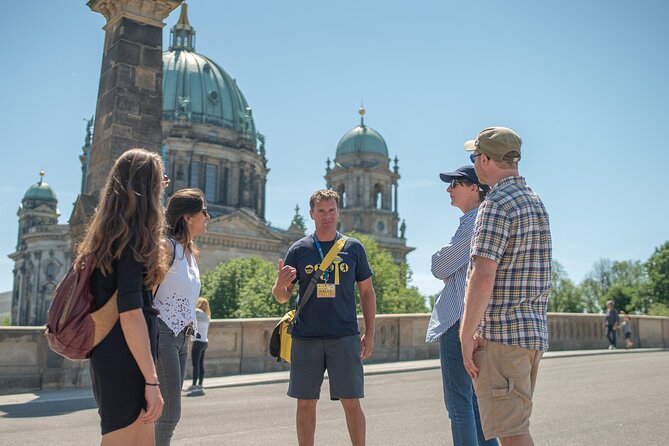
The Fuhrerbunker stop is one of the most striking parts of the tour because there is very little to see. You stand above the former bunker location while the guide explains the final days of World War II and Hitler’s suicide on April 30, 1945.
The site is deliberately plain. There is no dramatic entrance or preserved room to photograph. That absence makes the guide’s explanation especially important. You learn what happened below ground and how Berlin has dealt with a place that could easily have become a shrine to Nazi power.
The tour also connects the bunker to the wider question of how Germans have confronted the country’s destructive past. That makes the stop more useful than a simple list of dates. It asks what should be marked, what should be left uncelebrated, and how public memory can avoid turning perpetrators into legends.
The former Air Ministry and East Germany’s birth
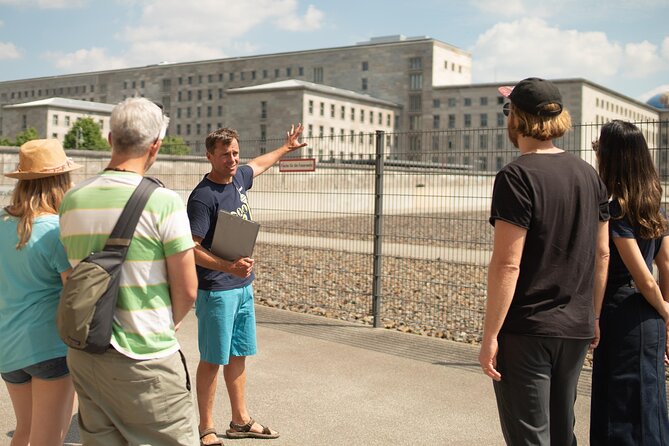
The route then passes along the former Aviation Ministry of Berlin, the long building associated with Hermann Göring’s air force. You spend about five minutes here and hear that the building was also the place where East Germany, or the GDR, was proclaimed in 1949.
This is a compact but worthwhile stop because the same structure connects two very different political eras. First, it belonged to Nazi military power. After the war, it became linked to the creation of a socialist East German state.
You will mostly view the building from outside. The point is not architectural sightseeing alone. It is the way one address helps explain the shift from Nazi rule to occupation, division, and the Cold War.
The Topography of Terror and Nazi terror by bureaucracy
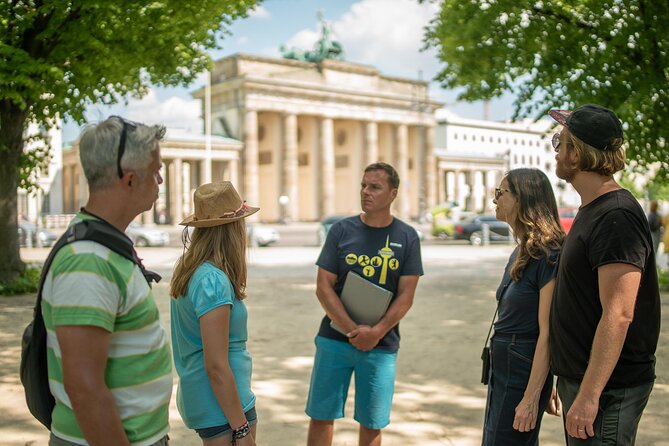
At the Topography of Terror, you reach the site where the SS, Gestapo, and SD had their headquarters. The tour allows about 15 minutes here.
This stop puts the machinery of Nazi persecution at the centre of the story. The institutions based here were involved in surveillance, political repression, terror, and crimes during World War II. The present-day Topography of Terror exhibition documents those crimes on the same site.
You should think of this as an orientation stop, not a full museum visit. The walking tour can show you where the institutions operated and explain why the address matters. If you want to study the exhibition in detail, set aside another visit after the tour.
The guide’s approach matters here. Several guides, including Mikey and Georgia, have been praised for handling painful subjects with seriousness while keeping the talk accessible. That balance is useful in Berlin, where a guide can either flatten the past into dates or make it sensational. This tour aims for neither.
The Berlin Wall on Niederkirchnerstraße
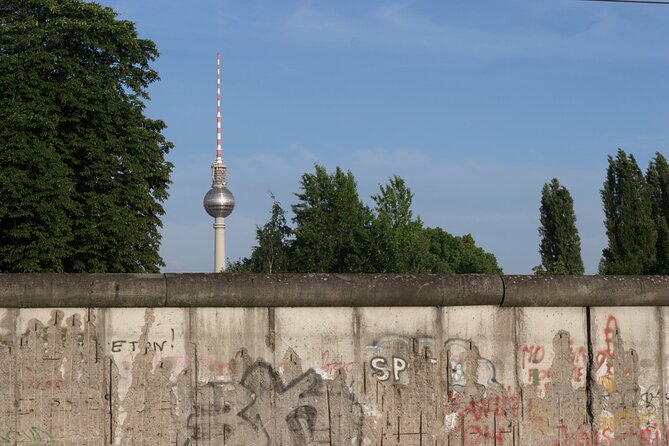
On Niederkirchnerstraße, you see a large remaining section of the Berlin Wall. The stop lasts about seven minutes and focuses on escape attempts, life on both sides of the Wall, and what happened to people who tried to cross and failed.
This section helps you understand that the Wall was not just a concrete barrier. It split families, jobs, neighbourhoods, and daily routines. The guide explains the contrast between East and West Berlin and gives personal stories about people who tried to escape.
The piece of Wall is valuable because it gives you a physical reference point. Much of central Berlin has changed since reunification, so surviving sections help you grasp the scale of the former border. Still, seven minutes passes quickly. If Cold War history is your main reason for booking, note the location and consider coming back for a longer look.
Checkpoint Charlie and the road to reunification
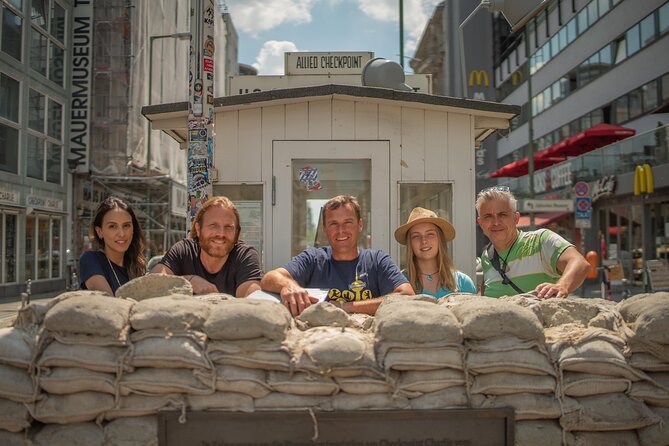
The tour ends at Checkpoint Charlie on Friedrichstraße, after about 15 minutes at the site. This was the best-known crossing point through the Berlin Wall and the setting for the tense 1961 confrontation between Soviet and American tanks.
Your guide also explains how the Wall fell on November 9, 1989, and considers how successful reunification has been in the more than 30 years since. That ending gives the route a proper conclusion. You begin with Brandenburg Gate as a symbol of reunified Germany and finish with the border crossing that once represented division.
Checkpoint Charlie itself can feel commercial and crowded. The tour helps by shifting attention away from the souvenir stalls and toward the Cold War crisis that made the checkpoint famous. You finish in a central area with public transport nearby, so the endpoint works well for continuing your day.
How the two-hour pace works
The route covers many major sites in a short period. That is its strength and its limit.
You can expect frequent stops, short explanations, and steady walking between locations. The guides are expected to entertain as well as inform, and the strongest comments describe a good mix of clear detail, humour, and time for questions. Guides such as James, Tom, Peter F., and Mikhail have been singled out for answering questions and keeping the group involved.
The group can include up to 30 people. That is not an intimate private tour, but the size remains workable for an outdoor route if the guide projects well. Historical photographs are sometimes used to show how a location looked during the Nazi era, the war, or the Cold War. Those images can make empty spaces, such as the bunker site, easier to understand.
Plan for the weather. The entire experience is outside, and winter conditions can make the two hours feel longer. Wear shoes suited to city walking, bring warm layers and gloves in cold weather, and use the restroom before you begin. There is little time built into the route for long breaks.
What $24.07 gets you
At $24.07 per person, this is a strong value if you want a guided introduction to central Berlin’s 20th-century story. You are paying for a professional English-speaking guide, a carefully connected route, and two hours of interpretation at places that are free to view.
The price does not include paid museum entry, transport, food, or an indoor shelter from bad weather. That is not a problem if you see the tour as a city orientation. It matters if you expect a museum-based experience or a relaxed pace.
The tour is booked around 16 days ahead on average, so I would not leave it until the last minute if your Berlin dates are fixed. Confirmation is provided at booking, and free cancellation is available up to 24 hours before the start time. After that point, the cost is not refunded, and changes are not accepted.
Who will get the most from this Berlin walk
I would choose this tour early in a Berlin visit if you want a framework for the city. It helps you understand why the Reichstag, Brandenburg Gate, Wall remnants, Checkpoint Charlie, and memorials matter before you explore them on your own.
It suits adults and older children who can handle serious subjects. One family found the format worked well for an 11-year-old and a 16-year-old, with the younger visitors feeling comfortable asking questions. The guide’s tone is important, but the content still covers dictatorship, murder, war, suicide, escape attempts, and political repression.
It is also a good fit if you have only a short stay. You see many central landmarks without spending half a day on a single museum. On the other hand, history specialists may want longer visits at the Holocaust Memorial, Topography of Terror, and Berlin Wall sites after the walk.
The tour is offered in English only. Most people can participate, and service animals are allowed. Since the route is outdoors and on foot, sensible shoes remain the practical choice.
Should you book this tour?
Book it if you want a brisk, affordable introduction to Berlin’s Nazi and Cold War past, especially if you value a guide who can connect sites into one story. The route is well chosen, the endpoint at Checkpoint Charlie makes sense, and the two-hour length fits neatly into a busy day.
Skip it if you want extensive indoor visits, lots of free time at each memorial, or a quiet private experience. For most first-time visitors who want context without spending a large sum, this is a useful starting point. Just dress for the weather, arrive early under the pink umbrella, and be ready for a serious walk through Germany’s most difficult chapters.
FAQ
How long is the Berlin Third Reich and Cold War walking tour?
The tour lasts approximately two hours.
Where does the tour start?
It starts at Brandenburg Gate on the Pariser Platz side, in front of the Tourist Information office.
Where does the tour end?
The tour ends at Checkpoint Charlie on Friedrichstraße 43-45, 10117 Berlin.
What language is the tour offered in?
The tour is offered in English only.
What sites are covered?
The route includes Brandenburg Gate, the Reichstag Building, the Soviet Memorial in the Tiergarten, Victory Column, the Holocaust Memorial, the Fuhrerbunker location, the former Aviation Ministry, the Topography of Terror, a section of the Berlin Wall on Niederkirchnerstraße, and Checkpoint Charlie.
How far in advance can I cancel for a full refund?
You can cancel at least 24 hours before the start time for a full refund. Cancellations or changes made within 24 hours are not refunded.
More walking tours in Berlin
- Discover Berlin Half-Day Walking Tour
★ 5.0 · 9,624 reviews - Berlin: Discover Berlin Walking Tour
★ 4.9 · 5,998 reviews - Berlin: Hidden Backyards Guided Walking Tour
★ 4.8 · 5,360 reviews - Berlin: Alternative Berlin Walking Tour
★ 4.6 · 1,204 reviews
More Berlin Wall and Cold War tours in Berlin
- Skip-the-Line: Berlin Wall Museum at Checkpoint Charlie
★ 4.1 · 2,041 reviews - Cold War, Berlin Wall, Spies and the East Side Gallery
★ 5.0 · 1,024 reviews - Berlin: Cold War Walking Tour on Berlin Wall Route
★ 4.8 · 437 reviews - Berlin: Cold War Era History Guided Bike Tour
★ 4.8 · 413 reviews
Just added in Berlin
- Berlin: Energizing 2-Hour Morning Segway Tour★ 4.7 · 35 reviews
- Berlin: Thrilling E-Scooter Adventure Tour★ 4.4 · 66 reviews
- Beelitz-Heilstätten: Baum&Zeit Tree Top Walk Entry Ticket★ 4.9 · 7 reviews
- Beer Bike & Party Bike: Unforgettable Berlin City Tour incl. pickup★ 5.0 · 5 reviews
- AXE THROWING EXPERIENCE IN BERLIN★ 4.7 · 24 reviews
- Alternative Berlin / Street art tour – Private group★ 5.0 · 6 reviews
- Berlin: Alternative & Street Art Tour★ 4.5 · 6 reviews
- Berlin: 2.5-Hour Beer & Sunset Sightseeing Boat Cruise★ 4.6 · 61 reviews
Third Reich & WWII Tours, compared.

Third Reich Berlin: Hitler and WWII Walking Tour
Read our review →
Walking Tour of Former Nazi Party Rally Grounds
Read our review →
Berlin Third Reich Sites: Half-Day Walking Tour
Read our review →
Birthplace of the Third Reich Guided Walking Tour
Read our review →Browse the lists this tour appears in