
Reviewed · THIRD REICH & WWII TOURS
Munich: Third Reich and World War II Private Guided Tour
Munich’s Nazi past comes into sharp focus on this private walk from Marienplatz to Königsplatz. You follow the route of the Beer Hall Putsch, see the buildings used by Hitler’s movement, and hear how Munich became the center of National Socialism.
I like the private format, which gives you room to ask difficult questions, and the clear route through the Old Town. The optional visit to the NS Documentation Center is another strong point, since photographs, films, documents, and media stations add useful context.
The main drawback is the price: $311 per person is a serious spend for a walking tour. The three-hour version also remains almost entirely outdoors, so the 4.5-hour option is the better choice if you want museum material and more time with your guide.
Key points to know before booking
- Munich’s Nazi story begins at Marienplatz, a former setting for major propaganda events.
- Hofbräuhaus is tied to the Nazi Party’s early public history, including a 1920 speech by Adolf Hitler.
- The Beer Hall Putsch route leads to Feldherrnhalle and Odeonsplatz, where you learn about Hitler’s failed attempt to seize power in Bavaria.
- The tour does not ignore resistance, covering the White Rose Group and the Monument to the Victims of National Socialism.
- Führerbau connects the walk to the Munich Agreement of 1938, signed by Hitler and British Prime Minister Neville Chamberlain.
- The 4.5-hour option includes the NS Documentation Center, the best choice for a fuller look at the movement, the war, and Munich after 1945.
Starting at Marienplatz, where Munich’s Nazi story begins
Meet your guide in front of hotel BEYOND by Geisel at Marienplatz 22, opposite St. Peter’s Church. Do not go inside the hotel. It is only a meeting point, and the hotel staff is not involved with the tour.
Marienplatz is a fitting start because it places you in the center of Munich’s civic life. The square hosted Nazi propaganda events, and your guide uses the setting to explain how the city became the capital of the National Socialist movement. This is not just a list of buildings and dates. The key question is how a major German city became so closely tied to Hitler’s rise.
You also see the New Town Hall, or Neues Rathaus. The building was reconstructed after the Second World War, and the surrounding city center suffered major bombing damage in 1945. That contrast matters. You are looking at a rebuilt public space while discussing a regime that helped bring destruction to Munich and much of Europe.
I like beginning here because the tour sets its tone early. You are not simply hunting for old Nazi offices. You are considering how public spaces, civic pride, political theater, and ordinary city life became part of a dictatorship’s story.
More Third Reich and WWII Tours in Munich
- Munich: Third Reich & WWII Walking Tour
★ 4.6 · 6,181 reviews - Third Reich Walking Tour Munich
★ 4.5 · 4,291 reviews - Munich: Birthplace of the Third Reich Guided Walking Tour
★ 4.6 · 771 reviews
Hofbräuhaus and the Nazi Party’s early public face
The route continues to Hofbräuhaus am Platzl, one of Munich’s best-known beer halls. Its connection to this tour is not based only on the building’s fame. Adolf Hitler gave a speech here in 1920 associated with the founding of the National Socialist German Workers’ Party.
This stop helps explain how political movements tried to reach people in familiar social settings. A beer hall was not an isolated government office. It was part of daily Munich life, and that made it a useful place for speeches, recruitment, and public theater.
Your guide covers the origin story of the party and the role of its supporters. The focus is on how Hitler’s movement developed in Munich before it took control of Germany. That early period is important because it shows a political organization forming in public, rather than appearing fully formed once it gained power.
You should expect this part of the walk to be observational rather than theatrical. The tour deals with serious history, and the value comes from connecting the modern city around you with the political events that took place there.
Following the Beer Hall Putsch to Feldherrnhalle
The walk then follows the route of the Beer Hall Putsch toward Feldherrnhalle and Odeonsplatz. In 1923, Hitler and his supporters attempted to storm the Bavarian Defense Ministry and seize political control. The attempt failed, but it became a major part of Nazi mythology.
This is one of the most useful sections for understanding Hitler’s rise. The failed putsch did not immediately give him power. Instead, the event helped shape his later approach, including the decision to pursue power through political and legal means rather than relying only on an armed uprising.
The story also connects to Mein Kampf, Hitler’s semi-autobiographical political manifesto. Your guide explains how the failed coup influenced Hitler’s political thinking and public image. I find this part especially valuable because it shows that the Nazi takeover was not a single event. It involved failed plans, changes in strategy, propaganda, and the steady use of political opportunity.
Feldherrnhalle and Odeonsplatz are open city spaces, so the physical setting helps you picture the movement of people and power. Still, you should not expect preserved interiors or a museum display at every stop. Much of the experience depends on the guide’s explanation and your ability to imagine the past within a changed city.
Resistance in Munich, including the White Rose Group
A good tour of this subject must cover more than Hitler and his supporters. This one includes resistance in Munich, especially the White Rose Group, a movement led by five university students who opposed the Nazi regime.
That change of focus is important. Munich was a center of National Socialism, but it was also a city where people challenged the regime. The White Rose story brings moral choice into the tour. It asks what resistance looked like when speaking out could lead to arrest or death.
I like that the route places resistance within the same city streets associated with Nazi power. The result is a less simplistic picture of Munich. You learn about political rallies and party offices, but also about people who rejected the system around them.
The tour also visits the Monument to the Victims of National Socialism. This is a quieter, more reflective stop than the political sites earlier in the walk. It shifts attention from the machinery of the Nazi Party to the people who suffered under it.
Because the subject is difficult, the private format is useful here. You can ask about the White Rose, the role of Munich’s citizens, and the difference between active resistance, quiet opposition, and cooperation. The experience is built for questions, not just a fixed speech.
Other trips into the same period in Munich:
- Munich World War II Sites Including Dachau Concentration Camp
★ 4.5 · 570 reviews - Munich City Walking Tour, includes Third Reich & Viktualienmarkt
★ 5.0 · 458 reviews - Third Reich & WWII Walking Tour
★ 4.5 · 417 reviews - Munich 3-Hour Segway Tour: Nazi Munich & Royal Architecture
★ 4.9 · 194 reviews
Führerbau and the Munich Agreement
Another major stop is Führerbau, known as the Führer’s Building. This former Nazi Party office building is tied to the 1938 Munich Agreement, signed there by Hitler and British Prime Minister Neville Chamberlain.
The building gives the tour a direct link to European diplomacy before the Second World War. The Munich Agreement is often discussed in broad political terms, but seeing the place connected to it helps anchor the event in a real setting in Munich.
Your guide also explains the former Nazi Party offices and the role of these buildings in the movement’s administration and public image. The point is not simply that Hitler visited or used them. It is to show how political power occupied the city through offices, ceremony, speeches, and symbols.
Some visitors may find the exterior-focused nature of the three-hour walk limiting at this point. You will see historic locations and hear their stories, but the standard option does not include a broad indoor exhibition. If you want documents, photographs, film, and more structured interpretation, choose the longer tour.
Königsplatz, rallies, and book burning
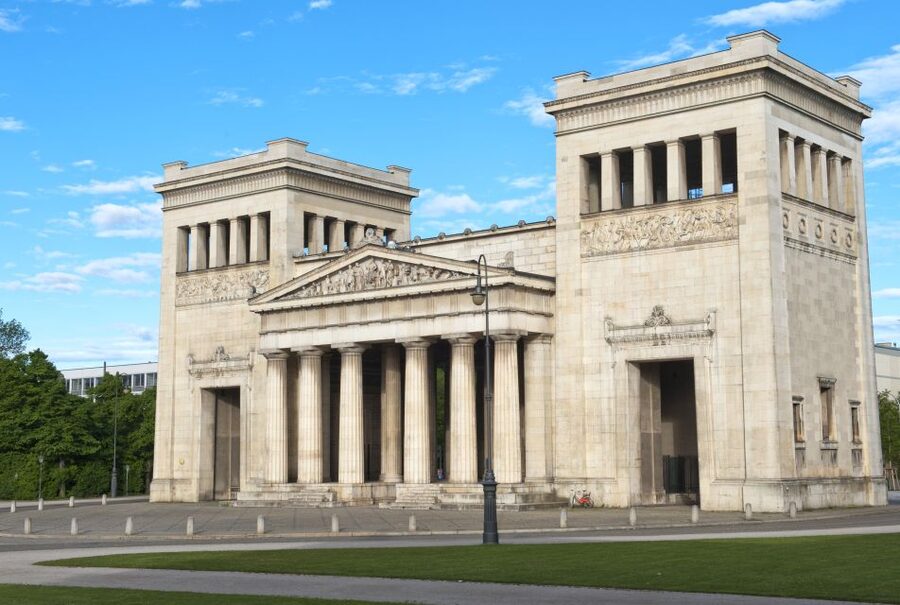
The walking route ends at Königsplatz, a place used for Nazi Party mass rallies and book burning. It is a strong final stop because it brings together several themes from the tour: propaganda, public spectacle, control of ideas, and the use of architecture and open space to project political power.
Königsplatz also gives your guide a chance to discuss the scale of Nazi public events. Mass rallies were not casual gatherings. They were carefully staged displays designed to make the movement appear disciplined, powerful, and inevitable.
The mention of book burning is especially useful for understanding how the regime attacked culture and free expression. This part of the tour moves beyond military history. You learn about censorship and the attempt to shape what people could read, study, and discuss.
Ending here creates a natural stopping point after the earlier sites. You have moved from party origins at Hofbräuhaus, through the failed Beer Hall Putsch, past resistance memorials and Nazi offices, and finally to a major rally ground.
Adding the NS Documentation Center for 4.5 hours
The 4.5-hour option adds the NS Documentation Center for the History of National Socialism. This is the better version if you want more than a guided walk through city streets.
The center includes photographs, documents, texts, film projections, and media stations. Its material covers the origin and rise of the Nazi movement, the war, and the postwar period in Munich. That last part matters. The story does not stop in 1945, when the city was bombed and liberated.
Your private guide remains with you at the center and helps explain the material. That can be useful because exhibitions about National Socialism often contain dense information and difficult questions. You can connect what you saw outdoors with the evidence presented inside.
I would choose the longer option for a first visit to Munich if you have the time. The three-hour walk gives you the city’s physical framework. The Documentation Center adds primary material and a more organized account of how the movement developed and what followed.
The tradeoff is time. Four and a half hours is a substantial block of a sightseeing day, especially when the subject matter is emotionally demanding. If you have only a short stay or already plan to visit the center separately, the three-hour route may be enough.
What the private format adds
This is a private group tour, rather than a large shared walk. That makes the experience more flexible in conversation. You can ask your guide to explain the Beer Hall Putsch in greater detail, spend more time on the White Rose Group, or focus on Munich’s destruction and liberation in 1945.
The guide languages are English, German, French, Italian, and Spanish. A guide named Mireya received specific praise, and that is useful to know if she is assigned to your group, though guide availability can vary.
The tour is led by a historian guide, and the subject demands more than basic sightseeing knowledge. You are dealing with propaganda, dictatorship, war, resistance, and mass suffering. A good guide should help you distinguish documented events from Nazi self-presentation and later myths.
The private setting also suits families, couples, and small groups with different levels of background knowledge. You can ask direct questions without worrying about slowing down a large group. The downside is simple: private guiding costs more.
Is $311 per person good value?
At $311 per person, this is expensive for a three-hour walking tour. If you are comparing it with a standard group walk, the price difference will be obvious.
The value improves if you are booking for a small private group and want direct access to a guide. It improves again with the 4.5-hour version, which includes the NS Documentation Center and extends the experience beyond outdoor landmarks.
I would not choose this tour for a quick introduction to Munich. You can see Marienplatz, Hofbräuhaus, Odeonsplatz, and Königsplatz on your own. You are paying here for the historical explanation, the connected route, the private conversation, and the guide’s help with a difficult subject.
The tour is strongest for people who want to understand how Munich became central to National Socialism, not just photograph buildings associated with Hitler. If you already have a strong background in the period, you may find the standard walk too basic unless you use the private format to ask specialist questions.
Free cancellation up to 24 hours before the tour and the reserve-now, pay-later option reduce some booking risk. The tour is also wheelchair accessible, which makes the format practical for more visitors, though the experience remains a city walk with several outdoor stops.
Who should book this Munich history tour?
I would recommend it to first-time visitors who want a serious introduction to Munich’s Nazi past. It also fits anyone who prefers a private guide over a large group and wants to ask questions about local responsibility, resistance, and the city’s wartime fate.
History students, families with older children, and visitors with a strong interest in the Second World War may get the most from the longer version. The Documentation Center gives you more evidence and helps turn a series of city landmarks into a connected historical account.
I would think twice if you want a light sightseeing activity. This is not a casual walk. The subject includes dictatorship, war, propaganda, book burning, resistance, bombing, and liberation. You should allow time afterward to process what you have seen.
Should you book it?
Book this tour if you want Munich’s Nazi history explained through the places where it happened, with a private guide who can respond to your questions. The 4.5-hour option is my pick because the NS Documentation Center adds photographs, films, documents, and postwar context that the outdoor route cannot provide.
Choose the three-hour version if your schedule is tight or you mainly want the central sites and the Beer Hall Putsch route. At $311 per person, it is not a bargain, but the private format can justify the cost for a small group seeking a focused and serious history experience.
FAQ
Where does the tour meet?
Meet your guide in front of hotel BEYOND by Geisel at Marienplatz 22, 80331 Munich, opposite St. Peter’s Church.
Should I enter the hotel at the meeting point?
No. The hotel is only the meeting point, and its staff is not informed about the tour.
How long is the tour?
The available options are three hours and 4.5 hours, or 270 minutes.
What is included in the three-hour tour?
The three-hour option includes a private walking tour with a history guide through Munich’s Old Town and Nazi-era sites.
What is added to the 4.5-hour option?
The 4.5-hour option adds a visit to the Munich Documentation Center for the History of National Socialism with your guide.
What can I see at the NS Documentation Center?
The center includes photographs, documents, texts, film projections, and media stations covering the Nazi movement’s origins and rise, the war, and the postwar period in Munich.
Which languages are available?
The tour is available in English, German, French, Italian, and Spanish.
Is this a private group tour?
Yes. The experience is offered for a private group.
Is the tour wheelchair accessible?
Yes. The activity is listed as wheelchair accessible.
Just added in Munich
- Pub crawl incl. Oktoberfest museum guided tour with beer tasting (private)★ 5.0 · 5 reviews
- South Tyrolean specialties and wine tasting★ 5.0 · 5 reviews
- Short & sweet: Tasting the Viktualienmarkt★ 4.8 · 37 reviews
- Size Matters Beer Tour Munich★ 4.6 · 105 reviews
- Secret Food Tours Munich★ 4.8 · 5 reviews
- Munich: Romantic Wine Experience for Two at Viktualienmarkt★ 4.2 · 14 reviews
- Munich: Resistance against Hitler – Historical Walking Tour★ 5.0 · 5 reviews
- Residence of Munich private tour with skip the line ticket★ 5.0 · 4 reviews
Third Reich & WWII Tours, compared.

Third Reich Berlin: Hitler and WWII Walking Tour
Read our review →
Walking Tour of Former Nazi Party Rally Grounds
Read our review →
Berlin Third Reich Sites: Half-Day Walking Tour
Read our review →
Birthplace of the Third Reich Guided Walking Tour
Read our review →Browse the lists this tour appears in