
Reviewed · THIRD REICH & WWII TOURS
Third Reich & WWII Walking Tour
Munich’s old center is handsome, busy, and full of postcard views. This tour asks you to look again. From Hofbräuhaus and Feldherrnhalle to the grand party grounds at Königsplatz, you follow the local steps of the Nazi movement, then consider the resistance that opposed it. The route turns familiar squares into places loaded with political and human meaning.
I like two things right away. First, the tour connects big events to exact Munich locations, so the story does not float away as a list of dates. Second, guides such as Josh, Michael, Alex, Danielle, and Ulrich are praised for clear storytelling, good pacing, and calm handling of a painful subject. The main drawback is practical: you walk and stand for most of 2 hours 45 minutes, with only a short chance to sit.
Key points to know before you book
- Munich was the setting for the Nazi Party’s early rise: The route follows the movement from meetings at Hofbräuhaus to the failed attempt to seize power at Feldherrnhalle.
- The tour includes resistance, not only Nazi landmarks: Time in the Hofgarten covers the White Rose movement and the people who opposed Hitler from within Munich.
- The route runs from Marienplatz to Königsplatz: You finish near Hitler’s former headquarters and the Munich Documentation Center area.
- Guides shape the experience: Josh, Michael, Alex, and Ulrich are singled out for strong narration, visual material, thoughtful answers, and group management.
- Plan for cold or wet weather: The experience is outdoors, and the walk can feel long in winter, even when the guide keeps the pace moving.
- The subject suits mature visitors: The tour is not recommended for children under 12, and the material calls for attention and quiet reflection.
Why Munich matters to this story
The tour begins at Marienplatz, in the heart of Munich. That is a practical meeting place, but it also places you in the center of a city whose political life changed sharply after World War I.
In 1919, Germany faced defeat, economic chaos, political violence, and public anger. Bavaria had its own revolutionary struggles and assassinations. Munich became fertile ground for radical movements, and the tour explains how Adolf Hitler and the Nazi Party used that uncertainty to build support.
I find this local approach more useful than a general account of World War II. You are not simply hearing that the Nazis gained power. You are learning how their message took root in this city, how public spaces were used to gather support, and how ordinary streets became settings for intimidation, ceremony, and resistance.
The guide’s job here is important. The strongest guides reported for this tour do more than recite facts. Josh is praised for explaining the psychology behind the rise of Nazism. Alex is noted for allowing quiet moments before opening discussion. Michael is known for handling detailed questions. Those qualities matter because the subject can quickly become either too dry or too theatrical. The better approach is factual, direct, and restrained.
More Third Reich and WWII Tours in Munich
- Munich: Third Reich & WWII Walking Tour
★ 4.6 · 6,181 reviews - Third Reich Walking Tour Munich
★ 4.5 · 4,291 reviews - Munich: Birthplace of the Third Reich Guided Walking Tour
★ 4.6 · 771 reviews
From Marienplatz to the first Nazi meetings
Marienplatz is the starting point, and you should arrive with the meeting instructions clearly sorted out. One practical warning is worth taking seriously: the exact meeting point can be confusing, and a map pin has reportedly been less useful than the written directions near the Munich tourist office. Give yourself extra time rather than assuming the first central square location you see is correct.
From here, the tour moves through central Munich toward places tied to the Nazi Party’s early growth. The walking itself is part of the lesson. You pass through a living city, with shops, cafés, churches, and modern traffic around you, while the guide explains what happened in the same area a century ago.
One featured site is Hofbräuhaus, famous today for beer halls and Bavarian atmosphere. In the tour’s historical frame, it becomes the setting for one of the Nazi movement’s first mass meetings. That contrast is striking. You see how a familiar social venue could be used as a political stage, and how speeches and organized gatherings helped turn anger into a movement.
This section is especially helpful if you know World War II mainly from military history. The tour concentrates on the period before the war, including the conditions that helped the Nazis gain influence. You learn about Munich as a center of the movement, not simply as a city later damaged by bombing.
Feldherrnhalle and the failed 1923 putsch
The route continues to Feldherrnhalle, a monument at the southern end of the Odeonsplatz area. This is the site connected with Hitler’s failed attempt to seize power in 1923, often called the Beer Hall Putsch.
The guide explains the event as part of the larger rise of the Nazi Party. The failed coup did not bring Hitler immediate control of Germany, but it became a major piece of Nazi political mythology. That distinction is useful. A failed attempt can still be turned into a powerful story, and the tour shows how political movements use defeat, ceremony, and memory to strengthen loyalty.
Feldherrnhalle also helps you see the difference between a place as it appears today and how it was used under dictatorship. The stone monument is easy to photograph, but the meaning is not obvious without context. A good explanation connects the location, the people involved, the political climate, and the later propaganda built around the event.
This is one of the tour’s more crowded portions, especially during the Christmas market season or other busy periods. Alex is praised for moving a group through packed areas without losing the thread of the story. Still, you should expect to stop on public streets and squares, not in a private lecture room. Keep close to the guide and listen for meeting instructions.
Hofgarten and the White Rose resistance
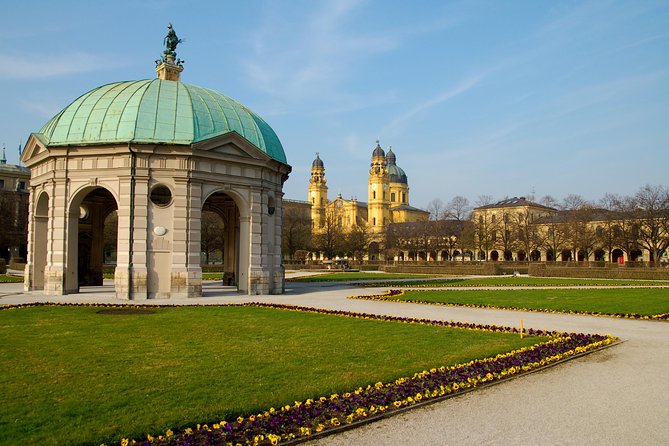
The stop in the Hofgarten adds needed balance. A tour about the Third Reich should not present Munich only as the birthplace and headquarters of Nazism. Here, the guide discusses the White Rose, a resistance movement led by students who opposed Hitler and distributed anti-Nazi leaflets.
This section changes the mood. The earlier stops show how propaganda and political organization gained power. The White Rose reminds you that opposition existed, even under a regime built on fear and control. The tour treats these people with respect, without turning their story into a simple heroic sidebar.
I particularly value this part because it connects the political story to moral choices. The question is not only how a dictatorship rose. It is also how individuals responded when speaking out could bring imprisonment or death. Guides have used quiet pauses here before inviting questions, which is the right rhythm for such material.
The Hofgarten stop may also be your only meaningful indoor or seated break, depending on the day and guide. One account describes roughly 15 minutes inside during a cold tour. Do not count on a long rest, though. Wear shoes you can walk in and bring water, since the route has little time set aside for food or a proper snack.
Other trips into the same period in Munich:
- Munich World War II Sites Including Dachau Concentration Camp
★ 4.5 · 570 reviews - Munich City Walking Tour, includes Third Reich & Viktualienmarkt
★ 5.0 · 458 reviews - Berlin: Third Reich and Cold War 2 Hour Walking Tour
★ 4.9 · 6,830 reviews - Berlin’s Best: 2 Hour Walking Tour Third Reich and the Cold War
★ 5.0 · 5,486 reviews
Königsplatz and the architecture of power
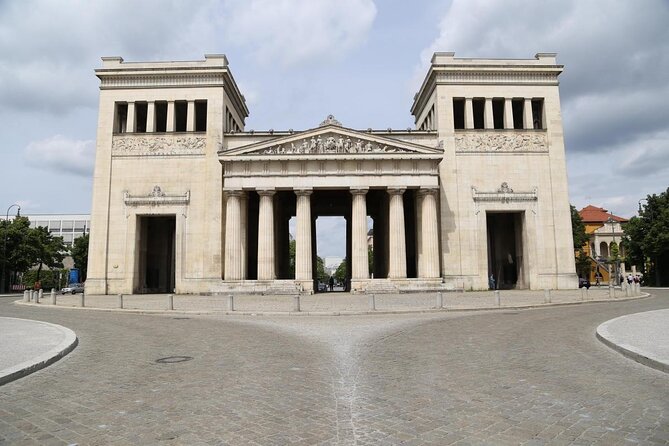
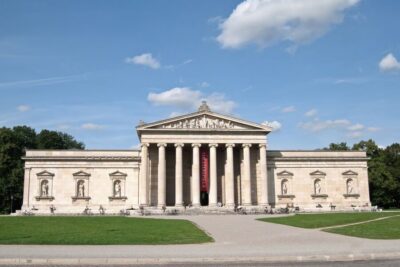
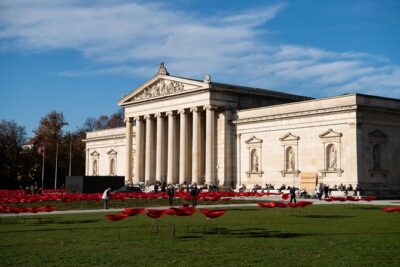
Königsplatz is the major endpoint and one of the most revealing places on the route. The broad neoclassical space was used for mass Nazi party rallies and ceremonies. Its size and formal design helped create the feeling of order, power, and historical destiny that the regime wanted to project.
The guide explains how the Nazis used architecture and public space to shape behavior. A large square can make a gathering feel inevitable. Rows, monuments, flags, marching formations, and speeches turn politics into spectacle. Standing there today, you can consider how deliberately the regime selected and staged such places.
The endpoint is near Hitler’s former headquarters, and the walk concludes at Königsplatz 1. The area also connects with the Munich Documentation Center, which several guides suggest visiting after the tour. The center is not included in the walking tour, but it can extend your understanding with photographs, films, and other material about Munich during the Nazi era.
That suggestion is useful when planning your day. If you visit the documentation center immediately afterward, you can continue with the same subject while the locations and chronology are fresh. If you are emotionally tired, you may prefer a pause first. The tour is compact in geography but heavy in subject matter.
The guides make the difference
The experience is offered in English, and the individual guide can shape the tone. Josh is praised for strong preparation, historical context, and an ability to keep the subject engaging without making it light. Michael receives similar praise for clear explanations and detailed answers.
Alex is described as personable, patient with questions, and skilled at handling a group through crowded streets. Ulrich is praised for combining information with an entertaining delivery and for suggesting the Documentation Center at the end. Danielle and Bridget are also noted for keeping the history clear and moving at a workable pace, including in cold weather.
You should not expect every guide to use exactly the same examples or visuals. Some guides bring historical photographs and other visual aids. That can help when you are trying to picture how a square or street looked during the period.
One caution is hearing. At least one participant found the guide difficult to hear outdoors and felt that a small amplifier would have helped. If you have any trouble hearing in a crowd, move close to the guide and tell them early. The tour has been praised for questions and discussion, but you cannot benefit from that if you are standing at the back of a noisy group.
Nearly three hours on foot
The tour takes about 2 hours 45 minutes and covers several central locations. It is not a strenuous mountain hike, but it is a steady urban walk with repeated standing stops. One account describes the pace as good, while another found nearly three and a half hours of walking and standing tiring. Your experience will depend on the exact route, group, weather, and guide.
Wear supportive shoes. Bring water and a small snack, since there is little time for a proper break. Winter deserves special planning. Several tours took place in freezing conditions, yet the guides kept the group moving and used an indoor stop when possible. Still, warm clothing is your responsibility.
The group size needs a careful note. The tour is presented as a small-group experience limited to 10 people, while the additional booking information gives a maximum of 30 participants. That is a meaningful difference. Check the current group limit when booking if a very small group is important to you.
The route begins at Marienplatz and ends at Königsplatz, so you do not return to the start. That is convenient if you plan to visit the Documentation Center or continue toward the museums and central sights near Königsplatz. It is less convenient if you have left belongings near Marienplatz or need to return there for a timed booking.
Is $35.09 a fair price?
At $35.09 per person, the tour is priced as a moderately costly walking experience rather than a budget stroll. The value depends on how much context you want. You are paying for a professional English-speaking guide, nearly three hours of explanation, and a route that links several sites into one chronological story.
The price does not include food, drinks, admission tickets, or hotel pickup and drop-off. That matters because the walk ends near the Documentation Center, and you may decide to pay separately for that museum. The tour itself is best viewed as an outdoor historical introduction, not a complete museum visit.
I think the price is fair if you want Munich’s Nazi past explained in place and prefer asking questions as you go. It is less compelling if you already know the subject well and want long periods inside museums or formal exhibits. The value is strongest for first-time visitors who want a clear framework before exploring further on their own.
Who should take this tour?
You should consider it if you are interested in modern German history, World War II, political propaganda, resistance movements, or the way cities remember difficult events. It also works well if you want local context rather than a broad European war tour.
The tour is suitable for most people who can walk and stand for close to three hours. It is not recommended for children under 12, and the subject includes persecution, dictatorship, war, and resistance. Parents should judge maturity rather than rely only on age.
This is not a light sightseeing walk. You will still see central Munich, but the purpose is historical study. The best mindset is attentive and respectful. Guides invite questions, and beginners can follow the story, yet the amount of information may feel heavy if you have no prior background at all.
Should you book the Third Reich walking tour?
Book it if you want a serious, place-based account of Munich’s role in the rise of Nazism. The route covers Hofbräuhaus, Feldherrnhalle, Königsplatz, and the Hofgarten, while the guides connect political events with propaganda, public space, resistance, and wartime destruction.
Skip it if you need frequent seating, dislike extended outdoor walking, or want a tour focused mainly on Munich’s art, churches, and food. For everyone else, the combination of clear chronology, important sites, and guides such as Josh, Michael, Alex, and Ulrich makes this a strong use of a morning or afternoon. Bring water, dress for the forecast, confirm the meeting point, and leave room in your schedule for the Documentation Center afterward.
FAQ
Where does the Third Reich walking tour begin?
It begins at Marienplatz in central Munich, Germany.
Where does the tour end?
The tour ends at Königsplatz 1, near Hitler’s former headquarters and the Munich Documentation Center area.
How long does the walking tour last?
The tour lasts approximately 2 hours 45 minutes.
What language is the tour offered in?
The tour is offered in English.
Which historic locations are included?
The route includes Hofbräuhaus, Feldherrnhalle, Königsplatz, and the Hofgarten, along with other central Munich locations connected with the Nazi era and World War II.
Is the tour suitable for children?
The tour is not recommended for children under 12 years old because of the serious subject matter.
Are food and drinks included?
No. Food and drinks are not included, and you should consider bringing water and a small snack because the walk has limited break time.
Is hotel pickup and drop-off provided?
No. Hotel pickup and drop-off are not included.
More walking tours in Munich
- Munich: Old Town & Viktualienmarkt City Walk in German
★ 4.7 · 2,304 reviews - Munich: Night Watchman Walking Tour
★ 4.7 · 2,092 reviews - Munich Ghosts and Spirits Evening Walking Tour
★ 5.0 · 1,900 reviews - Munich Old Town Walking Tour
★ 4.5 · 1,287 reviews
Just added in Munich
- 2 Hours Munich: VIP Private Segway Tour★ 4.9 · 5 reviews
- “Comedykills” – das Open Mic im Glockenbachviertel★ 4.1 · 51 reviews
- From Munich: Herrenchiemsee Palace and Boat Trip Day-Tour★ 4.8 · 129 reviews
- Munich: Classical Concert at the Residenz Palace★ 4.5 · 148 reviews
- Munich: City Highlights Guided Segway Tour★ 4.6 · 266 reviews
- From Munich: Guided Group Tour to Eagle’s Nest★ 4.8 · 303 reviews
- From Munich: Dachau Memorial Site Tour in Spanish★ 4.9 · 300 reviews
- From Munich: Nuremberg Day Trip by Train★ 4.4 · 357 reviews
Third Reich & WWII Tours, compared.
Third Reich Berlin: Hitler and WWII Walking Tour
Read our review →
Walking Tour of Former Nazi Party Rally Grounds
Read our review →
Berlin Third Reich Sites: Half-Day Walking Tour
Read our review →
Birthplace of the Third Reich Guided Walking Tour
Read our review →Browse the lists this tour appears in