
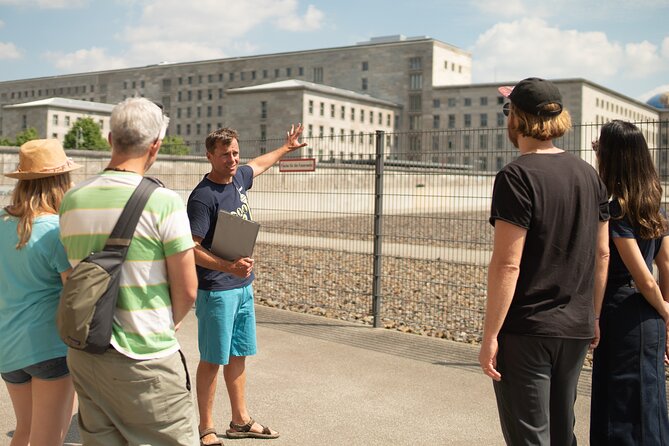
Reviewed · THIRD REICH & WWII TOURS
Private Walking Tour Berlin Third Reich Hitler and World War II
Berlin’s most important Nazi-era sites are scattered across the city, and this private walking tour connects them into one sobering story. In a few hours, you move from the Soviet Memorial and former Nazi ministries to the Holocaust Memorial, the Führerbunker site, and places tied to resistance and deportation.
I like the private format, since your guide can adjust the pace and answer questions without a large group competing for attention. I also like the hotel pickup and drop-off, a useful perk when the route covers many districts and the subject matter requires plenty of concentration.
The main drawback is the speed. The schedule gives some stops only 10 or 15 minutes, and most sites are viewed from outside or visited briefly. If you want time inside the Topography of Terror or the Holocaust Memorial Information Centre, plan to return on your own.
Key points to know before booking
- Twelve major sites in three to four hours: Expect a brisk route covering Nazi government, wartime destruction, resistance, remembrance, and the Holocaust.
- Private guiding makes a difference: Guides including Daniel, Jimmy, Georgia, Jasper, Simon, and others can shape the tour around your interests.
- Hotel pickup and drop-off are included: This removes some of the effort from organizing a route across central Berlin.
- The strongest stops are often the quietest: The T4 memorial, Bendlerblock, and Anhalter Bahnhof add human detail beyond Hitler’s headquarters.
- Most admissions are free, but time inside is limited: The Reichstag admission is not included, and the itinerary mainly focuses on outdoor sites.
- Bring good shoes and weather gear: The tour runs in rain or cold, and one family reported walking about 10,000 steps.
What this private Berlin history tour is really like
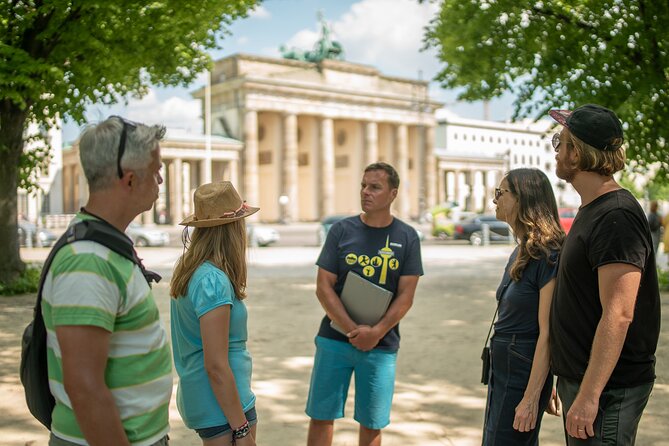
This is not a tour about grand buildings alone. It is about how a dictatorship used ministries, police offices, propaganda, transport systems, and military power to control people, then how Berlin remembers the damage.
Your guide meets you at your hotel and builds the outing around the group when possible. Daniel, for example, asked what his group wanted to see and quickly shaped a plan. Georgia also adjusted the route around a hotel meeting point and ended near the Berlin Wall. Those details matter because a private tour works best when you use its flexibility rather than simply follow a fixed script.
The tour is offered in English and runs in all weather. Wear shoes you can walk in and bring a coat or rain layer. The subject is heavy, too, so the private setting helps if you want to pause, ask a difficult question, or spend less time on a site you have already visited.
At $192.97 per person, the price is high for a walking tour, particularly for a solo visitor. For a couple or family, though, the cost buys several hours of one guide’s attention, hotel transfers, and a route that would take careful planning to assemble. The value rests largely on the guide. A strong guide turns disconnected locations into a clear chain of events. A less suitable guide may follow a personal agenda or move too quickly, so tell the company what matters to you when booking.
More Third Reich and WWII Tours in Berlin
- Berlin: Third Reich and Cold War 2 Hour Walking Tour
★ 4.9 · 6,830 reviews - Berlin’s Best: 2 Hour Walking Tour Third Reich and the Cold War
★ 5.0 · 5,486 reviews - Third Reich Berlin: Hitler and WWII Walking Tour
★ 5.0 · 3,301 reviews
Soviet Memorial Tiergarten: victory viewed from the Soviet side
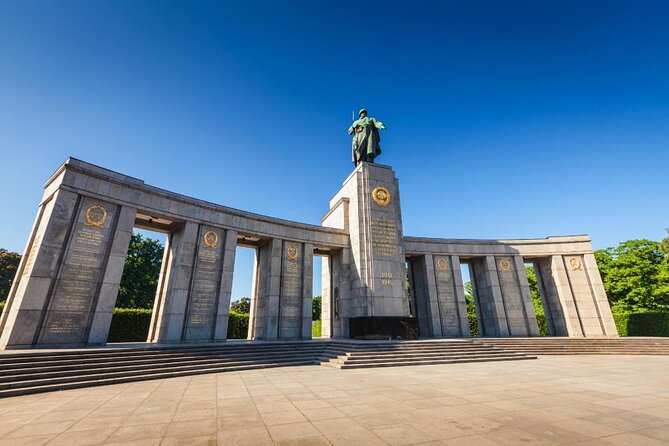
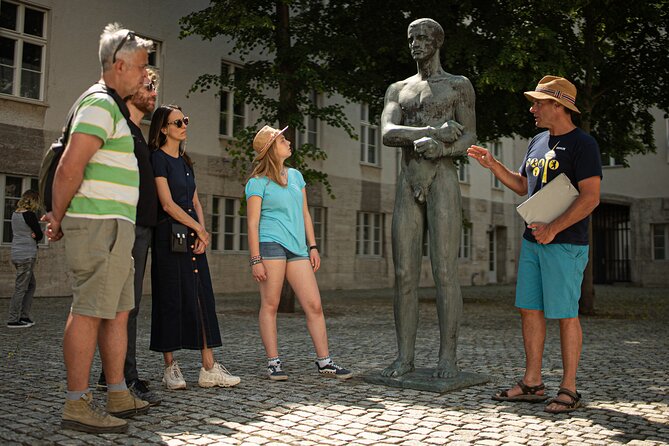
The tour often begins at the Soviet Memorial in Tiergarten, opened in 1949 to honor Soviet soldiers killed in the Battle of Berlin. Its large statue of a soldier with sword and shield sets the tone at once: this is a memorial to the army that defeated Nazi Germany, but it also reflects the political order that followed the war.
Allow about 10 minutes here. Your guide can explain the Soviet assault on Berlin, the final fighting of 1945, and the memorial’s place in both German and Soviet memory. This is a useful opening because it puts the end of the war before you begin tracing the machinery that caused it.
Do not expect a long visit or a museum-style presentation. The value comes from the explanation and the setting. The memorial is best understood as part of the larger story of Berlin’s destruction and division.
Wilhelmstraße and the Aviation Ministry: where power became paperwork
Along Wilhelmstraße, your guide introduces the former center of Nazi government. The Detlev-Rohwedder-Haus began as the Reichsbank headquarters and later housed the Ministry of Aviation under Hermann Göring. After the war, it became the German Federal Treasury.
The building is a sharp reminder that dictatorship depends on offices, budgets, orders, and administrators, not only speeches and weapons. Your guide can explain the work carried out by the ministries along Wilhelmstraße and how political decisions became military and social policy.
The scheduled stop is about 10 minutes, followed by roughly 20 minutes walking along Wilhelmstraße. That combination is more useful than a quick photograph because it lets you picture the avenue as a working government quarter rather than a collection of unrelated façades.
Much of what you see is exterior. If you want architectural detail or a long discussion of Göring, tell your guide early. The private format makes that sort of adjustment possible.
Topography of Terror: the clearest place to slow down
The Topography of Terror occupies the grounds of the former SS and Gestapo headquarters. Its indoor and outdoor displays use photographs, documents, and personal accounts to explain political repression and state violence.
The planned visit is about 20 minutes, which is enough for an introduction but not enough for a full reading of the exhibits. I would treat this as a guide-led orientation, then return later if the subject matters to you. One visitor used the short stop this way, coming back the next day for a longer visit.
This is one of the tour’s most valuable locations because it shifts attention away from Hitler alone. You learn how police agencies, officials, and institutions helped enforce the regime. The displays also keep victims and ordinary lives in view, which gives the broader political story a human scale.
Other trips into the same period in Berlin:
- Berlin: Third Reich, Hitler, and WWII Walking Tour
★ 4.9 · 1,133 reviews - Berlin Third Reich Sites: Half-Day Walking Tour
★ 5.0 · 835 reviews - Berlin: Guided Bike Tour of the Berlin Wall and Third Reich
★ 4.7 · 499 reviews - Hitler’s Germany: Berlin During the Third Reich & WWII
★ 4.8 · 476 reviews
Bendlerblock and German resistance
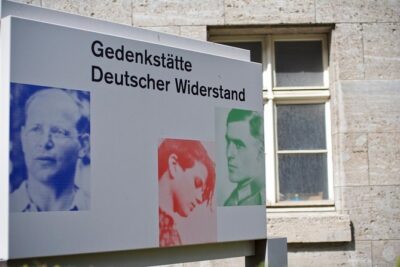
At the German Resistance Memorial Center in the Bendlerblock, the focus changes from Nazi control to opposition. The building is closely tied to Claus von Stauffenberg and the July 20, 1944 attempt to kill Hitler.
Your guide explains that resistance took different forms and came from people with different motives. The site gives particular attention to those who tried to act against tyranny and paid with their lives.
The stop is planned for about 20 minutes. That is enough to explain the setting and the main events, but not enough to study every exhibit. If resistance movements are a major interest, ask for more time here and accept that another stop may become shorter.
I appreciate this part of the route because it avoids presenting Germans only as victims or followers. It also raises hard questions about moral courage, obedience, and the risks of acting late against a criminal government.
Bebelplatz and the attack on free expression
Bebelplatz is associated with the Nazi book burning of May 10, 1933. Thousands of books considered politically or culturally unacceptable were destroyed here in a public display of censorship.
Look for the underground memorial with empty bookshelves. It is easy to miss if you are not told where to look, and its simplicity makes the point without spectacle. Your guide also places the square among the State Opera House and Humboldt University, showing how the event took place in the heart of Berlin’s cultural and academic life.
The stop lasts about 10 minutes. That is enough for the book burning and memorial, but you will not have much time to explore the surrounding buildings. This is a good place to ask about propaganda, censorship, and how public institutions were brought into line.
The Reichstag: fire, power, and democratic repair
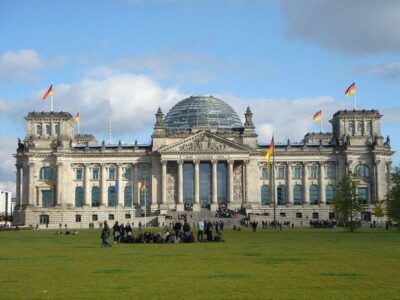
The Reichstag dates from 1894 and became central to the Nazi rise after the fire of February 1933. The Nazis used the event to suspend civil liberties and suppress political opponents.
Your guide explains how the building was damaged in World War II and later restored as a symbol of parliamentary democracy. That change gives the stop its weight. The Reichstag is not only a wartime ruin or a Nazi-era landmark. It also represents Germany’s effort to rebuild democratic government after dictatorship.
The planned visit is about 15 minutes, and admission is not included. This tour focuses on the Nazi history and exterior context rather than a full visit to the building. If you want to enter the Reichstag, make separate arrangements and allow more time than this itinerary provides.
Holocaust Memorial: a place for silence and questions
The Memorial to the Murdered Jews of Europe covers a large area with 2,711 concrete slabs of different heights. Walking between them can feel confusing and enclosed, while the open space around them offers no simple viewpoint from which to take in the whole design.
Your guide connects the memorial’s form to the scale of the Holocaust and the difficulty of representing mass murder. The visit also places Nazi policy toward European Jews at the center of the tour, rather than treating the Holocaust as a side chapter in the war.
The scheduled time is about 15 minutes. That is brief for a memorial designed to be walked through slowly. I suggest using the guide’s explanation as a starting point, then returning alone when you can take the time at your own pace. The underground information centre is not listed as part of the tour, so do not assume it is included.
The Führerbunker site: what is no longer visible
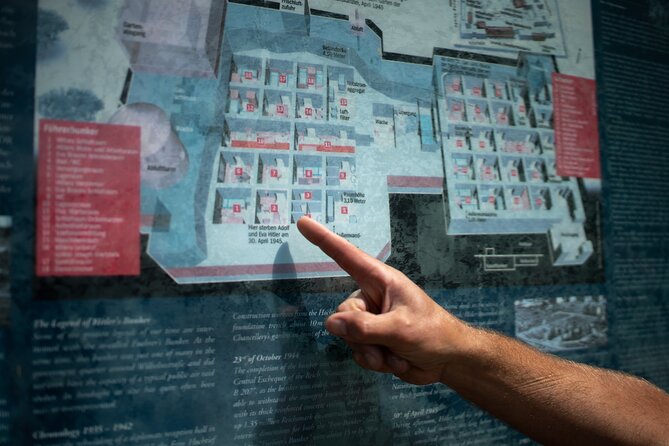
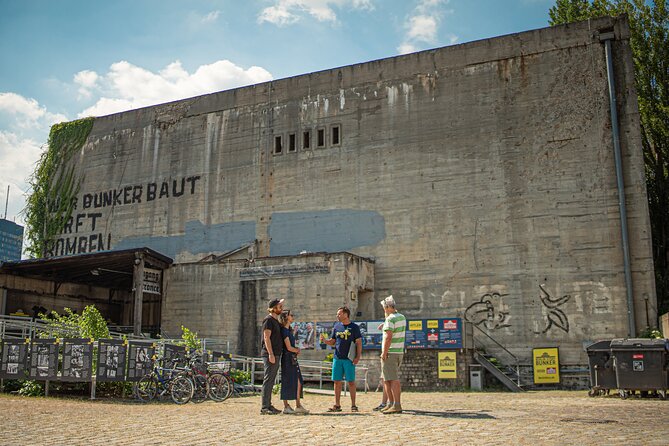
At the Führerbunker site, you stand above the location of Hitler’s final headquarters. The bunker was an underground complex beneath the Reich Chancellery, where Hitler spent the last months of the war as Soviet forces closed in on Berlin.
The original structure was largely destroyed after the war. Today, there is no grand entrance to explore and no intact bunker interior. That absence is part of the lesson. Your guide describes the layout, the final decisions made there, and the collapse of the Nazi leadership without turning the site into a shrine.
The stop lasts around 10 minutes. It is most useful when handled with restraint. A good explanation keeps attention on the consequences of dictatorship and the people harmed by it, rather than on fascination with Hitler’s private surroundings.
Anhalter Bahnhof and the machinery of deportation
Anhalter Bahnhof was once one of Berlin’s main railway stations. During the Nazi period, it was connected with the deportation of Jews to concentration camps, making the station part of a system that separated families and transported people toward murder.
Today, only part of the grand station remains. Your guide uses the site to connect ordinary railway travel with the administrative process of persecution. That is a difficult but important point: mass crimes required schedules, orders, records, and transport.
The stop is about 10 minutes. Much of its power comes from the stories and context supplied by the guide, since the surviving architecture alone cannot explain what happened. If you want a more extended memorial visit, ask how the route can be adjusted.
The T4 memorial and victims of Nazi euthanasia
The T4 Memorial on Tiergartenstraße 4 marks the Nazi euthanasia program, which targeted people with disabilities and mental illnesses as supposedly unworthy of life. The program involved systematic killing and helped develop methods later used in the Holocaust.
This is one of the tour’s most important and least familiar stops. It expands the story beyond war and antisemitic persecution, showing how racist and eugenic ideas were applied to disabled people and others the regime rejected.
The memorial includes information about the victims, the program, and the moral issues raised by the killings. The visit lasts around 10 minutes, so expect a concise explanation rather than a long study session. The subject can be especially difficult for families, but it is handled as a lesson in human dignity and the dangers of state discrimination.
Moltkebrücke and the final battle for Berlin
At Moltkebrücke, the guide recounts how Soviet forces crossed the bridge during the assault on Berlin in April 1945. The bridge’s strategic position made it part of the fighting that brought the war in Europe to its final stage.
The stop lasts about 10 minutes. It offers a physical sense of how the Soviet advance moved through the city, and it links back to the opening memorial in Tiergarten. You can picture the shift from Nazi control to occupation and the beginning of Berlin’s postwar division.
This is another location where the guide’s storytelling matters more than what you see. The bridge remains an urban structure, but its wartime meaning is invisible without context.
The guides and the value of a private format
The strongest feature of this experience is the human guide. Daniel is described as flexible and warm, while Jimmy is praised for keeping a four-hour route lively with stories. Georgia is noted for adapting the meeting point and pace, and Jasper, Simon, Callum, Tobi, Oren, Xavier, Artie, Martin, Maria, and others are all identified with clear explanations, personal attention, or strong subject knowledge.
Guides vary, so I would not book expecting one specific person unless the company confirms availability. One mixed experience involved a guide who was punctual and informed but seemed to follow his own agenda. That is a useful warning: tell your guide whether you want military history, the Holocaust, resistance, architecture, family education, or the Cold War connection.
The private format also helps families. One guide adjusted the pace for children and kept quieter boys involved. Another group used the tour as a starting point, then returned to the Topography of Terror and Holocaust Memorial the next day.
Who should book this tour?
Book it if you want a structured introduction to Berlin’s Nazi and World War II sites, especially if you have limited time or prefer personal explanations to an audio guide. It also suits families, first-time visitors, and anyone who wants hotel pickup rather than a complex route across town.
It is less suitable if you want long museum visits, extensive interior access, or a slow photographic walk. The route covers a lot, but the short stops mean you should choose one or two places to revisit later.
The tour is recommended by 99 percent of 360 ratings and carries a five-star average, but the practical lesson is more useful than the numbers: guide quality and customization matter most. The experience can be moving and substantial when your guide listens to you and gives the subject enough care.
FAQ
How long does the private Berlin Third Reich tour last?
The tour lasts approximately three to four hours.
Is hotel pickup included?
Yes. Hotel pickup and hotel drop-off are included.
Is the tour private?
Yes. Only your group participates in the activity.
What language is the tour offered in?
The tour is offered in English.
Is admission to the Reichstag included?
No. Admission to the Reichstag is not included. The visit focuses on its history and is scheduled for about 15 minutes.
What should I wear?
The tour operates in all weather conditions, so dress appropriately. Comfortable walking shoes and weather protection are sensible because the route includes many outdoor stops.
Should you book it?
I would book this tour if you want Berlin’s difficult history explained in a clear sequence, with the freedom to ask questions and change the pace. The price makes the most sense for two or more people sharing a private guide, especially when hotel transfers save time.
Choose it with realistic expectations. You will see many sites, but several visits last only 10 minutes, and the tour is mainly an outdoor history walk. If that sounds right, this is a strong way to get your bearings, understand the city’s Nazi past, and learn which memorials deserve a longer return visit.
More walking tours in Berlin
- Discover Berlin Half-Day Walking Tour
★ 5.0 · 9,624 reviews - Berlin: Discover Berlin Walking Tour
★ 4.9 · 5,998 reviews - Berlin: Hidden Backyards Guided Walking Tour
★ 4.8 · 5,360 reviews - Berlin: Alternative Berlin Walking Tour
★ 4.6 · 1,204 reviews
Just added in Berlin
- Berlin: Energizing 2-Hour Morning Segway Tour★ 4.7 · 35 reviews
- Berlin: Thrilling E-Scooter Adventure Tour★ 4.4 · 66 reviews
- Beelitz-Heilstätten: Baum&Zeit Tree Top Walk Entry Ticket★ 4.9 · 7 reviews
- Beer Bike & Party Bike: Unforgettable Berlin City Tour incl. pickup★ 5.0 · 5 reviews
- AXE THROWING EXPERIENCE IN BERLIN★ 4.7 · 24 reviews
- Alternative Berlin / Street art tour – Private group★ 5.0 · 6 reviews
- Berlin: Alternative & Street Art Tour★ 4.5 · 6 reviews
- Berlin: 2.5-Hour Beer & Sunset Sightseeing Boat Cruise★ 4.6 · 61 reviews
Third Reich & WWII Tours, compared.

Third Reich Berlin: Hitler and WWII Walking Tour
Read our review →
Walking Tour of Former Nazi Party Rally Grounds
Read our review →
Berlin Third Reich Sites: Half-Day Walking Tour
Read our review →
Birthplace of the Third Reich Guided Walking Tour
Read our review →Browse the lists this tour appears in