
Reviewed · THIRD REICH & WWII TOURS
Nuremberg: Walking Tour of Former Nazi Party Rally Grounds
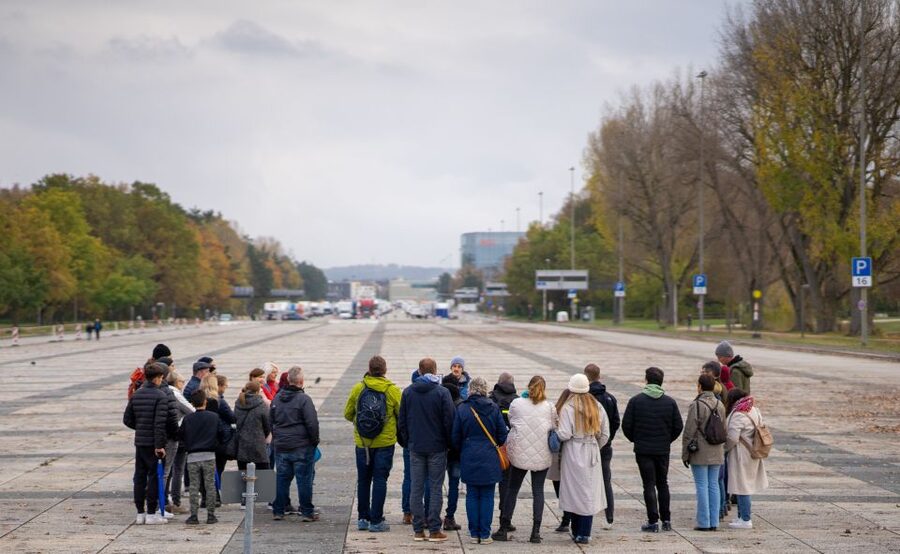
The most striking part of this Nuremberg tour is the sheer scale of the former Nazi Party Rally Grounds. The unfinished Congress Hall rises about 40 meters, while the Great Road and Zeppelin Field show how architecture was used to make power feel vast, permanent, and unquestionable. You are not just looking at ruins. You are seeing propaganda in stone and concrete.
I like the way the tour links the buildings to the Nazi use of mass spectacle, rather than treating them as disconnected photo stops. I also like the use of historical pictures, which help you compare the present-day ruins with the staged rallies of the 1930s. The main drawback is practical: this is a long outdoor walk, and late tours can finish at Zeppelin Field in darkness, especially in winter.
Key points to know before you go
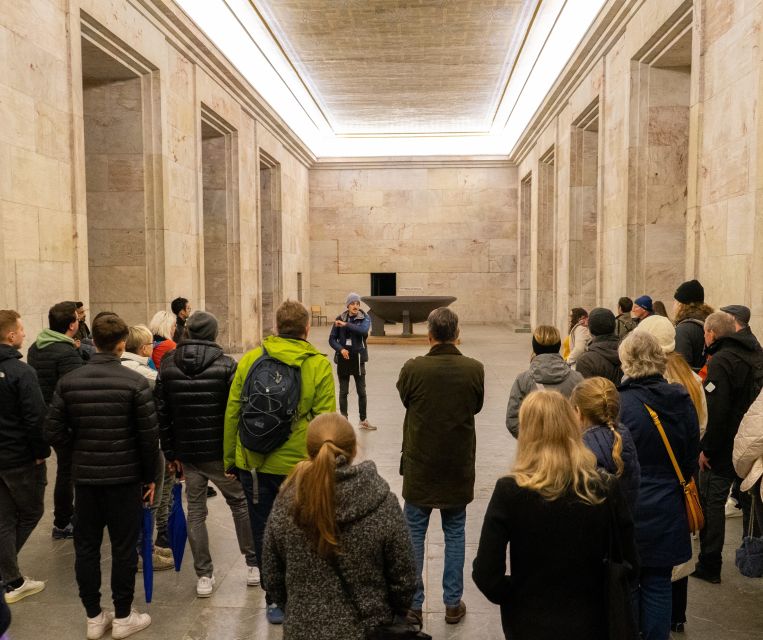
- The route covers three major sites: Congress Hall, the Great Road, and Zeppelin Field.
- The focus is propaganda: Your guide explains how architecture, crowds, ritual, and spectacle supported the National Socialist message.
- Expect substantial walking: The tour takes two hours and covers roughly 5,000 steps according to one detailed account.
- Guides bring the past into view: Guides including Kai, Sylvia, Anita, Frank, and others use photographs and careful explanation.
- The tour runs outdoors in all weather: Bring suitable shoes and clothing for rain, cold, or strong sun.
- The final stop is time-sensitive: Check the starting time carefully if seeing Zeppelin Field in daylight matters to you.
Why the rally grounds matter beyond the ruins
Nuremberg is often linked with the postwar trials, but the city also served as one of the most important stages for Hitler’s political theater. The former Nazi Party Rally Grounds were designed to turn political power into a physical experience. Huge spaces, strict lines, monumental buildings, flags, uniforms, music, and mass gatherings all worked together.
That is the key idea this walking tour explains. You are not simply studying Nazi architecture as a style. You are looking at how a government tried to shape belief through public space.
The subject is difficult, and the tone matters. The strongest guides keep the attention on the crimes of the Nazi regime, the human cost of its policies, and the danger of propaganda. They do not treat the grounds as a spectacle detached from the people harmed by the system.
This experience is especially useful if you want to understand how the National Socialist Party gained support and maintained control. It also addresses the concentration camp system and the relationship between public celebration and state violence. That connection gives the tour moral weight without turning it into a lecture full of dates and names.
The provider, Geschichte Für Alle e.V., uses guides who take questions seriously. Guides such as Kai, Sylvia, Anita, Andreas, Frank, and Marina have been singled out for clear explanations, strong command of the subject, and a calm way of handling difficult questions. Individual guides vary, but the tour’s value depends heavily on this human element.
More Third Reich and WWII Tours in Nuremberg
- Nuremberg: Historischer Kunstbunker WWII Art Bunker Tour
★ 4.8 · 921 reviews - Nuremberg Old Town and Nazi Party Rally Grounds Walking Tour in English
★ 4.5 · 504 reviews - Nuremberg Old Town and Nazi Rally Grounds Walking Tour
★ 4.7 · 377 reviews
Starting at Congress Hall and its 40-meter walls
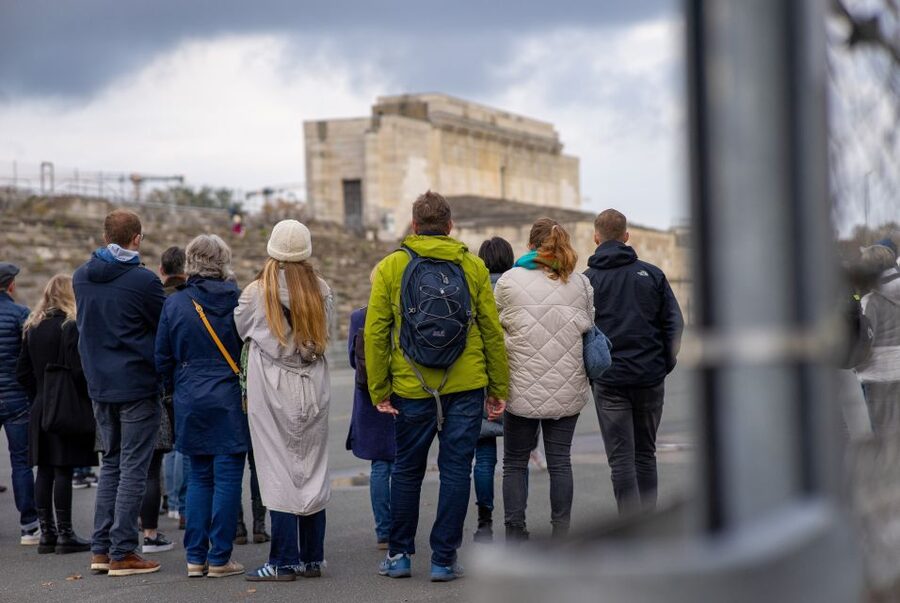
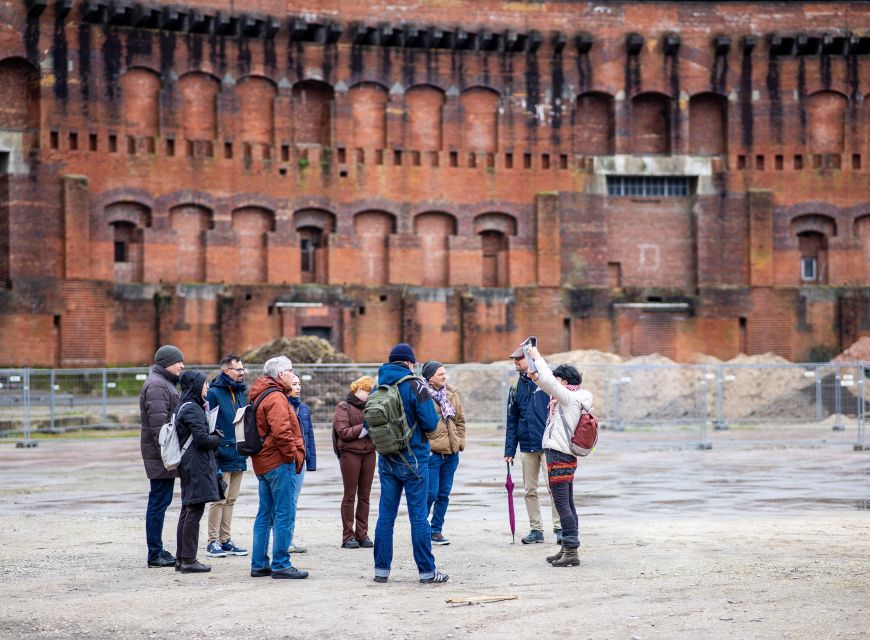
Meet your guide beside the entrance stairs to the Documentation Center Nazi Party Rally Grounds at Bayernstraße 110. Look for a guide holding a picture folder and wearing a name tag marked Geschichte Für Alle e.V. This is a useful meeting point because the enormous Congress Hall gives you an immediate sense of place.
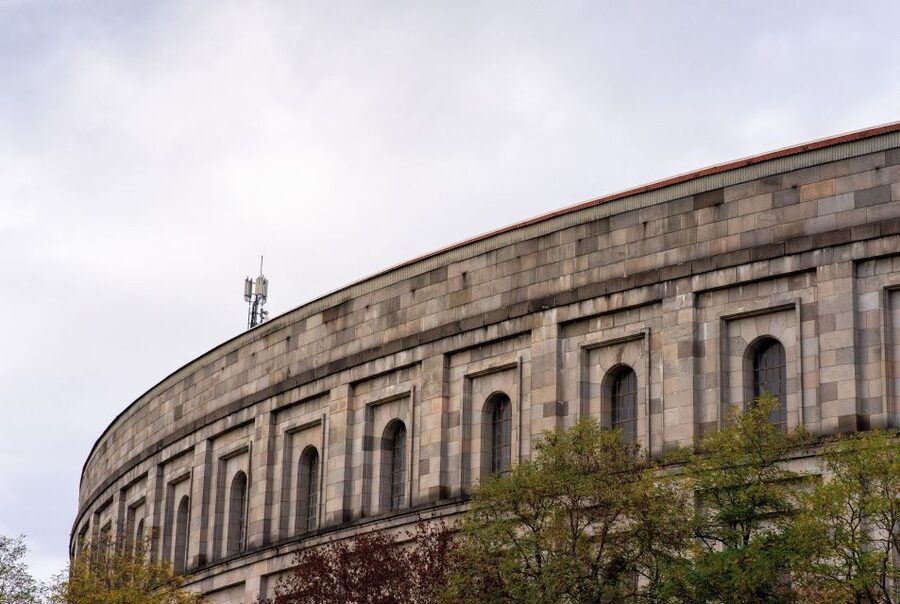
The Congress Hall was built as part of the Nazi plan for Nuremberg but was never completed. Its remaining structure is imposing even in its unfinished state. At about 40 meters high, it gives you a direct lesson in scale before the walking route even begins.
Your guide explains the intended function of the building and the message its architecture was meant to send. The point is not only that it was large. It was designed to make ordinary people feel small and the political movement feel permanent.
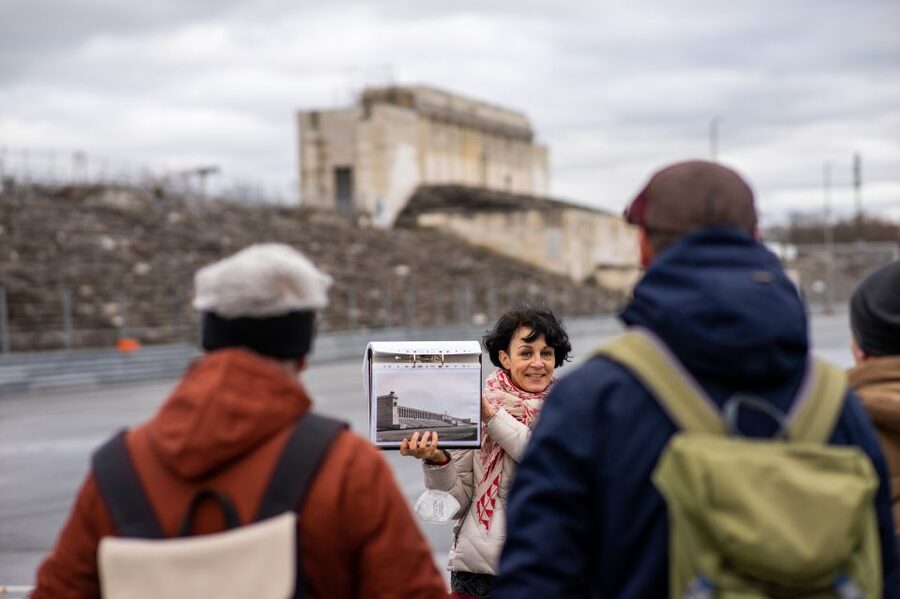
That is where the historical photographs help. A present-day wall can be hard to read on its own. A picture folder showing the site during the Nazi period lets you compare the surviving structure with the planned and staged version of the grounds.
The Congress Hall stop also introduces the basic features of the National Socialist view of history. The regime presented itself as the heir to a grand German past and used architecture to create a sense of destiny. Your guide connects that claim to the buildings around you.
The Documentation Center itself is not included in the two-hour walking tour. The meeting point is beside it, so you may want to allow separate time for the indoor exhibition if it fits your plans. The walking experience focuses on the outdoor grounds and does not replace a museum visit.
Walking the Great Road’s north-south axis
From Congress Hall, the tour continues on foot to the Große Straße, or Great Road. This walk takes about 10 minutes, and the route makes an important point: the grounds were planned as a huge system, not as a collection of unrelated buildings.
The Great Road formed the central north-south axis of the rally complex. Its length and width were part of the message. The setting was made for ordered movement, mass gatherings, and carefully controlled views.
Here, I find the connection between urban planning and political control especially useful. A broad road can look neutral today, but on this site its dimensions were meant to organize people and magnify the image of the state. Your guide explains how a crowd became part of the performance.
This section is also a good reminder that propaganda was not limited to speeches. The route, the spacing, the sightlines, and the placement of buildings all helped create an emotional response. The architecture did some of the speaking before a leader ever appeared.
You should expect the tour to pause outdoors while the guide explains the setting. Comfortable shoes matter, even though the distance is not extreme. One detailed account counted roughly 5,000 steps over the two hours, which is manageable for many people but more than a quick city stroll.
There is no food or drink included, and this is not a café-to-café walking tour. Plan to eat beforehand or carry what you need, while following the meeting instructions and local rules. In warm weather, water is sensible. In cold weather, gloves and a warm coat will make the stops easier.
Reaching Zeppelin Field and the Tribune
The route then continues on foot for about 15 minutes to Zeppelinfeld. This is the part of the tour where the size of the rally grounds becomes hardest to grasp from photographs alone.
The Zeppelin Field was used for major Nazi Party rallies, and the Zeppelin Tribune was designed to hold up to 200,000 people. Your guide explains how the site was arranged, how mass events were staged, and how the architecture helped create the image of unity and obedience.
The Tribune is one of the most important sights on the route. Its scale helps you understand why the rallies were so effective as propaganda shows. The space was not simply built to hold people. It was built to frame them as part of a carefully directed image.
Today, the surviving structures are ruins and altered remains, not a preserved Nazi event space. That difference matters. You are seeing what remains after war, destruction, neglect, repair, and changing ideas about how Germany should deal with this past.
The tour also addresses the current discussion about how the grounds should be used. That makes the experience more than a history lesson. It asks what a democratic society should do with buildings created by a dictatorship, especially when those buildings can attract curiosity, political misuse, or empty fascination with the regime.
Some people may want more time inside the Zeppelin Field area. The walking tour provides guided explanation and access to the route, but it is not a private architectural inspection. One participant wished for more opportunity to look inside the grounds. If you want long, quiet photo stops, the group format may feel brisk.
Other trips into the same period in Nuremberg:
- Nuremberg Third Reich Tour in Spanish
★ 5.0 · 355 reviews - Berlin: Third Reich and Cold War 2 Hour Walking Tour
★ 4.9 · 6,830 reviews - Munich: Third Reich & WWII Walking Tour
★ 4.6 · 6,181 reviews - Berlin’s Best: 2 Hour Walking Tour Third Reich and the Cold War
★ 5.0 · 5,486 reviews
How the guides make a difficult subject clear
The guide is the heart of this experience. The best moments come when an explanation helps you connect a physical feature to a political purpose. Several guides, including Kai, Sylvia, Anita, Andreas, Frank, and Marina, have been praised for answering questions in detail and keeping the group involved.
A strong guide may ask you to consider how the buildings were meant to make people feel, why the movement invested in such enormous spaces, or how a modern society can be drawn into destructive politics. This approach is more useful than a stream of dates.
The tour also places the rallies beside the wider Nazi system. You learn about the regime’s crimes, the concentration camp system, and the way mass entertainment and mass violence existed within the same political order. That link is one of the most important reasons to take a guided walk rather than simply explore the grounds alone.
You can walk around these locations independently, but the meaning is not always obvious from the surviving concrete. A guide supplies the missing context, points out what you are seeing, and uses photographs to show what has vanished.
The English guides are reported to speak clearly, and the tour is also offered in German. Some guides have academic or professional backgrounds in politics and history, while others bring personal knowledge of postwar Germany and the process of confronting this period. The exact guide is not guaranteed, but the repeated strength of the guiding is a major reason this tour earns a 4.7 rating from 1,665 reviews.
Timing, weather, and the practical tradeoffs
The tour lasts two hours and takes place rain or shine. That simple detail should shape your plans. The site is open and exposed, with no promise of shelter during explanations, so dress for the forecast rather than for a normal museum visit.
Winter daylight is the biggest timing issue. Several people found that tours beginning too late reached Zeppelin Field after sunset. You can still hear the explanation and see the route, but the Tribune and the open field lose much of their visual force in the dark.
If daylight photography matters to you, choose the earliest suitable departure, particularly from late autumn through winter. In summer, light should be less of a concern, but you still need to check the available starting times when booking.
The tour is not suitable for people with mobility impairments. The route involves walking between the sites and standing outdoors, so anyone with limited mobility should consider this restriction carefully before paying.
The price is $15 per person. That is strong value for a two-hour guided experience covering three major areas of the rally grounds. You are paying for interpretation rather than admission to a large indoor attraction, and the guide’s ability to explain the site is what makes the money worthwhile.
Free cancellation up to 24 hours before the start and the option to reserve now and pay later add useful flexibility. The booking confirmation serves as proof of payment, since an invoice cannot be issued for bookings made through GetYourGuide.
Who will get the most from this walk
I would choose this tour if you have a serious interest in 20th-century history, political communication, architecture, or the way public memory is shaped. It also suits anyone who wants to understand Nuremberg beyond its medieval center and postwar courtroom history.
You do not need to be a military history specialist. The focus is broader than battles, weapons, or commanders. It is about power, public emotion, political theater, and the practical methods used to win and control support.
This is also a good choice if you prefer a guide who encourages questions. The tour can work for first-time learners and for people who already know the basic story. One history teacher found that the walk added new links between Nuremberg and Hitler’s regime, which suggests that the material is not limited to beginners.
I would think twice if you dislike long outdoor stops, have difficulty walking for two hours, or want to spend most of your time inside buildings. I would also avoid a late winter departure if seeing Zeppelin Field clearly is important.
The experience is not light entertainment, and it should not be treated as a photo opportunity alone. The subject calls for attention and respect. If that suits the way you travel, the tour gives you a grounded way to face one of Germany’s hardest historical sites.
Should you book this Nuremberg walking tour?
Book it if you want the former Nazi Party Rally Grounds explained as a working propaganda machine, not just photographed as imposing ruins. The route from Congress Hall along the Great Road to Zeppelin Field gives you a clear physical story, and the guide adds the political and human meaning that the concrete cannot provide by itself.
Choose an earlier time in winter, wear solid shoes, and prepare for rain or cold. At $15, this is one of the better-value ways to understand the site, provided you can manage the walking and are ready for a serious subject.
FAQ
How long does the Nuremberg rally grounds walking tour last?
The tour lasts two hours.
What sites does the walking tour visit?
The route visits Congress Hall, the Great Road, and Zeppelin Field, including the Zeppelin Tribune.
How much walking is involved?
The tour is conducted on foot and covers roughly 5,000 steps over two hours, according to the activity information. It is not suitable for people with mobility impairments.
What languages are available?
The live guided tour is offered in English and German.
Where is the meeting point?
Meet beside the entrance stairs to the Documentation Center Nazi Party Rally Grounds at Bayernstraße 110. The guide holds a picture folder and wears a name tag marked Geschichte Für Alle e.V.
Does the tour run in bad weather?
Yes. The tour takes place rain or shine, so you should dress for outdoor conditions.
More walking tours in Nuremberg
- Nuremberg: Old Town Guided Walking Tour
★ 4.6 · 2,416 reviews - Discover Berlin Half-Day Walking Tour
★ 5.0 · 9,624 reviews - Berlin: Discover Berlin Walking Tour
★ 4.9 · 5,998 reviews - Berlin: Hidden Backyards Guided Walking Tour
★ 4.8 · 5,360 reviews
Just added in Nuremberg
- Nuremberg’s Mystery Morning: Breakfast & Escape Game★ 4.4 · 57 reviews
- Nuremberg: The Old Town in Evening Light – IN GERMAN★ 4.7 · 353 reviews
- Nuremberg Third Reich Tour in Spanish★ 5.0 · 355 reviews
- Nuremberg Old Town and Nazi Rally Grounds Walking Tour★ 4.7 · 377 reviews
- Nuremberg Old Town and Nazi Party Rally Grounds Walking Tour in English★ 4.5 · 504 reviews
- Nuremberg: Hop-On Hop-Off Bus Tour★ 4.3 · 763 reviews
- Nuremberg: PLAYMOBIL®- FunPark★ 4.7 · 863 reviews
- Nuremberg: Historischer Kunstbunker WWII Art Bunker Tour★ 4.8 · 921 reviews
Third Reich & WWII Tours, compared.

Third Reich Berlin: Hitler and WWII Walking Tour
Read our review →
Berlin Third Reich Sites: Half-Day Walking Tour
Read our review →
Birthplace of the Third Reich Guided Walking Tour
Read our review →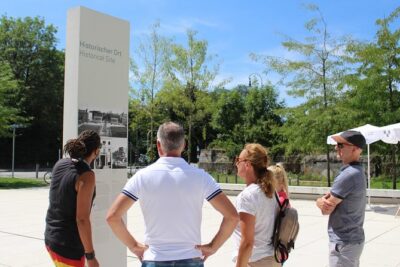
Munich World War II Sites Including Dachau Concentration Camp
Read our review →Browse the lists this tour appears in