
Reviewed · THIRD REICH & WWII TOURS
Nuremberg: WWII Tour, Courtroom 600 and 3rd Reich Sites
Nuremberg’s Nazi rally grounds are so vast that photographs alone do not quite prepare you for them. This four-hour tour helps you grasp the scale, then connects those grand plans to Courtroom 600, where Nazi war criminals were tried after World War II. The mix of outdoor sites and courtroom history gives the day a clear arc.
I like the small group of up to eight and the hotel pickup, which save you from sorting out transport between scattered sights. I also like the use of old photographs, which lets you compare the present-day ruins and surviving structures with the propaganda spectacle once staged here. The main drawback is time: some people feel rushed at Courtroom 600, especially since the final portion is self-guided.
Key points to know before you book
- Courtroom 600 is the emotional centerpiece: You visit the courtroom and its exhibition at the Palace of Justice, but you must pay the €7.50 entrance fee separately.
- The rally grounds are huge: Luitpold Arena, Große Straße, Congress Hall, and Zeppelin Field show the intended scale of Nazi party gatherings.
- Your vehicle matters: The sights are spread across southeastern Nuremberg, so hotel pickup and transport make this easier than arranging separate buses or taxis.
- Rob and Robson receive repeated praise: Their lively, personal guiding style helps make a difficult subject easier to follow.
- Avoid Tuesday: The Palace of Justice and Courtroom 600 are closed that day.
- The tour is best for history-focused visitors: It is serious, sometimes sobering, and more about context than sightseeing thrills.
Why this Nuremberg tour works
This is not simply a drive past old buildings. It explains how Nuremberg was used as a stage for Nazi power, then brings you to the place where the postwar legal reckoning began.
That sequence matters. At the rally grounds, you see the physical scale of the regime’s public theater. At the Palace of Justice, you face the legal response to its crimes. The two parts give you a better sense of both ambition and consequence.
You spend about four hours on the experience, with vehicle transfers and guided stops. The group is limited to eight people, which is a real advantage at sites that can feel impersonal. A guide can adjust the pace, answer questions, and point out details you might otherwise miss.
The tour costs $147 per person. That is not a cheap city excursion, but the price includes pickup and drop-off from your accommodation in Nuremberg, a live guide, transport between the sites, and a small-group format. You still pay €7.50 for the Palace of Justice entrance, so budget for that extra cost.
For me, the value depends on your priorities. If you want a quick overview of several Nazi-era sites without arranging local transport, the price is easier to justify. If you mainly want a long, careful visit inside Courtroom 600, you may find the time there too brief.
More Third Reich and WWII Tours in Nuremberg
- Nuremberg: Walking Tour of Former Nazi Party Rally Grounds
★ 4.7 · 1,665 reviews - Nuremberg: Historischer Kunstbunker WWII Art Bunker Tour
★ 4.8 · 921 reviews - Nuremberg Old Town and Nazi Party Rally Grounds Walking Tour in English
★ 4.5 · 504 reviews
Hotel pickup makes a spread-out morning easier
Your guide collects you outside your accommodation in Nuremberg and drives you to the first site in a comfortable vehicle. The transfer time is listed as about an hour, though the exact flow depends on pickup arrangements and the day’s route.
This is one of the tour’s practical strengths. The former rally grounds cover a large area in the southeastern part of the city. You could visit them independently, but you would need to plan transport and work out how much time to allow at each site.
The vehicle also gives the guide room to explain what you are about to see. Guides such as Rob and Robson are praised for keeping the talk lively and interactive. One useful point from the experience is that Rob sometimes speaks quickly, so tell your guide early if you need a slower pace.
The van holds only a small group, with a maximum of eight participants. That makes it easier to hear explanations than on a large coach tour, and it gives the morning a more personal feel. It also means the tour may feel less flexible if you want to linger at one stop.
Luitpold Arena: power staged on a massive scale
The first main stop is Luitpoldhain, the area associated with the Luitpold Arena. You have about 30 minutes with the guide here.
The key thing to notice is not a single intact monument. It is the size of the space and the way it was intended to frame political ceremony. The area was designed to create a feeling of order, power, and mass participation during Nazi party events.
This is where period photographs are especially useful. Your guide can show how the space looked during rallies and help you compare those images with what remains today. The contrast is important. The present-day setting is not a preserved showpiece, and that makes it harder to picture the crowds unless someone supplies the missing visual context.
The subject is grim, but the stop is not presented as a celebration of Nazi architecture. The guide explains how the setting was used and why its scale mattered. For you, the value is in learning to read the space rather than simply taking photographs of it.
Große Straße and the unfinished vision
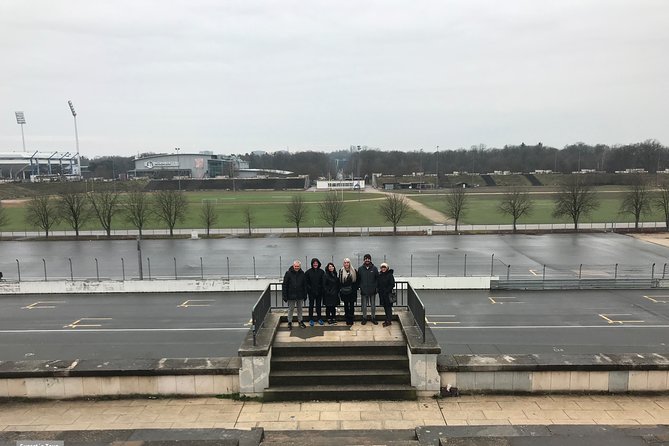
The tour then moves to Große Straße for roughly 30 minutes. This broad ceremonial route was part of the planned rally complex, and its size gives you another clear sense of how much land the regime set aside for spectacle.
You will spend much of this section outside, looking at the route and hearing how it fitted into the larger plan for Nuremberg. The guide’s role is important here because the physical remains can be difficult to interpret on their own.
This stop also helps explain why Nuremberg was meant to become the symbolic center of the Nazi Party. The party did not choose modest surroundings for its major events. It planned spaces meant to dwarf the individual and turn political gatherings into carefully controlled displays.
I would pay attention to the relationship between the route, the nearby arena, and the larger rally grounds. Taken one by one, the sites can seem disconnected. Together, they show a deliberate plan for movement, ceremony, and visual impact.
Other trips into the same period in Nuremberg:
- Nuremberg Old Town and Nazi Rally Grounds Walking Tour
★ 4.7 · 377 reviews - Nuremberg Third Reich Tour in Spanish
★ 5.0 · 355 reviews - Nuremberg: World War II Tour with Hotel Pickup
★ 4.4 · 51 reviews - Nuremberg: Tour of Former Nazi Party Rally Grounds
★ 5.0 · 43 reviews
Congress Hall: a building that overwhelms by size
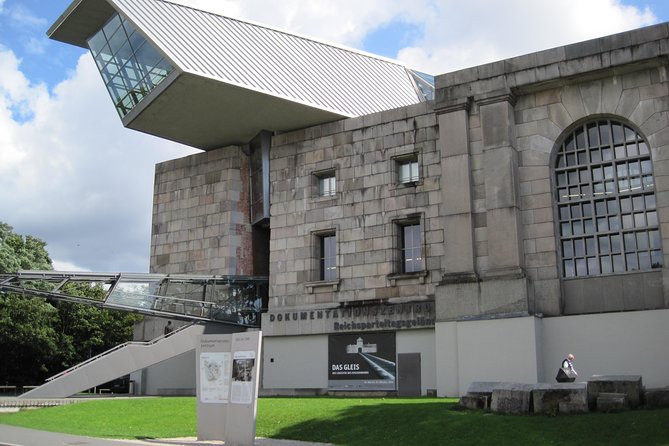
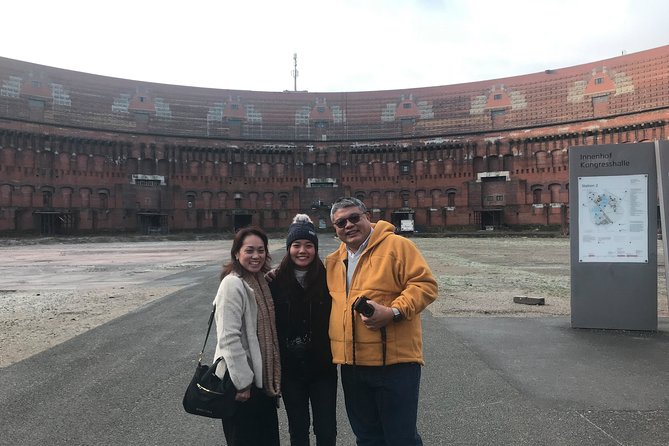
At Nuremberg Congress Hall, you have about 30 minutes for a guided visit and photographs. The building is described as the largest preserved National Socialist monumental structure, and its sheer bulk is the point.
The structure was intended to house enormous party gatherings. Even unfinished, it communicates the scale of the plans. You do not need to admire the design to understand why the building is historically important. Its size was part of the message: the individual was meant to feel small beside the state and its institutions.
Your guide will explain the building’s intended purpose and the wider plan for the rally grounds. This is a good place to ask questions, since the present structure may not immediately tell you what it was meant to become.
The adjacent Documentation Center Nazi Party Rally Grounds is also part of the stop. The building’s modern design creates a sharp architectural contrast with the old monumental structure. Its glass and steel form cuts through the historic building, an intentional visual intervention that many people find memorable.
The tour passes by the Documentation Center rather than giving you a long museum visit. This is an important distinction. You get an explanation and a look at the building, but the experience is not a substitute for spending several hours inside the museum. One person would have preferred more time at Zeppelin Field and less time around the Documentation Center, so your priorities may affect how you judge the balance.
Zeppelin Field: the most powerful outdoor stop
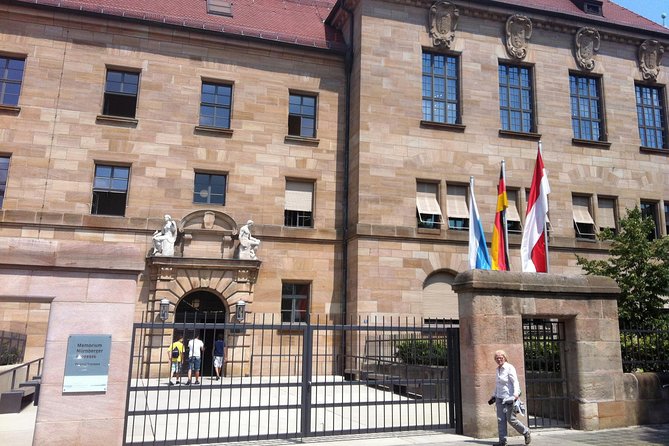
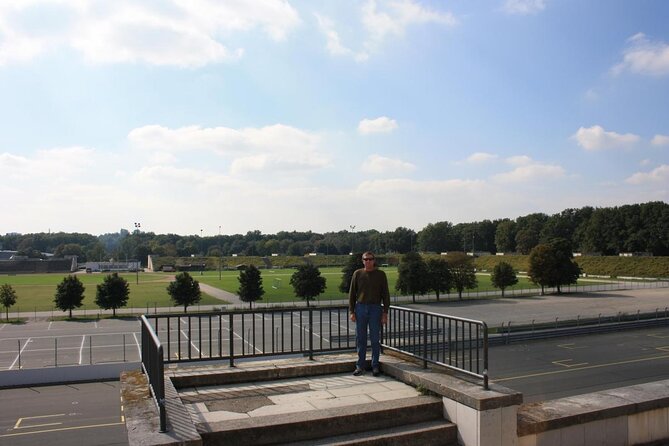
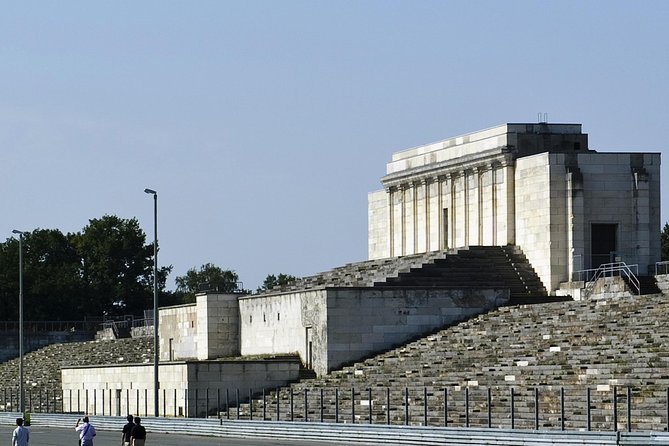
Zeppelin Field receives about 40 minutes, including a photo stop and guided explanation. For many people, this is the most striking part of the outdoor portion because the open space makes the scale of Nazi rallies easier to understand.
The field was planned as a backdrop for party events, with architecture and crowd placement working together. You can see how the setting was designed to turn a political gathering into a vast public performance.
Your guide may use photographs from the period to show the field filled with people. That comparison is central to the experience. An empty field does not automatically reveal how it was used, but the old images help you connect the surviving structure to the events held there.
The stop is not only about architecture. It is also about propaganda and crowd control. You are looking at a place designed to shape emotion, create obedience, and make political power seem permanent.
The 40-minute allocation is useful but not generous. If Zeppelin Field is your main reason for booking, pay attention to the meeting time and stay close to the group. You may wish for longer to examine the area, but the wider route has several other stops to cover.
Courtroom 600 and the Palace of Justice
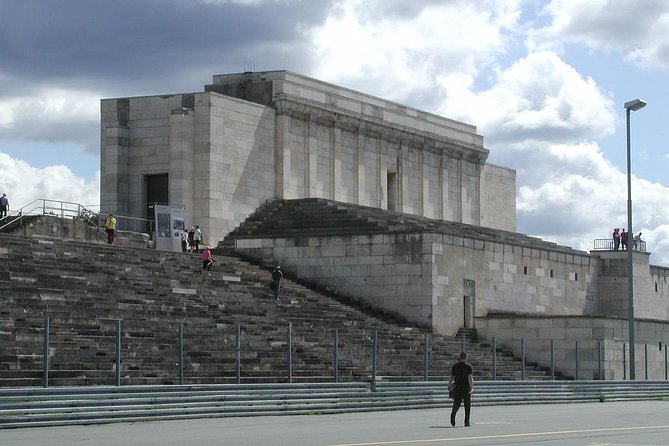
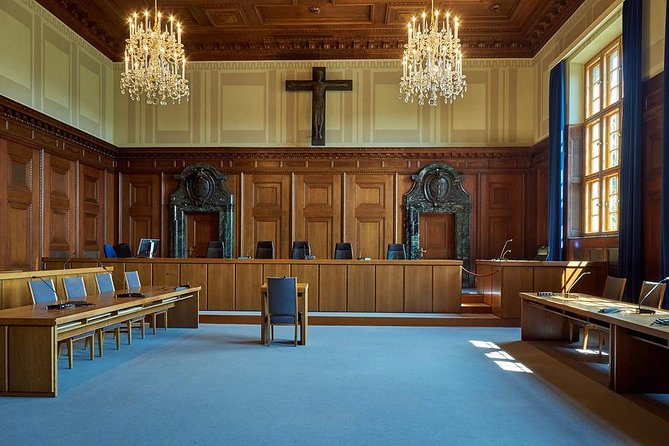
The final major stop is the Nuremberg Palace of Justice, with about 45 minutes for sightseeing and a self-guided visit. Courtroom 600 is where the International Military Tribunal tried major Nazi war criminals after the war.
This stop changes the tone of the morning. The rally grounds show how the regime presented itself to the public. Courtroom 600 focuses on the effort to establish responsibility through law.
The courtroom and exhibition are powerful because they move the subject away from abstract dates and buildings. You are brought into the setting of the trial itself. The exhibition adds material about the proceedings and helps explain why Nuremberg became associated with postwar justice.
The visit is self-guided, so your guide may provide the wider story before you enter and then allow you to explore at your own pace. This can be a benefit if you like reading displays quietly. It can also feel rushed if the earlier stops run long.
That timing issue deserves attention. Several people have enjoyed the courtroom most but wished for more time there. One particularly useful detail is that the tour may reach Courtroom 600 with only about 45 minutes remaining. Since the courtroom visit is the part many people are most eager to see, keep that expectation in mind.
The Palace of Justice is closed on Tuesdays. It is also worth checking the opening status during holidays, since a Christmas Day visit could leave you seeing the building from outside while relying on the guide for the history. Do not book this tour on Tuesday if Courtroom 600 is essential to you.
The guides shape the experience
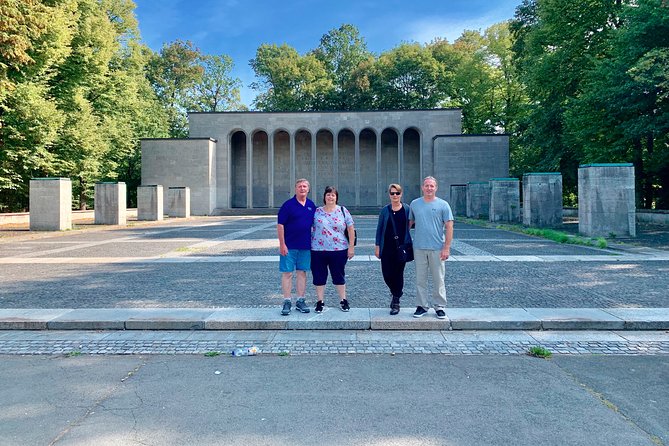
The strongest part of this tour is often the guide’s delivery. Rob is repeatedly singled out for energy, humor, personal attention, and clear explanations. Robson is also praised for detailed commentary and an attentive manner. Other guides may lead the tour in English, Portuguese, Spanish, or Italian.
This subject can easily become a list of dates and names. A good guide keeps it connected to the places in front of you. Rob, in particular, is described as using photographs from the period to show how the sites looked during the Nazi era. That method is simple and effective.
You should also know that speaking speed and accent may affect how easy the commentary is to follow. Some people have found the guide difficult to understand at times, especially when he speaks quickly. This is not a reason to dismiss the tour, but it is a reason to ask for repetition or a slower pace.
The small group makes that request practical. You are not trying to interrupt a bus full of people. With only eight participants, you can tell the guide what you need and ask about details that interest you.
Who should book this experience?
I would choose this tour if you want a structured introduction to Nuremberg’s Nazi-era sites and prefer not to manage transport yourself. It is especially useful on a first visit, when the distances and scale of the rally grounds are not yet familiar.
It suits you if you:
- Want to see several rally sites in one morning
- Prefer a small group rather than a large coach
- Value hotel pickup and drop-off
- Want a guide to connect present-day remains with period photographs
- Plan to visit Courtroom 600 but do not need a long museum session
- Are comfortable with a serious and sometimes disturbing subject
You may prefer a different plan if you want to spend most of the day at the Documentation Center or Courtroom 600. The tour gives you an overview of both, but it does not offer extensive free time at either one.
It is also not the best choice if you want a light sightseeing outing. The material concerns dictatorship, war crimes, propaganda, and mass persecution. The guides present it with energy, but the subject itself remains heavy.
Price, timing, and practical value
At $147 per person, the tour costs more than a simple self-guided visit. The price includes the vehicle, pickup, drop-off, guide, and small-group service, but not the €7.50 Palace of Justice entrance fee.
The transport is the main reason to consider paying for the organized experience. The rally grounds are spread out, and the tour covers several sites in a fixed four-hour route. You are not spending your morning working out bus connections or trying to understand what you are seeing without context.
The tradeoff is control. You cannot easily add an extra hour at Zeppelin Field or stay longer at Courtroom 600 without affecting the rest of the group. The itinerary is efficient, but it is not leisurely.
Free cancellation up to 24 hours before the tour and the option to reserve now and pay later add useful flexibility. The activity is wheelchair accessible, though the supplied details do not explain the exact accessibility arrangements at every stop. Pickup is outside your accommodation in Nuremberg, and starting times depend on availability.
Should you book the Nuremberg WWII tour?
Book it if you want the broadest useful introduction to Nuremberg’s Nazi rally grounds in a single morning, especially if you value a lively guide and easy transport. The combination of Luitpold Arena, Große Straße, Congress Hall, Zeppelin Field, and Courtroom 600 gives you more context than visiting one site alone.
I would book on a day other than Tuesday and go in with realistic expectations about Courtroom 600. You will see it, but the visit may be shorter than you hope. If the courtroom is your top priority, plan an additional visit or choose a schedule that leaves you more time there.
For history-minded visitors, the tour offers a clear, sobering look at how Nuremberg was used by the Nazi regime and how the city later became linked to international justice. For $147, it is a worthwhile convenience and orientation service, provided you value expert explanation over a slow, independent visit.
FAQ
How long does the tour last?
The tour lasts four hours, including transport, guided stops at the rally grounds, and the visit to the Palace of Justice.
Is hotel pickup included?
Yes. Pickup and drop-off are included from outside your accommodation in Nuremberg.
What is the maximum group size?
The tour is limited to eight participants.
Is Courtroom 600 included in the price?
The guided tour includes the visit to the Palace of Justice, but the €7.50 entrance fee is not included.
Is Courtroom 600 open every day?
No. The Palace of Justice and Courtroom 600 are closed on Tuesdays.
What languages are available?
Live guides are available in English, Portuguese, Spanish, and Italian.
Is the tour wheelchair accessible?
Yes, the activity is listed as wheelchair accessible.
Can I cancel the booking?
Yes. You can cancel up to 24 hours in advance for a full refund. You can also reserve now and pay later.
Just added in Nuremberg
- Tour en español al Campo Zeppelin★ 5.0 · 8 reviews
- Stein: Public guided tour of the “Old Mine” museum★ 4.5 · 18 reviews
- “Rotes Bier” and “Blaue Zipfel”. A historical-culinary walk★ 4.4 · 190 reviews
- Nuremberg: Old Town Guided Tour By Bus★ 4.4 · 198 reviews
- Nürnberg kennenlernen: Highlights in der Altstadt★ 4.7 · 189 reviews
- Nuremberg: Bar and Club Tour with Free Shots and Free Entry★ 3.8 · 23 reviews
- Nürnberg Bachelor(ette) Party with Night PubCrawl★ 4.2 · 5 reviews
- Nuremberg: Tour of Former Nazi Party Rally Grounds★ 5.0 · 43 reviews
Third Reich & WWII Tours, compared.

Third Reich Berlin: Hitler and WWII Walking Tour
Read our review →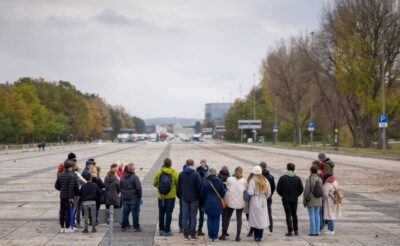
Walking Tour of Former Nazi Party Rally Grounds
Read our review →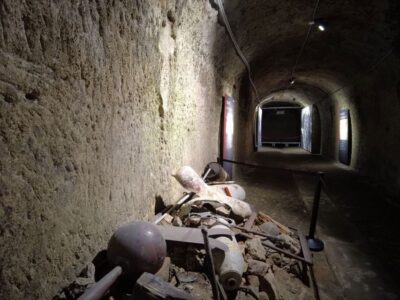
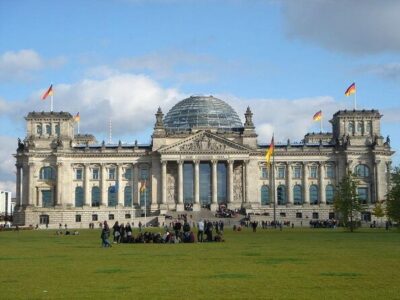
Berlin Third Reich Sites: Half-Day Walking Tour
Read our review →
Birthplace of the Third Reich Guided Walking Tour
Read our review →Browse the lists this tour appears in