Reviewed · WALKING TOURS
In Search of Jewish Berlin Walking Tour
Berlin’s Jewish story is written into grand buildings, quiet courtyards, memorial stones, and places where ordinary people took remarkable risks. This three-hour walking tour links those places through the Scheunenviertel, giving you a clear sense of how Jewish life grew, suffered under Nazi rule, and began again.
I like the small groups of no more than 10 and the chance to ask real questions. I also like that the guides are Jewish Studies scholars, professors, graduate students, or journalists rather than guides reciting a memorized script. The subject is serious, so expect a thoughtful walk rather than light sightseeing.
The main drawback is the price: $156.53 per person is a serious spend for a walking tour, especially since food, drinks, and admission are not included. You are paying for specialist teaching and close attention, not a long list of paid attractions.
Key points to know before you book
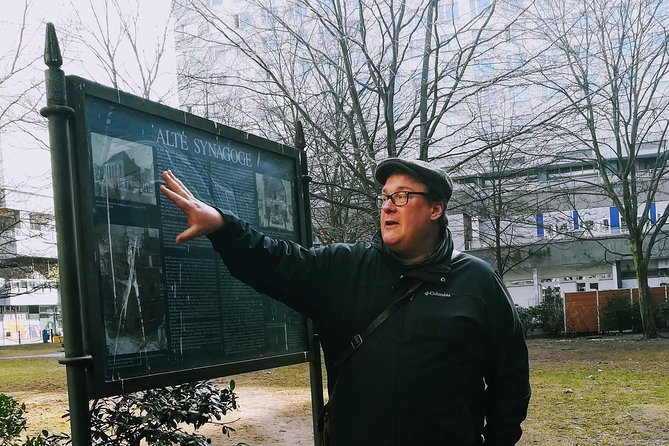
- A Jewish Studies scholar leads the walk: Guides may include Ioana, Forrest, Lee, Heather, or Isabel Daniel, with experience in Berlin and academic research.
- The route centers on the Scheunenviertel: You see the New Synagogue, Auguststrasse, Hackesche Höfe, and other sites tied to Jewish Berlin.
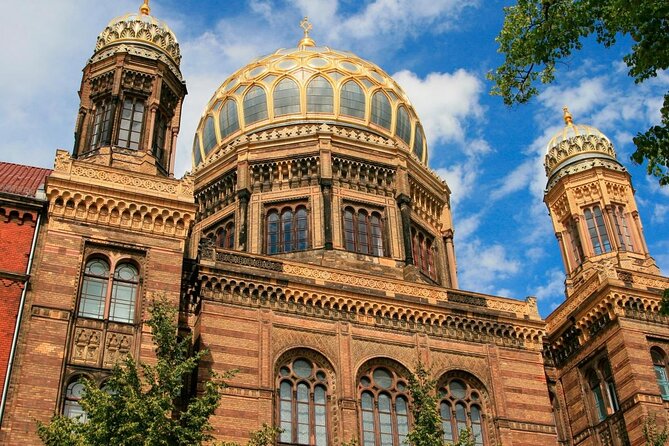
- The New Synagogue is a powerful opening stop: Its grand 19th-century design reflects Jewish assimilation and public confidence before the destruction of European Jewry.
- The Women’s Block adds a story of protest: The memorial recalls non-Jewish wives and relatives who publicly demanded the release of Jewish men arrested by the Nazis.
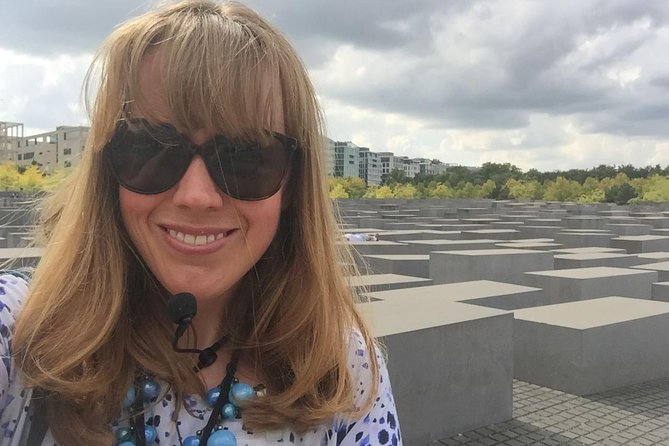
- The final stop is the Holocaust Memorial: You walk among 2,711 concrete slabs, with time to consider the memorial’s stark design.
- The tour suits curious, serious visitors: It is best for you if you want context, discussion, and personal questions rather than a quick photo stop.
A focused walk through Jewish Berlin
This tour begins at Rosenthaler Strasse 40/41 in central Berlin and moves through streets linked to the city’s Jewish past. The route includes both major memorials and less obvious places where schools, homes, community institutions, and businesses once shaped daily life.
You should allow about three hours. The five listed stops account for roughly 110 minutes, leaving time for walking, introductions, questions, and discussion. Since the route is in central Berlin and near public transportation, it is practical to fit into a day of sightseeing, though the emotional weight of the subject deserves more than a rushed slot between other plans.
The tour is offered in English. Confirmation arrives at booking, and most people can take part. You should wear comfortable shoes because this is a walking tour, but the supplied information does not describe a specific accessibility arrangement, so ask the provider if you have mobility concerns.
Other walks around Berlin:
- Discover Berlin Half-Day Walking Tour
★ 5.0 · 9,624 reviews - Berlin: Third Reich and Cold War 2 Hour Walking Tour
★ 4.9 · 6,830 reviews - Berlin: Discover Berlin Walking Tour
★ 4.9 · 5,998 reviews
The New Synagogue sets the tone
The first major stop is Stiftung Neue Synagoge Berlin, also called Centrum Judaicum. You spend about 20 minutes here, with admission included at no extra cost.
The building’s large scale and ornate design matter. The New Synagogue was built as a public statement of Jewish belonging in 19th-century Germany. Its architecture reflected confidence, ambition, and a desire to take part fully in German civic life. That makes the site especially affecting when you learn what happened to Jewish citizens in the decades that followed.
Today, the building is connected with the Jewish community reviving in Berlin. That detail keeps the visit from becoming only a story of loss. Jewish Berlin was not simply erased and left in the past. There is a present-day community, and the tour helps connect the city’s earlier Jewish life with its renewed one.
The stop is short, so your guide’s explanation does much of the work. Ioana, who has lived in Berlin for 17 years, has been praised for handling difficult material with care and for shaping the discussion around the group’s questions. That sort of flexibility is useful here. You can look at the building on your own, but the historical meaning is far greater with a guide who can explain why its style and location matter.
Auguststrasse reveals everyday community life
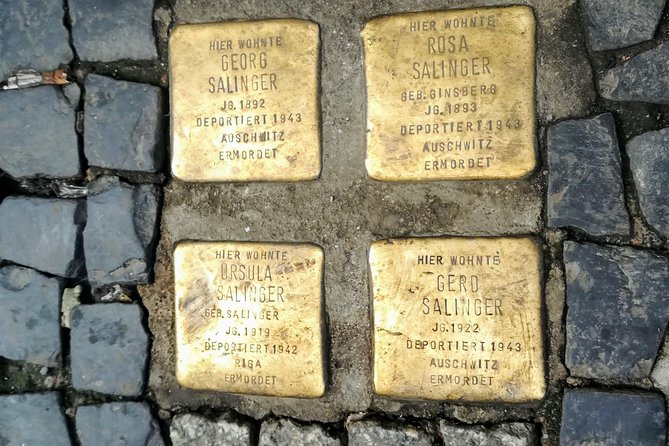
From the New Synagogue, the walk continues to Auguststrasse, where you spend about 20 minutes. This street once held a number of Jewish institutions, including the Jewish Girls’ School at Auguststrasse 11 to 13.
The school was built between 1927 and 1928 by architect Alexander Beer in the New Objectivity style. Its design offers a different view of Jewish Berlin from the grand synagogue. Here, the focus is education, family, and community life. You are not only studying persecution. You are seeing the institutions that helped people build ordinary lives.
The former school building now contains an exhibition hall and a coffee shop. The tour does not include food or drinks, but you may want to note the site for a return visit if you have time. It is one of the places where the city’s history remains part of a working neighborhood rather than being sealed away in a formal memorial.
This stop also shows why a walking tour can be more useful than a museum visit alone. A museum can gather objects and documents in one place. On Auguststrasse, you see how community institutions fit into the city itself.
Hackesche Höfe and the Scheunenviertel
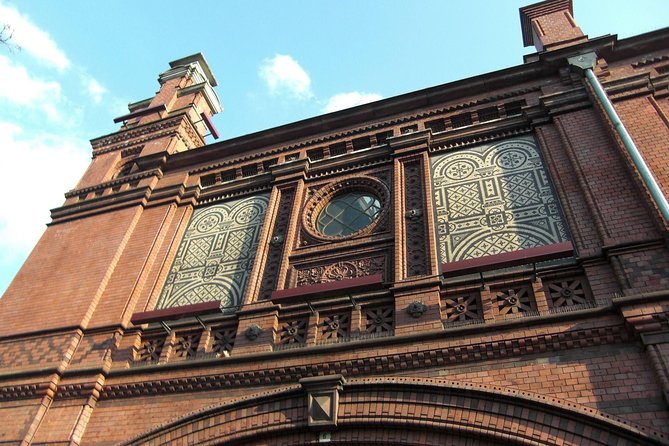
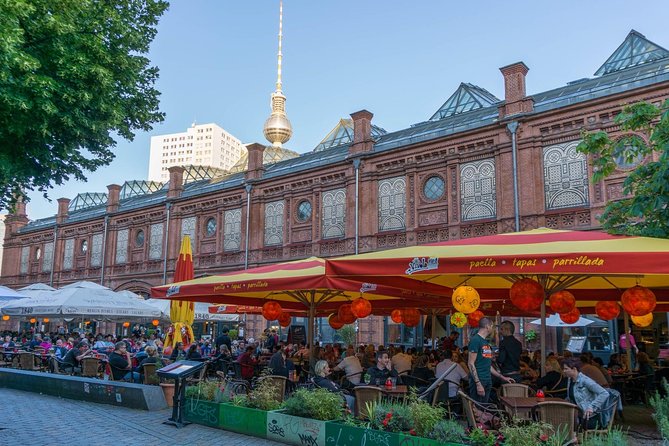
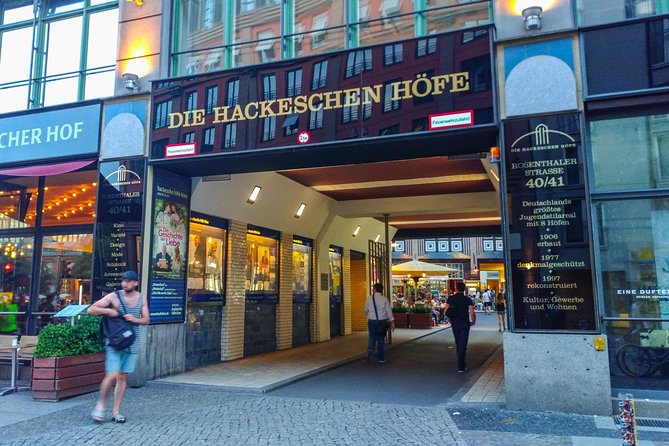
The longest stop is at Die Hackeschen Höfe, with about 30 minutes set aside for the courtyards and surrounding area. A Jewish community developed around Hackescher Markt, within Spandauer Vorstadt and the Scheunenviertel, known as the Barn Quarter.
The courtyards are a visual change after the solemnity of the New Synagogue and Auguststrasse. Their architecture helps you picture a district where people lived, worked, traded, worshipped, and met one another. Your guide connects the buildings and streets with the story of German Jewish life, making the area more than a pleasant architectural walk.
I like this part because it puts history at street level. You are not looking only at monuments that announce their importance. You are walking through spaces that once supported daily routines. That can make the past easier to understand, while also reminding you that urban neighborhoods are full of lives that are no longer visible.
The limitation is that the modern area can feel like a regular central Berlin stop rather than a preserved historical district. The value comes from the explanation. Without the guide, you might notice the courtyards and architecture but miss the Jewish connections that give the area its meaning.
Same base, a different kind of day out:
- Berlin: Reichstag, Dome and Government District Guided Tour
★ 4.7 · 18,288 reviews - Berlin: 1-Hour City Tour by Boat with Guaranteed Seating
★ 4.3 · 16,993 reviews - Berlin: Boat Tour Along the River Spree
★ 4.4 · 11,252 reviews - Berlin: Hop-on Hop-off Bus Tour with Live Commentary
★ 4.3 · 8,579 reviews
The Women’s Block tells a different resistance story
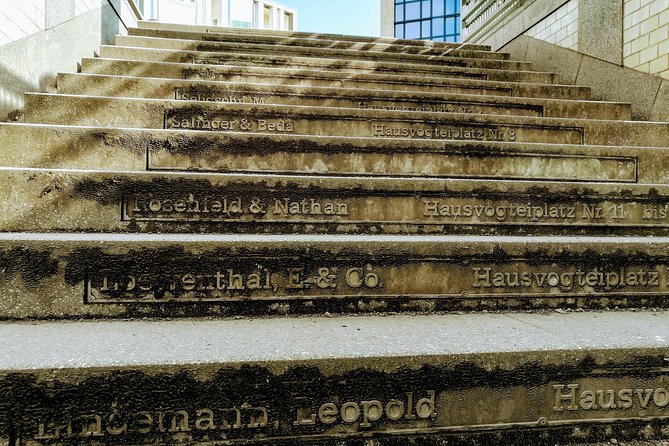
The next stop is Block der Frauen, or the Women’s Block. You spend about 20 minutes at this memorial, dedicated to the non-Jewish wives and relatives of Jewish men who were arrested by the Nazis and targeted for deportation.
This is an important shift in the tour. The memorial focuses on sustained public protest by people who were not themselves the primary targets of the arrests. Their actions show that resistance did not always take the form of secret networks or armed rebellion. Sometimes it meant standing in public and refusing to leave.
The site gives your guide room to discuss courage, family ties, and the risks ordinary people faced under Nazi rule. It also complicates easy ideas about who resisted and how. I would pay close attention here, since the memorial’s story may be less familiar than the better-known sites on the route.
The stop is not a grand architectural attraction. Its power lies in the event it recalls and the discussion around it. If you prefer fast sightseeing, 20 minutes may feel long. If you want to understand how individual choices shaped Jewish history in Berlin, it is time well spent.
The Holocaust Memorial ends the walk on a sober note
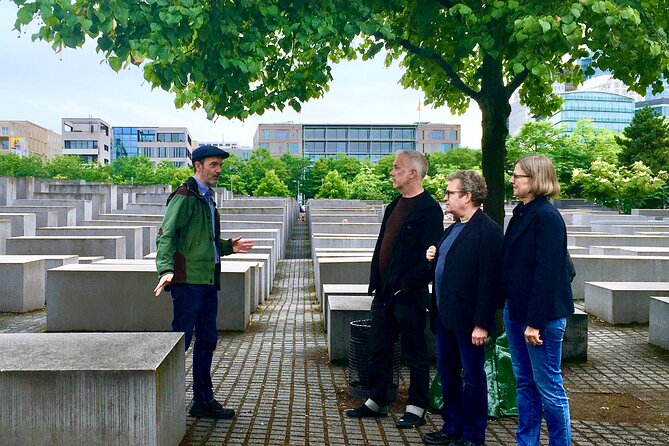
The final listed stop is the Memorial to the Murdered Jews of Europe, commonly called the Holocaust Memorial. Architect Peter Eisenman designed the site, which contains 2,711 concrete slabs arranged across a large open area.
You walk through the memorial rather than simply viewing it from the edge. The changing height and spacing of the slabs create a personal physical experience. The design does not give you a single viewpoint or a simple message. Your guide can offer context, but the site also asks you to pay attention to your own response.
This is a difficult place to end, but it fits the purpose of the tour. By this point, you have seen evidence of Jewish community life, education, public identity, and protest. The memorial brings the story to the Holocaust and Germany’s acknowledgment of the murder of European Jews.
The memorial is free, but that does not mean the stop is casual. Give yourself time after the tour if you need it. The supplied schedule allows about 20 minutes here, yet your own response may last longer.
The guides are the main reason to pay more
The price of $156.53 per person is high for a three-hour walk. You are not paying for a meal, a museum package, or a large number of admissions. The listed stops have free admission, and the tour does not include food or drinks.
You are paying for a small class taught outdoors. The difference depends on your guide. Ioana is described as having extensive study of the subject and 17 years of life in Berlin. Forrest is praised for presenting difficult material in a way that is easy to follow. Lee brings enthusiasm and personal insight from living in Berlin. Heather is noted for her open discussion and passion for the subject. Isabel Daniel is completing a Ph.D. on the topic and has led a very small tour that ended up being only two people.
That range matters. A guide who can answer questions and adjust the pace can make the same streets far more useful. The small-group format also gives you a better chance to ask about family history, religious life, modern Berlin, or a particular memorial without holding up a large crowd.
The tour has a 4.9 rating from 12 reviews and is recommended by 100 percent of those who rated it. That is a small sample, so I would not treat the number as a guarantee. Still, the praise is consistent: the guides are valued for their subject knowledge, empathy, enthusiasm, and willingness to discuss questions.
Who will get the most from this tour
I would choose this walk if you want an introduction to Jewish Berlin that connects buildings, people, and political events. It works well for a first visit to the city because it covers several central sites while giving you a framework for later museum visits.
It is also a good choice if you prefer conversation to headphones or a large group. The maximum of 10 people creates a setting where the guide can notice your interests and adjust the explanation. In Isabel Daniel’s case, the group was only a couple, showing that the maximum is not necessarily the usual group size.
You should be comfortable with serious material. The walk covers persecution, deportation, and the Holocaust. It is not designed as a light overview of Berlin architecture, and you should not expect entertainment to soften the subject.
Families and school-age children may find some parts difficult, though the supplied information does not set an age restriction. If you are booking for children, ask the provider whether the content and pace suit them.
Practical planning for the three-hour route
The start point is Rosenthaler Strasse 40/41, 10178 Berlin. The endpoint is listed simply as Berlin, Germany, so confirm the exact finishing point when you book. The tour is near public transportation, which makes it easy to reach from other parts of the city.
The route is offered in English, and mobile tickets are available. Group discounts may be offered, so check the price if you are booking for several people. At $156.53 per person, a discount could make a meaningful difference for a couple or family.
Book ahead if your dates are fixed. The tour is booked an average of 66 days in advance, suggesting that the small capacity can matter during popular travel periods. Free cancellation is available if you cancel at least 24 hours before the start time. Cancellations or changes inside that window are not refunded or accepted.
Should you book In Search of Jewish Berlin?
Book it if you want a serious, personal introduction to Jewish Berlin and value a specialist guide who can handle questions with care. The route is well chosen, the group is small, and the guides bring academic or journalistic experience rather than only general sightseeing knowledge.
Skip it if $156.53 feels too steep for a walking tour or if you prefer to explore memorials on your own. You can visit the listed sites without paying admission, and the tour does not include food or drinks.
For me, the strongest reason to book is the teaching. The New Synagogue, Auguststrasse, Hackesche Höfe, the Women’s Block, and the Holocaust Memorial become parts of one connected story. If that kind of context is what you want from Berlin, the price is easier to justify.
FAQ
How long is the In Search of Jewish Berlin tour?
The tour lasts approximately three hours.
How much does the tour cost?
The listed price is $156.53 per person.
What language is the tour offered in?
The tour is offered in English.
How many people can join the tour?
The maximum group size is 10 people.
Who leads the walking tour?
The guides are professors, graduate students, or journalists with a connection to Jewish Studies, Berlin, or related research. Named guides associated with the experience include Ioana, Forrest, Lee, Heather, and Isabel Daniel.
What sites are included?
The route includes the New Synagogue and Centrum Judaicum, Auguststrasse, Die Hackeschen Höfe, Block der Frauen, and the Memorial to the Murdered Jews of Europe.
Are admission tickets included?
Admission is listed as free for the stops described. Food and drinks are not included.
Can I cancel for a full refund?
Yes. You can cancel at least 24 hours before the experience start time for a full refund. Cancellations or changes made less than 24 hours before the start time are not accepted or refunded.
Just added in Berlin
- Private One way Airport Transfer Berlin Airport To Berlin★ 3.5 · 17 reviews
- Private Walking Tour: Berlin Wall, Cold War and Checkpoint Charlie★ 5.0 · 37 reviews
- Modern Berlin Private Walking Tour: Diverse, Vibrant and Exciting German Capital★ 5.0 · 13 reviews
- Private Day Trip to Potsdam from Berlin by Train★ 4.5 · 27 reviews
- City Explorer: Potsdam Private Day Trip★ 4.5 · 10 reviews
- Private Half-Day Sightseeing Tour in Berlin★ 3.5 · 6 reviews
- Berlin Private Custom Tour in a Minivan, East and West★ 5.0 · 123 reviews
- Berlin Private Custom 5-Hour Tour by Car★ 5.0 · 30 reviews
Walking Tours, compared.

Third Reich Berlin: Hitler and WWII Walking Tour
Read our review →