
Reviewed · WALKING TOURS
Hamburg: Guided Walking Tour in Danish
Hamburg’s story makes the most sense on foot, where a medieval marketplace, a fire-scarred old town, a vast warehouse district, and a futuristic concert hall sit within one compact route. This Danish-language walking tour links those pieces in two hours, with a licensed guide explaining how Germany’s largest port city grew from a Saxon trading post into a major economic and cultural center.
I like the route’s clear historical arc and its finish at the Elbphilharmonie, where you can continue to the public Plaza on your own. I also like the small-group price structure: $280 covers up to 30 people, so it can be good value for a family or private group. The main drawback is the brisk pace and uneven suitability for anyone with mobility, vision, or hearing limitations.
Key points to know before you book
- A Danish guide leads the entire two-hour walk, making this a useful choice for Danish-speaking families, friends, and private groups.
- The route connects old and new Hamburg, from the Townhall and St. Nikolai Memorial to Speicherstadt, HafenCity, and the Elbphilharmonie.
- Christian Meyer-Pedersen is one named guide, praised for lively, well-organized explanations of Hamburg’s culture and history.
- The tour ends at the Elbphilharmonie, not back at the starting point, giving you a natural next stop at the concert hall’s public viewing area.
- The $280 group rate can work well for a larger party, but it is a steep price for one or two people.
- You need comfortable shoes and weather-ready clothing, since the walk goes ahead in rain or shine.
Why Hamburg works so well in Danish
Hamburg is close enough to Denmark to feel familiar in parts, but its story is distinctly its own. The city began as a Saxon marketplace, gained power as a member of the Hanseatic League, and later became one of the world’s great ports. A guide can connect those broad chapters to streets, buildings, canals, memorials, and modern construction.
That local context matters. A quick look at Hamburg can leave you with a jumble of red brick, grand civic buildings, cranes, waterways, and polished new architecture. In Danish, a live guide can explain the links between them without making you stop to translate a museum panel or sort out a history book later.
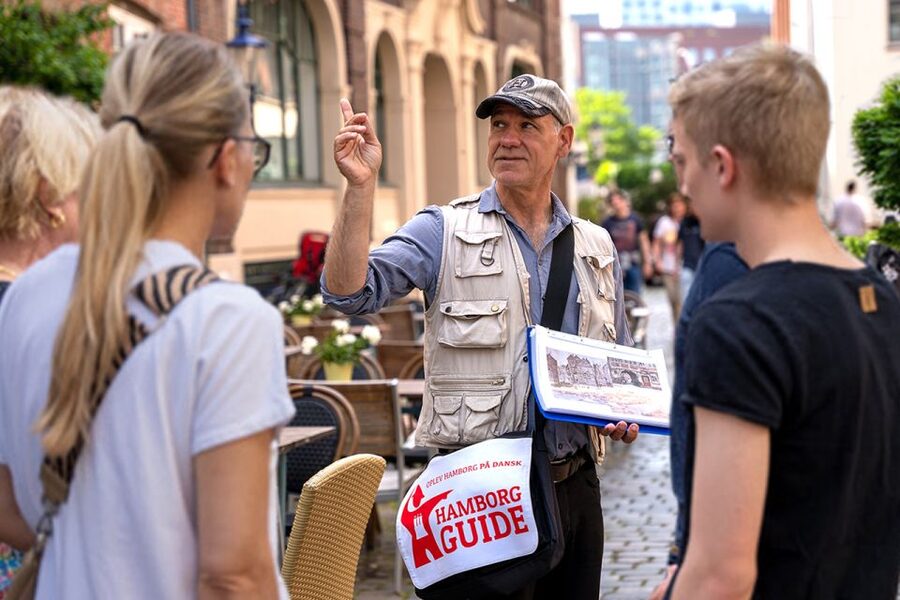
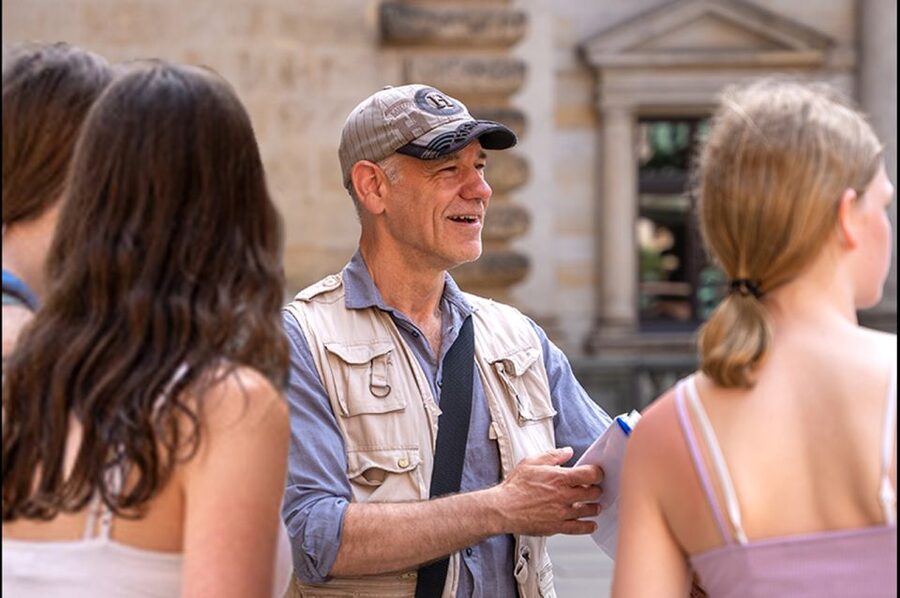
The language is the central reason to choose this experience. You are not simply joining a general city walk and hoping to follow along. The tour is conducted in Danish, and the positive feedback points to explanations that are both informative and pleasant to hear. Christian Meyer-Pedersen is specifically named as a guide who presents the subject in a lively, organized way.
The route also has a useful shape. It starts in central Hamburg and gradually moves toward the harbor districts. That means the city’s development unfolds as you walk, rather than appearing as unrelated sights on a checklist.
Other walks around Hamburg:
- Hamburg: Guided Walking Tour for Magic Fans
★ 4.8 · 1,992 reviews - Reeperbahn Walking Tour with St. Pauli Local
★ 4.8 · 577 reviews - Hamburg: Speicherstadt Walking Tour with Coffee Tasting
★ 4.6 · 360 reviews
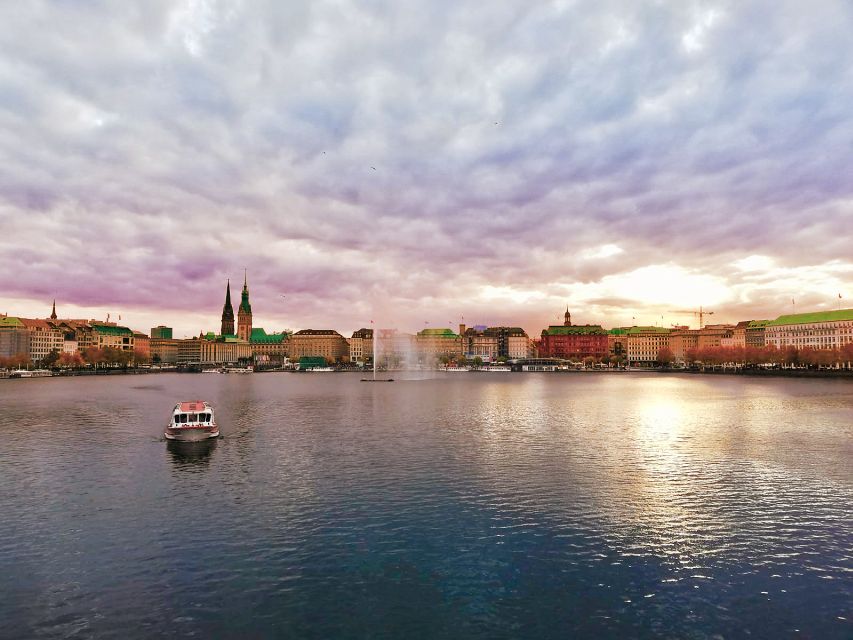
Starting at Jungfernstieg and the Hamburg Townhall
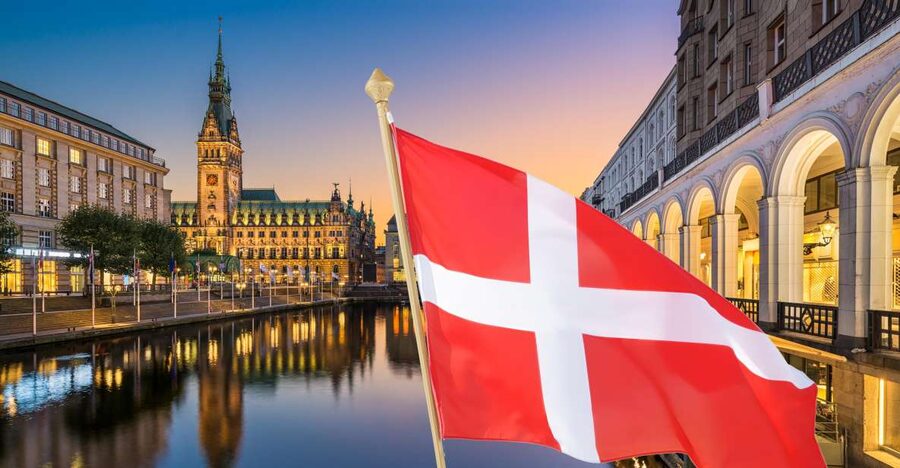
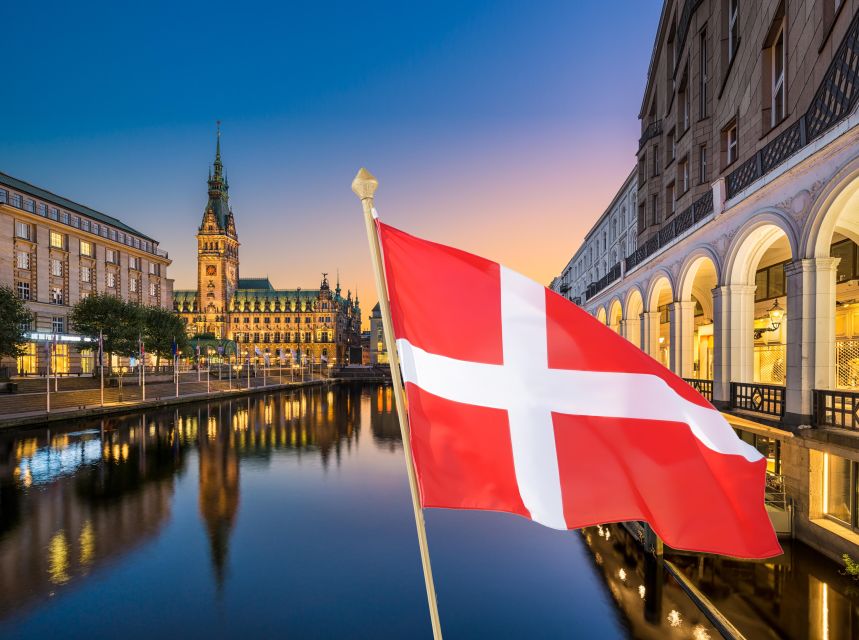
Meet your guide in front of the Swatch shop at the corner of Jungfernstieg and the Alsterarkaden. This is a practical central meeting point, but it can be busy, so arrive with enough time to locate the shop and guide without a last-minute scramble.
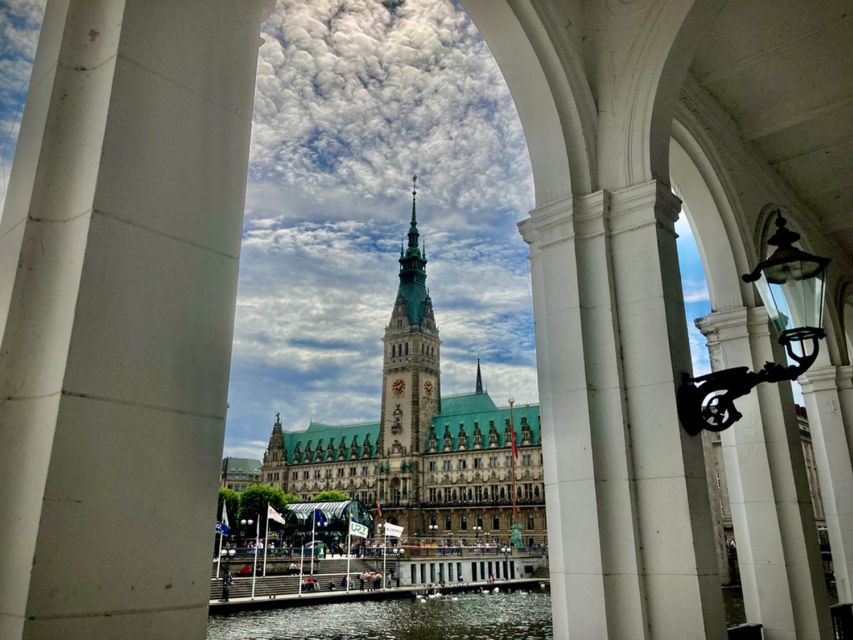
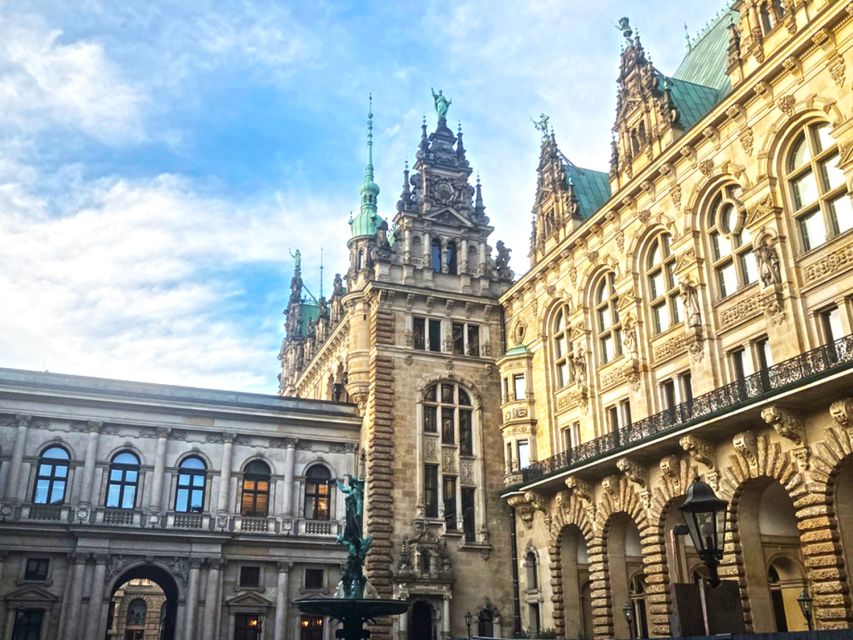
The walk first reaches Hamburg’s Townhall, with about 20 minutes devoted to the building and its setting. This is one of the best places to begin because the Townhall represents civic power, wealth, and the city’s long commercial life.
You will hear how Hamburg developed from its early marketplace roots into an important Hanseatic city and then into a modern port. The guide uses historical visual aids, which should help make the earlier periods easier to picture when the present-day streets offer few obvious clues.
The Townhall stop is also a good early test of the tour’s pace. You receive enough time for explanation and orientation, but this is not a long architectural study or an interior museum visit. The experience is designed to keep moving.
Deichstraße and the city shaped by fire
The next section leads to Deichstraße, with around 15 minutes of guided explanation. This area helps show what Hamburg looked like before modern rebuilding changed much of the center.
Fire is a major thread in the city’s story. The guide explains why it played such an important role in Hamburg’s development and why the Old Town is, in a surprising sense, quite new. That detail gives you a useful correction to the usual assumption that every old-looking European center has survived intact for centuries.
Deichstraße is valuable because it lets you think about Hamburg as a working city, not just a collection of grand sights. The route’s historical focus may appeal most to you if you like understanding why a place looks the way it does. If you mainly want long stops for photographs, the 15-minute visit may feel short.
The Patriotic Society and Hamburg’s civic identity
The walk continues to the Patriotic Society of 1765 for roughly 10 minutes. This stop adds a civic and social layer to the story, showing how Hamburg’s identity developed through local institutions as well as trade and government.
A short stop here works well within the overall plan. It prevents the tour from becoming only a march between famous landmarks, while still leaving time for the larger sights ahead. The guide’s job is to give you the meaning of the place, not simply point at a façade.
You should expect a compact explanation rather than a full visit inside. The attraction is the context, especially how Hamburg organized itself and understood its own role over time.
A few more things to do in Hamburg worth a look
- Hamburg: Elbphilharmonie Plaza Guided Tour
★ 4.7 · 5,882 reviews - Hamburg: Chocoversum Guided Tour with Tastings
★ 4.7 · 2,443 reviews - Hamburg: St. Pauli Highlights Guided Tour with Beer for 18+
★ 4.7 · 2,353 reviews - Hamburg: Speicherstadt and Hafencity Guided Tour
★ 4.7 · 1,344 reviews
St. Nikolai Memorial and the memory of Operation Gomorrah
The St. Nikolai Memorial receives about 15 minutes. The church was bombed by Allied forces during Operation Gomorrah in 1943, and the surviving ruins now house a World War II memorial and museum.
This is one of the most serious parts of the walk. The ruined church brings wartime destruction into the city center in a direct, physical way. You are not just hearing that Hamburg suffered damage. You are seeing a remaining fragment of that history.
The stop is especially useful because it connects the city’s older past with the events that helped reshape modern Hamburg. It also keeps the tour from presenting the city as only prosperous, handsome, and forward-looking.
The time is limited, so plan your expectations accordingly. You will get an introduction and historical explanation, but not a full museum visit. If the subject matters deeply to you, you may want to return later on your own if your schedule allows.
Laeiszhof and Hamburg’s commercial power
Laeiszhof comes next, with about 15 minutes of guided attention. This stop continues the story of merchants, shipping, and Hamburg’s economic growth.
The name may be less familiar than the Townhall or Elbphilharmonie, which is precisely why a guide adds value here. Without explanation, you might walk past it without understanding its place in the city’s commercial story. With the guide, the building becomes part of the larger picture of Hamburg as a port and business center.
I like this section because it broadens the tour beyond postcard sights. Hamburg’s identity was built by trade, shipping, and business, not only by churches and public buildings. The route gives those forces a proper place.
Speicherstadt, Hamburg’s red-brick warehouse district
The walk then reaches Speicherstadt, the world’s largest warehouse district, for around 15 minutes. This is likely to be one of the most visually memorable parts of the route, with large brick buildings and waterways creating a very different feel from the civic center.
Speicherstadt shows how Hamburg handled goods on a huge scale. Its warehouses were part of the machinery of port commerce, and the district still makes that past easy to understand from the street.
The stop is short, but the guide can explain why this district mattered and how it fits into Hamburg’s growth. You will have time to take in the setting, though not necessarily to explore every canal, courtyard, or museum in the area.
I recommend paying attention to the transition as you walk. The city does not change from old to new in one clean line. Commercial districts, historic warehouses, and modern construction overlap, which makes the route feel like a real city rather than a staged historic quarter.
HafenCity and the city’s next chapter
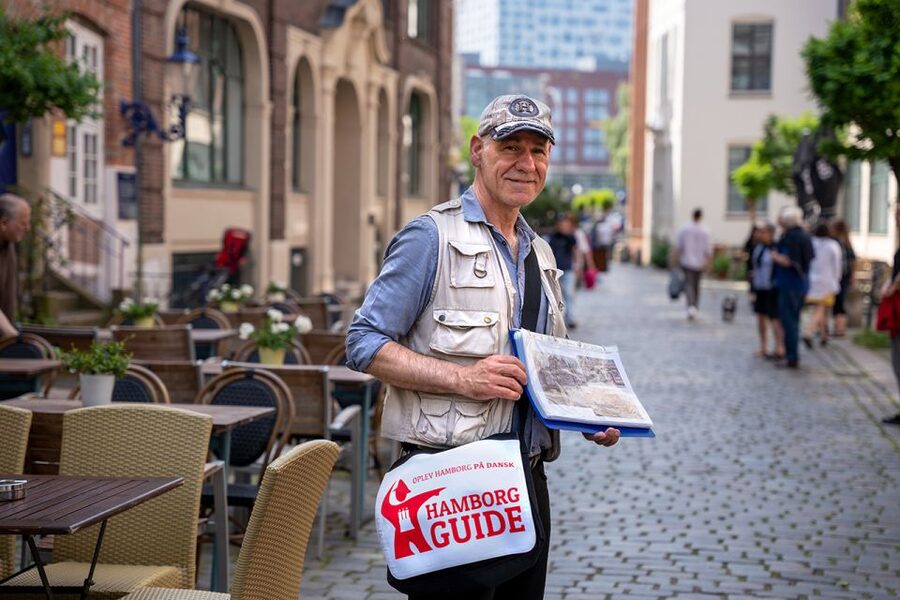
After Speicherstadt, the route enters HafenCity for about 15 minutes. This is Hamburg’s residential and business district, and it presents a sharp contrast with the older warehouse area.
HafenCity helps explain what Hamburg is becoming. You move from the city’s trading past into a modern district built around new homes, offices, public spaces, and major architecture. The guide places this development within the city’s longer story, so the new buildings do not feel disconnected from the old port.
This part will appeal to you if you like seeing how cities change. It may be less satisfying if you want only preserved old streets, but that is not what Hamburg offers. The city’s character comes from the collision of old harbor infrastructure and new urban plans.
The route also gives you a sense of scale. Hamburg is not simply an old center with a port attached. It is a city still making room for its economic and cultural future.
Ending beneath the Elbphilharmonie
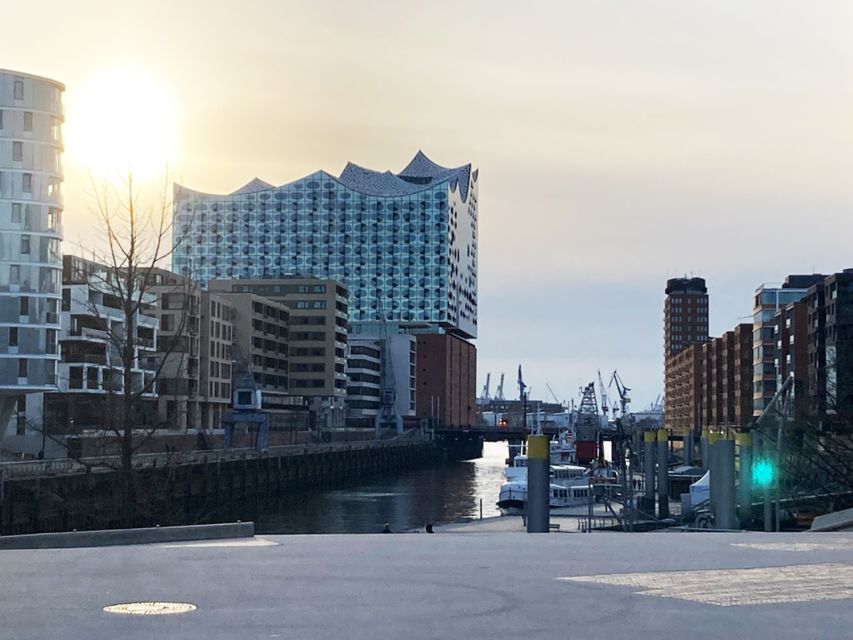
The final stop is the Elbphilharmonie, with around 15 minutes of guided time. The concert hall’s imposing design makes a strong finish, especially after the earlier discussion of warehouses, trade, war, and rebuilding.
The tour ends at Platz der Deutschen Einheit rather than returning to Jungfernstieg. That is worth noting when planning your day. The finish places you in HafenCity, close to the Elbphilharmonie, and gives you the chance to continue independently.
You can explore the Elbphilharmonie Plaza and public viewing platform on your own after the tour. The experience does not include a concert, food, drinks, or a separate interior visit, so think of the guided portion as an introduction to the building and its setting.
Ending here is smart. The concert hall is a natural place to pause, take in the views, and decide what you want to do next. It also gives the walk a satisfying final image: Hamburg’s port city identity expressed through a bold modern cultural building.
How much walking and how fast is the pace?
The advertised duration is two hours, and the route includes nine stops. That means the walk is organized and fairly brisk, with short explanations at each location rather than long periods spent in one place.
You should wear comfortable shoes and clothing suited to the weather. The tour runs rain or shine, so a wet forecast should not come as a surprise. Carrying cash is also recommended, though food and drinks are not included.
Because the route crosses several parts of central Hamburg, you should expect regular walking between stops. The activity is not suitable for people with mobility impairments or wheelchair users. It is also not suitable for people who are visually or hearing impaired, and children under six cannot join.
That makes this a better choice for older children, adults, and private groups who can keep moving and listen while standing outdoors. If you need frequent rests or step-free access, choose a different way to see Hamburg.
Is $280 a fair price for a private group?
The price is $280 per group of up to 30 people. The value depends almost entirely on your group size.
For one or two people, the cost is high compared with a standard shared walking tour. You are paying for a Danish-speaking licensed guide and a private group structure, not for admission to museums, meals, or a concert.
For a larger family, school group, club, or group of friends, the calculation changes. A full group of 30 would pay less than $10 per person, while a group of 10 would pay $28 each. That can be reasonable for two hours of live guiding in your preferred language, especially when the route covers both historic Hamburg and HafenCity.
The strongest value comes from the interpretation. You can see the Townhall, Speicherstadt, and Elbphilharmonie without a guide, but the links between them are harder to grasp on your own. The historical visual aids also add something beyond simply pointing out buildings.
The booking terms keep the decision flexible. You can reserve and pay later, and cancellation is free up to 24 hours before the start for a full refund. Check the available starting times before committing, since the tour runs at scheduled times.
Who will get the most from this walk?
I would choose this tour if you want Hamburg explained in Danish and prefer a single route that covers major sights without spending a full day. It is particularly useful at the beginning of a city break, since you finish with a better sense of how the center, warehouse district, port, and new developments connect.
It also suits groups that value a private guide. Christian Meyer-Pedersen is one named guide, and the available feedback describes his presentation as organized, lively, and full of cultural and historical detail. The Danish language is not a small bonus here. For many people, it is the main reason the experience will work.
You may want to skip it if you prefer to explore at your own speed, spend a long time inside museums, or focus on food and harbor transport. Nothing to eat or drink is included, and the tour does not offer a dedicated museum visit.
The walk also requires realistic expectations about the weather and access. A cold day did not prevent a good experience for one participant, but you should still dress properly rather than hoping Hamburg will be kind. Bring a rain layer when needed, wear shoes you can walk in, and remember that the route ends away from the starting point.
Should you book this Danish Hamburg tour?
Book it if your group wants a clear, well-organized introduction to Hamburg in Danish, especially if you are visiting for the first time. The route gives you the city’s main storyline in two hours: medieval trade, fire, civic life, wartime destruction, warehouse commerce, HafenCity, and the Elbphilharmonie.
The $280 price makes the most sense for a group rather than a couple. For a full or mid-sized party, it can be a practical way to get a private Danish-language guide and cover a wide section of the city without arranging several separate visits.
Skip it if you need an accessible route, want extensive time inside attractions, or prefer a cheaper shared walk. For everyone else, the combination of Danish guiding, a strong historical sequence, and a finish at the Elbphilharmonie makes this a useful first look at Hamburg.
FAQ
What language is the tour conducted in?
The tour is conducted in Danish with a live Danish-speaking guide.
How long does the walking tour last?
The tour lasts two hours.
Where does the tour begin?
The meeting point is in front of the Swatch Shop at the corner of Jungfernstieg and Alsterarkaden.
Where does the tour end?
The tour ends at Platz der Deutschen Einheit in HafenCity, near the Elbphilharmonie.
Does the tour visit the Hamburg Townhall?
Yes. The route includes a guided stop at Hamburg’s Townhall for about 20 minutes.
Will I see the St. Nikolai Memorial?
Yes. The route includes about 15 minutes at the St. Nikolai Memorial, a World War II memorial and museum in the ruins of St. Nikolai Church.
Does the tour include Speicherstadt?
Yes. Speicherstadt is included as a guided stop and is described as the world’s largest warehouse district.
Can I visit the Elbphilharmonie Plaza after the tour?
Yes. The tour ends at the Elbphilharmonie, giving you the opportunity to explore its Plaza and public viewing platform independently.
Is food or drink included?
No. Food and drinks are not included.
Is the tour suitable for wheelchair users?
No. The activity is not suitable for wheelchair users or people with mobility impairments. It is also not suitable for people who are visually or hearing impaired.
Just added in Hamburg
- Hamburg: Historical Tour of the St. Pauli Sex Work District★ 4.4 · 215 reviews
- Hamburg: St. Pauli Food and Bier Tour★ 4.7 · 5 reviews
- St. Pauli Tour: Drag-Attack with Barbie Stupid & Lee Jackson★ 4.8 · 280 reviews
- Hamburg: Private Tour Red Light District Walking Tour★ 4.7 · 227 reviews
- St. Michael’s, Elbe Tunnel & Harbor 2-Hour Hamburg Tour★ 4.9 · 21 reviews
- Satt Pauli – der kulinarische Rundgang durch St. Pauli★ 4.8 · 12 reviews
- Hamburg: Safari tour in St. Pauli★ 4.9 · 11 reviews
- Radtour um die Alster & durch traumhafte Alsterviertel★ 4.9 · 34 reviews
Walking Tours, compared.

Third Reich Berlin: Hitler and WWII Walking Tour
Read our review →
Browse the lists this tour appears in