Reviewed · WALKING TOURS
Berlin Highlights Walking Tour
Berlin’s 20th-century story comes at you fast on this focused walk. In about two hours, you move from the grand Brandenburg Gate to the stark site of Hitler’s bunker, the Holocaust Memorial, the Topography of Terror, and Checkpoint Charlie.
I like the compact route and the way it links Nazi-era and Cold War sites in one outing. I also like the low price, just $4.81 per person, which makes this an unusually inexpensive way to get your bearings in central Berlin.
The tradeoff is pace. With roughly 24 minutes planned at each of five stops, you’ll hear the main story, but you won’t have time for a leisurely museum visit or long personal exploration at every site.
Key points to know before you book
- Five major sites in two hours: The route covers Brandenburg Gate, the Führerbunker site, the Holocaust Memorial, Topography of Terror, and Checkpoint Charlie.
- A history-first experience: The focus is Berlin under Nazism, the Holocaust, World War II, and the Cold War.
- Starts beside Brandenburg Gate: Meet at the Starbucks at Pariser Platz 4A.
- Finishes at Checkpoint Charlie: The walk ends at Friedrichstraße 43-45, a useful central location for continuing your day.
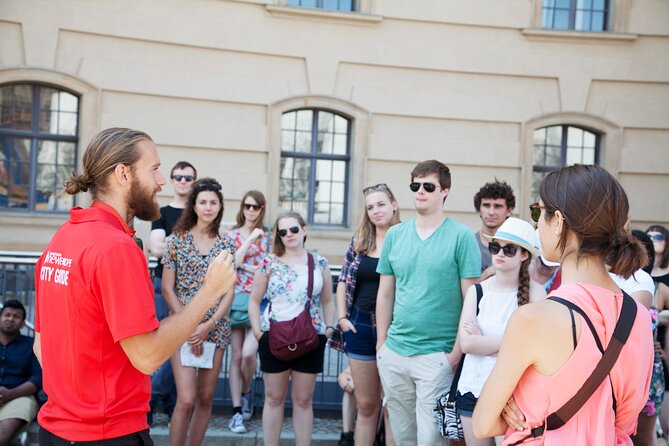
- English-language guiding: The tour is offered in English and includes a local guide.
- Small enough to stay manageable: Group size is capped at 25 people.
Why this short Berlin walk works
Berlin can feel like a history book spread across a wide city. You can spend days visiting museums, memorials, government buildings, and former border sites. This walk gives you a clean first chapter in just two hours.
The route is especially useful because the stops are connected by subject, not simply by fame. You begin with the Brandenburg Gate, move into the final days of the Nazi regime, confront the Holocaust, examine the machinery of Nazi repression, and finish with the Cold War division of Berlin.
I like that progression. It helps you see that Berlin’s past is not one single story. The city’s monuments point to different periods, and the walk places them in an understandable order.
The tour is also practical for a busy schedule. You can fit it between other plans without giving up half a day. It is a good choice for a first morning in Berlin, when you want orientation before deciding which museums deserve more of your time.
The $4.81 price gives the experience strong value if your goal is a guided introduction. You are paying mainly for the guide’s explanations and the structure of the route, not for long museum access or elaborate transport. Since the stops are public sites, there is no large admission cost built into the experience.
At this price, I would view the walk as a starting point rather than a complete Berlin history course. The guide can explain what happened at each location, but you will need separate time if you want to read every panel, visit every exhibition room, or study the memorials at length.
Other walks around Berlin:
- Discover Berlin Half-Day Walking Tour
★ 5.0 · 9,624 reviews - Berlin: Third Reich and Cold War 2 Hour Walking Tour
★ 4.9 · 6,830 reviews - Berlin: Discover Berlin Walking Tour
★ 4.9 · 5,998 reviews
Beginning at the Brandenburg Gate
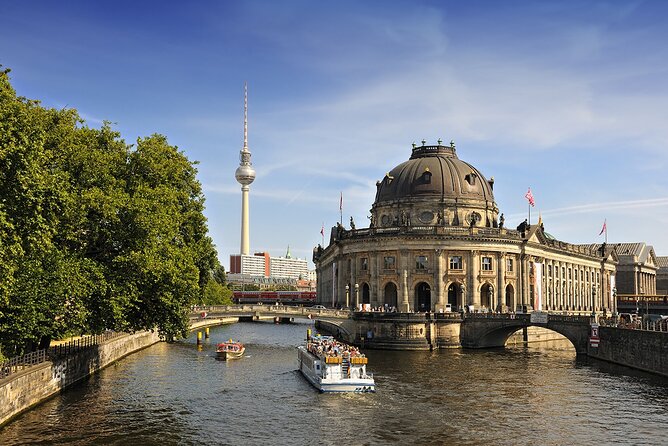
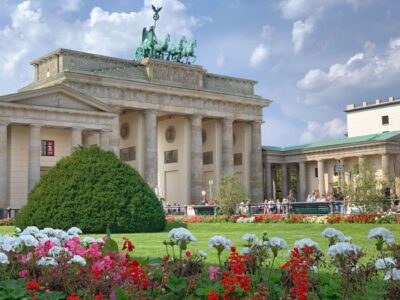
The walk starts at the Starbucks at Pariser Platz 4A, beside the Brandenburg Gate. This is a sensible meeting point because the gate is one of Berlin’s clearest landmarks and easy to identify in the center of the city.
Your first stop lasts about 24 minutes. That gives the guide enough time to explain why the gate matters without letting the opening run long.
The Brandenburg Gate began as a grand entrance to the city and later became a symbol tied to Berlin’s division and reunification. The guide uses the monument to set the tone for the walk, showing how one structure can take on different meanings as political power changes around it.
I find this a strong opening because it gives you a physical reference point. You are not hearing a list of dates in a classroom. You are standing at a place that has witnessed major changes in Berlin’s public life.
The drawback is that the gate is also one of the city’s busiest photo stops. Depending on the time of day, you may need to stay close to the guide to hear clearly and keep the group together. Bring your attention to the explanation, not just the classic photograph.
The Führerbunker site and the end of World War II
From Brandenburg Gate, the walk continues to the former site of the Führerbunker. The bunker itself is no longer visible, so this stop depends heavily on the guide’s explanation.
That absence is part of the point. You are not entering a preserved wartime room or touring an underground complex. Instead, you are learning what happened at the site during the final days of World War II and considering how Berlin treats a location tied to Hitler’s last days.
The stop is scheduled for about 24 minutes. That is enough for a clear account of the bunker’s role and the events that unfolded there, but not enough for an extended discussion of every military and political detail.
I appreciate the restraint of a site like this. There is no grand display and no dramatic interior to turn the place into a spectacle. The guide has to supply the context, while the ordinary surroundings make the history feel unsettlingly close to everyday Berlin.
For that reason, your experience here will vary with the guide. A guide named Nir has led this route and was specifically praised for offering helpful, interesting insight while keeping the tour on schedule. The timing matters on a route with five stops, and a clear explanation is especially important at a place where little physical evidence remains.
Walking through the Holocaust Memorial
The next stop is the Memorial to the Murdered Jews of Europe, often called the Holocaust Memorial. Its field of concrete slabs creates a powerful place for a quiet walk.
The guide explains the memorial’s design and the history it commemorates. As you move among the slabs, the ground and surrounding forms can change in feeling from one section to another. The memorial does not present the Holocaust as a simple story with one easy message. Its effect comes partly from your physical movement through the space.
You have about 24 minutes here. That is enough to understand the memorial’s purpose and hear essential historical context. It is not enough to take a long, unhurried walk through every corner or visit additional displays at length.
I recommend listening first, then taking a moment to look around for yourself. The guide’s explanation gives the site a frame, but the memorial also asks for quiet personal attention.
This is one of the most serious stops on the route, and the tone matters. It is not a place for rushed jokes or casual sightseeing. The walk handles several dark chapters in succession, so you should expect the subject matter to be sobering.
The memorial is also a good example of why a guide can add value even when the site itself is free. You may see the concrete forms without knowing what the design is intended to express. The explanation connects the physical setting with the historical crime it commemorates.
Same base, a different kind of day out:
- Berlin: Reichstag, Dome and Government District Guided Tour
★ 4.7 · 18,288 reviews - Berlin: 1-Hour City Tour by Boat with Guaranteed Seating
★ 4.3 · 16,993 reviews - Berlin: Boat Tour Along the River Spree
★ 4.4 · 11,252 reviews - Berlin: Hop-on Hop-off Bus Tour with Live Commentary
★ 4.3 · 8,579 reviews
Reading the Topography of Terror
The route then moves to the Topography of Terror, a permanent exhibition on the former site of the Gestapo and SS headquarters. This stop adds structure to the story by showing how the Nazi regime organized power and carried out persecution.
The exhibition focuses on the rise and fall of the Nazi regime and the crimes committed under it. Here, the subject shifts from individual places and final events to the systems behind them.
The itinerary allows about 24 minutes at this stop. That is useful for an introduction, but it is also the clearest point where time becomes a limitation. A permanent exhibition can contain far more material than a short guided visit can cover.
If you have a strong interest in Nazi Germany, I would consider returning on your own after the walk. The tour can point out why the site matters and help you decide if the exhibition deserves more of your day.
I like the placement of this stop after the Holocaust Memorial. The memorial gives you a place of remembrance, while the Topography of Terror explains more about the institutions and leaders that made mass persecution possible. Together, they provide a fuller picture than either stop would on its own.
Because the exhibition is serious and information-heavy, stay near the guide during the introduction. If you wander too far from the group, you may miss the explanation that ties the displays to the other stops.
Ending at Checkpoint Charlie
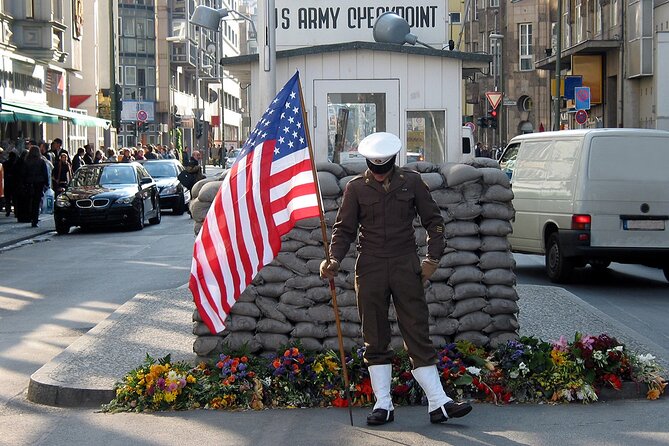
The walk concludes at Checkpoint Charlie on Friedrichstraße, where the subject changes from Nazi rule and World War II to the Cold War.
Checkpoint Charlie was one of the best-known crossings between East and West Berlin. The guide recounts the tense standoffs and escape attempts connected with the border crossing, helping you picture a city divided by political force.
This final stop gives the route a useful second half. Berlin’s difficult history did not end in 1945. The city remained split, and its residents lived with the consequences of that division for decades.
The location is also practical. Finishing at Checkpoint Charlie leaves you in a central part of Berlin, with the rest of the day still available. You can stop for food, continue sightseeing, or use public transportation to reach another district.
As with the Brandenburg Gate, Checkpoint Charlie is a famous site that can be reduced to a quick photograph if you do not know its background. The guide’s account gives the crossing human and political meaning.
Still, do not expect the site to look exactly like a preserved Cold War border station. The value here is the explanation and location, not a long visit to an intact historical complex. The tour gives you the essentials, then leaves you free to continue.
Timing, group size, and walking pace
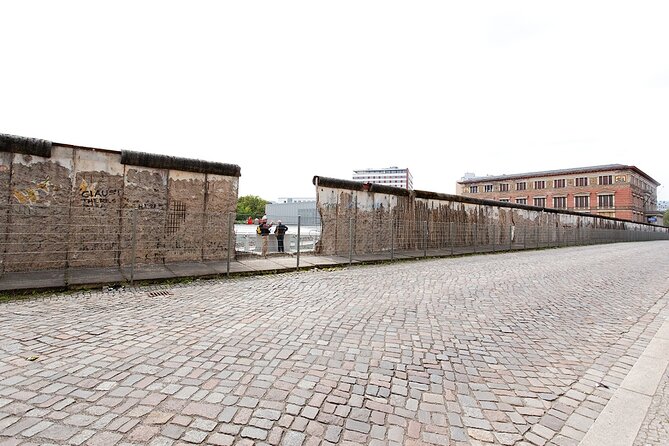
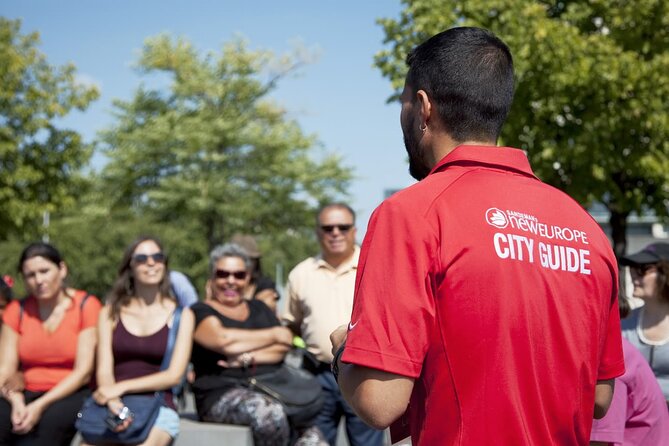
The tour lasts about two hours and is limited to 25 people. That is a useful group size for a city walk. It is large enough to keep the price low, but not so large that the guide is addressing a huge crowd.
The route is designed around five stops of roughly 24 minutes each. Those blocks include the main explanations, with walking time between locations fitting into the overall schedule. The guide’s ability to keep things moving matters, and Nir’s reported strength on staying on schedule is worth noting.
You should wear comfortable shoes and arrive ready to walk between sites. The route is compact, but it is still a walking tour, not a series of seated talks.
The English-language format makes the experience straightforward for English speakers. Confirmation is provided at booking, and the meeting point is near public transportation. Most people can participate, and service animals are allowed.
Because the tour is offered at a very low price, I would not expect a private experience or a flexible route built around individual interests. The guide needs to balance the needs of a group and keep the schedule moving.
Who will get the most from this tour
I think this walk suits you best if you want a clear first look at Berlin’s major 20th-century sites. It is especially useful if you have only a short stay, want an introduction before visiting museums, or prefer learning with a guide rather than reading signs on your own.
History-minded visitors will get the most from it. The focus is not on shopping, food, architecture across many centuries, or neighborhood life. It is a concentrated walk through Nazi and Cold War Berlin.
The tour can also work well on a first day in the city. You will finish near Checkpoint Charlie with a better sense of where several central landmarks fit together. That basic orientation can make later independent sightseeing more rewarding.
I would choose a longer or more specialized experience if you already know these sites well. The schedule is built for broad coverage, not detailed study. You may want more time at the Topography of Terror, the Holocaust Memorial, or other museums than this route allows.
The subject matter also deserves consideration. This is a serious outing. If you want a light introduction to Berlin, choose another type of walk. If you want direct context for some of the city’s hardest places, the tone is appropriate.
Cancellation and booking details
You can cancel for a full refund up to 24 hours before the start time. Changes or cancellations made less than 24 hours before the start are not accepted for a refund, and the cut-off follows local Berlin time.
The experience is booked an average of 19 days ahead, so I would reserve early if your schedule is fixed. The maximum group size is 25, and the tour is offered in English.
Should you book this Berlin walk?
Book it if you want maximum historical coverage in a short time. The route connects five important sites, costs very little, and finishes in a central location. Its strongest feature is the efficient structure, especially for a first visit or a tightly planned itinerary.
Skip it if you want long museum visits, a relaxed pace, or a broad survey of Berlin beyond the 20th century. The two-hour schedule gives you context and orientation, but you will need extra time to explore the exhibitions and memorials properly.
For $4.81, I see this as an excellent-value introduction rather than a complete tour of Berlin. If you arrive on time, stay close to the guide, and treat the stops as a foundation for further exploring, this compact walk can make the city’s difficult history easier to understand.
FAQ
How long does the Berlin Highlights Walking Tour last?
The tour lasts approximately two hours.
What sites does the tour visit?
The route visits Brandenburg Gate, the former Führerbunker site, the Memorial to the Murdered Jews of Europe, the Topography of Terror, and Checkpoint Charlie.
Where does the tour begin?
The tour begins at Starbucks, Pariser Platz 4A, 10117 Berlin, Germany.
Where does the tour end?
The tour ends at Checkpoint Charlie, Friedrichstraße 43-45, 10117 Berlin, Germany.
Is the tour offered in English?
Yes. The experience is offered in English and includes a local guide.
How many people can join the tour?
The maximum group size is 25 people.
Can I cancel for a full refund?
Yes. You can cancel up to 24 hours before the experience start time for a full refund. Cancellations or changes made less than 24 hours before the start are not accepted for a refund.
Just added in Berlin
- Private One way Airport Transfer Berlin Airport To Berlin★ 3.5 · 17 reviews
- Private Walking Tour: Berlin Wall, Cold War and Checkpoint Charlie★ 5.0 · 37 reviews
- Modern Berlin Private Walking Tour: Diverse, Vibrant and Exciting German Capital★ 5.0 · 13 reviews
- Private Day Trip to Potsdam from Berlin by Train★ 4.5 · 27 reviews
- City Explorer: Potsdam Private Day Trip★ 4.5 · 10 reviews
- Berlin Private Custom 5-Hour Tour by Car★ 5.0 · 30 reviews
- Private Half-Day Sightseeing Tour in Berlin★ 3.5 · 6 reviews
- Berlin Private Custom Tour in a Minivan, East and West★ 5.0 · 123 reviews
Walking Tours, compared.

Third Reich Berlin: Hitler and WWII Walking Tour
Read our review →