
Reviewed · WALKING TOURS
Berlin Highlights in 2 Hours: Express Walking Tour
Berlin’s most important 20th-century sites are packed into this brisk walk from Brandenburg Gate to Checkpoint Charlie. In two hours, you move from Nazi power and genocide to the Cold War division of Germany, with an English-speaking guide connecting the places along the way.
I like the clear historical focus and the fact that every stop is free to enter. I also like the group format: at $21.77 per person, you get a useful introduction without paying for a private guide. Guides including Ryan, Gregor, Dylan, and Giles have been praised for clear explanations and a good walking pace.
The trade-off is simple: this is an express tour. You will see many sites, but you will not have time to study museum exhibits or linger at each memorial. Plan to return later if one subject catches your attention.
Key points at a glance
- Nine major sites in two hours: The route covers Brandenburg Gate, the Reichstag, Nazi-era memorials, the Berlin Wall, and Checkpoint Charlie.
- A strong history lesson: The focus runs from the Holocaust and Hitler’s final days to the Cold War and divided Berlin.
- All stops are free to enter: The $21.77 fee pays for the guide and group experience rather than admission tickets.
- An English-speaking guide leads the way: Guides such as Ryan, Gregor, Dylan, and Giles have been praised for communication and answering questions.
- A useful first-day orientation: The short route leaves much of your afternoon free for museums, cafés, or a return visit to a site that interests you.
Why this two-hour route works in Berlin
Berlin can feel scattered at first. Important sites sit among ordinary streets, government offices, apartment blocks, and modern construction. A walking tour gives you the order and context that a map alone cannot provide.
This route has a strong narrative. You begin at Brandenburg Gate, see the seat of modern German government, face the memorials to people murdered under National Socialism, then move toward the former Nazi ministries and the Berlin Wall. The final stop, Checkpoint Charlie, brings the story into the Cold War.
That sequence helps you connect events rather than treat each monument as an isolated photo stop. You will not get a full course in German history, but you will get a usable framework for understanding central Berlin.
The pace matters. Each listed stop has about 10 minutes, with walking time between them. That means you should expect short explanations, a chance to look around, and a few questions, not long periods of quiet reflection at every location.
For a first visit, I see that as a strength. You can cover a lot before lunch or later in the day, then choose which places deserve more time.
Other walks around Berlin:
- Discover Berlin Half-Day Walking Tour
★ 5.0 · 9,624 reviews - Berlin: Third Reich and Cold War 2 Hour Walking Tour
★ 4.9 · 6,830 reviews - Berlin: Discover Berlin Walking Tour
★ 4.9 · 5,998 reviews
Starting at Brandenburg Gate and the Reichstag

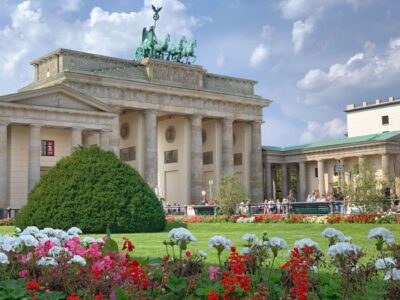
The tour begins at Pariser Platz, directly by Brandenburg Gate. This is one of Berlin’s easiest meeting points to find, and the surrounding square gives you an immediate sense of the city’s political importance.
Brandenburg Gate is more than a grand neoclassical entrance. It has become a symbol of German unity and peace, making it a fitting place to start a route about division, dictatorship, war, and reunification. Your guide can help explain why this landmark carries such weight in modern Germany.
You will also have a quick look around Pariser Platz, where impressive buildings frame the gate. The stop is short, so do not expect a detailed architectural tour. Still, the setting gives you useful orientation before the group heads toward the Reichstag.
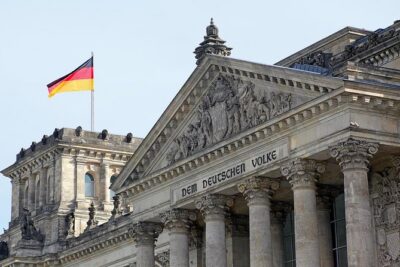
The Reichstag is Germany’s parliamentary building and one of the route’s key links between past and present. Its story reaches from the Weimar Republic to today’s federal government. You will hear about the building’s political role and see its exterior rather than enter for a parliamentary visit.
That distinction is important. This tour does not include entry to the Reichstag, and the listed stops have no admission tickets. If you want to see the interior or dome, you will need to arrange that separately.
Remembering the Sinti and Roma victims
The stop at the Memorial to the Sinti and Roma Victims of National Socialism brings attention to a group often left out of quick introductions to the Holocaust. The memorial honors the thousands of Sinti and Roma people persecuted and murdered under the Nazi regime.
This is one of the route’s most valuable stops because it broadens the story. Berlin’s memorial culture is not limited to one group or one monument. The guide can explain why remembering Sinti and Roma victims matters and how the memorial fits into the city’s effort to face its past.
You will have only about 10 minutes here. That is enough for an introduction and a quiet look, but not enough for a detailed study of the memorial’s design or the full history of Nazi persecution against Sinti and Roma communities.
I recommend listening closely at this point. It is easy to rush from famous sight to famous sight in Berlin. This stop asks you to pause and notice a part of the past that a casual sightseeing walk might skip.
Walking through the Memorial to the Murdered Jews of Europe
The Memorial to the Murdered Jews of Europe is one of Berlin’s most powerful public spaces. Its field of concrete slabs creates a shifting path that feels different as you move through it. The ground rises and falls, and the narrow corridors can make you feel enclosed.
The guide will provide historical context, but the site also gives you room to think for yourself. You can walk among the slabs during the short stop and consider the scale of the Holocaust without the usual museum labels competing for your attention.
Do not expect the two-hour tour to cover every part of the memorial complex. The emphasis is on the outdoor memorial and its meaning. If you want a fuller visit, return later for the underground Information Centre, provided it is open and fits your schedule. The tour itself does not promise interior admission.
This is also a place where group behavior matters. Keep your voice low and treat the memorial as a place of remembrance, not just a backdrop for photographs. Your guide can set the tone, but you should allow yourself a quiet moment here.
Other two-hour trips in Berlin:
- Berlin’s Best: 2 Hour Walking Tour Third Reich and the Cold War
★ 5.0 · 5,486 reviews - Berlin: 2-Hour Lake Oberhavel Cruise from Tegel
★ 4.4 · 577 reviews - Berlin 2-Hour Segway Tour
★ 4.6 · 238 reviews - East Berlin and the Berlin Wall 2-Hour Walking Tour
★ 5.0 · 228 reviews
The Führerbunker site and the final days of the war
The former Führerbunker is not an intact underground attraction. The tour takes you to the area above the bunker, where the guide explains Hitler’s final days, including his suicide on April 30, 1945.
The site is deliberately understated. There is no grand entrance or preserved chamber to explore. That absence is part of the story, since the place has been treated as a historical site rather than a shrine.
This stop works best when the guide focuses on facts and on how modern Germany deals with the location. The point is not to glorify Hitler or make the bunker into a spectacle. It is to understand the closing moments of the Nazi regime and the destruction left behind.
You may find the stop less visually dramatic than the Holocaust Memorial or Brandenburg Gate. Its value comes from the explanation, so stay close enough to hear clearly and use the time for questions if the group allows it.
The former Aviation Ministry and Nazi architecture
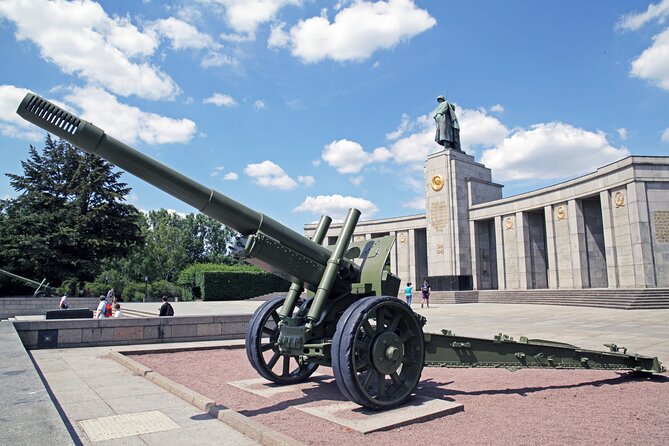
The former Reich Air Ministry is a striking example of Nazi-era government architecture. It later served the East German government and now houses Germany’s Federal Ministry of Finance.
That changing use makes the building especially useful for understanding Berlin’s political layers. One structure connects the Nazi state, East Germany, and the present-day Federal Republic. The architecture remains, but the political systems around it have changed.
You will see the building from outside and hear about its former role as the Luftwaffe headquarters. This is not a stop for interior access, and the tour does not provide a detailed architectural survey. Instead, the guide uses the building to show how Berlin’s streets preserve evidence of several different regimes.
I like this kind of stop because it moves beyond famous monuments. The building may look like an office to you at first. Once you know its past, the street feels less ordinary.
The Berlin Wall on Niederkirchnerstraße
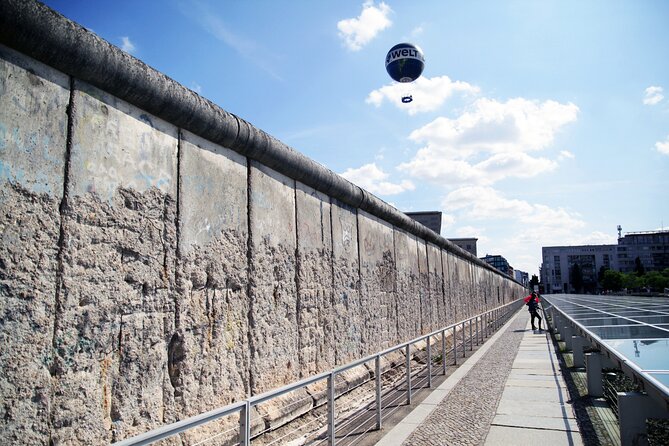
On Niederkirchnerstraße, you see a preserved section of the Berlin Wall and hear about escape attempts across the former border. The guide also explains daily life on both the East and West sides of divided Berlin.
This is where the Cold War story becomes more personal. The wall was not just a political boundary. It shaped work, family visits, travel, education, and the basic rhythm of daily life in Berlin.
The stop also brings out the risks of trying to cross. Some escape plans worked, while others ended in tragedy. A short explanation cannot cover every method or individual story, but it can help you understand why the wall became such a powerful symbol of the divided world.
The preserved section is useful because it gives you something solid to look at while the guide explains what once stood around it. Do not expect a long stretch of wall or a full museum visit. This is a focused look at one surviving section.
Topography of Terror and the machinery of Nazi rule
The Topography of Terror occupies the former headquarters area of the SS, Gestapo, and SD. The site now contains an exhibition about the institutions and crimes of Nazi Germany.
This stop gives the tour a needed shift from individual leaders and memorials to the systems that carried out persecution. The Nazi regime depended on offices, police agencies, records, orders, and people who enforced them. The exhibition helps show how that machinery operated.
The walking tour’s stop is brief, so you should not expect to read the entire exhibition. If this subject matters to you, set aside extra time for a return visit. The building and exhibition can reward a slower pace than the tour schedule allows.
Even the exterior location adds context. You are not hearing about Nazi power in an abstract classroom. You are standing at the site where key institutions planned and carried out repression.
Ending at Checkpoint Charlie
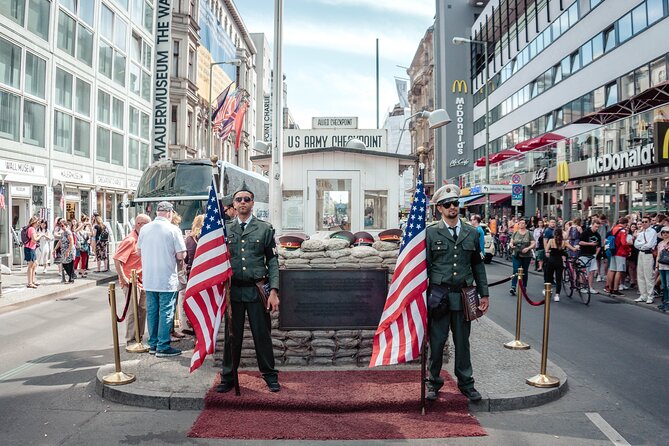
The route ends at Checkpoint Charlie, at Friedrichstraße 43 to 45. This famous crossing point once marked the boundary between East and West Berlin and became a major Cold War symbol.
Your guide will explain stories of espionage and escape attempts, bringing the route to a natural close. After the earlier stops, Checkpoint Charlie helps you see how Berlin’s division remained part of everyday public life long after the Second World War ended.
The location is also a practical ending point. It is near public transportation, so you can continue to another part of Berlin after the walk. You might visit a museum, find lunch, or return to one of the earlier memorials for a slower look.
Checkpoint Charlie can feel more commercial than the memorial sites and preserved wall section. That contrast is worth noting. The crossing point has a famous name and a busy setting, but the guide’s explanation helps separate the Cold War meaning from the modern tourist activity around it.
What the $21.77 price really gives you
At $21.77 per person, this is a fairly economical way to get a guided introduction to central Berlin. Since the stops are free, you are paying for the guide’s route, historical explanations, and the chance to ask questions while walking.
The value is strongest if you are new to Berlin or short on time. A good guide can point out why a plain-looking building matters, explain the relationship between nearby sites, and keep you from missing places that are easy to pass without context.
You should not compare the price with a private tour. The group can include up to 25 people, so the experience is shared rather than tailored entirely to you. On the other hand, several guides have been praised for answering questions and adjusting their pace to a mixed-age group, including people in their 20s through their 70s.
The short format also saves you money in another way: it leaves most of the day open. You can use the tour to decide which museums or memorials deserve a separate visit instead of paying for a longer tour that covers subjects you may not want to pursue.
Guide quality and group pace
The guide is the main variable in any walking tour, and the feedback here points to strong communication. Ryan has been described as pleasant and very informed, Gregor as a guide who brought meaning to each sight, Dylan as both informative and interesting, and Giles as a clear speaker who handled questions well.
Those details matter because the route includes difficult material. A guide needs to explain Nazi crimes and the Holocaust with care, then shift into the politics of the Cold War without making the walk feel like a list of dates.
The group limit of 25 is reasonable for a city walk, though the experience may feel more personal with fewer people. One past departure had only one participant, which made it especially flexible. You should not count on that, but a smaller group can make it easier to ask questions and stay close to the guide.
Wear comfortable shoes and arrive ready to walk for two hours. The activity is near public transportation, and most people can participate, but you should still consider your own comfort with standing and walking between nine outdoor stops.
Who should book this express walk
I would choose this tour if you want a first look at Berlin’s central historical sights, especially if you care about the Nazi period, Holocaust remembrance, and the Cold War. It is also a good fit if your schedule is tight and you want a useful orientation before exploring on your own.
Families with older children may find the route helpful, though the subject matter is serious. The guide can provide context that makes the sites easier to understand, but this is not a light sightseeing stroll.
History-focused visitors will get the most from it. You will see memorials and political landmarks, hear about escape attempts and Nazi institutions, and finish near one of Berlin’s best-known Cold War sites.
I would be more cautious if you want long museum visits, detailed architecture, or plenty of time for photographs. The express format keeps moving, and several stops deserve more than 10 minutes.
The tour is offered in English and comes with a mobile ticket. Confirmation is provided when you book. Service animals are allowed, and the activity is near public transportation. You can cancel for a full refund up to 24 hours before the start time, but cancellations or changes inside that window are not accepted.
Should you book Berlin Highlights in 2 Hours?
Book it if you want a well-priced historical overview and can accept a quick pace. The route covers an unusually strong set of sites for two hours, and the best guides add the context that turns ordinary streets and government buildings into meaningful places.
Skip it if you already know central Berlin well or want extended time inside memorials and exhibitions. In that case, spend your time at individual sites instead.
For most first-time visitors, I see this as a smart opening walk. Use it to learn the city’s basic story, note the places that move you, and return later for a slower visit.
FAQ
How long does the Berlin Highlights walking tour last?
The tour lasts approximately two hours.
Where does the tour begin?
It begins at Pariser Platz 1, 10117 Berlin, Germany, beside Brandenburg Gate.
Where does the tour end?
The tour ends at Checkpoint Charlie, Friedrichstraße 43 to 45, 10117 Berlin, Germany.
What language is the tour offered in?
The tour is offered in English.
How much does the tour cost?
The listed price is $21.77 per person.
How many people can join the group?
The group can include a maximum of 25 people.
Can I cancel for a full refund?
Yes. You can cancel at least 24 hours before the start time for a full refund. Cancellations or changes made less than 24 hours before the start time are not accepted and are not refunded.
Just added in Berlin
- Private One way Airport Transfer Berlin Airport To Berlin★ 3.5 · 17 reviews
- Private Walking Tour: Berlin Wall, Cold War and Checkpoint Charlie★ 5.0 · 37 reviews
- Modern Berlin Private Walking Tour: Diverse, Vibrant and Exciting German Capital★ 5.0 · 13 reviews
- Private Day Trip to Potsdam from Berlin by Train★ 4.5 · 27 reviews
- City Explorer: Potsdam Private Day Trip★ 4.5 · 10 reviews
- Berlin Private Custom 5-Hour Tour by Car★ 5.0 · 30 reviews
- Private Half-Day Sightseeing Tour in Berlin★ 3.5 · 6 reviews
- Berlin Private Custom Tour in a Minivan, East and West★ 5.0 · 123 reviews
Walking Tours, compared.

Third Reich Berlin: Hitler and WWII Walking Tour
Read our review →
Browse the lists this tour appears in