Reviewed · WALKING TOURS
An Introduction to Berlin Private Walking Tour
Berlin’s past is packed into this three-hour private walking tour, where a historian connects grand monuments with the darker chapters behind them. You move from the Reichstag and Brandenburg Gate to the Berlin Wall, Holocaust Memorial, Museum Island, and Hackescher Markt, with public transport filling the gaps between distant sights.
I like the one-group format, since you can stop for questions instead of listening from the back of a crowd. I also like the guide’s ability to adjust the discussion. Jakob, one guide named in the feedback, was able to go into greater detail with guests who already knew a lot about World War II. The main consideration is price: at $520.73 for up to 10 people, it is good value for a full group but expensive for one or two people.
Key points to know before booking
- A private historian leads the route, giving you room to ask detailed questions about Berlin’s politics, war, division, and reunification.
- Eight major areas fit into three hours, including the Reichstag, Brandenburg Gate, Museum Island, Potsdamer Platz, and Hackescher Markt.
- Public transport is part of the plan, since Berlin’s key sights are too spread out for one continuous walk.
- The Holocaust Memorial receives a thoughtful stop, with time to consider Peter Eisenman’s 2,711 concrete slabs.
- The tour begins near Unter den Linden, at Cafe Einstein, unless hotel pickup has been arranged.
- The price works best for a family or group of friends, since all 10 participants share the flat group cost.
Berlin’s story works best with a historian
Berlin can feel like several cities placed on top of one another. Prussian royal power, Nazi terror, the Cold War, reunification, and modern Germany all appear within a short distance. A guide helps you read those layers instead of simply ticking off monuments.
That is the main reason to choose this private tour over a basic sightseeing walk. You are not only shown the Brandenburg Gate. You learn why it mattered under Prussia, how Napoleon used it, and how it later became a symbol in the Cold War era.
The private setup also changes the rhythm. Your group can ask about a particular period, request more detail on the Wall, or move quickly through a sight that interests you less. Jakob, mentioned by name in the tour feedback, also offered restaurant suggestions, a useful extra when you are still finding your way around Berlin.
The word historian matters here. This is not presented as a simple photo stop route. The experience is built around interpretation, with local guides described as historians and enthusiastic hosts. If you have already read about World War II or the divided city, you can ask sharper questions and get past the standard introduction.
Other walks around Berlin:
- Discover Berlin Half-Day Walking Tour
★ 5.0 · 9,624 reviews - Berlin: Third Reich and Cold War 2 Hour Walking Tour
★ 4.9 · 6,830 reviews - Berlin: Discover Berlin Walking Tour
★ 4.9 · 5,998 reviews
Starting at the Reichstag and Brandenburg Gate
The tour begins at Unter den Linden 42, near Cafe Einstein, unless you arrange hotel pickup. You are asked to meet 15 minutes before the start, which gives you time to find the guide and settle in before the first stop.
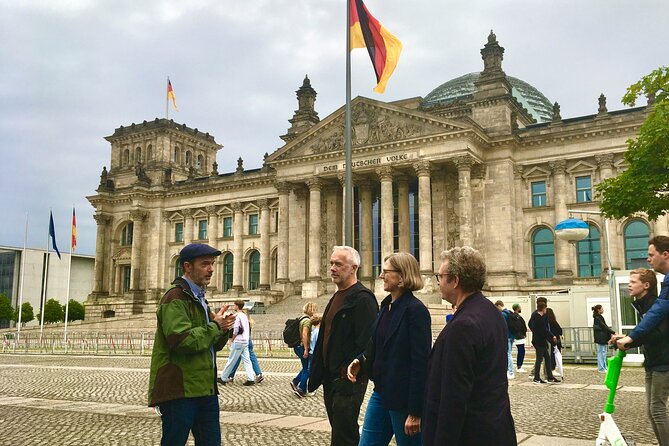
The Reichstag is a strong opening. Germany’s lower house of parliament, the Bundestag, meets here, and the building’s glass dome has become a modern symbol of open government. Norman Foster added the dome in the 1990s, after reunification, turning an old political building into a statement about transparency.
The tour allows about 20 minutes at the Reichstag. That is enough to understand the building’s role and take in its exterior, but you should not assume this tour includes a visit inside the dome. The information supplied lists the stop as free admission, not a reserved dome entry.
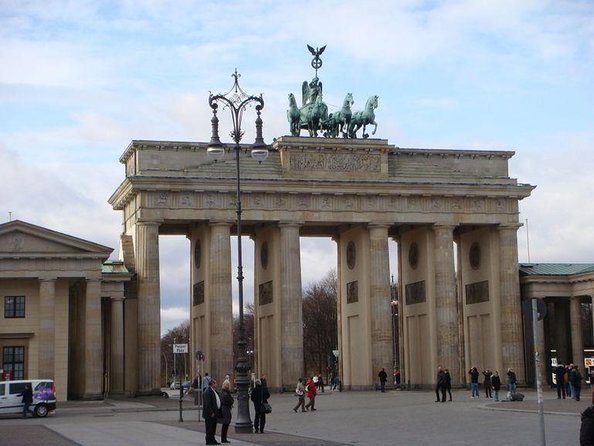
From there, the Brandenburg Gate gives you another 20-minute lesson in how one monument can change meaning. Frederick William II ordered the neoclassical gate in the 18th century. Napoleon later passed through it after defeating Prussia, and Ronald Reagan used the site for a famous Cold War speech.
Today, it is one of Berlin’s easiest places for a photograph. The useful part of the stop is the context. The gate was once an entrance to the city, then a political stage, and later a powerful image of reunification. Your guide can explain those shifts without reducing the site to a single date.
Museum Island and the grand sweep of Unter den Linden
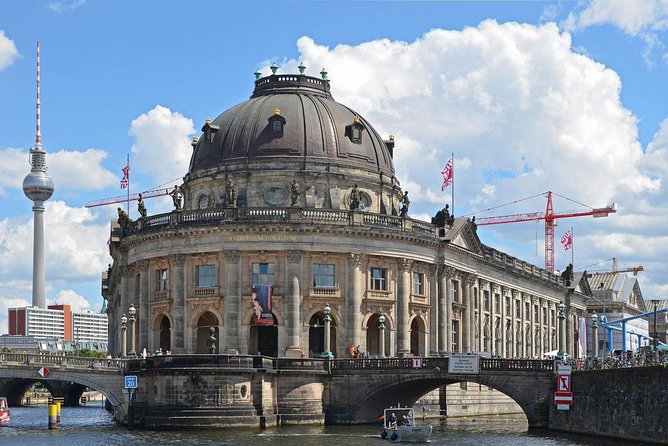
Museum Island sits on Spree Island in central Berlin. Five major museums occupy this small area, including the Pergamon Museum, Neues Museum, and Alte Nationalgalerie. The tour gives it about 20 minutes.
This is a short orientation stop rather than a museum visit. No museum admission is included, and the schedule does not leave time to explore the collections. Still, a guide can explain how the museums were built under Prussian rulers and why this part of Berlin was designed as a public showcase of art, archaeology, and state power.
If you plan to return to one of the museums later, pay attention to the layout and names. The stop can help you choose how to spend a separate half-day. It also keeps the tour from focusing only on 20th-century Berlin.
Unter den Linden receives the longest single stop, about 30 minutes. The broad boulevard runs from the City Palace area toward the Brandenburg Gate and takes its name from the linden trees lining the route. It was Berlin’s answer to grand European avenues such as the Champs-Élysées.
This is where the city’s royal and political character comes into focus. Rather than rushing down the street, you get time to look at the route as a planned axis. It links important buildings and helps you understand how Berlin expanded from a royal center into a national capital.
Potsdamer Platz and the marks left by the Wall
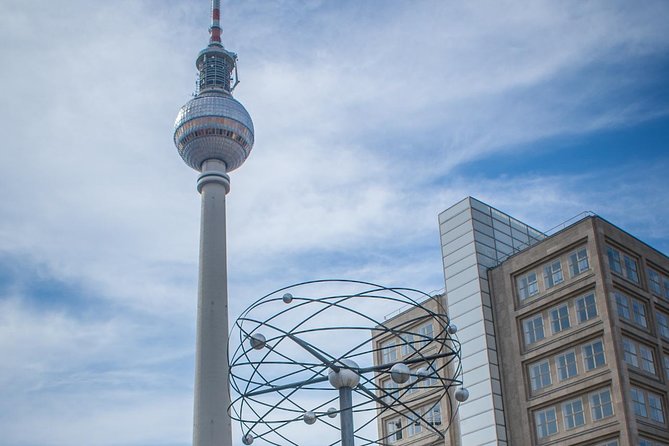
Potsdamer Platz gets about 15 minutes. Before the Wall fell, this area was cut apart by the border. After reunification, it was rebuilt as a center for shops, restaurants, offices, and entertainment.
The appeal here is contrast. You see a modern urban district where a divided city once left open space and barriers. The area is not an old square preserved in place. Its story is about demolition, redevelopment, and the effort to create a new Berlin after 1989.
The broader Wall discussion is one of the tour’s important strengths, although the supplied route details do not assign a separate timed stop to a specific Wall section. The route does include the Berlin Wall and Checkpoint Charlie among its key subjects, so ask your guide how the current day’s route handles them.
That question matters because Berlin’s Wall sites are spread around the city. Some are preserved fragments, some are marked only by lines or signs, and some are modern memorial spaces. A historian can help you tell the difference between an original structure and a later reconstruction or marker.
Public transport makes this possible. You will need to use Berlin transit a few times because the distances between the main sights are too great for a single continuous walk. A day pass is suggested if you do not already have one. The listed fares are 2.80 euros for a one-way AB ticket, with a 1.70 euro senior fare, or 7 euros for a one-person day ticket, with a 4.70 euro senior fare.
A few more things to do in Berlin worth a look
- Berlin: Private Reichstag and Glass Dome Tour
★ 4.8 · 2,226 reviews - Berlin Private Complete History All Day Walking Tour
★ 5.0 · 474 reviews - Private Walking Tour Berlin Third Reich Hitler and World War II
★ 5.0 · 360 reviews - Private Berlin: Iconic Sights and Hidden Gems Walking Tour
★ 5.0 · 292 reviews
Tiergarten and the Memorial to the Murdered Jews of Europe
Tiergarten is Berlin’s best-known inner-city park, with formal gardens, statues, and broad green space. The planned stop is brief, about 10 minutes, so think of it as a setting for explanation rather than a park visit.
The park helps make sense of Berlin’s scale. A capital can feel dense around the monuments, then suddenly open into a large public park. Your guide can point out how the park fits into the central city and its ceremonial routes.
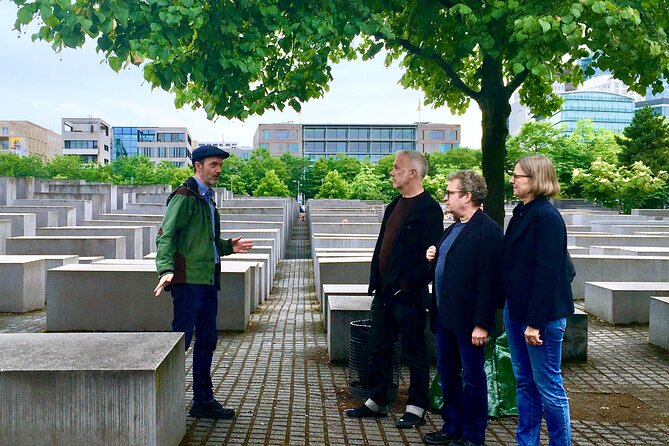
The Holocaust Memorial receives about 15 minutes. Peter Eisenman designed the Memorial to the Murdered Jews of Europe, which opened in 2005. Its 2,711 concrete slabs vary in height and form a shifting grid that you can enter.
This is not a place for a quick, cheerful photo stop. The narrow passages and uneven sense of space encourage quiet thought, and the meaning is not delivered by a long list of names carved into the stone. The experience depends on how you move through it.
Fifteen minutes is enough for an introduction, but you may want to return on your own if you wish to visit the underground information center. The supplied tour details do not say that an indoor visit is included. That is an important distinction for anyone hoping for a longer study of the memorial.
The guide’s family connection can also shape this part of the tour. Jakob was described as the grandchild of a Holocaust survivor. That personal background does not replace historical evidence, but it can bring a human dimension to a subject that is often presented through dates and military movements.
Hackescher Markt and pre-war Berlin
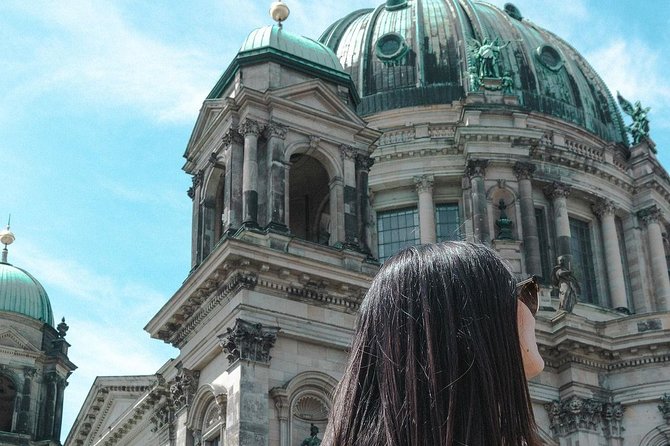
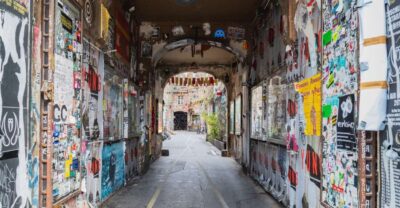
Hackescher Markt is the last listed stop and receives about 10 minutes. The square offers access to preserved Art Nouveau courtyards that give you a glimpse of pre-war Berlin.
This is a useful change of tone after the memorial. Berlin is not only its war ruins and political monuments. Courtyards, old facades, and urban passages show how ordinary city life looked before the destruction of World War II and the later division of the city.
Ten minutes is short, so you will not have time for a relaxed meal or extended shopping visit during the tour. Treat this as an introduction. You can return later if the courtyards catch your interest.
Food and drinks are not included. That keeps the tour focused, but you should plan a meal before or after rather than expect a cafe break along the route.
What the private price really buys you
The stated price is $520.73 per group of up to 10 people. The math changes sharply depending on group size. Ten people pay about $52 each, while five people pay about $104 each. For two people, the cost is more than $260 per person.
That makes this a sensible choice for a family, multigenerational group, or set of friends who want one guide for the day. It is harder to justify for a couple unless you place a high value on private conversation and a tailored history lesson.
You are paying for three hours with a historian, not for admissions, meals, or private transportation. The attractions listed have free admission for the stops, but you must cover transit. The guide can help you buy a ticket at the first station if needed.
I would compare the cost with a small-group option if price is your main concern. The feedback about Jakob says a private group allowed more individual questions, but the same person also found a small-group tour broadly similar in content. That is a useful warning: private does not automatically mean a completely different route.
The difference is control. In a private group, your questions do not compete with 15 or 20 other voices. If someone in your party already knows the basics, the guide can spend more time on political choices, personal stories, or the details of reunification.
Timing, walking, and practical preparation
Three hours is enough for a strong first look at central Berlin, but it is not enough for full visits to every museum and memorial. Expect an active orientation with several stops, brief explanations, and transit between areas.
Wear comfortable shoes. Even with public transport, you will walk between monuments, parks, courtyards, and stations. Bring water, since drinks are not included, and keep your schedule flexible after the tour if you want to revisit Museum Island or the Holocaust Memorial.
The default meeting point is Cafe Einstein at Unter den Linden 42, listed with the postal code 10117 Berlin. Hotel pickup may be arranged, but you should confirm that when booking rather than assume it is automatic.
The tour is offered in English and uses a mobile ticket. Confirmation is received at booking, and the meeting point is near public transportation. Most people can participate according to the supplied information, though the exact walking demands are not described in detail.
Free cancellation is available when you cancel at least 24 hours before the start time. Changes or cancellations inside that window are not accepted for a refund.
Who will get the most from this Berlin tour
I would choose this for a first visit when I wanted the city’s major political and historical sites put in order quickly. It is also a strong fit for relatives with different levels of background knowledge, since the private guide can explain the basics to one person and go further with another.
It suits anyone who wants to ask direct questions about the Nazi era, the Holocaust, the Cold War, and reunification without waiting for a scheduled group discussion. Jakob’s ability to adjust the depth of the conversation is exactly the kind of benefit a private booking should provide.
It is less suitable if you want long museum visits, extensive time at the Wall, or a relaxed neighborhood walk. It is also not the best value for one or two people on a tight budget. The route covers a lot, and some stops are introductions rather than full explorations.
Should you book this private Berlin walk?
Book it if your group can share the $520.73 cost and you want a historian’s framework for Berlin’s major sights. The best value comes with six to 10 people, when the flat price becomes easier to justify.
Before confirming, decide what you most want to discuss. Ask about the Wall, the Reichstag dome, museum interiors, or the Holocaust Memorial so you know how the three hours can be shaped. For a focused, question-friendly introduction to Berlin, this tour offers more personal attention than a standard group walk. If your priority is low cost or long time inside museums, choose another format.
FAQ
How long is the private Berlin walking tour?
The tour lasts approximately three hours.
How much does the tour cost?
The price is $520.73 per group, with up to 10 people included.
Is the tour offered in English?
Yes. The tour is offered in English.
Where does the tour begin?
Unless hotel pickup has been arranged, meet at Cafe Einstein, Unter den Linden 42, 10117 Berlin, 15 minutes before the start time.
Is hotel pickup available?
Pickup is offered, but it must be arranged. The default meeting point is Cafe Einstein.
Does the price include public transportation?
No. Transportation to and from the attractions is not included. You will need public transit between some sights.
Are food and drinks included?
No. Food and drinks are not included.
Can I cancel for a full refund?
Yes, if you cancel at least 24 hours before the experience starts. Cancellations or changes made less than 24 hours before the start time are not accepted for a refund.
Just added in Berlin
- Private One way Airport Transfer Berlin Airport To Berlin★ 3.5 · 17 reviews
- Private Walking Tour: Berlin Wall, Cold War and Checkpoint Charlie★ 5.0 · 37 reviews
- Modern Berlin Private Walking Tour: Diverse, Vibrant and Exciting German Capital★ 5.0 · 13 reviews
- Private Day Trip to Potsdam from Berlin by Train★ 4.5 · 27 reviews
- City Explorer: Potsdam Private Day Trip★ 4.5 · 10 reviews
- Private Half-Day Sightseeing Tour in Berlin★ 3.5 · 6 reviews
- Berlin Private Custom Tour in a Minivan, East and West★ 5.0 · 123 reviews
- Berlin Private Custom 5-Hour Tour by Car★ 5.0 · 30 reviews
Walking Tours, compared.

Third Reich Berlin: Hitler and WWII Walking Tour
Read our review →