
Reviewed · BERLIN WALL & COLD WAR TOURS
Berlin Wall Self-Drive Trabi Tour
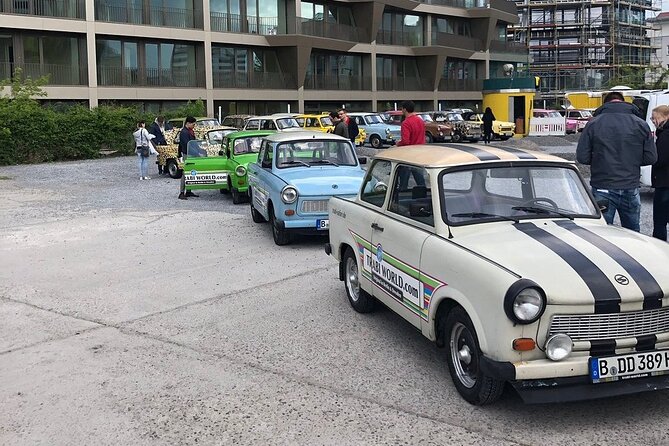
The most unusual way to see Berlin may be from behind the wheel of a 600cc Trabant, the small East German car that once filled the streets behind the Iron Curtain. You follow a guide-led convoy through central Berlin, shifting gears, listening to Cold War stories over the radio, and watching pedestrians reach for their cameras.
I like the tour’s direct connection between car and history, and I like the chance to see several major sights without spending the whole afternoon on foot. The catch is simple: every car has a manual gearbox, and Berlin traffic is no place to learn clutch control from scratch.
Key points at a glance
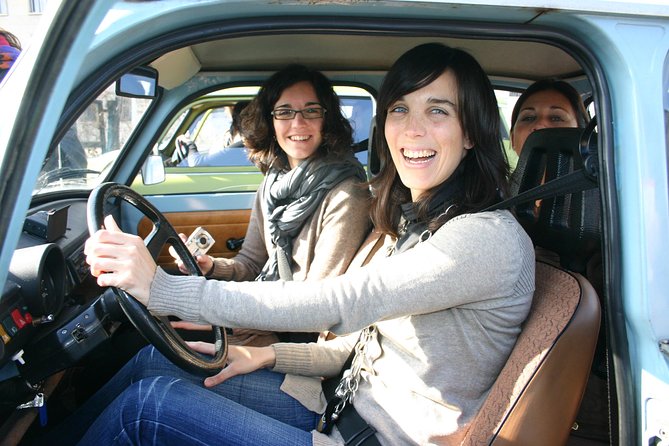
- Drive an East German icon: Choose a colorful Trabant at TrabiWorld, with colors assigned first come, first served.
- See Cold War Berlin from the road: The route includes the Berlin Wall, East Side Gallery, a former border crossing, and a central memorial to German division.
- Expect real city driving: Cars have manual shifts, no modern driving aids, and can be tricky at busy intersections.
- Share the car with up to four people: The total weight limit is 350 kilograms per Trabant.
- Hear the story as you go: Your guide leads the convoy and speaks through a radio system in each car.
- Take home a playful souvenir: Everyone receives a Trabant driver’s license, even if someone else did the driving.
Why a Trabant makes Berlin feel different
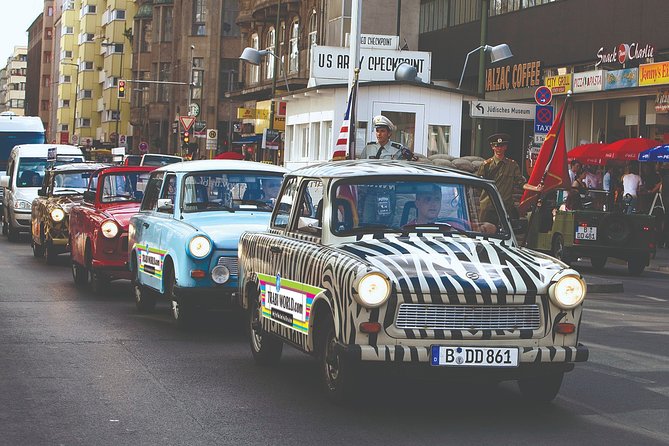
A Trabant is not a polished vintage car built for easy sightseeing. It is small, basic, noisy, and wonderfully old-fashioned. The gear shift is mounted on the steering column, the wing mirrors may not move, and the brakes and steering do not have the assistance you expect from a modern car.
That is the point. The car gives the route a physical connection to East Germany. You are not just hearing about daily life before reunification. You are sitting in one of the machines that shaped it.
The tour begins at TrabiWorld Berlin on Zimmerstrasse, at number 97 to 100. This is a practical central meeting point, close to major sights and public transport. After check-in, you receive a safety briefing and choose from the available car colors. The choice is first come, first served, so arriving with time to spare may help if color matters to you.
Your guide then leads the convoy. The cars travel together, and the guide waits for the group to catch up. That matters in Berlin, where traffic lights, bicycles, scooters, buses, and pedestrians can quickly stretch a small convoy across several blocks.
The commentary comes through a radio system in the car. It is meant to keep the tour moving while giving you the historical setting of each area. Guides named Heinrich and Tomas have led this route, and the guide’s manner can shape the trip. Heinrich is praised for keeping the group together, while Tomas is noted for turning the drive into a moving history lesson.
Other divided-city history in Berlin:
- Berlin: Third Reich and Cold War 2 Hour Walking Tour
★ 4.9 · 6,830 reviews - Berlin’s Best: 2 Hour Walking Tour Third Reich and the Cold War
★ 5.0 · 5,486 reviews - Skip-the-Line: Berlin Wall Museum at Checkpoint Charlie
★ 4.1 · 2,041 reviews
Learning the car before entering traffic
The safety briefing is short, but the driving itself deserves respect. The cars are manual only, and all drivers must show a valid license for non-automatic vehicles. The tour is for adults aged 18 and over as drivers. Children up to age 17 can ride free with an adult, but any needed child seat must be supplied by you.
If you already drive a manual car, you will still need a few minutes to adjust. The Trabant has a different feel from a modern hatchback. The controls are basic, and the car responds more slowly than most vehicles on Berlin streets.
If you are an inexperienced manual driver, this is not an ideal place for a first lesson. One person had trouble at a busy intersection and had to swap seats. Another managed to learn the gears during the tour, but that kind of success depends on calm nerves, traffic conditions, and a helpful passenger.
The good news is that you are not navigating Berlin alone. The guide sets the route, gives instructions, and waits when drivers fall behind. If two adults share a car, switching halfway can give both people a chance to drive, provided the guide and timing allow it.
The central Berlin route
The route works best as a moving introduction rather than a series of long sightseeing stops. You pass many important places, but this is not a hop-on, hop-off tour. The car keeps moving, and most stops are brief.
The opening stretch takes you through central Berlin, including a major public square and traffic intersection. This part shows you the city as a working capital rather than a collection of isolated monuments. You are dealing with lanes, signals, and other road users while the guide explains what you are seeing.
You also pass a famous 18th-century neoclassical monument, the Brandenburg Gate. Its history reaches from Prussian Berlin through the Nazi period, the division of the city, and reunification. Seeing it from a Trabant adds a useful layer: this is the kind of place where the old East and West met symbolically, even when the border divided the city nearby.
The route includes the Red Town Hall, built in the 19th century. Its red brick facade is one of central Berlin’s recognizable landmarks, and it helps place the tour in the older civic heart of the city. You may not have time to stop and study the building, so note its location and return later if you want photographs or a closer look.
East Side Gallery and the Berlin Wall
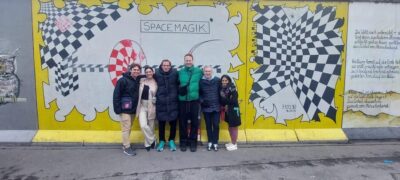
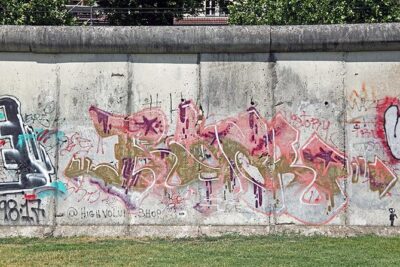
The most colorful part of the route is the East Side Gallery. This open-air gallery covers a 1,316-meter remnant of the Berlin Wall, with murals painted directly onto the concrete.
The gallery is not simply decoration. It is a surviving section of the barrier that divided Berlin, now covered with images connected to freedom, peace, politics, and reunification. You get about five minutes here, which is enough to recognize the site and take a quick look, but not enough for a careful walk along the full length.
That short stop is one of the tour’s main limits. If you want to read the murals, photograph several works, or take in the wall at a slower pace, return separately. The Trabant drive gives you the location and context. It does not replace a dedicated visit.
The East Side Gallery also shows the odd mix of memory and daily city life in Berlin. The wall is a memorial, an art site, and part of an active urban district. From the convoy, you see that contrast quickly, then move on.
Other rides in something old:
- Berlin: 75-minute Trabi Safari
★ 4.8 · 2,854 reviews - Berlin Self-Drive Trabi Tour with Guide
★ 4.5 · 410 reviews - Berlin: The Wall Ride Guided Trabi Tour
★ 4.7 · 157 reviews - Berlin: E-Trabi City Tour
★ 4.8 · 127 reviews
Alexanderplatz, Checkpoint Charlie, and the division memorial
The route also passes a public square known for Berlin’s television tower, Alexanderplatz. The tower is an easy visual marker, and the square helps you understand East Berlin’s former civic center. This is another location worth revisiting on foot, since the short drive cannot cover all its details.
A former border crossing comes next, identified with Checkpoint Charlie. During the Cold War, this was one of the best-known crossing points between East and West Berlin. Today the area is busy with shops, signs, and visitors, but the guide’s explanation helps you picture the controlled border that once cut through the city.
The route also includes a central memorial site dedicated to German division. This portion gives the tour its most serious tone. The Trabant is playful, but the subject is not. Berlin’s division affected families, work, housing, travel, and ordinary routines for decades.
That balance is one of the activity’s strengths. You get the fun of driving a tiny, attention-grabbing car, but the commentary keeps the route tied to the human meaning of the places. Guides such as Heinrich and Tomas have been praised for making the historical information clear while keeping the convoy relaxed.
What the drive feels like in Berlin traffic
The convoy attracts attention. People take photographs, wave, and watch the colorful Trabants pass. That can make the drive feel like a small parade, and it adds an entertaining social side that you would not get from a standard sightseeing bus.
It also means you are conspicuous. If you prefer to move unnoticed through a city, this is not your tour. The cars are slow and old, and you may need patience at intersections.
The streets can be demanding. You share them with cars, bicycles, scooters, and pedestrians. One useful advantage is that the guide does not expect every car to move at exactly the same pace. The convoy pauses or waits when needed, which takes some pressure off less confident drivers.
The radio commentary is generally easy to follow from the back seat, though sound quality can vary. One account describes difficulty understanding the guide because of weak audio. Sit where you can hear clearly, and do not be shy about asking the guide to repeat something before the convoy moves on.
The cars can also produce exhaust that drifts into the cabin, especially when you are following another Trabant. If you are sensitive to fumes or have a sore throat, this is worth considering. It is part of the old-car character, but it is not the most comfortable feature.
Sharing a Trabant with your group
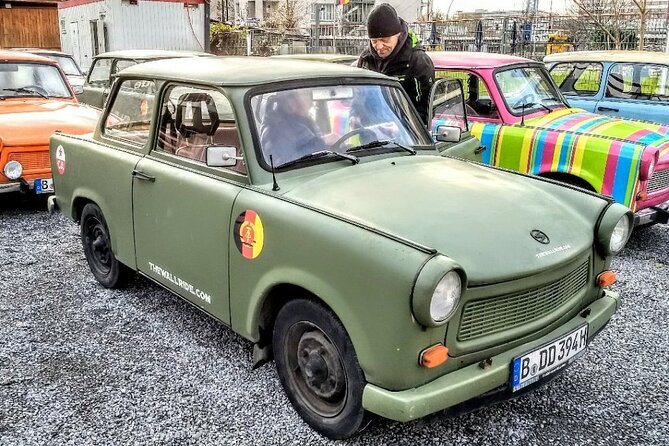
Each vehicle carries up to four people and has a maximum total weight of 350 kilograms. That makes the car suitable for a couple, a small family, or a compact group of friends. Four adults can fit, but personal space will be tight.
Tall passengers have managed to ride together, yet you should not expect generous legroom. If comfort matters more than novelty, two people in a car will be easier than four. If your group is larger, the activity allows a maximum of 12 participants overall, so the convoy remains fairly small.
Children can ride with an adult at no charge up to age 17, but they cannot drive. You must bring a child seat if one is needed. This can make the tour useful for a family visit, though the manual driving and compact cabin may be less comfortable for very young children.
The souvenir Trabant driver’s license goes to everyone, not only the person who takes the wheel. That is a small touch, but it solves a common problem in shared cars. A passenger still gets a keepsake from the experience.
Is $119.48 a fair price?
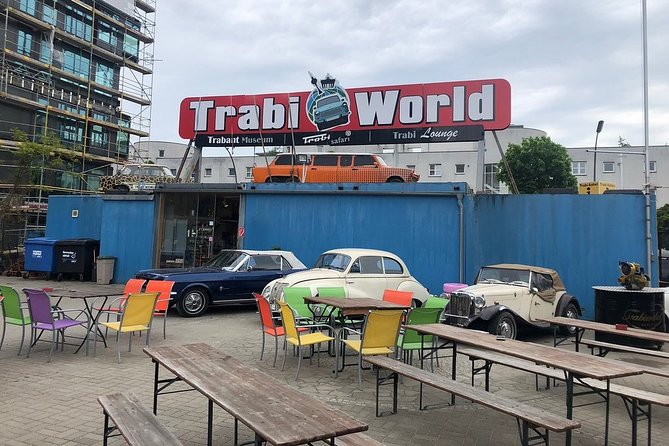
At $119.48 per person, this is not the cheapest way to pass Berlin’s major sights. Public transport and walking cost far less, and a conventional city tour may cover more information in a calmer setting.
The value comes from the combination of transport, entertainment, and access to a piece of East German material culture. You receive an in-person guide, the use of a Trabant, a roughly 2-hour-15-minute route, and a souvenir license. You also avoid arranging a rental car or learning a historic vehicle on your own.
For two people who both want to drive, the price feels more reasonable because the activity becomes part sightseeing tour and part hands-on museum visit. If only one person is interested in cars and the other dislikes manual driving, the value is weaker.
The tour is often booked about 25 days ahead, so do not leave it until the last moment if your dates are fixed. The activity begins at 11:30 a.m. and ends back at TrabiWorld, with no hotel pickup, drop-off, lunch, or separate meal stop.
The booking is non-refundable and cannot be changed after purchase. That makes it important to check the date, driving requirements, group size, and weather before paying.
Who should book this Berlin drive?
I would choose this tour for a first or second day in Berlin, when you want a broad look at the central sights before returning to the places that catch your interest. It is especially good for people who enjoy cars, Cold War history, unusual museums, or activities that get you out of the walking routine.
It suits confident manual drivers best. You should be comfortable with a clutch, willing to handle city traffic, and ready for a car with no modern refinements. A passenger who can help with directions and keep the mood light is useful, even though the guide leads the way.
It is less suitable for anyone seeking a quiet, slow visit to the Berlin Wall. You will not have long at each site, and the convoy format means you see the city in passing. Plan a separate visit to the East Side Gallery or the division memorial if those places are central to your interests.
Should you book the Trabant tour?
Book it if you want Berlin history with a steering wheel in your hands. The Trabant connects the vehicle to the city’s divided past, while the convoy covers major landmarks in a lively two-hour route.
Skip it if you dislike manual cars, busy streets, tight seating, or a fixed, non-refundable booking. For everyone else, this is a memorable way to get your bearings, hear the story of divided Berlin, and leave with more than another set of monument photographs.
FAQ
Where does the Berlin Wall Trabant tour start?
It starts at TrabiWorld Berlin, Zimmerstrasse 97-100, 10117 Berlin, Germany.
What time does the tour begin?
The scheduled start time is 11:30 a.m.
How long does the tour last?
The tour lasts approximately 2 hours and 15 minutes.
Where does the tour finish?
The activity ends back at the TrabiWorld meeting point.
Do I need a manual driving license?
Yes. All Trabants have manual gearboxes, and every driver must provide evidence of a valid license for non-automatic cars.
How many people can ride in one Trabant?
Each Trabant can carry a maximum of four people and has a total weight limit of 350 kilograms.
Can children join the tour?
Children up to age 17 may join free when accompanied by at least one adult. Children cannot drive, and you must bring a child seat if one is needed.
Is lunch or hotel transportation included?
No. Lunch and hotel pickup and drop-off are not included.
Just added in Berlin
- Private Walking Tour: Berlin Wall, Cold War and Checkpoint Charlie★ 5.0 · 37 reviews
- Modern Berlin Private Walking Tour: Diverse, Vibrant and Exciting German Capital★ 5.0 · 13 reviews
- Private One way Airport Transfer Berlin Airport To Berlin★ 3.5 · 17 reviews
- Private Day Trip to Potsdam from Berlin by Train★ 4.5 · 27 reviews
- City Explorer: Potsdam Private Day Trip★ 4.5 · 10 reviews
- Berlin Private Custom 5-Hour Tour by Car★ 5.0 · 30 reviews
- Private Half-Day Sightseeing Tour in Berlin★ 3.5 · 6 reviews
- Berlin Private Custom Tour in a Minivan, East and West★ 5.0 · 123 reviews
Berlin Wall & Cold War Tours, compared.

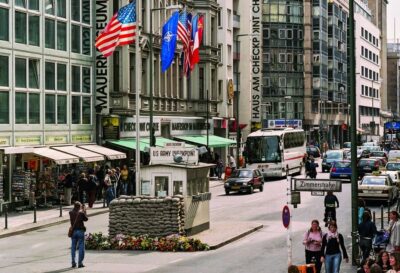
Skip-the-Line: Berlin Wall Museum at Checkpoint Charlie
Read our review →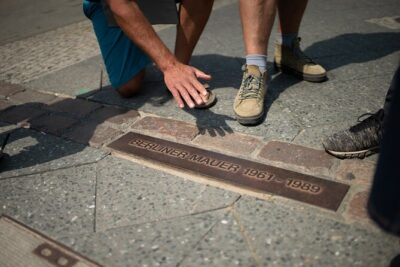
Cold War, Berlin Wall, Spies and the East Side Gallery
Read our review →
Guided Bike Tour of the Berlin Wall and Third Reich
Read our review →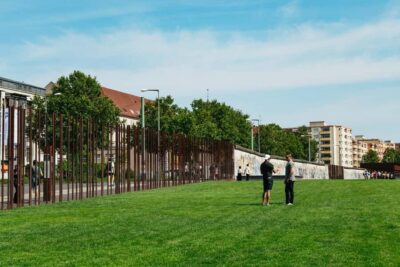
East Berlin and the Berlin Wall 2-Hour Walking Tour
Read our review →Browse the lists this tour appears in