
Reviewed · WALKING TOURS
Rostock: Private Guided Walking Tour
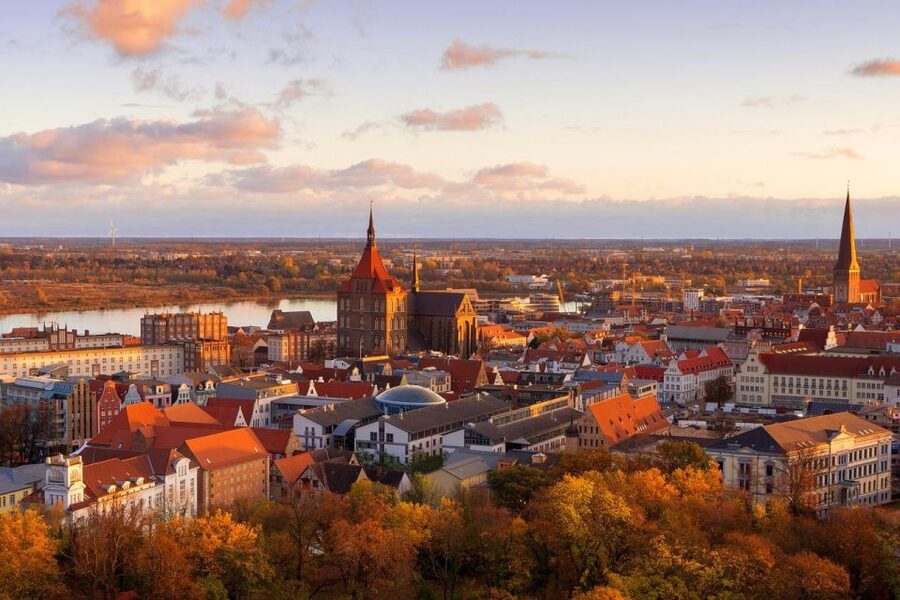
Rostock’s story comes into focus fastest on foot. In two hours, you move from the seven-towered Town Hall and Neptune fountain to St. Mary’s astronomical clock, battered churches, old walls, and the Stone Gate. The city’s Hanseatic past and postwar rebuilding give the buildings more meaning than a quick photo stop ever could.
I like the private format, since your guide can adjust the pace and answer your group’s questions. I also like the mix of grand landmarks and smaller details, including the fountain figures, a surviving section of wooden wall walk, and the university’s Fountain of Happiness. The main drawback is time: two hours is enough for an overview, but not for long interior visits or a leisurely look at every church.
Key points at a glance
- Start at New Market Square: Meet by the Seagulls’ Fountain, an easy central point surrounded by Rostock’s most important civic buildings.
- See St. Mary’s famous clock: Its 15th-century astronomical clock is one of the tour’s most unusual sights.
- Follow the Hanseatic story: Learn how Rostock grew through trade and its place in the Hanseatic League.
- Connect war and rebuilding: St. Petri Church and other landmarks show how WWII damage shaped the city.
- Walk the old defenses: Ramparts, guard houses, a wooden wall walk, and Stone Gate reveal Rostock’s medieval edge.
- Book for a private group: The price is $280 for up to 15 people, with an English- or German-speaking guide.
Why Rostock makes a strong walking-tour city
Rostock is a Baltic port with a long reach. It is Germany’s fourth-largest port city and the largest on the German Baltic coast, linking the country with Scandinavian destinations and cruise routes around the world. That maritime role is not just a modern statistic. It helps explain why the city’s public buildings, churches, gates, and open squares grew so grand.
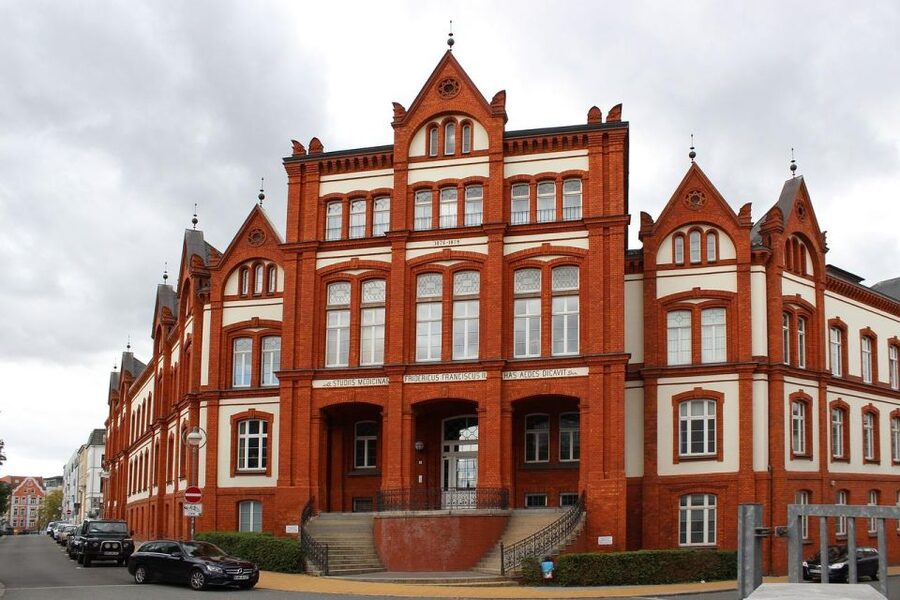
The tour also introduces Rostock as a university city. Its university dates to 1419 and is one of the oldest in the world, as well as the oldest in the Baltic region. That gives the city a useful contrast: merchant wealth, seafaring work, religious architecture, and student life all occupy the same compact center.
I find this kind of introduction valuable because it keeps the walk from becoming a parade of names. You are not only told that a building is old. You learn why Rostock had the money and influence to build it, how war changed it, and why the city still matters today.
Other walks around Rostock:
- Rostock: City Walking Tour
★ 4.9 · 198 reviews - Discover Berlin Half-Day Walking Tour
★ 5.0 · 9,624 reviews - Berlin: Third Reich and Cold War 2 Hour Walking Tour
★ 4.9 · 6,830 reviews
New Market Square and the seven-towered Town Hall
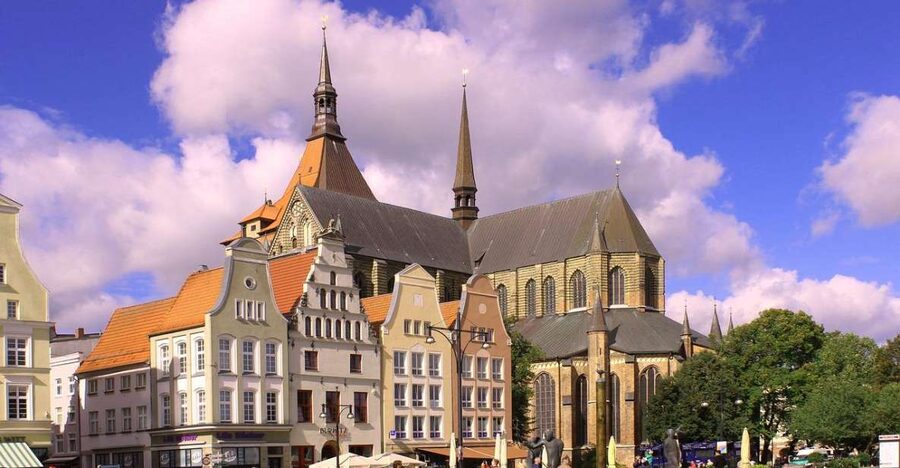
Your meeting point is the Seagulls’ Fountain in New Market Square, Neuer Markt, 18055 Rostock. This is a practical place to begin because the square puts several important sights in front of you at once.
The Town Hall is the first major visual lesson. Its style mixes Gothic and Baroque features, and its seven towers give the building a distinctive profile. Your guide explains how Rostock’s civic power took shape here, tying the building to the city’s trade and municipal life.
The Seagulls’ Fountain adds a lighter touch. Its figures represent Neptune, the sea god, and his sons, an apt subject in a port city whose fortunes were tied to the Baltic. This is the sort of detail that rewards a few extra minutes. The fountain is not merely decoration. It reflects Rostock’s relationship with the water and the people who worked on it.
New Market Square also helps you get your bearings. Since the route begins here, you can pay attention to the surrounding architecture before moving into the narrower streets and church spaces. If you are arriving from a cruise or planning to explore independently afterward, the central location makes this a useful first orientation.
St. Mary’s Church and a clock from the 15th century
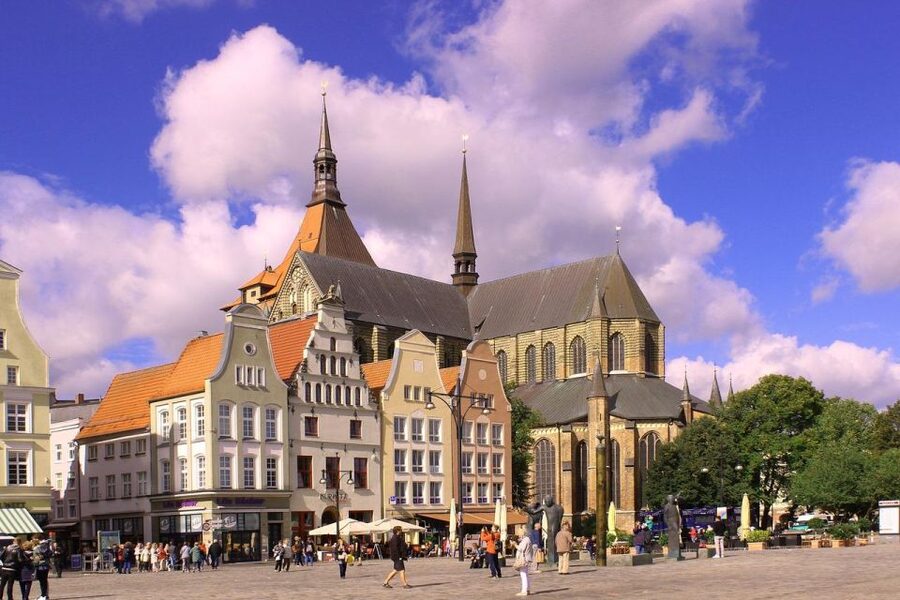
St. Mary’s Church is one of the tour’s strongest stops. It was the only main Rostock church to survive the WWII air raids, making it an important link between the older city and the rebuilt one.
Inside, the main attraction is the astronomical clock built in the 15th century. The clock gives the visit a mechanical and scientific angle, not just a religious or architectural one. Ask your guide to explain what you are seeing, since the significance of an old astronomical clock can be easy to miss if you simply walk past it.
The church also anchors the wartime part of the tour. Rostock’s story is not presented as a frozen medieval scene. The city suffered heavy bombing, and its survival required rebuilding and adaptation. St. Mary’s provides a rare direct connection to what remained, while other landmarks show how much had to be restored or reconstructed.
Entrance fees are not included, so check the current arrangements if entering the church matters to you. The walk itself covers the exterior landmarks and historical context, but interior access can involve separate charges or opening conditions.
St. Petri Church and the cost of war
St. Petri Church offers a different view of WWII. Its Gothic tower was a key landmark for local fishermen, a useful signal for people approaching or working from the Baltic. The church was destroyed during the war and rebuilt later.
That combination of loss and reconstruction is central to understanding Rostock. You see how a city can preserve an old identity even when parts of its physical fabric are gone. The rebuilt church is not simply an old building untouched by time. It is also evidence of the decisions made after destruction.
The tower’s connection to fishermen gives the stop a human scale. A church tower can be a religious monument, a navigation point, and a familiar sight for families tied to the sea. Your guide can connect those roles to Rostock’s position as a major port.
Do not expect a separate visit to every church interior in a two-hour route. The strength here is the comparison: St. Mary’s survived the raids, while St. Petri’s was rebuilt. Seeing both allows you to understand the city’s wartime experience without spending the entire tour inside churches.
A few more things to do in Rostock worth a look
- Berlin: Private Reichstag and Glass Dome Tour
★ 4.8 · 2,226 reviews - Berlin Private Complete History All Day Walking Tour
★ 5.0 · 474 reviews - Munich Private Tour with a Local – Highlights & Hidden Gems
★ 5.0 · 469 reviews - Private Walking Tour Berlin Third Reich Hitler and World War II
★ 5.0 · 360 reviews
Ramparts, guard houses, and a surviving wooden wall walk
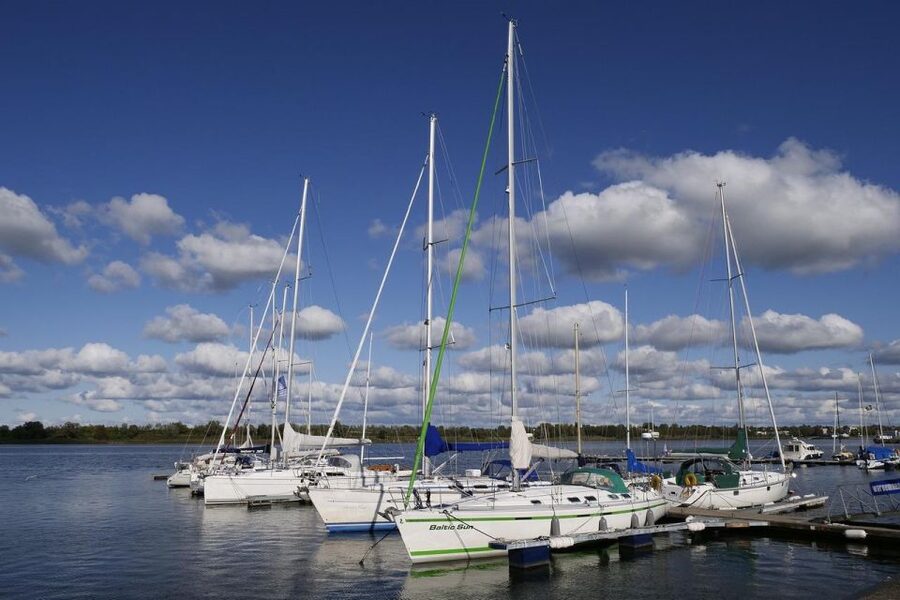
Rostock’s old fortifications add texture to the walk. Parts of the city defenses remain, including stretches of ramparts, built-in guard houses, and a section of wooden wall walk.
These fragments are easy to underestimate. A large church or ornate town hall announces its importance immediately. A wall section requires your guide to explain how it worked. Once you understand that the defenses helped protect a trading city, the surviving pieces become much easier to read.
The wall walk is especially useful because it shows how soldiers and guards once moved along the defenses. The ramparts also offer a break from the grand civic architecture. You get a sense of Rostock as a fortified working city, not only a place of churches and merchant buildings.
The remains are partial, so this is not a fully preserved medieval fortress circuit. That is worth keeping in mind. The appeal lies in reading the surviving sections alongside the modern city, seeing where the old defensive line still shapes the center.
Stone Gate and a message about civic life
The Dutch Renaissance Stone Gate is one of the tour’s most memorable architectural details. Its design marks a change from the more familiar Gothic forms and shows how outside artistic influences reached this Baltic trading city.
The motto on the walls reads: May harmony and prosperity reign within your walls. It is a fitting message for a city shaped by commerce, civic order, and competition among port towns. It also gives you something concrete to remember after the tour, a short line that connects architecture with the hopes of the people who built it.
This is a good place to consider Rostock’s Hanseatic role. The Hanseatic League was an influential network of trading towns and merchant communities around northern Europe. Rostock benefited from that system, and its public buildings and defenses reflect the need to protect wealth, manage trade, and project civic strength.
Your guide’s explanation matters here. Without context, a gate is simply a photogenic entrance. With context, it becomes a statement about status, security, and the city’s place in a wider trading world.
The university and the Fountain of Happiness
Rostock’s university dates to 1419, making it one of the oldest universities in the world and the oldest in the Baltic region. The tour includes the university area and its Fountain of Happiness.
This stop broadens the city story. Rostock is not only a port and former Hanseatic power. It is also a place of study and long-running intellectual life. The university helps explain why the city has a cultural role that reaches beyond shipping and commerce.
The Fountain of Happiness provides a smaller, more local point of interest. It is the kind of feature you might pass without noticing on your own. A private guide can point it out, explain its place in the city, and adjust the discussion to what interests your group.
That flexibility is one of the clearest benefits of booking privately. You can ask for more detail about the university, the churches, the Hanseatic League, or the wartime rebuilding instead of following a fixed script. Jana, one of the guides available for this experience, has been specifically praised for offering appealing local insights and guiding the city with care.
How the two-hour pace works
Two hours gives you a compact route through the main center. You should expect a steady walk with repeated stops for explanation and photographs, rather than a long museum-style visit at each landmark.
The route works best if you want a clear first look at Rostock. You will cover the New Market Square, Town Hall, Seagulls’ Fountain, St. Mary’s Church, St. Petri Church, the fortifications, Stone Gate, and the university area. That is a lot for one short tour, so some sights may receive only a brief exterior explanation.
I would treat this as an orientation walk, not the whole Rostock experience. Afterward, you can return to the church or square that interested you most. The tour gives you a framework, then leaves you better prepared to explore independently.
The private group can include up to 15 people. That makes the $280 group price easier to assess. For one or two people, it is a substantial cost. For a larger family or group of friends, the per-person price drops sharply. At the maximum group size, it works out to less than $19 per person before any separate entrance fees.
Price, flexibility, and who gets the best value
The $280 price covers the private guide for your group, with possible customization during the walk. It does not include entrance fees. That distinction matters if your main goal is going inside several sights, but it is less important if you mainly want orientation, context, and exterior architecture.
I see the strongest value for groups that want a personal pace. A family with different ages, friends arriving from a cruise, or a small group interested in WWII and Hanseatic history can shape the conversation more easily than on a large scheduled walk.
English and German are available. The guide is with your group only, which can make the experience feel less formal and easier to adapt. The activity also allows reservation with payment later, and cancellation is free up to 24 hours before the start for a full refund. Those policies are useful if your Baltic itinerary may shift.
The main value question is group size. If you are alone or traveling as a couple, compare this cost with other walking options in Rostock. If you are sharing the price among several people, the private format becomes much more appealing.
Who should book this Rostock walk
I would choose this tour if you want the city’s main ideas explained in a short window. It suits first-time visitors, cruise passengers with limited time, history-minded families, and anyone who prefers questions and conversation over a fixed group script.
It is also a good match if you want wartime history included with the older Hanseatic story. Many city walks focus only on attractive façades. This one connects surviving buildings, destroyed landmarks, and reconstruction, giving you a more honest sense of Rostock.
I would hesitate if you want a slow architectural study, long interior visits, or a full day focused on museums. Two hours cannot cover every corner, and entrance fees are separate. You may also prefer a different arrangement if your group is very small and the $280 private rate feels high.
Should you book the Rostock private walking tour?
Book it if you want a focused introduction to Rostock with a guide who can adjust the conversation to your group. The best parts are the contrast between St. Mary’s surviving church and St. Petri’s rebuilt tower, the unusual astronomical clock, the Hanseatic explanation at Stone Gate, and the small details at the fountains and fortifications.
For a group of several people, the price can be fair, especially when you value privacy and flexibility. For one or two people, consider how much you want personal guiding versus exploring the center on your own.
If you do book, meet at the Seagulls’ Fountain in New Market Square and use the two hours to ask direct questions. Ask about the clock, the bombing and reconstruction, the university, and Rostock’s port connections. That is where this walk offers its greatest value: it turns a pleasant old center into a city you can understand.
FAQ
Where does the tour meet?
The meeting point is by the Seagulls’ Fountain in New Market Square, Neuer Markt, 18055 Rostock.
How long does the walking tour last?
The tour lasts two hours.
What languages are available?
The live guide is available in English or German.
Is this a private tour?
Yes. It is a private group tour, and the guide is with your group only.
How many people can join one booking?
The price covers a group of up to 15 people.
What is included in the price?
The price includes a local professional guide and possible customization during the tour with the guide.
Are entrance fees included?
No. Entrance fees are not included.
How much does the tour cost?
The listed price is $280 per group of up to 15 people.
Can I cancel the booking?
Yes. You can cancel up to 24 hours in advance for a full refund. You can also reserve now and pay later.
Just added in Rostock
- Rostock: Hot Rod Harbor City Tour★ 4.9 · 16 reviews
- Rostock: Electric Boat Rental on the Warnow River★ 4.8 · 106 reviews
- Rostock: Tour with the Rostocker Executioner★ 4.7 · 28 reviews
- Rostock: Hot Rod Sightseeing Tour to Warnemünde★ 5.0 · 19 reviews
- Berlin and Sachsenhausen: Shore Trip from Warnemünde Port★ 4.8 · 40 reviews
- Discover Rostock: A Guided City Tour for Cruise Guests★ 3.7 · 7 reviews
- Distillery tour with guide!★ 4.7 · 14 reviews
- Brewery tour with guide!★ 4.8 · 13 reviews
Walking Tours, compared.

Third Reich Berlin: Hitler and WWII Walking Tour
Read our review →
Browse the lists this tour appears in