
Reviewed · WALKING TOURS
Explore Berlin: Walking Tour of All The Iconic Sites
Berlin’s past is not tucked away in one museum. It is under your feet, in the empty space where the Berlin Wall once ran, beneath the Brandenburg Gate, and in the quiet square where Nazi book burning took place. This three-hour walk connects those places in a way that helps you understand how Berlin changed from Nazi capital to divided Cold War city to united Germany’s capital.
I like the strong line-up of major sights and the way the guide links them together instead of treating each stop as an isolated photo opportunity. I also like the excellent price, since $17 gives you a useful first look at central Berlin without committing half a day or paying museum-level admission.
The main drawback is simple: you cover a lot of ground. The pace includes frequent stops, but you still need comfortable shoes, water, and a willingness to walk in rain or shine. This is an outdoor history lesson, not a relaxed café-and-castle outing.
Key points at a glance
- Start beside the Palace of Tears: Meet outside Friedrichstrasse station, where guides carry yellow umbrellas.
- See Berlin’s central history in one route: Museum Island, Bebelplatz, Gendarmenmarkt, Checkpoint Charlie, the Wall, Hitler’s Bunker, the Holocaust Memorial, Reichstag, and Brandenburg Gate.
- Get the connections, not just the snapshots: The guide explains Berlin’s shift from dictatorship to division and then reunification.
- Expect a steady three-hour walk: Stops are regular, but the route still covers substantial ground.
- Choose your language and group style: Tours run in English, German, or Spanish, with small-group and private options available.
- Pay little for a useful orientation: At $17 per person, this works well near the start of a Berlin visit.
Why this route works for a first look at Berlin
Berlin can feel confusing at first. Its key sights are spread across a broad central area, and the city’s story jumps between Prussian kings, Nazi terror, the Cold War, and reunification. A guided walk gives you a framework before you tackle individual museums and memorials.
This route is especially useful because it follows the city’s political center. You see where power was displayed, where it was abused, where Germany was divided, and where modern Germany presents itself today.
The guide’s job matters here. A list of monuments would be easy to find on a map. The value comes from explaining how the sites fit together. Guides including Hannah, Daniel, Maria, Rohan, Tina, Ru, Xavier, and others are praised for clear explanations, humor, patience, and practical recommendations. The best guides on this tour do not bury you in dates. They keep the story moving and make room for questions.
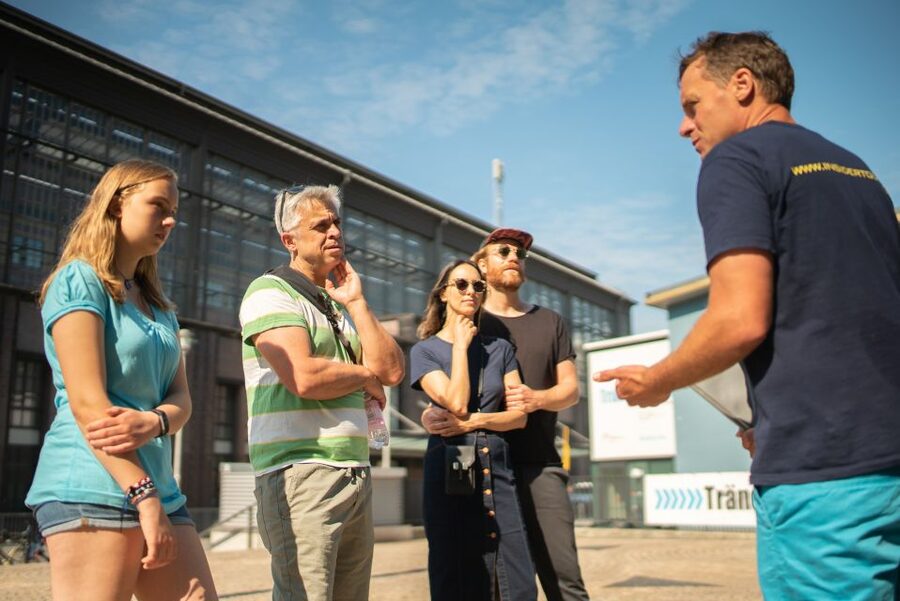
You can book an English, German, or Spanish tour. Private options include pickup from your Berlin accommodation, while the standard meeting point is outside Friedrichstrasse train station beside the Traenenpalast, also called the Palace of Tears. Look for the yellow umbrellas.
Other walks around Berlin:
- Discover Berlin Half-Day Walking Tour
★ 5.0 · 9,624 reviews - Berlin: Third Reich and Cold War 2 Hour Walking Tour
★ 4.9 · 6,830 reviews - Berlin: Discover Berlin Walking Tour
★ 4.9 · 5,998 reviews
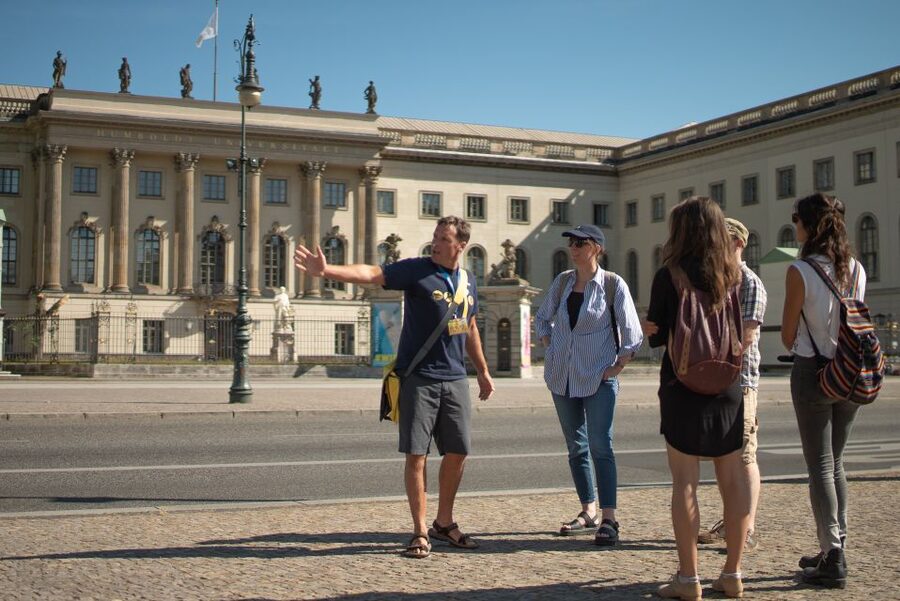
Museum Island begins the historical sweep
The walk includes a guided look at Museum Island, the group of major museums on an island in the River Spree. You should not expect an interior museum visit as part of this activity. Instead, the guide uses the area to explain Berlin’s cultural and political center.
This is a useful opening stop because it shows that Berlin’s story is not only about war and division. The city also built grand institutions to display art, archaeology, and national ambition. You get a quick orientation to the area, then continue through the historic center.
The 15-minute stop is short, so note down any museum you want to visit later. This tour is best used as a preview, not a substitute for time inside Berlin’s museums.
Bebelplatz turns a square into a warning
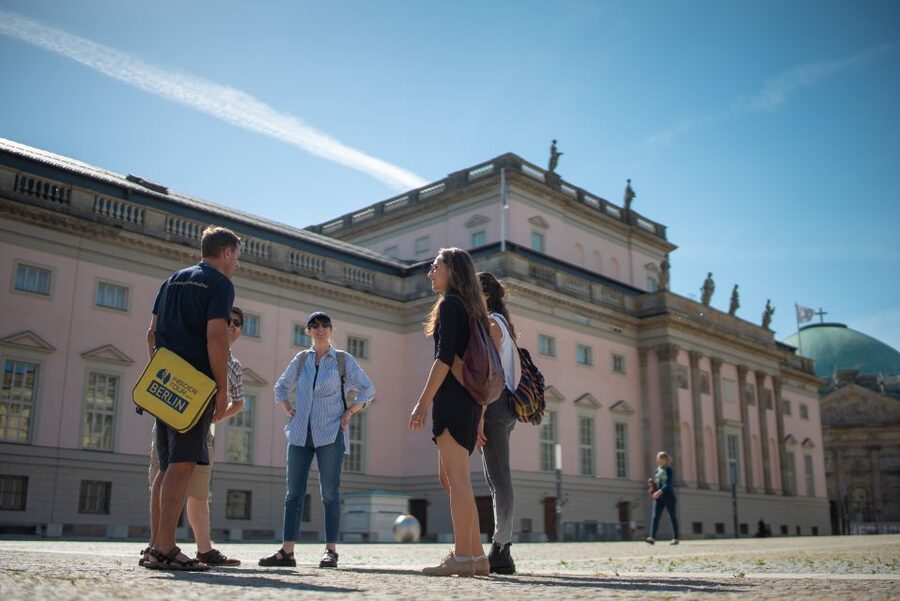
At Bebelplatz, the guide discusses the site of the Nazi book burning. The square looks open and formal, which makes the history easy to miss if you walk through alone.
This stop shows one of the tour’s strengths. Berlin often hides painful stories behind ordinary public spaces. The guide points out what happened and explains why the location matters, helping you read the city rather than simply photograph it.
You spend around ten minutes here. That is enough for context, though anyone wanting a detailed study of Nazi censorship will need a separate museum or memorial visit.
Gendarmenmarkt adds a different Berlin
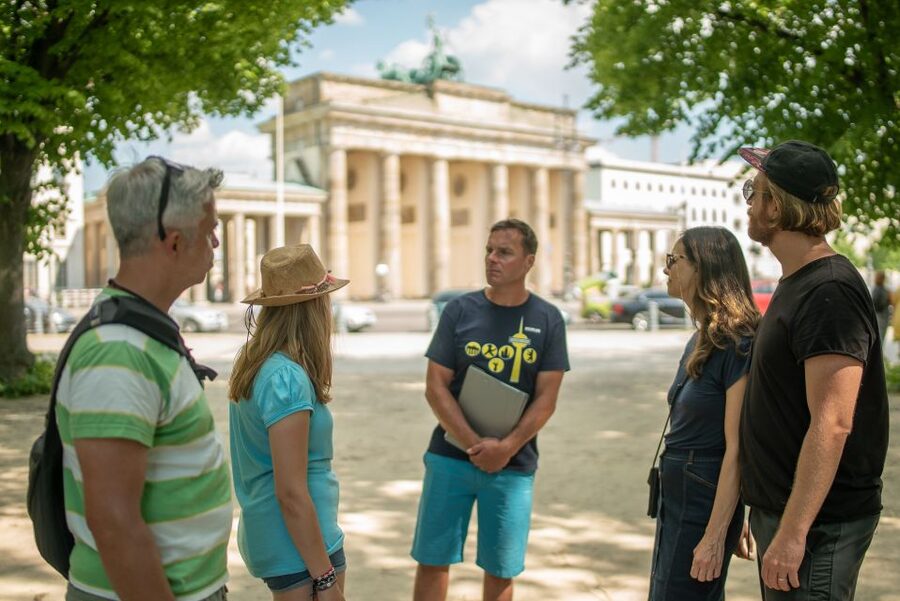
Gendarmenmarkt offers a change of mood and architecture. The guide uses the square to broaden the story beyond the twentieth century and show another layer of Berlin’s development.
The stop lasts about ten minutes. It works as a visual pause between the more difficult subjects at Bebelplatz and Checkpoint Charlie. You see a formal public square while hearing how Berlin’s center was shaped across different periods.
Because the tour covers many eras, the treatment here is introductory. That is a benefit if you are new to Berlin, but history buffs should expect a concise explanation rather than an architectural lecture.
Same base, a different kind of day out:
- Berlin: Reichstag, Dome and Government District Guided Tour
★ 4.7 · 18,288 reviews - Berlin: 1-Hour City Tour by Boat with Guaranteed Seating
★ 4.3 · 16,993 reviews - Berlin: Boat Tour Along the River Spree
★ 4.4 · 11,252 reviews - Berlin: Hop-on Hop-off Bus Tour with Live Commentary
★ 4.3 · 8,579 reviews
Checkpoint Charlie explains a divided city
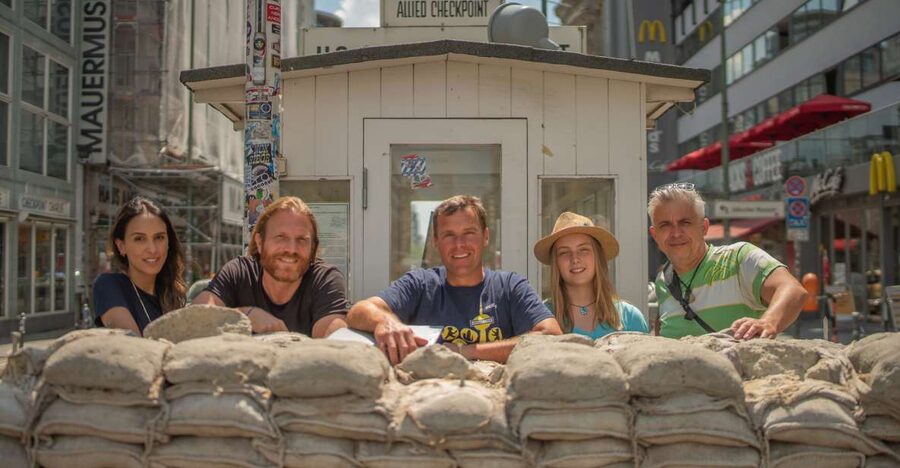
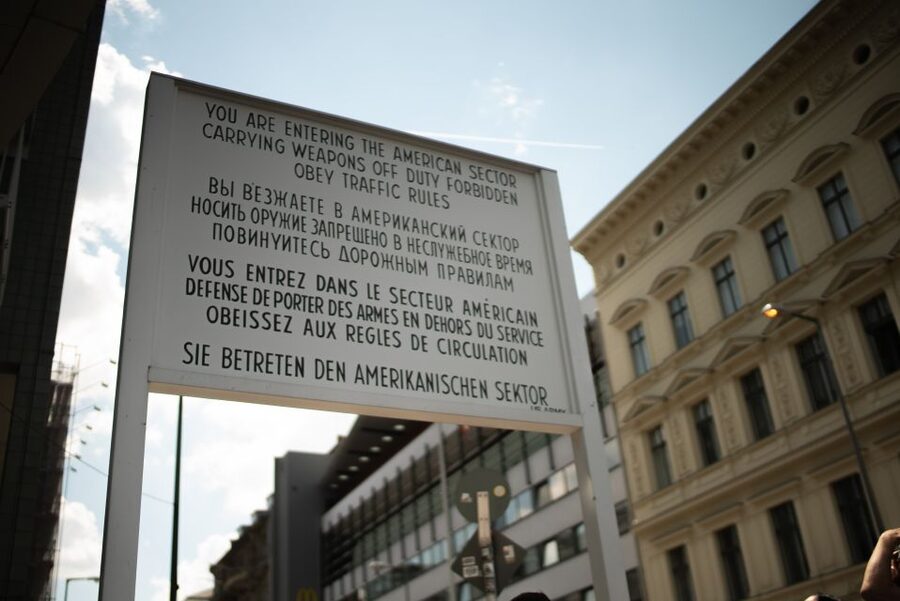
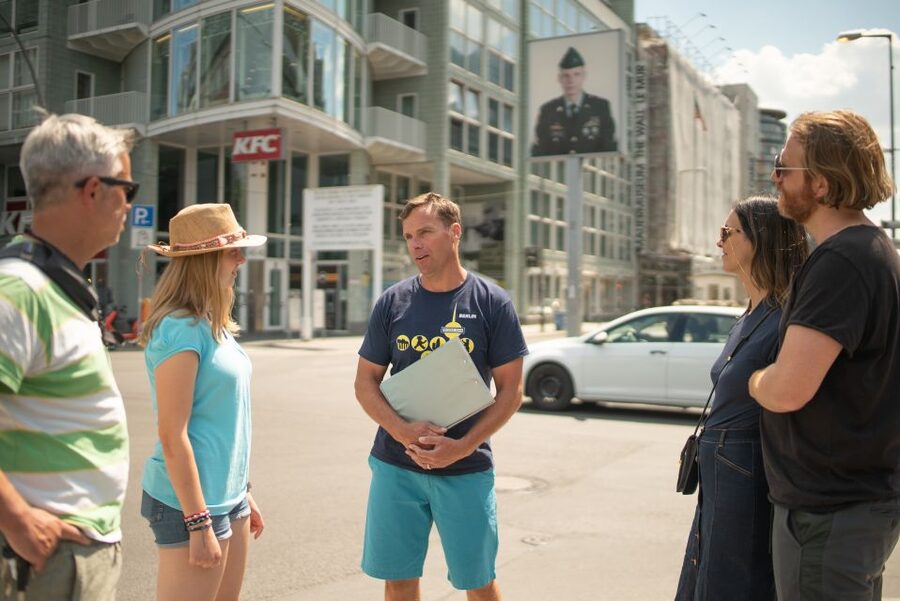
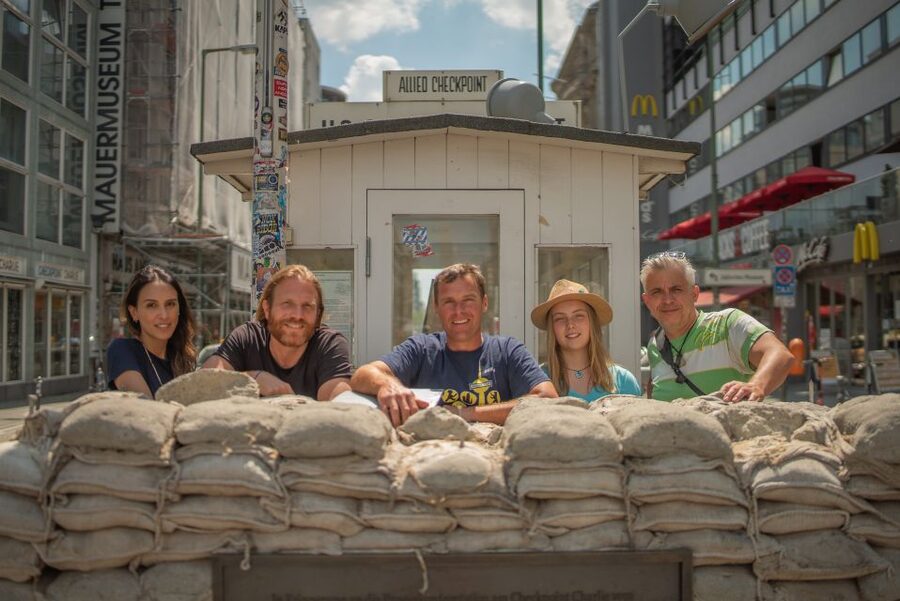
Checkpoint Charlie is one of the most recognizable Cold War locations in Berlin. The tour stops for photographs and explains the former crossing between East and West Berlin.
The important thing here is not just the guardhouse or sign. It is the idea of a city divided by political systems, military power, and a border that shaped everyday life. Your guide can connect this stop with the later Wall visit, making the division easier to understand.
Checkpoint Charlie can feel crowded and commercial, and the immediate area is not the most atmospheric part of Berlin. A guide helps you look past the staged photo moment and focus on the crossing’s historical purpose.
Touching the Berlin Wall brings the Cold War closer
The Berlin Wall stop gives you a direct encounter with a surviving section or visible reminder of the former barrier. The tour also discusses escape attempts, espionage, and the separation of East and West.
This part often carries the most emotional weight because the Wall was not an abstract political boundary. It cut through streets, neighborhoods, and families. Standing beside it gives the later discussion of reunification a physical anchor.
The stop is listed as both a photo opportunity and a guided explanation. Bring a camera if you want a record, but give yourself time to listen. The Wall is easy to reduce to a quick snapshot, yet the guide’s context is the useful part.
Hitler’s Bunker is a lesson in what is absent
The stop at Hitler’s Bunker is not a visit inside a preserved attraction. The site is associated with the former bunker, while the visible surroundings offer little in the way of a dramatic monument.
That absence is part of the point. The guide explains what happened at the site and places it within the final days of the Nazi regime. You are asked to think about how a location tied to a dictatorship has been treated in modern Berlin.
The tour gives this stop about ten minutes. That keeps the discussion focused and prevents the bunker from becoming a sensational detour. It also fits the larger theme of Berlin: the city often presents history through traces, gaps, and deliberately restrained memorials.
The Holocaust Memorial asks for quiet attention
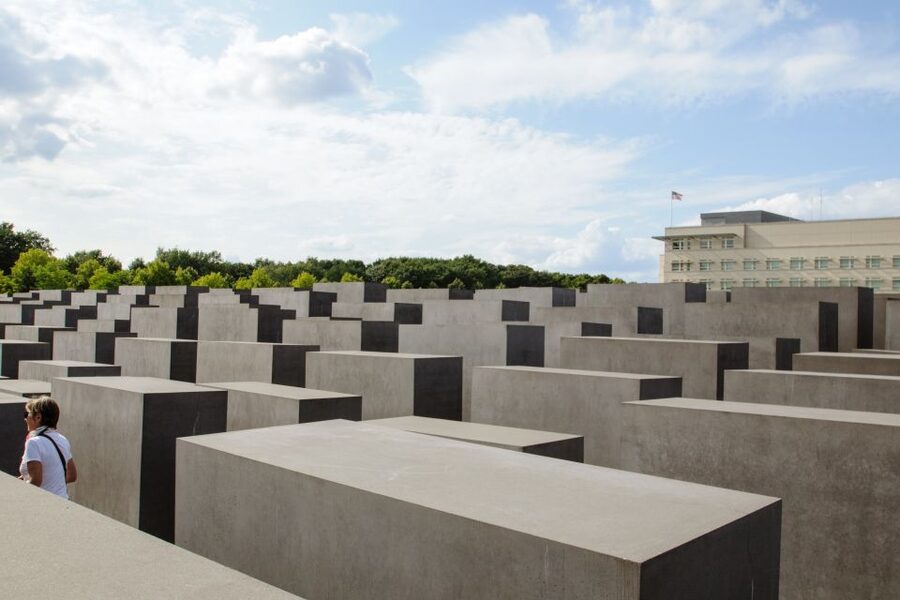
The Memorial to the Murdered Jews of Europe is one of the tour’s most important stops. Its field of concrete slabs creates an uneasy sense of changing height and direction as you walk through it.
Your guide explains the purpose of the memorial and gives you time to consider it. This is not a site for a rushed speech or casual sightseeing. The best approach is to listen, walk respectfully, and notice how the memorial changes as you move through it.
The stop lasts around 15 minutes, longer than several other locations. Even so, you may want to return on your own if you need more time. The memorial’s effect comes partly from walking through it without a fixed route.
The Reichstag shows modern Germany’s political face
The Reichstag, home of Germany’s parliament, marks a shift from historical memory to present-day government. The building’s past includes imperial politics, the Nazi period, wartime destruction, and the return of parliament to Berlin after reunification.
The tour views the building from outside and explains its role. It does not include a Reichstag interior visit or a guaranteed dome entry. If you want to see the dome, arrange that separately and allow extra time.
This stop works well near the end of the route. After hearing about dictatorship and division, you see the building used by the federal parliament of a united Germany. The contrast gives the tour a clear sense of change without pretending that the past has disappeared.
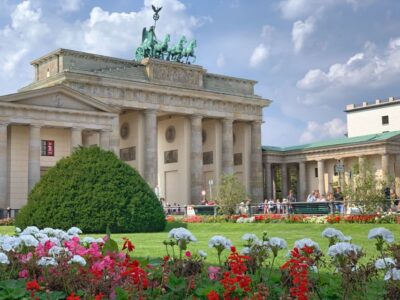
Brandenburg Gate closes the story with a powerful image
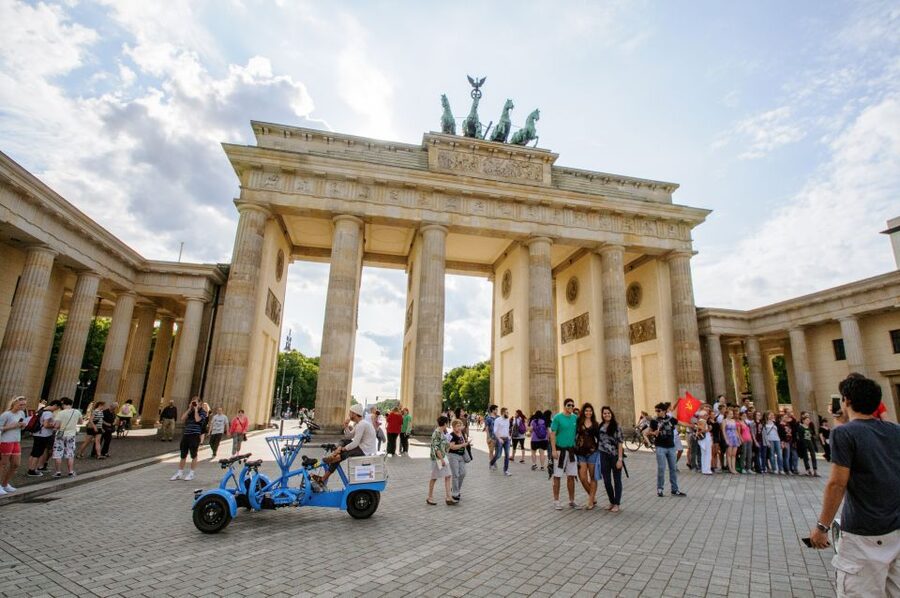
Walking through the Brandenburg Gate is the natural finish. Once tied to Prussian power, the gate later became a symbol of division because it sat near the Berlin Wall, and then a symbol of reunification after the Wall fell.
The guide explains how its meaning changed over time. That is more useful than simply learning when it was built. The same monument can represent different ideas depending on who controls the city and what the city has just endured.
Pariser Platz provides a fitting final setting for questions and photographs. The tour information lists two ending locations, including Pariser Platz, while the standard activity details also describe the walk as ending back at the meeting point. Confirm the exact finish for your selected departure option when booking.
How much walking should you expect?
The advertised duration is three hours, with guided stops of roughly ten to fifteen minutes. You are not walking without pause, but the route is active and covers many central sights.
Wear shoes you can comfortably use for several hours. Bring water, and take an umbrella or rain layer because the tour operates in all weather. One guide specifically advised bringing water and an umbrella, practical advice for Berlin’s changeable conditions.
Wheelchair access is listed, but a participant using a wheelchair should still confirm the route details for the chosen group and departure option. The tour takes place outdoors and includes public squares, streets, and memorial spaces.
Guides make the difference
The strongest part of this experience is the human delivery. The guide names associated with the tour include Hannah, Daniel, Maria, Rohan, Tina, Ru, Giles, Glen, Emma, Paul, Xavier, Arte, and Natalie.
The praise is consistent across the guide team: clear historical explanations, humor used at the right moments, patience with questions, and genuine enthusiasm for Berlin. Hannah is noted for making the past accessible to families, including children aged 10 and 12. Daniel is described as both entertaining and caring, with some tours running beyond the scheduled time because the group remained engaged.
You should still keep expectations realistic. A walking tour depends on the individual guide and the day’s group. Some guides may give more detail, while others may move faster through the facts. The small-group and private options give you a better chance to ask questions and shape the conversation.
The tour is also a good place to ask for practical suggestions. Guides have offered advice about restaurants, bars, public transport, and things to do after the walk. If you are booking near the start of your stay, keep a short list of questions ready.
Is $17 a good value?
At $17 per person, this is strong value if you want orientation and historical context. You see many of Berlin’s most important central sites in one outing, and the guided explanations help you decide where to spend more time later.
The price does not cover museum admission or a Reichstag interior visit. That is not a problem if you view the walk as a city introduction. It would be less suitable if you want long visits inside buildings or detailed examination of individual memorials.
Private and small-group options may cost more than the advertised base price. They can make sense for families, visitors who prefer more questions, or anyone who wants pickup from their accommodation. The standard option is the better bargain if you mainly want a well-planned introduction.
Free cancellation up to 24 hours ahead and reserve-now, pay-later booking add useful flexibility. Check the exact departure time and option before committing, since starting times and pickup arrangements vary.
Who should book this Berlin walk?
I would put this near the beginning of a first Berlin visit. It gives you a map in your head and helps you understand why the city looks the way it does.
It suits:
- First-time visitors who want the major sights in one route
- Families with older children who can manage three hours of walking
- History-focused visitors who want Nazi and Cold War context
- Short-stay visitors with limited time
- People who prefer stories and explanation over independent sightseeing
- Anyone who wants local suggestions for the rest of the trip
It may not suit you if you dislike walking, want to spend substantial time inside museums, or prefer to explore each site slowly. The tour is broad rather than exhaustive.
Should you book it?
Book this tour if you want Berlin’s major historical locations explained in a clear sequence, especially at the start of your trip. The route covers a lot, the guide quality appears to be a major strength, and $17 is a modest price for three hours of useful context.
Skip it if you already know central Berlin well or want a specialist tour focused only on the Wall, Nazi history, architecture, or museums. For most first-time visitors, though, the combination of Brandenburg Gate, the Holocaust Memorial, Checkpoint Charlie, the Wall, Bebelplatz, and the Reichstag makes this a sensible first step.
FAQ
Where does the walking tour start?
Meet outside Friedrichstrasse train station, on the square beside the Traenenpalast, also called the Palace of Tears, at Reichstagufer 17, 10117 Berlin. Look for guides holding yellow umbrellas.
How long does the tour last?
The tour lasts three hours. Check the available options for the exact starting time.
Which languages are available?
The live tour guide is available in English, German, and Spanish.
Is the tour available as a private experience?
Yes. Private and small-group options are available. The private option includes pickup from your Berlin accommodation, and you should wait in the hotel lobby five minutes before pickup.
Is the tour wheelchair accessible?
The activity is listed as wheelchair accessible. Since the route takes place across public streets and squares, confirm the details for your selected option when booking.
What should I bring?
Wear comfortable shoes and bring a camera. Water and an umbrella are also sensible choices because the tour operates in rain or shine.
Can I cancel or pay later?
You can cancel up to 24 hours in advance for a full refund. Reserve-now, pay-later booking is also available.
Just added in Berlin
- Berlin: Energizing 2-Hour Morning Segway Tour★ 4.7 · 35 reviews
- Berlin: Thrilling E-Scooter Adventure Tour★ 4.4 · 66 reviews
- Beelitz-Heilstätten: Baum&Zeit Tree Top Walk Entry Ticket★ 4.9 · 7 reviews
- Beer Bike & Party Bike: Unforgettable Berlin City Tour incl. pickup★ 5.0 · 5 reviews
- AXE THROWING EXPERIENCE IN BERLIN★ 4.7 · 24 reviews
- Alternative Berlin / Street art tour – Private group★ 5.0 · 6 reviews
- Berlin: Alternative & Street Art Tour★ 4.5 · 6 reviews
- Berlin: 2.5-Hour Beer & Sunset Sightseeing Boat Cruise★ 4.6 · 61 reviews
Walking Tours, compared.

Third Reich Berlin: Hitler and WWII Walking Tour
Read our review →
Browse the lists this tour appears in