
Reviewed · OLD TOWN WALKING TOURS
Ulm: Evening stroll through the old town
Ulm’s old town makes its best impression after dark, when the minster, narrow lanes, bridges, and restored half-timbered houses take on a softer look. This 1.5-hour evening walk begins at Minster Square and links medieval landmarks with Ulm’s newer architecture.
I like the clear route, which brings you from the world’s tallest church tower to the Renaissance town hall and then into the atmospheric fishermen’s and tanners’ quarter. I also like the price: at $14 per person, you get a professional guide and a useful introduction to several of Ulm’s most important sights.
The main point to check is language. The live tour is listed in German, and one booking made with English selected still took place entirely in German. If you need English explanations, confirm this before paying.
Key points to know before you book
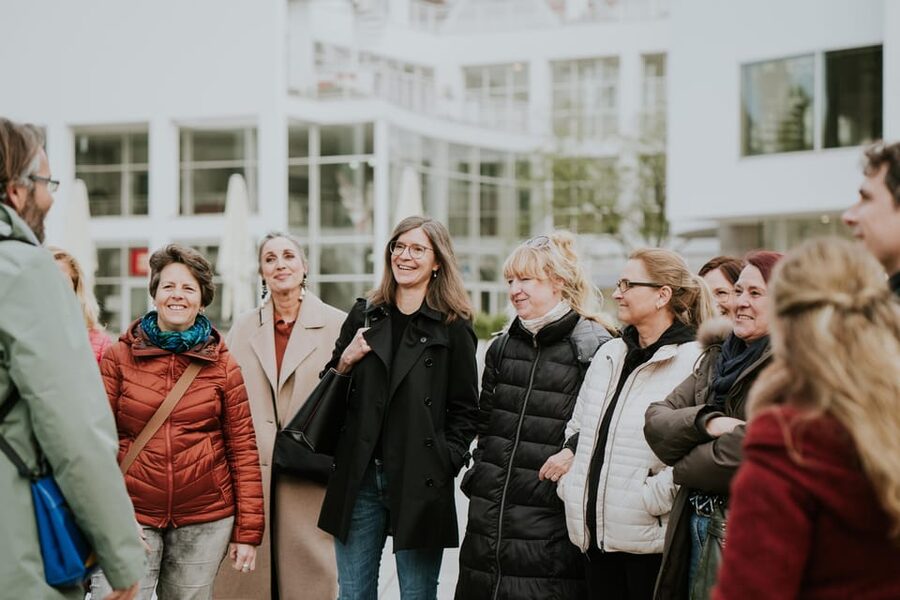
- The evening setting changes the old town: Illuminated buildings and quiet lanes give the walk a more romantic feel than a daytime sightseeing circuit.
- The route covers both old and new Ulm: You’ll compare medieval streets and restored craftsmen’s houses with modern buildings in the city center.
- The tour begins outside Ulm Minster: You hear about the church’s construction and tower, but this is not an interior visit.
- The fishermen’s and tanners’ quarter is the scenic finale: Bridges, footpaths, narrow alleys, and the Crooked House provide the most memorable setting.
- German is the confirmed tour language: Anne and other guides are praised for humor, anecdotes, and answers to questions, but English service is not assured.
- The price is modest for a guided introduction: Free cancellation up to 24 hours before departure and pay-later booking make it easier to fit into a changing schedule.
Starting beneath Ulm Minster’s record-breaking tower
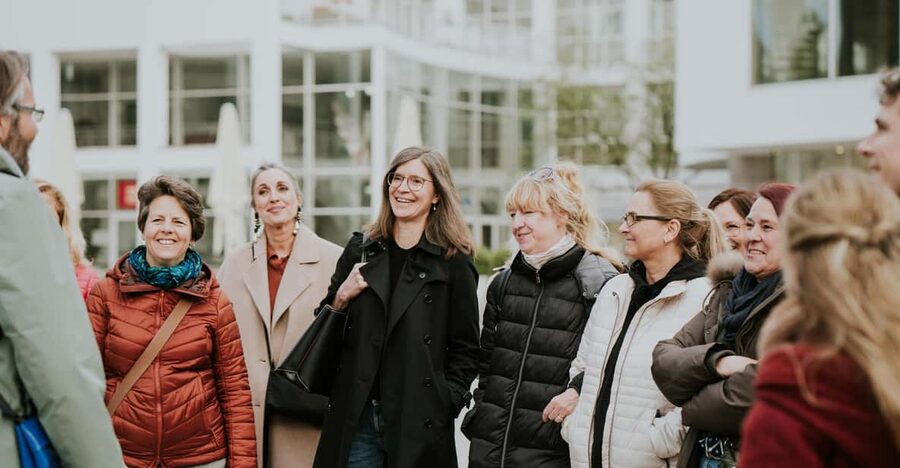
The walk begins in Minster Square, the natural starting point for understanding Ulm. The first subject is Ulm Minster itself, especially the story of its construction and its famous church tower, the highest in the world.
This opening is an exterior visit, so you should not expect time inside the church. That matters if your main goal is the interior, stained glass, or a climb up the tower. The value here is different: you get context for the building before moving into the streets around it.
I like this beginning because the minster gives the tour a clear anchor. You are not simply wandering from one attractive corner to another. The guide starts with the city’s most recognizable landmark, then uses it to orient you in the old town.
An evening departure should also make the square more pleasant for photography and sightseeing. Illumination can bring out the scale of the tower and the details of the surrounding buildings. Exact departure times vary, so check availability for the date you want.
More Old Town Walking Tours across Germany
- Dresden: Semperoper and Old Town Tour
★ 4.8 · 5,735 reviews - Nuremberg: Old Town Guided Walking Tour
★ 4.6 · 2,416 reviews - Munich: Old Town & Viktualienmarkt City Walk in German
★ 4.7 · 2,304 reviews
Medieval meets modern in Ulm’s city center
From Minster Square, the route heads north of the minster and continues toward the newer center of Ulm. This is one of the more useful parts of the walk because it avoids presenting the city as a single frozen medieval scene.
Ulm has added modern buildings in the heart of the city during recent decades. Their design creates a sharp contrast with the historic structures around them. The guide places these newer buildings beside the older sights, giving you a way to read Ulm as a living city rather than an open-air museum.
The phrase medieval meets modern fits the route well. You may prefer the old lanes and half-timbered houses, but the modern section helps explain how the city has changed. It also gives you a better sense of the central area if you are staying in Ulm and plan to explore on your own later.
This portion may appeal most to visitors who enjoy architecture. If you want only old houses and medieval atmosphere, the newer center could feel less picturesque. Still, the contrast is brief and purposeful, and it prevents the walk from becoming a string of similar historic façades.
Ulm Town Hall and its astronomical clock
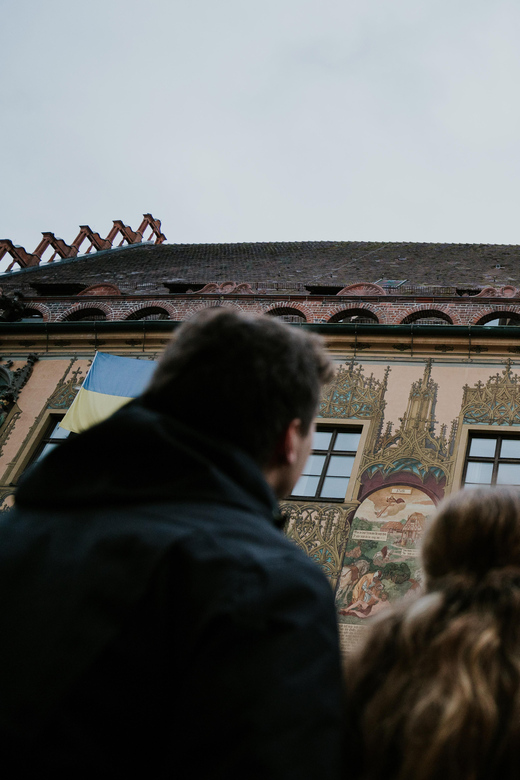
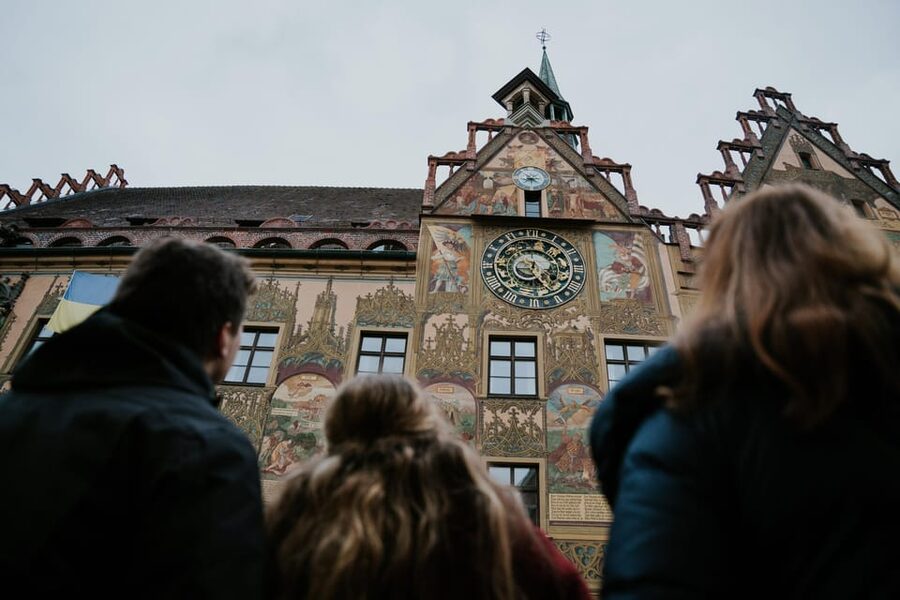
The next major stop is Ulm Town Hall, an early Renaissance building near the modern center. Its exterior is important for two reasons: a large fresco cycle from the 16th century and an astronomical clock with zodiac signs and moon phases.
The frescoes are described as probably Germany’s largest 16th-century fresco cycle. That gives the building more weight than a quick photo stop. You are looking at a civic building decorated to communicate stories, status, and ideas, not just a pretty façade.
The astronomical clock adds another layer. Zodiac signs and moon phases turn the building into a public display of time and the heavens. A guide can point out details that are easy to miss if you pass through the square alone.
The evening timing has both strengths and limits here. Artificial lighting may make certain features easier to notice, while other details can be harder to see than in daylight. If the fresco cycle is a top priority, look closely during the stop and consider returning during the day for your own examination.
The Butcher Tower and the city wall
After the town hall, the walk passes the leaning Butcher Tower and continues toward the city wall. These stops connect Ulm’s civic center with its defensive past and help you see how compact the older city once was.
The leaning tower is a quick visual reminder that historic buildings are not always perfectly straight. Its tilt gives the route a little humor and makes it easy to remember. The city wall then shifts the focus from individual buildings to the shape of the old town.
This is a good point to pay attention to the guide’s storytelling. The supplied information promises background details and anecdotes, and the strongest comments about the guides focus on humor and the ability to answer questions. Anne is specifically praised for presenting a lot of information in a funny, lively way.
The tour lasts only 90 minutes, so the city wall portion is an introduction rather than a long architectural study. You will not get an exhaustive account of every defensive feature. Instead, the stop works as a bridge between the central sights and the more intimate quarter at the end of the route.
Other trips that run after dark in Germany:
- Hamburg: 90-Minute Evening Lights Harbor Cruise
★ 4.5 · 7,728 reviews - Dresden: The Original Night Watchman Tour in Lantern Light
★ 4.6 · 6,653 reviews - Hamburg: 1-Hour Harbor Evening Lights Cruise
★ 4.4 · 4,861 reviews - Hamburg: Night Watchman’s Tour of St. Pauli in German
★ 4.7 · 4,818 reviews
Entering the fishermen’s and tanners’ quarter
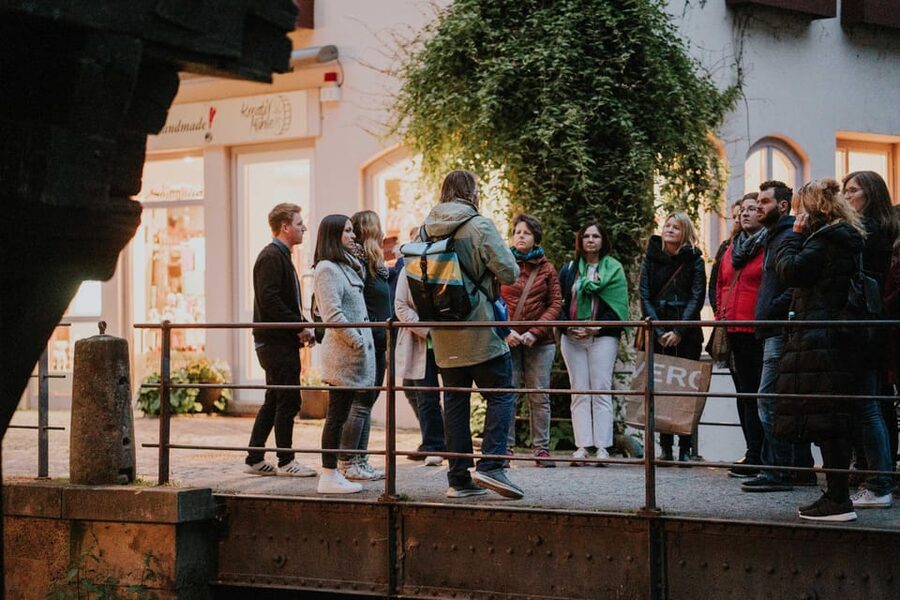
The most atmospheric section comes in the fishermen’s and tanners’ quarter. Narrow alleys, bridges, and footbridges create a close, irregular setting that feels very different from the broad space around the minster.
This was once a craftsmen’s quarter and, according to the description, was previously shabby before its buildings were restored. That change gives the area more meaning than its good looks alone. You are seeing an old working neighborhood that has been repaired and preserved, not a district designed from scratch for sightseeing.
I would save your best photographs for here. The combination of water, crossings, tight lanes, and old houses gives the walk its strongest evening mood. It is also the section most likely to reward a slower look after the guided portion ends.
The quarter is described as Ulm’s most important old town ensemble. That does not mean every building is equally grand. The appeal is in the overall setting: modest streets, unusual angles, restored façades, and the way the buildings fit together.
The Crooked House and the tour’s memorable finish
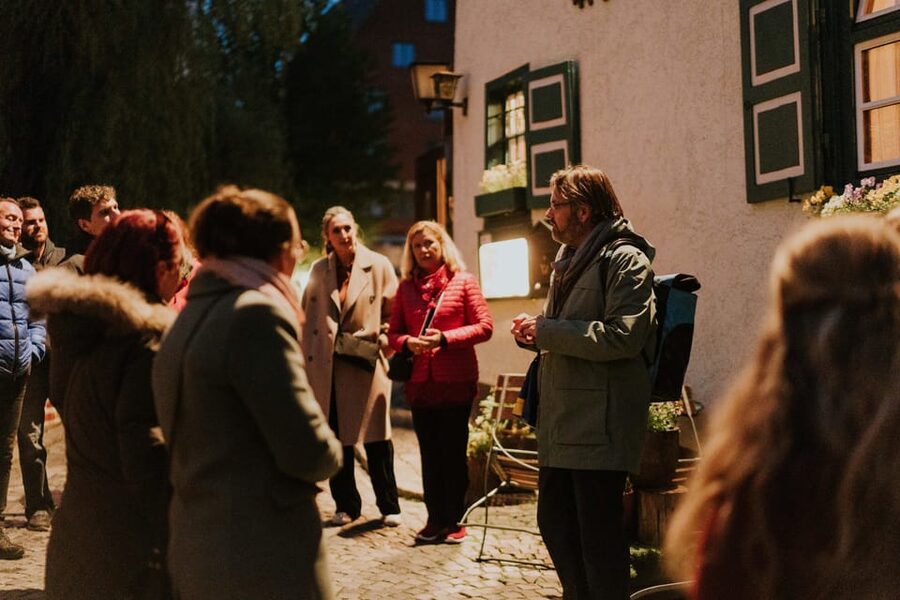
The Crooked House is one of the final highlights. It is recognized by the Guinness Book of World Records as the world’s most leaning hotel, which gives the tour a light and memorable ending.
The building works well as a guide-led stop because its shape is immediately visible, but its story adds context. You can appreciate the odd angles more fully when someone explains why the house is notable instead of treating it as just another old building.
This is also where the tour’s mix of facts and humor should work best. The itinerary has serious subjects, including construction, civic art, architecture, and urban change. The Crooked House provides a more playful image to finish with.
Do not expect the tour to include a hotel stay or an interior visit to every building. The available information describes a walking tour and an exterior look at the minster. Treat the Crooked House as a landmark viewed along the route.
How much information can fit into 90 minutes
Ninety minutes is a useful length for an evening introduction. You get enough time to move through several districts without giving up an entire night. At the same time, the schedule means the guide has to keep the pace moving.
The route includes the minster, newer central buildings, the town hall, the Butcher Tower, the city wall, and the fishermen’s and tanners’ quarter. That is a lot of ground for one short walk. You should expect selected highlights and explanations, not a room-by-room or street-by-street study.
The strongest fit is someone who wants orientation on a first visit. After the walk, you will know which areas deserve another look, especially the old craftsmen’s quarter and the town hall. You may also understand the modern center better instead of walking past it without context.
I would not choose this as the only activity for a visitor seeking a long historical lecture. The format is brisk, and the route favors variety. Its strength is the combination of clear landmarks, local stories, and evening atmosphere.
Guide style and the language question
The guide is central to the experience because many of the sights are viewed from outside. A good explanation turns a façade, tower, or clock into a reason to stop.
The available feedback is especially strong on humor, information, and willingness to answer questions. Anne is singled out as a very good city guide who presents a great deal of information in a funny way. Another booking describes the guide as excellent, while another notes that questions were answered and many interesting anecdotes were included.
That suggests you should ask questions during the walk. The format appears to allow room for interaction, even though the route is timed. Questions about the clock, the old craftsmen’s quarter, or the modern buildings may help you get more from the stops.
Language requires care. The listed live language is German. One booking selected English but received the entire tour in German, creating a real problem for part of that group. If you do not understand German well enough to follow detailed explanations, contact the provider before booking and do not assume that an English selection guarantees an English-speaking guide.
Is $14 a fair price for this Ulm walk?
At $14 per person, this is a low-cost guided introduction to central Ulm. You are paying for a professional guide and 90 minutes of commentary, not admission to an attraction or a private tour.
The value is strongest if you would otherwise walk through the old town without understanding what you are seeing. The guide links separate sights into a coherent route and adds background to buildings that might otherwise be quick photo stops.
It is also useful for a short stay. If you have limited time in Ulm, the route covers many of the city’s key central areas in one evening. You can then return to the places that interest you most.
The value drops if you already know Ulm well, speak little German, or want to enter the minster and other buildings. In those cases, the tour may feel like an exterior overview. Still, the low price limits the financial risk, and free cancellation up to 24 hours before the start gives you some flexibility. You can also reserve and pay later, which helps if your schedule is not fixed.
Who should book this evening walk?
I would recommend it to first-time visitors who want a quick, guided introduction before exploring on their own. It should also suit anyone who likes architecture, local anecdotes, and the contrast between old buildings and modern design.
The evening setting makes it a good choice if you prefer sightseeing after the day’s heat or want to see the old town under illumination. The fishermen’s and tanners’ quarter is likely to be the visual highlight, especially if narrow lanes and bridges appeal to you.
Families and casual sightseers may appreciate the short duration and the Crooked House. The route includes enough variety to hold attention: a huge church tower, a leaning tower, a decorated town hall, modern buildings, and a medieval quarter.
I would be cautious if you need English, want an interior tour, or prefer a slow and highly detailed architectural visit. Check the language first, and choose this walk for its broad view of Ulm rather than for access inside the monuments.
Should you book the Ulm evening stroll?
Book it if you want a well-priced orientation walk with a strong old-town finish. The route gives you Ulm’s biggest visual contrasts in a manageable 90 minutes, from the minster and modern center to the town hall and the restored fishermen’s quarter.
The guides appear particularly good at humor, anecdotes, and making a lot of information easy to follow. Anne is a name worth noting, though guide assignment can vary.
Before booking, confirm the tour language. For German speakers, this looks like an appealing and inexpensive way to meet Ulm at its most atmospheric. For English speakers, the language uncertainty is the deciding issue.
FAQ
Where does the Ulm evening stroll begin?
The tour begins at Minster Square, beside Ulm Minster.
How long does the tour last?
The tour lasts 1.5 hours.
What is the price?
The price is $14 per person.
Is the tour conducted inside Ulm Minster?
No. The information provided describes an exterior tour of Ulm Minster, including background about its construction and tower.
What language is the live tour in?
The listed live tour language is German.
Is an English-language tour guaranteed?
No. One booking made with English selected still took place entirely in German, so you should confirm the language before booking.
What sights are included on the route?
The route includes Ulm Minster, the area north of the minster, modern buildings in the city center, Ulm Town Hall, the Butcher Tower, the city wall, and the fishermen’s and tanners’ quarter.
Is the Crooked House included?
Yes. The route passes the Crooked House, described as the world’s most leaning hotel according to the Guinness Book of World Records.
Can you cancel for a full refund?
Yes. You can cancel up to 24 hours in advance for a full refund.
Just added in Germany
- Berchtesgaden: Via Ferrata Beginner Tour of Schützensteig★ 4.7 · 15 reviews
- Berlin: Energizing 2-Hour Morning Segway Tour★ 4.7 · 35 reviews
- Berlin: Thrilling E-Scooter Adventure Tour★ 4.4 · 66 reviews
- Beer Bike & Party Bike: Unforgettable Berlin City Tour incl. pickup★ 5.0 · 5 reviews
- Bayreuth: German City Walking Tour (Tourist Info)★ 4.7 · 202 reviews
- Beelitz-Heilstätten: Baum&Zeit Tree Top Walk Entry Ticket★ 4.9 · 7 reviews
- Bavaria: Beginner Canyoning Tour★ 4.5 · 10 reviews
- Bayreuth: Christmas city tour in German★ 4.9 · 12 reviews
Old Town Walking Tours, compared.
Old Town & Viktualienmarkt City Walk in German
Read our review →
The Night Watchman Old Town Walking Tour in German
Read our review →
New Old Town and Highlights German-Language Tour
Read our review →

Browse the lists this tour appears in