Reviewed · TOURS IN BERLIN
Night magic city tour in Berlin
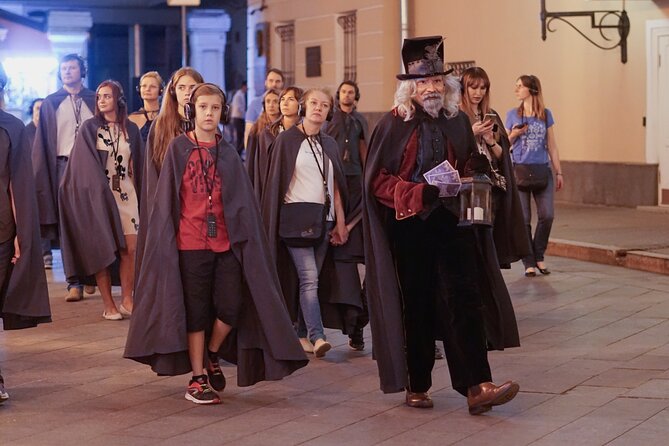
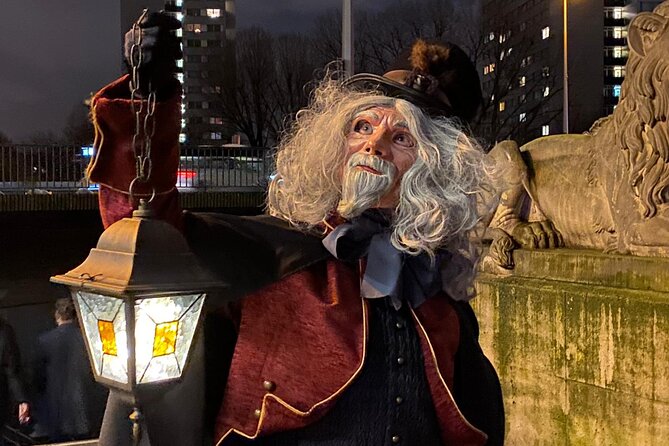
Berlin after dark takes on a different mood, especially in the old center around Nikolaiviertel. This 90-minute theatrical walk uses actors, costumes, audio-guide material, and visual effects to turn Berlin’s early history into a short evening show rather than a standard sightseeing lecture.
I like the intimate group size of no more than 20 people, and I like the route itself. It links the Neptune Fountain, Red City Hall, Nikolaiviertel, St. Nikolai-Kirche, Humboldt Forum, and the Spree in a compact central walk. The drawback is that you are outdoors for the whole experience, so cold, icy, or wet weather can affect the evening.
Key points at a glance
- Theatrical Berlin history: Actors, costumes, audio, and visual effects add drama to the old city center.
- A focused central route: The walk connects Alexanderplatz, Nikolaiviertel, Museum Island, and the Spree.
- Small maximum group: The tour accepts up to 20 people, which should make the performance easier to follow.
- English-language format: You can book the experience in English with a mobile ticket.
- Simple evening timing: The tour lasts about 1 hour and 30 minutes, with no transport between stops.
- Extra touches: Some outings include coffee, chocolate, and a small schnapps at the end, according to the experience details provided by the operator.
Why this short night walk works in Berlin
Berlin has plenty of grand monuments, but its oldest center is easy to miss. The modern capital is spread across a wide area, and the medieval core can seem like a handful of disconnected sights unless someone explains how they fit together.
This tour gives you that connection. You begin at St. Marienkirche near Alexanderplatz and finish beside the Spree at Ephraim’s. In between, you move through places tied to the beginnings of Berlin, Prussian power, German reunification, and the rebuilding of the historic center.
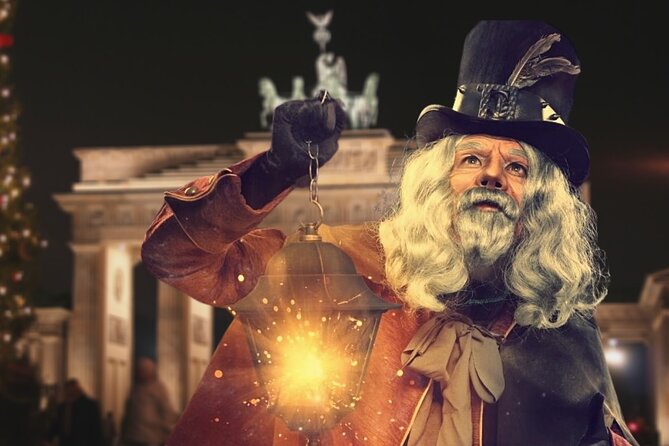
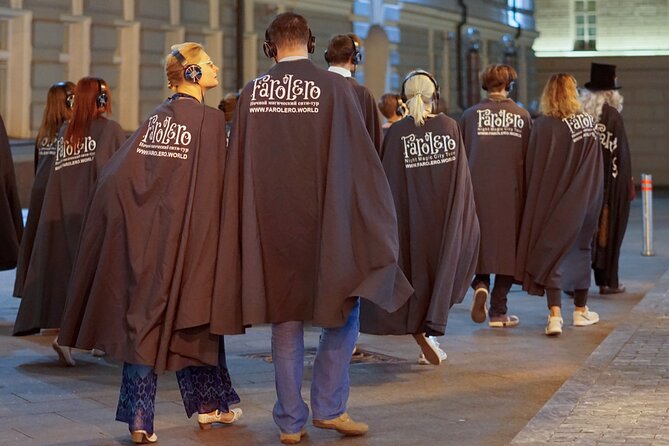
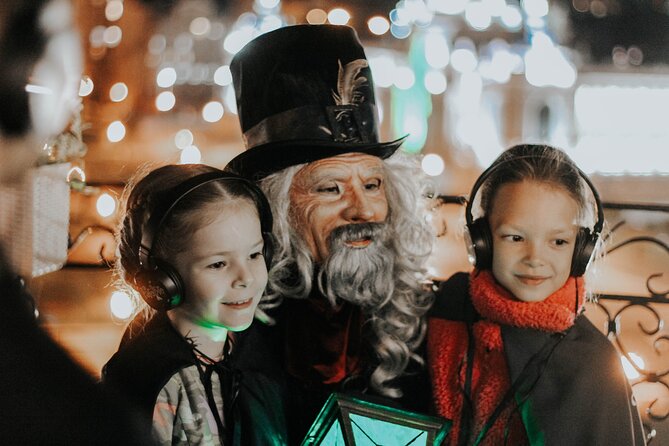
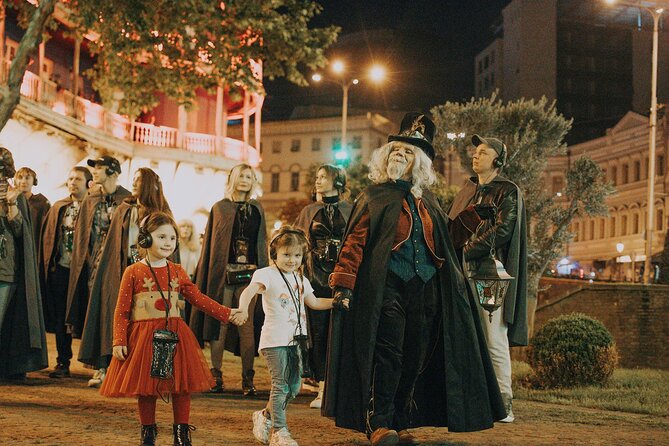
The format is more playful than a conventional walking tour. You may be handed a costume, brought into small scenes, or asked to take part in a short activity. Audio material and visual effects help create the sense of another time. That approach will suit you if you prefer history with a little performance mixed in.
I would not choose this as your only introduction to Berlin. The 90-minute route is compact, and the theatrical style means the guide cannot explain every building in detail. But it can be a lively first evening, especially after you have spent the day in museums or walking through the city.
Other trips that run after dark in Berlin:
- Berlin: Solar Powered Sunset Catamaran Cruise & Audio Guide
★ 4.6 · 1,043 reviews - Berlin: Live-Guided Evening Sightseeing Tour by Open-top Bus
★ 4.1 · 783 reviews - Berlin: Bus Tour by Night with Live Commentary
★ 4.2 · 687 reviews
Starting at St. Marienkirche and the Neptune Fountain
The meeting point is St. Marienkirche, at Karl-Liebknecht-Strasse 8. From there, the route brings you toward the Neptune Fountain, one of the most decorative public monuments in central Berlin.
The fountain was built in 1891 by sculptor Reinhold Begas. Neptune, the Roman god of the sea, sits at the center. Around him are four female figures representing the main rivers of Prussia at the time: the Elbe, Rhine, Vistula, and Oder.
The symbolism rewards a close look. One figure holds fruit and ears of corn for the Elbe. Another carries a fishnet and grapes for the Rhine. The Vistula is linked with wooden blocks and forestry, while the Oder figure has goats and animal skins. The political geography has changed since then. The Vistula now lies entirely in Poland, and the Oder forms part of the border between Germany and Poland.
At night, a fountain like this works well as a stage setting. The sculpture is large, easy to see, and full of details that a guide can turn into a short story. You will not need to spend half an hour studying it, but you should pause long enough to understand the river symbols.
Red City Hall and Berlin’s political center
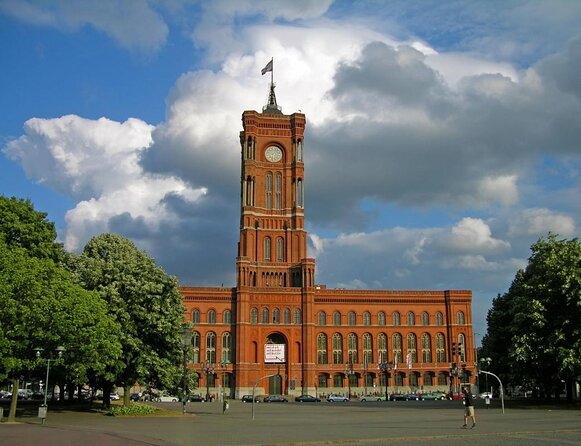
The next part of the walk brings you to the Rotes Rathaus, or Red City Hall. Its name comes from the red clinker bricks used on the facade, not from any political label.
The building sits near Alexanderplatz in the Mitte district. It remains the seat of Berlin’s governing mayor and the state government, known as the Senate of Berlin. That gives the stop a useful link between old Berlin and the city you see today.
The Red City Hall is also a good reminder that Berlin’s political center has shifted and changed many times. The tour does not need to take you inside to make the building useful. From outside, the brick facade gives you a strong visual marker and helps place the route within modern Mitte.
Because this is a night walk, you should expect a viewing experience rather than a detailed architectural study. If you want extensive information about the interior or government functions, you will need a separate visit. Here, the building serves as part of the larger story.
Ampelmännchen and the everyday side of reunification
One of the more unusual stops concerns Ampelmännchen, the little traffic-light man used on pedestrian signals.
Before German reunification in 1990, East and West Germany had different pedestrian figures. West Germany used a more generic human shape. East Germany used a figure that generally appeared male and wore a hat. The eastern version became especially well known after reunification and is now one of Berlin’s most familiar design symbols.
This is the sort of small detail that can make a city walk memorable. It is not a grand monument, but it gives you a quick way to think about the former division of Germany in everyday life. Berlin’s political history appears not only in walls and museums, but also in street signs and public design.
The Ampelmännchen stop should appeal to families and anyone who enjoys small cultural details. It also breaks up the older medieval and royal material with something more recent and immediately recognizable.
A few more things to do in Berlin worth a look
- Berlin: 1-Hour City Tour by Boat with Guaranteed Seating
★ 4.3 · 16,993 reviews - Berlin: City Sightseeing Hop-On Hop-Off Bus Tour
★ 4.1 · 4,233 reviews - Berlin: 1-Hour City Sightseeing Cruise
★ 4.4 · 2,210 reviews - Berlin City Hop-on Hop-off Tour with Optional Cruise
★ 3.5 · 1,155 reviews
Nikolaiviertel, Berlin’s reconstructed old quarter
Nikolaiviertel is the historical heart of Alt-Berlin. The area was founded around 1200 and, together with nearby Cölln, helped form the early city.
Today, the quarter contains restored medieval buildings and some more recent imitations. That mixture is important to understand before you arrive. You are walking through a carefully reconstructed historic district, not an untouched medieval neighborhood.
That does not make the area uninteresting. In fact, the rebuilt streets are useful for a night performance because the lanes and facades create a clear sense of place. The quarter lies only about five minutes from Alexanderplatz, yet it feels more intimate and old-fashioned than the broad roads around the square.
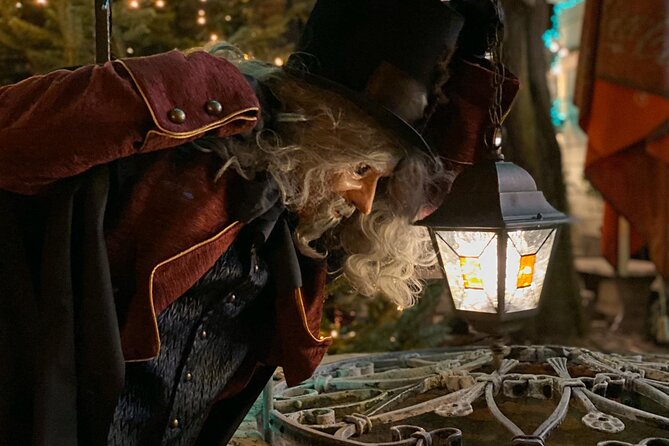
The theatrical format fits Nikolaiviertel particularly well. The actors can use the narrow streets and old-style buildings as a backdrop, while the audio and visual effects add atmosphere without requiring a large stage. A German-language comment describes the historical information as interesting, with humorous participation in front of the Nikolaiviertel setting. The English version may use a different presentation, but the basic appeal is clear: the quarter gives the walk its strongest sense of time and place.
St. Nikolai-Kirche and the oldest church in Berlin
St. Nikolai-Kirche is one of the central stops and one of the most historically important. Built between 1220 and 1230, it is the oldest church in Berlin. The Church of Our Lady near Alexanderplatz is also among the city’s oldest churches.
The church sits within Nikolaiviertel, close to Spandauer Strasse, Rathausstrasse, the Spree, and Mühlendamm. Its position helps explain why this small area became the center of early Berlin.
For you, the value of the stop is not only the age of the church. It is the way the building anchors the surrounding district. Once you know that this was part of the early city, the nearby streets and river crossings make more sense.
Expect an exterior-focused visit unless the tour description for your date states otherwise. The supplied information does not promise an interior entry. That is worth noting if seeing the inside of the church is important to you.
Humboldt Forum and the changing face of Museum Island
The walk continues toward the Humboldt Forum, located on Museum Island in Berlin’s historic center.
The building combines three reconstructed Baroque facades from the former Royal Palace with a contemporary side facing the Spree. The interior was designed by Franco Stella. The forum mainly houses non-European collections belonging to the Berlin State Museums, along with temporary exhibitions and public events.
The building gives the tour a useful contrast. Nikolaiviertel presents a reconstructed medieval quarter, while the Humboldt Forum combines a rebuilt royal exterior with modern design and museum use. Berlin often places old and new directly beside each other, and this stop makes that contrast easy to see.
The Humboldt Forum is sometimes compared with the British Museum because of its non-European collections. That comparison tells you something about its scale and purpose, but this short tour is not a museum visit. You should not expect time to explore the galleries. Instead, you will see the building as part of the city’s central story and may want to return during daylight for a longer look.
Mühlendamm and the Spree crossing
Mühlendamm provides the route’s final historical link. The name means Mill Dam and refers to the watermills once located here.
A causeway was first laid out at this point around 1200. It crossed the Spree between the historic Cölln and Fischerinsel areas and the Molkenmarkt section of Alt-Berlin. That crossing helped shape the late medieval city.
The modern thoroughfare is a busy central route, so it will not feel like a quiet medieval lane. Still, the location matters. The river crossing explains why Berlin developed here in the first place. Water, trade, mills, and movement all helped form the city.
The tour ends at Ephraim’s, at Spreeufer 1. That endpoint keeps you near the same historic center where the walk began. It also makes the outing easy to pair with dinner, a short evening stroll, or a return toward Alexanderplatz.
The performance style: actors, audio, and participation
The biggest difference between this experience and a standard city walk is the presentation. You are not simply following a guide who points out buildings and speaks for 90 minutes.
The experience includes actors, costumes, audio-guide elements, and visual effects. One detailed description highlights how these parts work together to block out traffic noise and other distractions. That may be especially useful in central Berlin, where cars, trams, crowds, and construction can compete with a spoken explanation.
You might be asked to take part in small scenes or group activities. The supplied experience details also describe visitors being welcomed warmly and dressed up at the start. These touches suggest a relaxed, playful format rather than a formal lecture.
That style is not for everyone. If you want dates, names, and architectural facts delivered in a steady sequence, a conventional guide may suit you better. If you enjoy short performances and do not mind joining in, the theatrical approach can make the old city easier to remember.
Some outings also include coffee, chocolate, and a schnapps at the end. Treat this as an added feature rather than the main reason to book, since the exact refreshments may depend on the operation of that particular departure.
Is $46.99 a fair price?
At $46.99 per person, this is more expensive than a basic free walking tour, but it is not priced like a long private tour or a full-day excursion.
You are paying for a short, organized production rather than only for information. The costumes, actors, audio, visual effects, and small-group limit help explain the cost. The route also covers several central landmarks without requiring public transport between them.
The value is strongest if you want an evening activity with a clear theme. It is less compelling if you mainly want maximum sightseeing time per dollar. In 90 minutes, you will see many important places, but most stops are brief and the tour does not include museum admission based on the details provided.
The high booking lead time, with the experience often reserved about 53 days ahead, suggests that you should plan early if your Berlin dates are fixed. That is particularly sensible if you want an English-language departure.
Practical details before you book
The tour is offered in English and uses a mobile ticket. The group limit is 20 people, which is small enough to keep the performance manageable but not so small that it feels private.
Most people can take part, but the activity requires being outside and moving between central sights. The provider states that good weather is required. If poor weather cancels the outing, you can choose another date or receive a full refund. The same applies if the minimum number of participants is not reached.
You can cancel for a full refund up to 24 hours before the start time. Cancellations or changes made within 24 hours are not accepted for a refund. Confirmation is normally sent at booking, though bookings made within two days of departure may take up to 48 hours to confirm, subject to availability.
Wear shoes suited to city pavements and check the forecast before leaving. Cold, icy conditions have already caused concern for at least one person who arrived for a departure that did not go ahead. That does not define the usual operation of the tour, but it is a good reason to keep your phone available for updates.
Who should book the Night magic city tour?
I would choose this for a first or second evening in Berlin if you want an easy introduction to the old center. It suits couples, families, and curious first-time visitors who like history presented with humor and a little audience participation.
It is also a good choice if you have already seen Brandenburg Gate and the Reichstag and want to explore a less obvious part of central Berlin. The route gives you medieval origins, Prussian symbolism, German division, museum architecture, and the Spree in one compact outing.
I would be more cautious if you dislike costumes, acting, or being included in a scene. The same features that make the tour memorable may feel distracting if you want a quiet, fact-heavy walk. I would also avoid booking it as your only historical tour of Berlin, since 90 minutes allows for atmosphere and selected stories, not a full account of the city.
The experience has a 4.7 rating from 25 ratings, with 92 percent recommending it. That matches the strongest qualities here: a friendly presentation, unusual storytelling, and a route that makes Berlin’s oldest center easier to understand.
Should you book it?
Book the Night magic city tour if you want a short, theatrical evening walk rather than a standard sightseeing lecture. The best reasons are the small group, the carefully connected central route, and the mix of actors, audio, costumes, and visual effects.
Skip it if you need museum entry, extensive architectural detail, or a guaranteed indoor activity. For everyone else, it offers a friendly way to meet Berlin’s medieval core after dark, with enough history to give your later daytime sightseeing more meaning.
FAQ
How long does the Night magic city tour last?
The experience lasts approximately 1 hour and 30 minutes.
What language is the tour offered in?
The tour is offered in English.
Where does the tour begin?
It begins at St. Marienkirche, Karl-Liebknecht-Strasse 8, 10178 Berlin, Germany.
Where does the tour finish?
The tour ends at Ephraim’s, Spreeufer 1, 10178 Berlin, Germany.
How much does the tour cost?
The listed price is $46.99 per person.
How many people can join the tour?
The maximum group size is 20 people.
What sights are included on the route?
The route includes the Neptune Fountain, Rotes Rathaus, Ampelmännchen, Nikolaiviertel, St. Nikolai-Kirche, Humboldt Forum, and Mühlendamm.
Does the tour require good weather?
Yes. The experience requires good weather. If it is canceled because of poor weather, you can receive a full refund or choose a different date.
Can I cancel for a full refund?
Yes. You can cancel at least 24 hours before the start time for a full refund. Cancellations and changes made less than 24 hours before the start time are not accepted.
Is the tour confirmed immediately after booking?
Confirmation is normally sent at booking. If you book within two days of the departure, confirmation may arrive within 48 hours, subject to availability.
Just added in Berlin
- Private One way Airport Transfer Berlin Airport To Berlin★ 3.5 · 17 reviews
- Private Walking Tour: Berlin Wall, Cold War and Checkpoint Charlie★ 5.0 · 37 reviews
- Modern Berlin Private Walking Tour: Diverse, Vibrant and Exciting German Capital★ 5.0 · 13 reviews
- Private Day Trip to Potsdam from Berlin by Train★ 4.5 · 27 reviews
- City Explorer: Potsdam Private Day Trip★ 4.5 · 10 reviews
- Berlin Private Custom 5-Hour Tour by Car★ 5.0 · 30 reviews
- Private Half-Day Sightseeing Tour in Berlin★ 3.5 · 6 reviews
- Berlin Private Custom Tour in a Minivan, East and West★ 5.0 · 123 reviews
Tours in Berlin, compared.
Reichstag, Dome and Government District Guided Tour
Read our review →
1-Hour City Tour by Boat with Guaranteed Seating
Read our review →
Reichstag, Plenary Chamber, Cupola & Government Tour
Read our review →