
Reviewed · HISTORICAL TOURS
Munich: Private Walking Tour of the Historical City Center
Munich’s central streets hold both royal grandeur and some of Germany’s hardest history. This private walk connects the two, taking you from the bells of the Rathaus-Glockenspiel and medieval churches to the Beer-Hall Putsch and Georg Elser’s bold attempt to kill Hitler.
I like the private format, which lets your group ask questions and set a comfortable pace. I also like the mix of famous sights and lesser-known stories, especially the tale of Elser and the local connection to Eva Braun. The main drawback is that the quality depends heavily on your guide. One guest found the guide difficult to hear and not very engaging, while Tom earned praise as a natural storyteller.
Key points to know before booking
- Three hours on foot: You cover Munich’s central sights without using transport, so comfortable shoes matter.
- A strong WWII focus: The tour explains the Beer-Hall Putsch and Georg Elser’s attempt to stop Hitler.
- Optional Residenz Museum visit: Choose the version that includes Munich’s former royal residence, but entrance fees are not included.
- Private group pricing: The $288 rate covers up to 15 people, making the value much better for a family or larger party than for only two people.
- English or German guiding: You can select a live guide in either language.
- Not suitable for wheelchairs: The walking format and stated accessibility restriction should be taken seriously.
Starting at Marienplatz and the Fish Fountain
Your meeting point is the fish fountain in front of the Town Hall at Marienplatz 8. This is a practical place to begin because Munich’s central square puts several major sights within a short walk of one another.
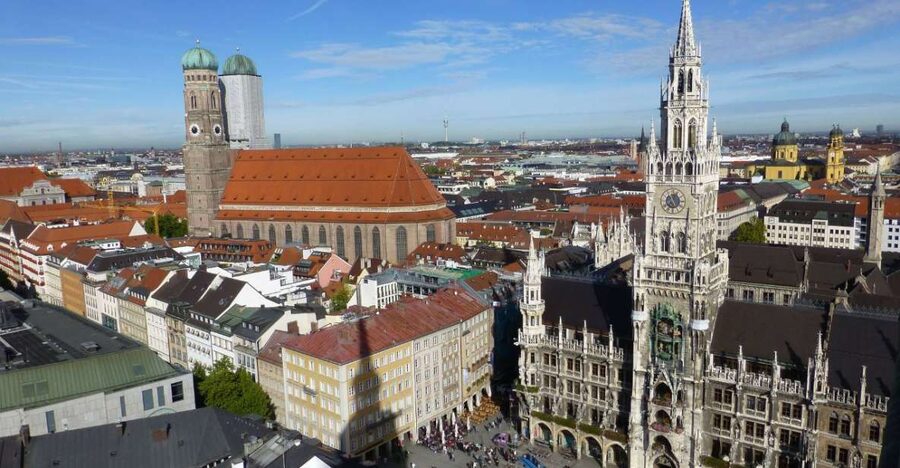
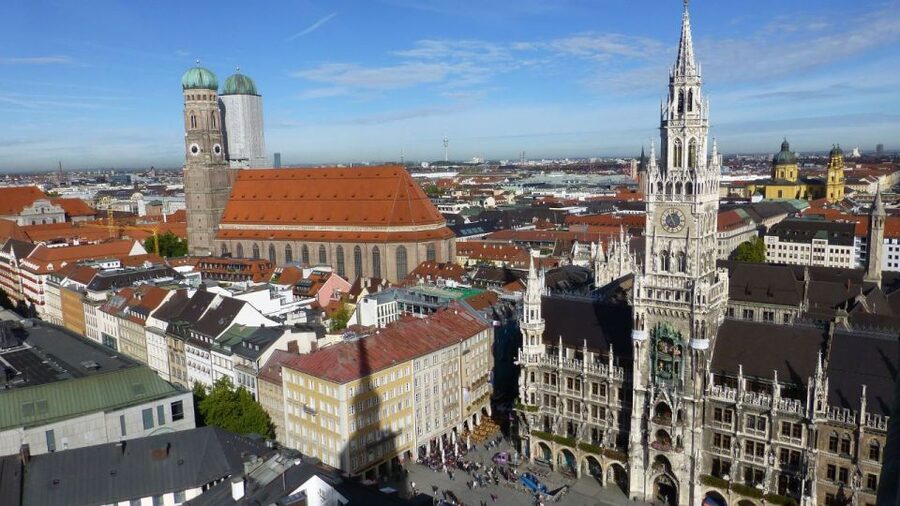
Marienplatz is named for Mary’s Column, the tall column at the center of the square. Your guide explains why it was placed here and how the square became the heart of Munich’s public life. This early context helps you see the city as more than a collection of handsome buildings.
The Old Town Hall and New Town Hall face the square. Their different styles and roles give the opening part of the tour a useful contrast. You can listen to the guide explain how Munich’s civic government developed while looking at the buildings where that public business took place.
The square can be lively, and the meeting point may feel crowded. Arrive early enough to identify the fish fountain and your guide without rushing. Since this is a private tour, your guide can meet your group at the agreed starting time, but the location itself remains a busy public space.
Other history to see in Munich:
- Munich: Guided Tour of the historic Town Hall on Marienplatz
★ 4.8 · 63 reviews - Munich and Nazi History Combination Day Tour Small Group
★ 5.0 · 31 reviews - Munich: Nazi History 2-Hour Small Group Walking Tour
★ 5.0 · 30 reviews
Reading the Rathaus-Glockenspiel
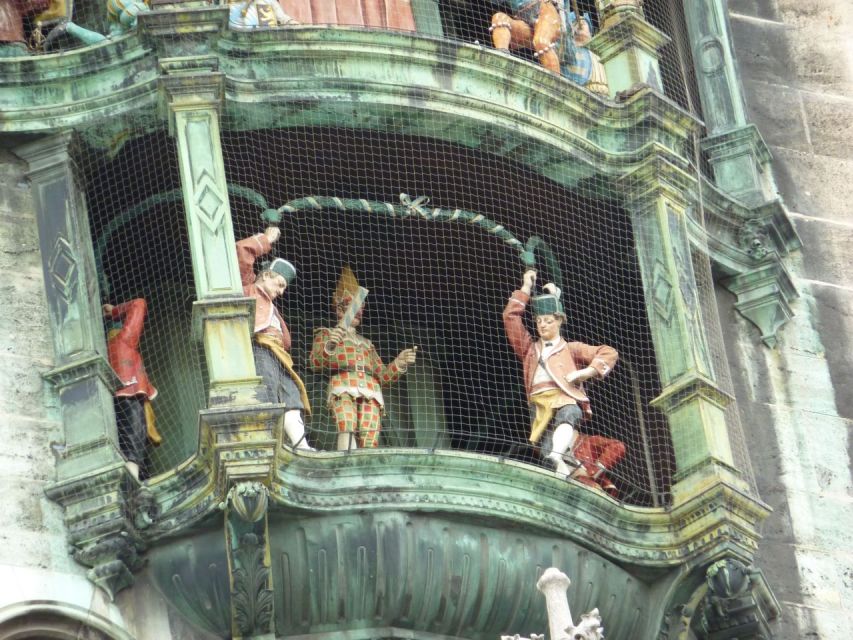
The New Town Hall’s clock tower is one of Munich’s most recognizable sights. The Rathaus-Glockenspiel is not simply a clock that rings on the hour. Its figures and scenes tell stories, and the guide explains what they mean.
This is one of the moments when a local guide adds real value. Without an explanation, you may see moving figures and hear bells, then continue walking. With context, the performance becomes a short lesson in Munich’s past and public traditions.
The tour information does not promise a specific time for the Glockenspiel performance. Ask your guide about the timing at the start if seeing it in motion is important to you. The clock tower can still be appreciated outside the performance, but the moving display is the feature most people want to catch.
St. Peter’s and the city’s monastic beginnings
The route continues to St. Peter’s, described as Munich’s oldest Catholic church. Your guide connects the church to the monks who helped give rise to the city.
That detail matters because Munich’s name and early growth are tied to its religious beginnings. The church is not treated as an isolated monument. Instead, it becomes part of the story of how a settlement developed into the Bavarian capital.
You will also hear about the church’s age and role in the city. The tour description does not include an entrance promise or a tower climb, so do not book this walk expecting a paid interior visit or panoramic ascent at St. Peter’s. Its value here is the setting and the explanation provided during the walk.
Frauenkirche and the Devil’s Footprint
The twin towers of Frauenkirche are among the clearest markers on Munich’s skyline. The cathedral is the largest church in Munich, and the tour gives you a good view of its double towers.
Inside or around the cathedral, your guide describes the famous Devil’s Footprint and the legend connected with it. This kind of story adds a touch of local folklore to an otherwise formal religious building. You get a useful change of mood after the civic history of Marienplatz and the early story of St. Peter’s.
The listing does not say that cathedral admission is included. Entrance fees are generally excluded from the tour, so confirm the plan with your guide if you want to go inside. The walk is still worthwhile for the exterior view and the explanation of the legend.
Other walks around Munich:
- Munich: Third Reich & WWII Walking Tour
★ 4.6 · 6,181 reviews - Third Reich Walking Tour Munich
★ 4.5 · 4,291 reviews - Munich: Old Town & Viktualienmarkt City Walk in German
★ 4.7 · 2,304 reviews - Munich: Night Watchman Walking Tour
★ 4.7 · 2,092 reviews
Eva Braun, Georg Elser, and Munich’s difficult past
The tour does not treat Munich as only a city of palaces, churches, and beer halls. It also addresses the city’s role during the Nazi period and the war.
You hear about Eva Braun, who came from Munich and later became Hitler’s wife. The subject is handled as part of the city’s local story, not as a reason to celebrate the Nazi leadership. For many visitors, this connection adds a personal dimension to a period that can otherwise feel distant and abstract.
The more striking story is Georg Elser, a Munich carpenter who planned a daring assassination attempt against Hitler. His goal was to prevent the coming war, and the tour explains how close his effort came to changing events. This is an important part of the walk because it shows that resistance existed inside Germany, even under a brutal dictatorship.
The WWII material may be the most serious section of the experience. If you want only light sightseeing, this tour may feel heavier than a standard orientation walk. I think that weight is useful, especially for a first visit to Munich, but it is worth knowing the tone in advance.
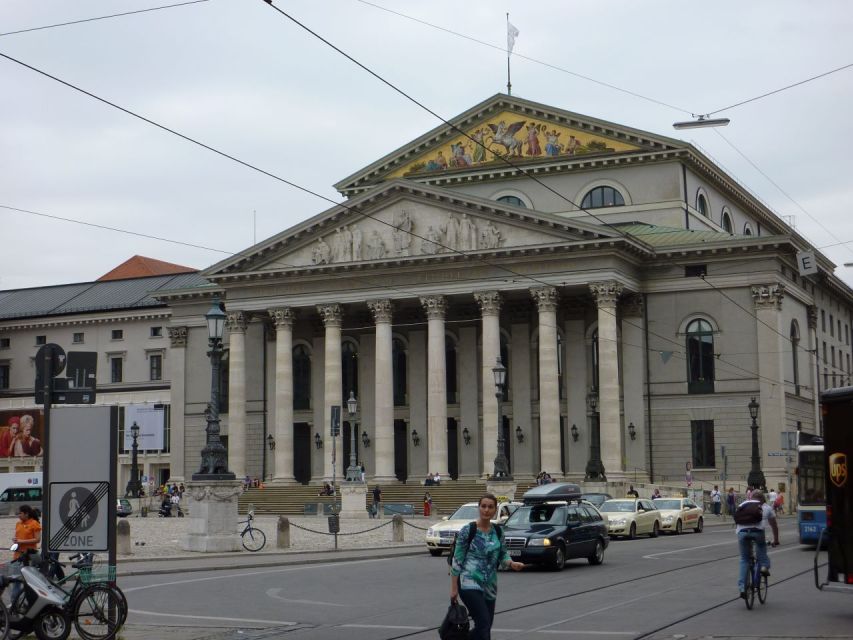
Odeonsplatz and the Beer-Hall Putsch
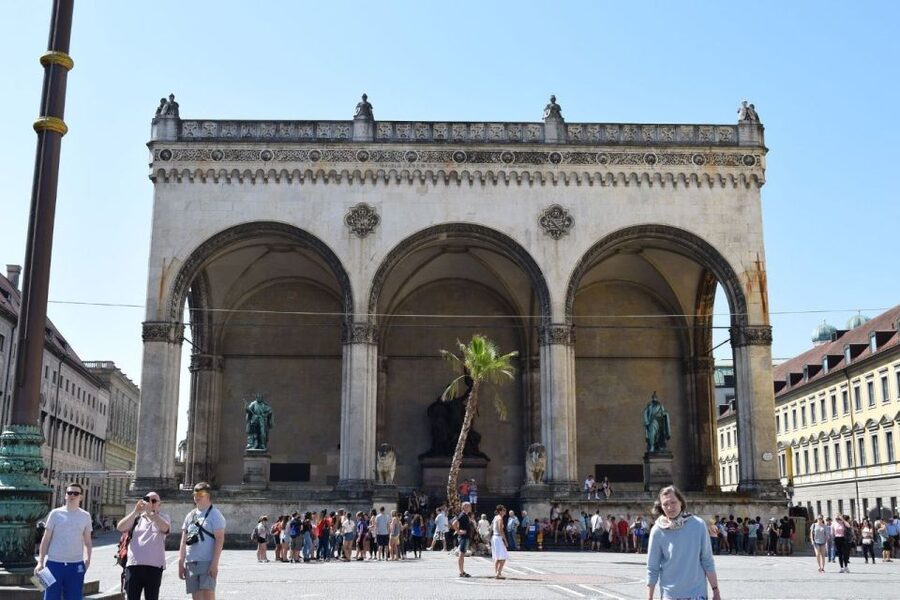
At Odeonsplatz, the guide explains the Beer-Hall Putsch. In that failed early attempt to seize power, about 2,000 men led by Adolf Hitler marched toward Munich’s center.
This stop gives the political history a physical setting. You are not hearing about an event in a distant textbook. You are standing in the same central part of the city where the attempted takeover unfolded.
The value of a private tour becomes clear here. You can ask how the event fitted into Munich’s wider role in the Nazi movement, or ask about details that interest your group. The tour will not turn you into a specialist in three hours, but it can give you a solid framework for understanding why Munich matters in twentieth-century German history.
The information provided does not describe a memorial ceremony or a specialist political-history route. Think of this as a broad city tour with a meaningful WWII thread, not a dedicated Nazi-era study tour.
Hofbräuhaus and Munich’s beer culture
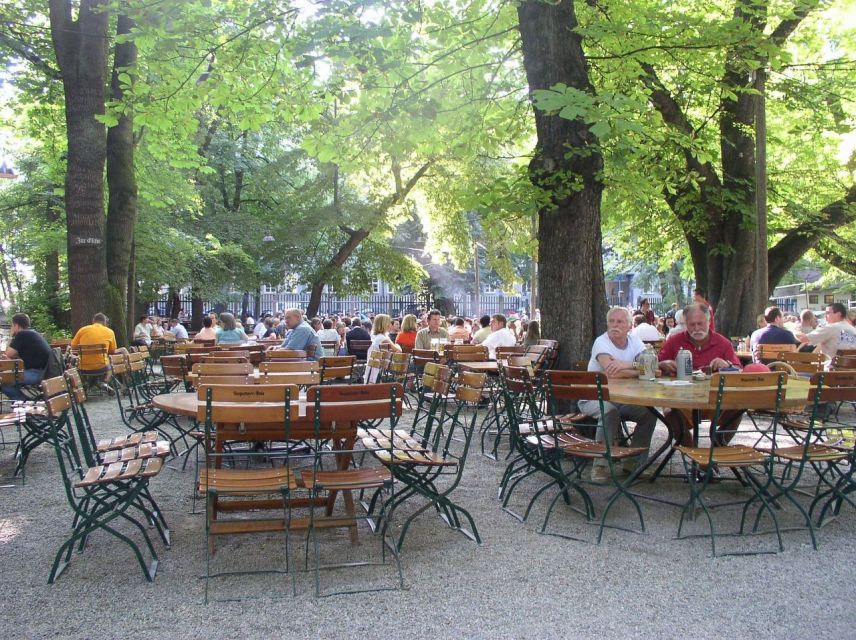
Munich’s beer tradition receives its own section of the walk. You pass Hofbräuhaus, the royal brewery established in 1589, and learn how beer became part of the city’s public life.
You also see some of Munich’s famous beer gardens, a tradition with nearly 450 years of history. This is a useful counterpoint to the darker political stops. Beer gardens are not just places to drink. They are part of Munich’s everyday social identity and help explain why the city’s food and drink culture is so closely tied to its image.
The tour does not include food or drinks, so plan to return to a beer hall or garden after the walk if you want to sit down. Passing these places gives you ideas for later, but it is not a tasting tour.
Hofbräuhaus can be crowded and tourist-oriented. The guide’s explanation helps put it in context, but you should not expect a reserved table, meal, or beer included in the $288 price.
The optional Residenz Museum visit
You can choose the tour option that includes a visit to the Residenz Museum. The Residenz was the home of Bavaria’s rulers, and adding it gives the walk a stronger royal and artistic side.
The museum option makes sense if you want more than an outdoor introduction. Munich’s streets show the city in public, while the Residenz lets you see how its rulers lived and presented their power indoors. It also adds another layer to the story of Bavaria beyond churches, beer, and twentieth-century politics.
There is one practical point to watch: entrance fees are not included. Check the exact arrangement before booking, since the option includes a guide-led visit but not admission costs. The museum also uses part of your three-hour time, so you will have less time for unhurried discussion at the outdoor stops.
I would choose the Residenz option if you have a first-time interest in Bavarian royal history or only a short stay in Munich. If you already plan to spend several hours exploring the palace on your own, the basic walking tour may give you better value.
Viktualienmarkt and the final beer garden
The route ends by passing Viktualienmarkt, Munich’s public food market. It offers local delicacies and fresh produce, along with one of the most central beer gardens in the city.
This is a smart place to finish. After three hours of sights, stories, churches, politics, and royal history, you end near food and drink rather than at an empty side street. You can continue exploring the market or use it as a convenient place for lunch.
The market is also useful for visitors who want a quick look at local food culture without booking a separate food tour. Still, the tour does not include tastings or a meal. I would treat Viktualienmarkt as a recommendation and orientation stop, then return at your own pace.
How good is the private format?
The tour costs $288 for a group of up to 15 people. That price is hard to justify for only two people unless you place a high value on a private guide and flexible questions. For a family, reunion, or group of friends, the calculation changes. Split among 10 people, it becomes much more reasonable than buying separate public tours.
A private walk also gives you some control over the experience. You can ask for more time on WWII history, spend less time on beer culture, or use the guide to clarify the Residenz option. The listed duration remains three hours, so flexibility does not mean you can cover every Munich museum and landmark.
The quality of the guide matters more than usual on a private tour. Tom is specifically praised as a natural storyteller with a great deal to share about Munich. Another guide was accommodating about meeting earlier, but spoke quietly and was difficult to understand, even with only two people in the group. Ask for a guide who speaks clearly and loudly enough for everyone to follow.
The overall rating is 4.8 from seven reviews, which points to a strong general response but is still a small sample. I would book for the private access and broad subject range, while keeping realistic expectations about guide style.
Timing, walking, and practical limits
You spend three hours walking through Munich’s historic center. The route covers many major stops, but the supplied details do not give a precise distance or promise interior access at every church and building.
Wear comfortable shoes and expect to remain on foot for most of the experience. Since food, drinks, and entrance fees are not included, budget separately for any museum admission and your meal afterward.
The tour is not suitable for wheelchair users. If someone in your group has mobility needs, check carefully before booking rather than assuming a central-city route will be easy to navigate.
English and German are the available guide languages. The group is private, and the maximum size is 15 people. That makes it useful for families and friends who want to stay together without joining strangers.
Free cancellation is available up to 24 hours before the tour for a full refund, and you can reserve now while paying later. Those terms are helpful when your Munich plans are still changing, but they do not alter the main question: are three hours of guided walking what your group needs?
Who should book this Munich walk?
I would recommend it to first-time visitors who want a clear introduction to Munich’s central sights and a guide who can connect architecture with political history. It suits people who prefer stories and context over simply taking photographs of the New Town Hall.
It also works well for groups that want a private experience without arranging several separate visits. The Residenz option is useful for anyone who wants royal Munich included in the same outing.
I would hesitate if you want a highly specialized WWII tour, a food tour, or a full museum visit. The experience covers all three themes lightly to moderately: civic sights, difficult history, and beer and market culture. Its strength is the combination, not deep treatment of one subject.
Should you book it?
Book this tour if you want to get your bearings in central Munich while hearing stories that go beyond the usual postcard sights. The Georg Elser story, the Beer-Hall Putsch at Odeonsplatz, the Glockenspiel explanation, and the final stop at Viktualienmarkt give the walk a useful range.
For two people, the price is a serious consideration. For a larger private group, it becomes a practical way to share one guide and shape the conversation around your interests. Choose the Residenz version if Bavarian royal life matters to you, and confirm the separate entrance cost before you go.
The best choice is also guide-dependent. If you can request Tom, his storytelling style sounds particularly well suited to this route. In any case, ask for clear English or German and a guide who can speak loudly enough for everyone to follow. With the right guide, this is a thoughtful, well-rounded introduction to Munich’s center rather than just a pleasant walk past famous buildings.
FAQ
Where does the Munich walking tour begin?
The meeting point is at the fish fountain in front of the Town Hall, Marienplatz 8, 80331 München.
How long does the tour last?
The walking tour lasts three hours.
What languages are available?
The live tour guide is available in English or German.
Is this a private tour?
Yes. The experience is offered as a private group tour, with space for up to 15 people.
Is the Residenz Museum included?
You can choose an option that includes a guide-led visit to the Residenz Museum. Entrance fees are not included.
Are food and drinks included?
No. Food and drinks are not included in the tour price.
Is the tour suitable for wheelchair users?
No. The experience is listed as not suitable for wheelchair users.
Just added in Munich
- Pub crawl incl. Oktoberfest museum guided tour with beer tasting (private)★ 5.0 · 5 reviews
- South Tyrolean specialties and wine tasting★ 5.0 · 5 reviews
- Short & sweet: Tasting the Viktualienmarkt★ 4.8 · 37 reviews
- Size Matters Beer Tour Munich★ 4.6 · 105 reviews
- Secret Food Tours Munich★ 4.8 · 5 reviews
- Munich: Romantic Wine Experience for Two at Viktualienmarkt★ 4.2 · 14 reviews
- Munich: Resistance against Hitler – Historical Walking Tour★ 5.0 · 5 reviews
- Residence of Munich private tour with skip the line ticket★ 5.0 · 4 reviews
Historical Tours, compared.
City History Canal Sightseeing Tour on a Motorboat
Read our review →

Browse the lists this tour appears in