
Reviewed · WALKING TOURS
Frankfurt Highlights English Walking Tour
Frankfurt’s story comes together on foot, from imperial coronations at the cathedral to the rebuilt Old Town, Jewish memorials, a food market, and the modern skyline along the Main. This is not just a march past monuments. Guides such as Hannes, Jennifer, Ann, and Anna connect the city’s medieval past with daily life today.
I like the strong historical storyline, especially the way the tour links the Holy Roman Empire, the old Jewish quarter, wartime destruction, and modern urban planning. I also like the small-group limit of 20, frequent stops, and practical advice about food, drinks, bathrooms, and other places to visit.
The main caution is time. At two to three hours, this is a full walk, and some visitors find the pace brisk or the final stretch tiring. A map-address mismatch has also caused at least one person to miss the start, so check the printed meeting address carefully.
Key points at a glance
- A full sweep of central Frankfurt: Cover the cathedral, Römerberg, New Old Town, Jewish cemetery, market hall, medieval wall, and Main River.
- History with a clear storyline: Learn how imperial elections, Jewish life, wartime destruction, rebuilding, and modern planning shaped the city.
- Good guides make the difference: Hannes, Jennifer, Ann, Anna, Philip, and others are praised for clear explanations, humor, and thoughtful answers.
- A useful food stop: Kleinmarkthalle adds local flavor with cheese, meats, pastries, chocolate, produce, and other market foods.
- Sunday planning matters: The cathedral and Old Nicholas Church are exterior visits on Sundays, while Kleinmarkthalle and the planning office close on Sundays and German holidays.
- Allow three hours if you can: The route is manageable for many people, but intermittent steps, weather, and a brisk pace may matter to older visitors or anyone with back or mobility concerns.
Why this walk gives Frankfurt a proper introduction
Frankfurt is often treated as a business stop, airport gateway, or quick connection between larger German cities. That misses the point. The center packs imperial politics, medieval trade, Jewish life, postwar rebuilding, food culture, and modern finance into a compact area.
This tour is useful because it gives you a framework before you wander on your own. You hear why the Römer matters, what the coronation route meant, how the medieval Jewish quarter fit into the city, and why Frankfurt looks both old and startlingly modern.
The advertised price is $36.28 per person. That is fair value if you want a guide to supply context you would not get from simply photographing the buildings. You are paying for two or three hours of interpretation, not entrance tickets, since the listed stops are free to view. The value rises if you are in Frankfurt for only a day or two and want to cover the essential center without arranging the route yourself.
The tour receives a 4.9 rating from 1,204 reviews, with 99 percent recommending it. Numbers do not guarantee a perfect day, but they match the consistent strengths here: clear speaking, strong preparation, lively stories, and guides who answer questions rather than recite a fixed script.
Other walks around Frankfurt:
- Frankfurt on Foot Daily Walking Tour in English
★ 4.9 · 323 reviews - 2-Hour Best of Frankfurt Walking Tour (English)
★ 5.0 · 55 reviews - Discover Berlin Half-Day Walking Tour
★ 5.0 · 9,624 reviews
Starting at Frankfurt Cathedral

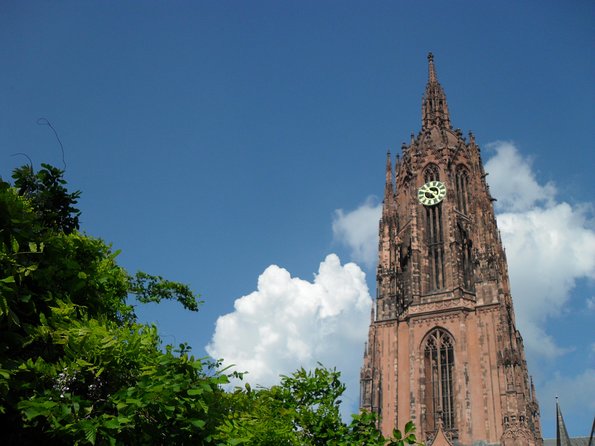
The walk begins at Braubachstraße 41 at 10:00 a.m. The first major stop is Frankfurt Cathedral, officially the Imperial Cathedral of Saint Bartholomew.
From outside, you learn why this church mattered far beyond local worship. It was the site where Holy Roman Emperors were elected and crowned, giving Frankfurt a political role that reached across central Europe. The planned 20-minute stop should give your guide enough time to explain the building and the imperial ceremonies without rushing you onward.
On Sundays, the visit is exterior only. That is not a flaw in the guide’s planning, but it is important to know before booking. If seeing the interior matters to you, choose a non-Sunday date and confirm the day’s access arrangements.
The cathedral is a good opening stop because it sets up the tour’s main theme: Frankfurt was not simply a trading town that later became a banking center. It held national importance long before the modern towers appeared.
Römerberg, the Römer, and a difficult memorial
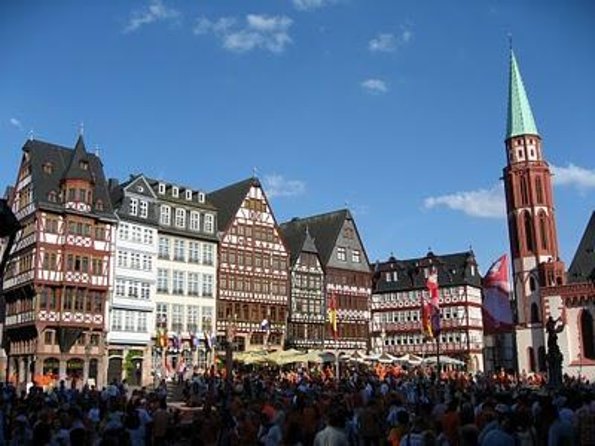
Römerberg is the visual heart of old Frankfurt. Here you see the Römer, the city hall complex, along with the Justicia statue and the Book Burning Memorial.
The square is a place where several layers of the city meet. The Römer represents civic power and the long life of the old center. Justicia points to law and public authority. The Book Burning Memorial brings the darker political history of the twentieth century into the same public space.
This is one of the tour’s strongest stops for anyone who wants more than pretty façades. A good guide can show you that monuments do not tell one single story. They also raise questions about public memory, whose voices were heard, and how Frankfurt marks painful events.
The stop lasts about 15 minutes. That is enough for a focused explanation, though you will not have unlimited time for photographs or a long independent look around the square.
Old Nicholas Church and the coronation route
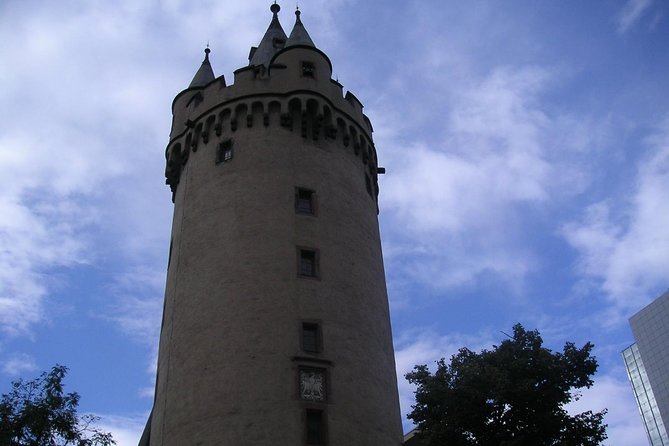
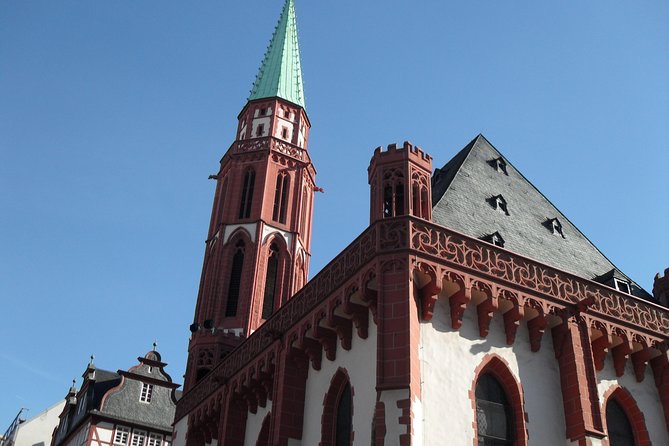
The Old Nicholas Church, or Alte Nikolaikirche, is one of Frankfurt’s oldest churches. The tour views it from outside on Sundays, with a planned stop of about 10 minutes.
The church sits within the old center’s ceremonial geography. It is not an isolated building to tick off. It helps explain the route used during imperial coronations and the way civic, religious, and political spaces were arranged around one another.
This part of the walk is brief, which suits the overall pace. You get the context, then keep moving. If you prefer long interior visits, this tour may feel more like a guided orientation than a church tour.
Same base, a different kind of day out:
- Frankfurt: River Main Sightseeing Cruise with Commentary
★ 4.3 · 5,127 reviews - Frankfurt: Hop-On, Hop-Off Grand or Express Bus Ticket
★ 3.9 · 2,088 reviews - Frankfurt: 1-Hour Panorama Boat Cruise on the river Main
★ 4.4 · 1,822 reviews - From Frankfurt: Rhine Valley Day Trip
★ 4.4 · 1,317 reviews
Karmeliterkloster and its painted walls
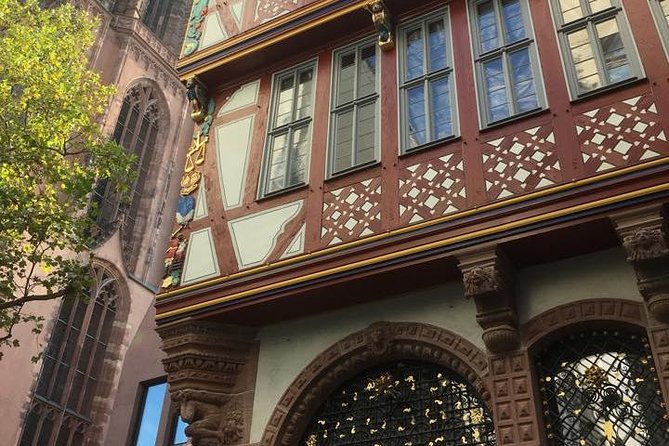
At the Carmelite Monastery, or Karmeliterkloster, the focus shifts to art. Wall paintings created between 1513 and 1521 give you a direct connection to the city’s medieval and early modern past.
The stop lasts around 15 minutes. That is enough to hear what makes the paintings important and to look closely, but you should not expect a long museum-style session.
This is a welcome change of pace after the political story of Römerberg. You move from emperors and city government to religious art and the visual world of the period. Guides who explain both dates and meaning make this stop far more useful than a quick glance at painted walls.
Kleinmarkthalle, Frankfurt’s edible break
Kleinmarkthalle is one of the most practical stops on the route. This indoor market sells produce, chocolate, cheeses, meats, pastries, and more.
The planned visit is about 15 minutes, so think of it as a short introduction rather than a full market meal. You can get ideas for a snack or later meal, and your guide may point out foods and drinks worth trying. Several guides are praised for giving useful recommendations beyond the formal sights.
This stop also breaks up the historical concentration. After churches, city halls, and memorials, the market shows Frankfurt as a living city where people shop and eat.
There is a catch: Kleinmarkthalle is not part of the route on Sundays or German holidays. The tour still has plenty to offer on those dates, but the food-market element disappears. If this stop appeals to you, book a weekday or Saturday.
The Old Jewish Cemetery and Frankfurt’s Jewish story
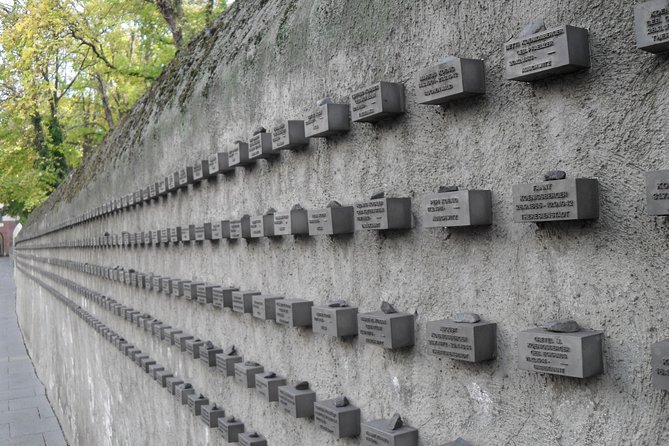
The Old Jewish Cemetery is scheduled for about 30 minutes, making it one of the longest stops. You view the medieval cemetery through the gate, while the Holocaust Remembrance Wall surrounds it.
The guide explains Frankfurt’s Jewish community, which has been present since the 1100s, as well as the medieval Jewish ghetto. This is a serious and moving part of the walk. It gives you a better sense of how long Jewish life has been part of Frankfurt, while also confronting the destruction and persecution that followed.
The cemetery is not a casual sightseeing stop. Give yourself room to listen. The gate viewing means you should not expect to walk freely through the grounds, but the location and surrounding memorial still carry considerable weight.
One useful strength of the route is that it does not isolate this history from the rest of Frankfurt. You encounter it alongside the old city streets, civic buildings, churches, and later urban changes. That helps place Jewish life within the city’s broader development rather than treating it as a detached subject.
City planning and the Frankfurt of today
The Stadtplanungsamt, or City Planning Department, offers a huge scale model of present-day Frankfurt. This stop lasts about 15 minutes and is not available on weekends or German holidays.
The model gives the tour a modern counterpoint. After spending much of the morning with medieval walls, churches, and old squares, you can see how the contemporary city is organized and how new buildings relate to the historic center.
This is particularly helpful if Frankfurt’s mix of old streets and high-rise finance towers puzzles you. The stop explains that the modern city did not simply grow without direction. Planning decisions shape what is rebuilt, preserved, or added.
If you take the tour on a weekend, you miss this indoor planning stop. That is worth weighing against the convenience of a Saturday booking.
The New Old Town and a rebuilt ceremonial route
Frankfurt’s New Old Town is one of the most distinctive parts of the experience. You walk through the reconstructed Altstadt and along the former coronation path used by Holy Roman Emperors.
The phrase New Old Town sounds contradictory because it is. The area recreates an old urban setting while also reflecting modern rebuilding. Your guide can help you separate original fabric from reconstruction and explain why the district matters to the city today.
For you, this is a good place to ask questions about memory and rebuilding. What should a city reconstruct after destruction? What should it leave modern? How does a rebuilt district gain meaning? The tour does not require you to settle those questions, but it gives you useful facts for looking at the streets with more care.
The 20-minute stop is long enough to understand the area without turning the tour into a detailed architecture seminar.
Eiserner Steg and the best open views
At the Eiserner Steg, also called the Love-lock Bridge, the setting opens up. From the bridge, you get views in both directions along the Main River, including the European Central Bank, the museum riverbank, and Sachsenhausen.
This is the route’s clearest change from enclosed old streets to broad city views. You can see the contrast between Frankfurt’s financial identity, its museums, its riverfront, and the older center you have just explored.
The scheduled stop is about 10 minutes. That can feel short if you want many photographs, especially in poor weather, but it keeps the group moving. Bring a coat or rain layer in colder months. One person completed the walk in very cold weather and still found it worthwhile, but conditions will affect how comfortable the bridge feels.
The bridge also gives you a natural pause before the final historic stop. You have time to look across the water and place the old and new parts of Frankfurt in one frame.
Staufenmauer and the medieval Jewish wall
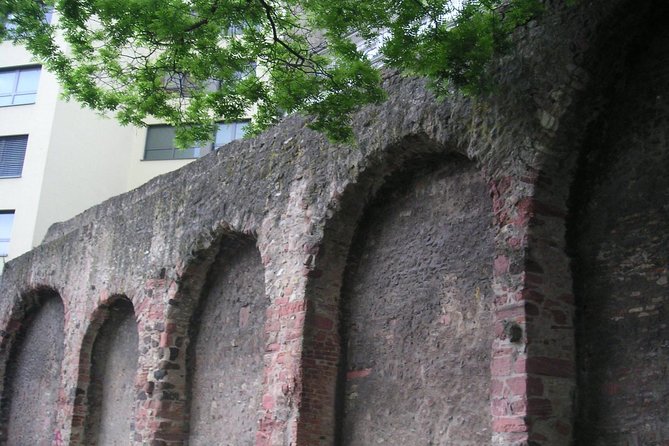
The final stop is the Staufenmauer, a city wall dating from the 1100s and part of the medieval Jewish wall. The planned visit lasts about 15 minutes.
This is a fitting ending because the wall brings together several themes from the walk: defense, urban boundaries, medieval Frankfurt, and Jewish history. By this point, you have seen the city’s ceremonial center and modern riverfront. The wall reminds you how compact and enclosed the medieval city once was.
The activity ends back at the meeting point. That makes the route convenient if you need to collect luggage, catch public transport, or continue exploring from the old center.
Pace, group size, and practical comfort
The tour takes about two to three hours, with frequent stops. That makes it easier than walking continuously, and the route is described as suitable for most people and stroller-friendly.
Still, stroller-friendly does not mean step-free. Intermittent steps are present, and one guide adapted the route when needed. If you have back pain, limited stamina, or difficulty with steps, tell the guide early and consider allowing the full three hours rather than planning a tight connection afterward.
Some people find the pace brisk, particularly older visitors. Others find it comfortable and appreciate the steady movement. The group can include a wide age range, from teenagers to people in their seventies, so the experience will not be tailored to one speed unless the guide makes adjustments.
The maximum group size is 20. That is large enough to provide energy but smaller than a mass tour. Guides are praised for projecting their voices clearly, checking on people who need help, and making room for questions.
The meeting point deserves special care. The printed address is Braubachstraße 41, 60311 Frankfurt am Main, but a map pointer has reportedly shown a spot about one block away. Use the written address, arrive early, and compare the location with your confirmation before setting out.
Who should book this Frankfurt walk
I would choose this tour if you want a first look at Frankfurt that combines major sights with context. It suits first-time visitors, short-stay visitors, and anyone who wants practical food suggestions along with history.
It is especially good for you if you enjoy connecting buildings to larger events. The imperial cathedral, Jewish cemetery, Book Burning Memorial, New Old Town, city-planning model, and river views create a much fuller picture than a simple old-town stroll.
You may want another option if you dislike guided history, need a very slow pace, or want long interior visits at each church. Sunday and holiday dates also remove Kleinmarkthalle and the planning office, while the cathedral and Old Nicholas Church are exterior-only.
Free cancellation is available up to 24 hours before the start time. Changes or cancellations made less than 24 hours ahead are not accepted for a refund.
Should you book it?
Book it if you want Frankfurt explained, not just photographed. The best guides, including Hannes, Jennifer, Ann, Anna, and Philip, turn a compact walk into a connected story about emperors, markets, Jewish life, rebuilding, and modern city planning.
At $36.28, the tour offers good value for a first visit, particularly if you have limited time. Choose a weekday or Saturday for the fullest itinerary, arrive early at the exact written address, and plan for three hours. If you can manage the distance and occasional steps, this is a strong way to get your bearings before exploring Frankfurt on your own.
FAQ
How long does the Frankfurt Highlights English Walking Tour last?
The tour lasts approximately two to three hours. Some groups finish closer to two hours, while others use the full three hours.
What time does the tour start?
The tour starts at 10:00 a.m.
Where does the tour begin?
The meeting point is Braubachstraße 41, 60311 Frankfurt am Main, Germany. The activity ends back at the meeting point.
Is the tour conducted in English?
Yes. The tour is offered in English.
What is the price?
The listed price is $36.28 per person.
How large is the group?
The maximum group size is 20 people.
Is the tour suitable for strollers?
The route is described as stroller-friendly. However, intermittent steps are present, so you should consider your specific needs before booking.
Are the cathedral and Old Nicholas Church open for an interior visit on Sundays?
No. On Sundays, the tour visits both Frankfurt Cathedral and Old Nicholas Church from the outside only.
Does the tour visit Kleinmarkthalle and the City Planning Department every day?
No. Kleinmarkthalle and the City Planning Department are not included on Sundays or German holidays.
Can I cancel for a full refund?
Yes. You can cancel at least 24 hours before the experience start time for a full refund. Cancellations or changes made less than 24 hours before the start time are not accepted for a refund.
Just added in Frankfurt
- 2-Hour Best of Frankfurt Walking Tour (English)★ 5.0 · 55 reviews
- Frankfurt: Romantic Road & Rothenburg ob der Tauber Tour★ 4.8 · 119 reviews
- Guided Axe Throwing Experience in Frankfurt Altstadt★ 5.0 · 93 reviews
- Frankfurt: Highlights and New Old Town English-Language Tour★ 4.7 · 96 reviews
- Frankfurt on Foot Daily Walking Tour in English★ 4.9 · 323 reviews
- Baden-Baden, Black Forest and Strasbourg Day Trip from Frankfurt★ 4.0 · 297 reviews
- Heidelberg Castle and City Day Tour from Frankfurt★ 4.5 · 292 reviews
- Frankfurt am Main: Night Pub Crawl Shots and Party★ 4.3 · 437 reviews
Walking Tours, compared.

Third Reich Berlin: Hitler and WWII Walking Tour
Read our review →
Browse the lists this tour appears in