
Reviewed · WALKING TOURS
Frankfurt: Private or Shared Walking Tour
Frankfurt’s story is easiest to understand when you see its old town and skyscrapers side by side. This 1.5-hour walk begins at the Justitia-Brunnen, crosses the 1868 Eiserner Steg, and moves through the Römerberg, Paulskirche, and reconstructed Neue Altstadt.
I like the clear historical thread, from wartime destruction to the 2008 to 2009 rebuilding project. I also like the choice between a low-cost shared tour and a private outing, though the German-only guiding is an important limitation if you do not speak German.
Key points at a glance
- Start at Justitia-Brunnen: Meet at the statue on Römerberg, Frankfurt’s central old-town square.
- Cross the Eiserner Steg: See the iron footbridge built in 1868 and hear how the city changed around it.
- Visit Paulskirche: Learn why this church matters in the story of Germany’s first national assembly.
- Explore Neue Altstadt: See Frankfurt’s modern reconstruction of an old-town quarter.
- Choose your group style: Book a shared walk for the lower price or a private group for more flexibility.
- Plan around the language: The live guide speaks German, and the walk lasts 1.5 hours.
Frankfurt’s old and new city in one short walk
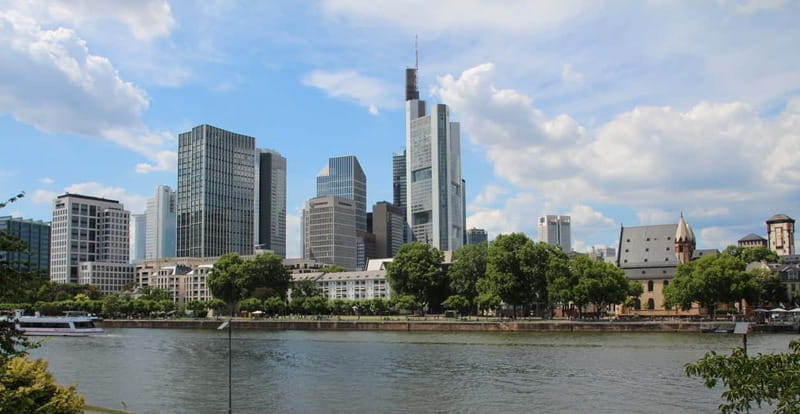
This tour works because Frankfurt offers a sharp visual contrast. Glass towers rise close to buildings that recall the traditional Altstadt, while rebuilt façades point to a past that was largely lost during World War II.
You are not simply ticking off monuments. You are following the city’s attempt to reconnect its present with its older identity. That makes the walk useful for a first look at Frankfurt, especially if you want the major central sights explained in one compact outing.
The price is $17 per person, which is fair for a guided walk of this length. You are paying for a local guide and a focused route rather than transportation, museum admissions, or a long full-day program. If you prefer private attention, the private option changes the value calculation, particularly for a small group that wants to ask questions or adjust the pace.
The main caution is language. The stated live tour language is German. That is ideal for German speakers, but you should not book expecting an English explanation. The experience also remains fairly short, so it gives you a framework for Frankfurt rather than a detailed examination of every sight.
Other walks around Frankfurt:
- Frankfurt Highlights English Walking Tour
★ 5.0 · 1,203 reviews - Frankfurt on Foot Daily Walking Tour in English
★ 4.9 · 323 reviews - Frankfurt Self-Guided Historical Walking Tour
★ 4.0 · 58 reviews
Meeting Justitia at Römerberg
The walk starts at the Justitia-Brunnen, the fountain statue on Römerberg. This is a sensible meeting point because Römerberg is at the center of Frankfurt’s historic core and close to several major stops on the route.
Starting here gives the guide a natural place to explain how Frankfurt’s old center functioned and how it changed over time. You can expect the opening discussion to set up the contrast between the traditional city and the modern business center nearby.
The meeting point is also practical for anyone with limited time in Frankfurt. You do not need a complicated transfer to begin the activity, and the walk finishes back at the same meeting point. That makes it easier to fit around other plans.
You should arrive ready to walk for 90 minutes. The information provided does not promise a seated break, a museum visit, or a food stop. This is an outdoor sightseeing walk, so weather can affect your comfort. One private group handled a rainy evening successfully, but you will still want suitable clothing and shoes.
Crossing the 1868 Eiserner Steg
One of the first important stops is the Eiserner Steg, Frankfurt’s iron footbridge built in 1868. The bridge gives the route a useful change of scene, taking you away from the square and into a place where the city’s older core can be considered from a different angle.
The bridge is more than a quick photo stop. It helps show how Frankfurt connects its historic center with the wider city. As you cross or examine the bridge, the guide explains how the surrounding buildings and urban fabric were affected by World War II.
That wartime context is one of the strongest parts of the experience. Many grand buildings were destroyed, so the old town you see today is not simply an untouched medieval quarter. Some parts are historic survivors, while others are reconstructions or newer buildings designed to recall earlier forms.
This distinction matters. It keeps the tour from presenting Frankfurt as an old city frozen in time. Instead, you see a place that had to decide what to rebuild, what to reinterpret, and how to make room for modern life.
Reading the scars of World War II
The walk gives particular attention to the destruction of Frankfurt during World War II. That background helps explain why the city can feel both old and new within a few minutes of walking.
You may notice that the route does not treat reconstruction as a minor footnote. The guide connects the damage to the city’s later renovation efforts, including the major 2008 to 2009 project. This is the kind of information that can change how you look at the façades around Römerberg.
For me, this historical connection is more useful than a simple list of dates. You learn to ask which parts are original, which parts were rebuilt, and why Frankfurt chose a particular appearance for its central old town.
The tour is best for people who enjoy that kind of visual reading. If you mainly want interior visits, long time at individual monuments, or a broad survey of museums, you may find the route too focused. Its purpose is to explain the city center from the street.
A few more things to do in Frankfurt worth a look
- Welcome to Frankfurt: Private Tour with a Local
★ 4.7 · 81 reviews - Private Tour with Native English speaking Local
★ 4.9 · 60 reviews - Frankfurt: Private Sport Boat Tour – Speed, Fun & Skyline
★ 4.9 · 42 reviews - Frankfurt: Private Romantic Skyline Boat Tour
★ 5.0 · 22 reviews
The Römer and Frankfurt’s traditional center
The historic Römer is another central stop. It is one of the clearest symbols of Frankfurt’s old civic identity, and it anchors the surrounding Römerberg area.
Here, the guide can place the traditional city beside the contemporary one. Frankfurt is often known for banking, trade, and tall office buildings, but the Römer shows the older civic face of the city. The value of seeing it with a guide is the connection between the building, the square, and the wider story of Frankfurt’s changing center.
The supplied information does not promise entry inside the Römer. You should therefore think of this as an exterior explanation and sightseeing stop rather than an indoor tour.
That is not a serious weakness for a short walking experience. The route covers several major places, and keeping the focus outdoors allows the guide to connect them without spending the entire 90 minutes inside one attraction.
Paulskirche and Germany’s first national assembly
Paulskirche gives the walk its strongest political history stop. This is where the first German national assembly took place, making the church important far beyond Frankfurt.
The guide explains the significance of that assembly as part of the city’s wider German history. Even if you are not deeply familiar with nineteenth-century politics, the stop gives you a reason to look at Paulskirche as more than another historic building.
The experience is especially helpful here because a church can be easy to see and quickly pass. A short explanation turns it into a place connected with national political change.
Again, the activity details do not include guaranteed interior access. The focus is on seeing the site and learning its importance during the walk. If going inside Paulskirche is a priority, confirm what is included before booking.
The Neue Altstadt and a modern reconstruction
The newest major section of the walk is Frankfurt’s Neue Altstadt, or new old town. The name captures the city’s unusual approach: rebuilding a central quarter with traditional references while creating a recent urban district.
This is where the tour’s main theme becomes most visible. You can compare the restored or newly built old-town forms with the modern structures that define Frankfurt’s skyline. The contrast is not abstract. You can see it in the streets and buildings around you.
The 2008 to 2009 renovation period provides useful context for understanding why the area looks the way it does. You are not being asked to assume that every old-looking building is centuries old. Instead, you learn how Frankfurt used reconstruction to bring back a traditional sense of place.
The Neue Altstadt is a good reason to choose this walk even if you have already seen the Römerberg. It adds a current urban story to the older landmarks. You get a look at how a major German city has tried to make its central area feel more connected to its past.
The drawback is that a new reconstruction can be interpreted in different ways. Some people value the familiar street pattern and traditional appearance, while others may prefer surviving historic buildings. A guide can help you understand the project, but the tour cannot settle that design debate in 90 minutes.
What the guides add to the walk
The experience depends heavily on the guide because the route itself is compact and the sights are close together. The guide is expected to provide useful information at each attraction, not simply lead you from one square to the next.
One guide named Sanel received particular praise for giving an in-depth account of Frankfurt’s history. That is helpful evidence for anyone who wants more than quick facts. A local perspective can also make the connections between the war damage, the reconstruction, and the new old town easier to follow.
The information also describes a private tour whose guide adjusted the timing and still offered good insights during a shortened visit. That suggests some flexibility may be possible in a private booking, though you should not assume every request can be accommodated.
The guide language is German. This point deserves a clear warning because the tour’s value comes from the spoken historical explanation. If you understand German, the walk may feel detailed and personal. If you do not, you should seek confirmation about language before paying.
Shared or private: which option fits you?
The shared tour is the straightforward value choice. At $17 per person, it gives you a guided introduction to Frankfurt’s central sights without the cost of arranging a dedicated guide.
Choose shared if you want a scheduled walk, are comfortable listening in German, and mainly need orientation. It is a good match for a first afternoon in Frankfurt or for anyone with only a few hours before a train or other plan.
A private group makes more sense when you want a more personal pace or have specific questions. A private guide may be able to respond more directly to your interests, and the experience can be a better fit for a family or small group that does not want to follow a larger public schedule.
The price difference for the private option is not provided, so I cannot judge its exact value. The useful point is flexibility, not an assumed upgrade in content. The private format does not automatically mean museum entry, a longer route, or another language.
Who will get the most from this tour?
I would recommend this walk to German-speaking visitors who want a short historical orientation before exploring Frankfurt on their own. It is also a good fit for visitors who are curious about reconstruction and city planning, not only medieval-looking buildings.
The experience suits first-time visitors because it covers several central reference points: Römerberg, Eiserner Steg, Römer, Paulskirche, and Neue Altstadt. You finish where you started, so you can continue sightseeing from a familiar part of the city.
History-minded visitors will appreciate the link between World War II, the destroyed buildings, and the rebuilding project. Architecture fans may enjoy comparing traditional forms with Frankfurt’s modern towers.
I would hesitate to recommend it to anyone seeking an English-language tour, a long museum visit, or a full survey of Frankfurt beyond the central old town. The 1.5-hour duration is efficient, but it naturally limits the depth and number of stops.
Timing, cancellation, and practical value
The duration is 1.5 hours, with starting times shown according to availability. That length is long enough to establish the city’s main story but short enough to fit into a busy day.
You can cancel up to 24 hours before the activity for a full refund. You can also reserve now and pay later, which helps if your Frankfurt schedule is still shifting.
The activity begins and ends at Justitia-Brunnen on Römerberg. Since no transport is included or needed during the walk, you should plan to reach the meeting point independently and allow a little extra time to find the statue.
A 4.8 rating from 156 reviews suggests strong overall satisfaction, with especially positive reactions to the historical detail, guide flexibility, and the depth of the explanation. One German-speaking local was particularly enthusiastic about Sanel’s account of Frankfurt, which is a useful sign for people who want more than a basic introduction.
Should you book the Frankfurt walking tour?
Book it if you want a focused German-language introduction to Frankfurt’s old town, wartime destruction, political history, and recent reconstruction. The $17 shared option offers good value for 90 minutes, and the private format may suit small groups that want more flexibility.
Think twice if you need English, want to enter several buildings, or prefer a long and leisurely tour. Before booking, check the available time and make sure the live guide language works for you.
For the right audience, this is a compact way to understand why Frankfurt looks the way it does. You see the old town, the new old town, the 1868 iron bridge, Paulskirche, and the modern city in one connected walk.
FAQ
Where does the Frankfurt walking tour start?
The tour starts at the Justitia-Brunnen on Römerberg.
Where does the tour end?
The activity ends back at the meeting point at the Justitia-Brunnen.
How long does the walking tour last?
The walking tour lasts 1.5 hours.
What language is the live tour in?
The live tour guide speaks German.
Is a private tour available?
Yes. You can choose a private group option, depending on availability.
What sights are included?
The route includes the Eiserner Steg, the Römer, Paulskirche, Römerberg, and Frankfurt’s Neue Altstadt.
What is the Eiserner Steg?
The Eiserner Steg is an iron footbridge built in 1868.
How much does the shared walking tour cost?
The listed price is $17 per person.
Can I cancel for a refund?
Yes. You can cancel up to 24 hours in advance for a full refund.
Just added in Frankfurt
- Day Trip to Rothenburg from Frankfurt★ 4.6 · 25 reviews
- Rhine Valley: Half Day Tour from Frankfurt★ 3.7 · 66 reviews
- Private Tour with Native English speaking Local★ 4.9 · 60 reviews
- Hohenzollern Castle: Full-Day Tour from Frankfurt★ 4.3 · 11 reviews
- From Frankfurt: Day Tour to Heidelberg with Local Guide★ 4.8 · 250 reviews
- Heidelberg and Rhine Combination Tour from Frankfurt★ 4.1 · 33 reviews
- Frankfurt: Guided walk between palm trees and skyline★ 4.8 · 9 reviews
- From Frankfurt: Heidelberg & Baden-Baden Full-Day Tour★ 4.9 · 23 reviews
Walking Tours, compared.

Third Reich Berlin: Hitler and WWII Walking Tour
Read our review →
Browse the lists this tour appears in