Reviewed · TOURS IN BERLIN
Get to Know Berlin’s Main Sites –A Private Tour with Jacob
Berlin’s past is packed into a surprisingly tight central area, and this private tour gives you a fast, personal introduction to it. In less than three hours, you move from the Reichstag and Brandenburg Gate to the Holocaust Memorial, Checkpoint Charlie, Gendarmenmarkt, and a chocolate shop.
I like the private format, since your group can ask questions and adjust the emphasis. I also like the practical extras: hotel pickup, a public transport map, an A3 guide folder, and help with museum and restaurant choices. The main drawback is pace. Ten stops in 2 hours 45 minutes means several places are brief exterior visits, not full museum tours.
Key points to know before booking
- Ten central Berlin stops: The route covers political landmarks, Nazi history, Cold War sites, imperial architecture, and a chocolate shop.
- A private group of up to six for the advertised price: The $310 group rate can make sense for families or friends traveling together.
- Hotel pickup is available: You can request pickup from a Berlin hotel, apartment, Airbnb, train station, or airport.
- You can shape the discussion: The guide can adjust the focus around your interests and offer suggestions for museums, restaurants, and other places.
- Public transport costs extra: Plan on roughly 3 to 11 euros per person for transit, depending on what you use.
- The tour moves quickly: It is best for getting oriented, not for detailed visits inside Berlin’s museums or government buildings.
Berlin’s story in one private route
This experience works as a first look at central Berlin. Instead of spending a whole morning in one museum, you cover the city’s major political and historical markers while your guide explains how they fit together.
The route is especially useful because Berlin’s story is not confined to one district or one time period. The Reichstag points to today’s German government. The Brandenburg Gate recalls a divided city and reunification. The Holocaust Memorial and the Führerbunker site confront the Nazi period. Checkpoint Charlie and the Trabi Museum turn toward the Cold War and East Germany. Gendarmenmarkt then brings you back to imperial Berlin.
You are not simply checking off monuments. You are moving through the changes in power that shaped the city. The private setting makes it easier to stop and ask why a site matters, or to shift the conversation if your group wants more detail about one period.
The tour title refers to Jacob, while the provider is listed as Nadav Jacobs Berlin Experience and one supplied response is signed Nadav. If knowing your guide’s exact name matters, confirm it when you book. The important point is that this is a personal guide service rather than a large scheduled group.
A few more things to do in Berlin worth a look
- Berlin: Private Reichstag and Glass Dome Tour
★ 4.8 · 2,226 reviews - Berlin Private Complete History All Day Walking Tour
★ 5.0 · 474 reviews - Private Walking Tour Berlin Third Reich Hitler and World War II
★ 5.0 · 360 reviews
The Reichstag and Brandenburg Gate
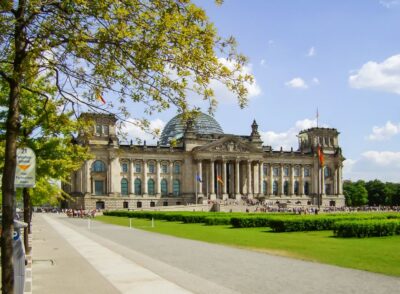
The Reichstag Building is the natural opening for a look at modern Germany. It houses the German parliament, and the stop is scheduled for about 10 minutes. That is enough to see the building from outside and establish its political importance, but not enough for an interior visit.
Your guide can help place the building in the broader story of Berlin’s government. For a first-time visit, that context is useful because the Reichstag is more than an impressive facade. It represents the German state today, after the city’s sharp turns through monarchy, dictatorship, war, division, and reunification.
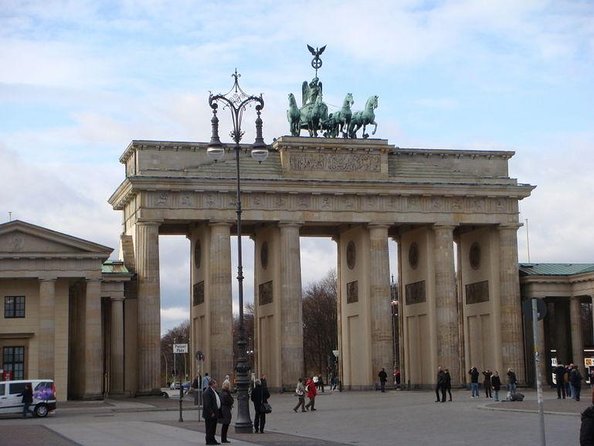
Next comes the Brandenburg Gate, with about 15 minutes to walk through and around it. This is one of Berlin’s clearest symbols of a once-divided city. The gate was near the former boundary between East and West Berlin, and its meaning changed after the Wall fell.
I like the pairing of these first two stops. One shows the current seat of government. The other links the present to the political division that shaped modern Berlin. You will have time for photographs, but not a long architectural study.
The Holocaust Memorial and Führerbunker site
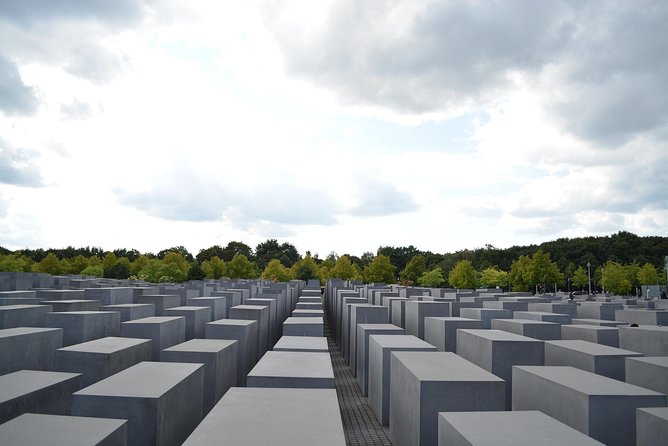
The Memorial to the Murdered Jews of Europe is one of the most affecting stops on the route. You spend about 20 minutes walking through its field of concrete blocks. The memorial is free, and the open-air design gives your guide room to explain how to approach the site respectfully.
This is a place where a few minutes can feel like a lot. The blocks create changing sightlines and a sense of uncertainty as you walk among them. The experience is not a conventional monument with a long inscription telling you exactly what to think. Give yourself time to pause rather than treating it as just another photograph stop.
The nearby Führerbunker site is handled more briefly, with about 10 minutes at the sign marking the location. Your guide discusses the final days of the war and explains what happened in this part of Berlin. There is no grand entrance to see, and that is part of the point. The site is marked rather than presented as a preserved attraction.
I appreciate the contrast between the memorial and the bunker stop. One asks you to confront the murder of Europe’s Jews through a physical space. The other points to the final stage of Nazi rule through a modest marker. If you want a full museum treatment of the Nazi era, the tour can suggest further places to visit, but these stops alone are introductions.
Nazi-era architecture and the Topography of Terror
The Federal Ministry of Finance is described as the largest remaining Nazi building. The visit lasts about 15 minutes, likely allowing time to see the structure and discuss its past from outside. This is an important detail for anyone interested in how political buildings can survive after the regime that built them has ended.
The building’s present use also creates a useful historical question. Berlin did not erase every physical trace of the Nazi period. Instead, some structures were given new purposes, while their earlier roles remain part of the city’s story. Your guide can help you read the building as both architecture and evidence.
At the Topography of Terror, the group stops for about 10 minutes to see the museum area and photograph a remaining section of the Berlin Wall. The museum focuses on the institutions and crimes of Nazi rule. Since the scheduled visit is short, treat this as an introduction rather than a museum visit.
This is one of the clearest places to decide how much time you want to spend after the tour. If the Nazi period is your main interest, you may want to return later for a slower visit. The tour gives you the location and basic setting, then leaves you with practical options for further study.
Same base, a different kind of day out:
- Berlin: Reichstag, Dome and Government District Guided Tour
★ 4.7 · 18,288 reviews - Berlin: 1-Hour City Tour by Boat with Guaranteed Seating
★ 4.3 · 16,993 reviews - Berlin: Boat Tour Along the River Spree
★ 4.4 · 11,252 reviews - Discover Berlin Half-Day Walking Tour
★ 5.0 · 9,624 reviews
The Trabi Museum and Checkpoint Charlie
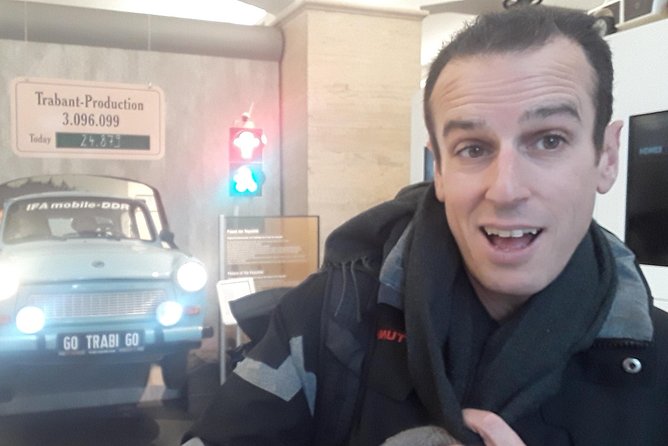
The Trabi Museum adds a lighter, more everyday angle to the Cold War. The Trabant was the familiar East German car, and the stop lasts about 15 minutes. A car may seem like a small subject beside border crossings and political conflict, but it helps explain ordinary life behind the Iron Curtain.
The museum stop also breaks up the heavier memorial sites. You can see how a product associated with East Germany became a cultural symbol after reunification. The tour does not promise an extended museum visit, so check with your guide if you want to spend more time inside.
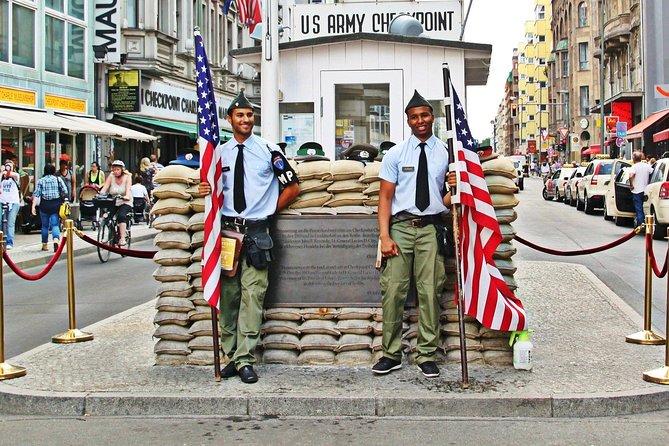
Checkpoint Charlie follows with about 20 minutes. This was one of the best-known crossing points between East and West Berlin, and your guide explains its role during the Cold War. You will cross the famous checkpoint area and see one of the places where Berlin’s division became highly visible.
Checkpoint Charlie is now a busy sightseeing location, and the short visit is useful for orientation. It may not feel like a quiet historical site. That is precisely why a guide helps here: the modern streetscape can make it hard to understand what the crossing meant without some background.
The Trabi Museum and Checkpoint Charlie work well together. One shows the private side of life in East Germany. The other shows the controlled border between two political systems. If your group wants more Cold War detail, say so early in the tour so the guide can give that period enough attention.
Gendarmenmarkt and Rausch Schokoladenhaus
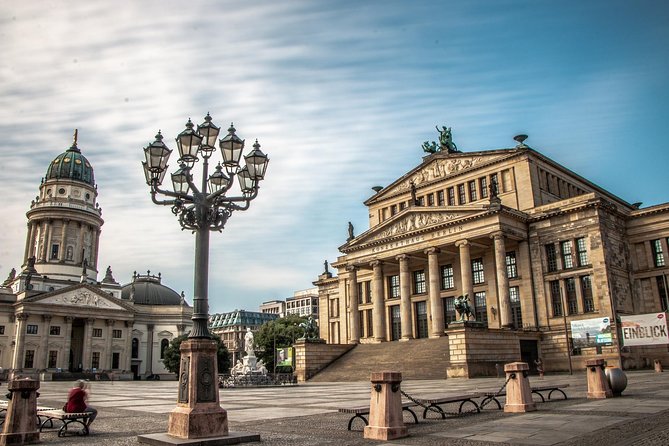
Gendarmenmarkt shifts the mood again. You spend about 15 minutes walking through what is described as Berlin’s most beautiful square, a surviving piece of imperial Berlin. The square’s formal design and grand buildings offer a sharp contrast with the government blocks, memorials, and Wall sites earlier in the route.
This stop matters because Berlin is not only a city of twentieth-century conflict. Its older identity is still visible in carefully planned public spaces and monumental architecture. A brief walk gives you a sense of that earlier city, even if it cannot replace a dedicated architecture tour.
The final stop is Rausch Schokoladenhaus, a well-known chocolatier in the city. You spend about 15 minutes inside. This is a pleasant way to finish, giving you time to browse and perhaps choose a gift or treat.
The chocolate stop is also a practical travel touch. After several serious historical sites, a short food stop lets the group relax and ask for suggestions about the rest of the day. It is not included as a tasting experience in the tour details, so plan to pay for anything you choose to buy.
What $310 means for a group of six
The price is $310 per group, with the advertised group size of up to six people. That works out to about $52 per person if six people share the booking. For two people, the effective cost is much higher, so the value depends heavily on group size and how much you value a private guide.
You are paying for more than a standard walk. The package includes your own guide, hotel or other requested pickup in Berlin, recommendations for museums and restaurants, an A3 guidance folder, a large public transport map, and guide availability for questions or help during your Berlin visit.
Public transportation is not included. The estimated cost is about 3 to 11 euros per person, depending on the transit used. A private van and driver can be arranged on request, but that is also outside the stated price.
For a family or group of friends, the fixed price is easier to justify. You can ask questions without holding up strangers, and the guide can adjust the route to your interests. For a couple on a tight budget, a public walking tour or self-guided route may cost less, though it will not offer the same pickup service or personal planning.
The tour is booked about 22 days ahead on average, so I would not leave it until the last minute if your schedule is fixed. You need to give your preferred departure time and central pickup location when booking.
Timing, transport, and the practical details
The tour lasts approximately 2 hours 45 minutes. Ten stops in that time means the route is an overview with many short pauses. The scheduled stops range from 10 to 20 minutes, and moving between them takes part of the available time.
You should wear comfortable shoes and expect a mix of walking and public transport. The experience is near public transportation, and the guide provides a large transit map. If your group includes people who need a slower pace, mention that before the tour so expectations are clear.
Pickup can be requested from a hotel, apartment, Airbnb, train station, or airport in Berlin. The details specify central pickup, so provide the exact location and preferred start time when you book. The tour can also be tailored around your interests, which is worth discussing in advance.
The activity is private, and only your group participates. A maximum of 10 people is given in the booking details, while the advertised $310 rate is for a group of up to six. If you have more than 10 people, contact the provider rather than assuming the same arrangement applies.
Service animals are allowed, and most people can participate. Free cancellation is available if you cancel at least 24 hours before the local start time. Changes or cancellations inside that 24-hour window are not accepted for a refund.
Who will get the most from this tour
I would choose this experience for a first visit to Berlin when I want a strong sense of the center before deciding which museums deserve more time. It is also a good fit for families, friends, and small groups who want a guide’s attention without joining a large party.
History-minded visitors will like the range of subjects. You see government, Nazi Germany, the Holocaust, the final days of the war, East Germany, the Cold War, reunification, imperial Berlin, and modern food culture in one outing.
I would not choose it as my only history experience in Berlin if I wanted lengthy museum visits. The Topography of Terror, the Holocaust Memorial area, and other sites deserve more time than this schedule allows. Think of the tour as a map of the city’s major themes, followed by your own return visits.
The guide’s extra recommendations are valuable here. Ask for a short list of museums and restaurants that fit your interests before the tour ends. The included folder and public transport map can also help you plan the next day rather than simply record where you have been.
Should you book Get to Know Berlin’s Main Sites?
Book it if you want a private orientation to central Berlin, especially if you are traveling with several people who can share the $310 price. The hotel pickup, flexible start time, guide access, and broad route save planning time.
Think twice if you prefer slow museum visits or dislike moving between many short stops. In that case, choose one historical area and spend several hours there.
For most first-time visitors with limited time, this is a useful starting point. You will see the major landmarks, understand how they connect, and leave with practical ideas for the rest of your stay. Ask in advance how the guide will handle the Jacob and Nadav Jacobs name difference, confirm your pickup point, and state which period matters most to you.
FAQ
How long does the private Berlin tour last?
The tour lasts approximately 2 hours and 45 minutes.
How much does the tour cost?
The price is $310 per group of up to six people.
Can I choose the starting time?
Yes. You should provide your preferred departure time when booking.
Where can the guide pick me up?
Pickup is available from a Berlin hotel, apartment, Airbnb, train station, or airport. You should provide a central pickup location when booking.
Is public transportation included?
No. Public transport is not included. The stated estimate is about 3 to 11 euros per person.
How many people can join?
The advertised price covers up to six people. The booking information also gives a maximum of 10 people per booking. Contact the provider for a larger group.
Can I cancel for a refund?
Yes. You can cancel at least 24 hours before the local start time for a full refund. Changes or cancellations made less than 24 hours before the start are not accepted.
Just added in Berlin
- Private One way Airport Transfer Berlin Airport To Berlin★ 3.5 · 17 reviews
- Private Walking Tour: Berlin Wall, Cold War and Checkpoint Charlie★ 5.0 · 37 reviews
- Modern Berlin Private Walking Tour: Diverse, Vibrant and Exciting German Capital★ 5.0 · 13 reviews
- Private Day Trip to Potsdam from Berlin by Train★ 4.5 · 27 reviews
- City Explorer: Potsdam Private Day Trip★ 4.5 · 10 reviews
- Berlin Private Custom 5-Hour Tour by Car★ 5.0 · 30 reviews
- Private Half-Day Sightseeing Tour in Berlin★ 3.5 · 6 reviews
- Berlin Private Custom Tour in a Minivan, East and West★ 5.0 · 123 reviews
Tours in Berlin, compared.
Reichstag, Dome and Government District Guided Tour
Read our review →
1-Hour City Tour by Boat with Guaranteed Seating
Read our review →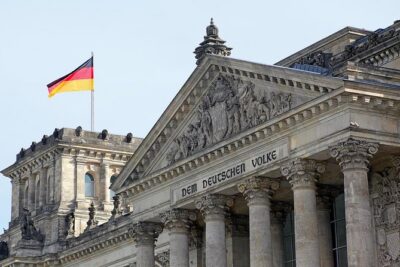
Reichstag, Plenary Chamber, Cupola & Government Tour
Read our review →