
Reviewed · WALKING TOURS
Frankfurt on Foot Daily Walking Tour in English
Frankfurt on Foot does more than point out the Römer and send you toward the river. It connects the postcard sights with the city’s medieval Jewish quarter, wartime destruction, postwar rebuilding, and modern financial identity. The WWII and Jewish history gives this tour more weight than a standard old-town stroll.
I like the mix of major sights and less obvious stops, especially the Stolpersteine, Holocaust memorial wall, and Jewish ghetto wall. I also like the practical rhythm: about three hours, a restroom break, a snack stop, and no time lost getting on and off transport. The main consideration is distance. Expect roughly 7 kilometers on foot, often over cobblestones, so comfortable shoes matter.
Key points at a glance
- A 3-hour English tour covering about 7 kilometers: You get a broad first look at central Frankfurt without using a bus or train.
- History beyond the postcard sights: The route includes the rebuilt Altstadt, Nazi book-burning memorial, Jewish quarter, and wartime memory sites.
- Guides with different strengths: Justin, Ann, Phillip, Jennifer, Hans, Jo, and others are praised for clear storytelling, humor, local tips, and patience with questions.
- A real Main River photo stop: The Eiserner Steg gives you a strong view of Frankfurt’s skyline and museum riverbanks.
- Daily departures and flexible booking: The tour runs every day of the year, starts at 10:00, and allows cancellation up to 24 hours ahead for a full refund.
- Good for many mobility needs, but not a short stroll: The tour is wheelchair and stroller friendly, yet the distance and cobblestones still deserve attention.
Why this walking tour gives you Frankfurt’s full story
Frankfurt can seem easy to sum up: a modern banking center with a compact old town beside the Main. That quick picture misses much of the city. The old streets were heavily damaged in World War II, the historic center was rebuilt in stages, and the Jewish quarter carries centuries of both cultural importance and painful memory.
This tour is useful because it places those pieces close together. You begin among the city’s most recognizable buildings, then move through churches, memorials, river views, and food culture. I like that structure for a first morning in Frankfurt. You get enough background to decide what deserves a longer visit later.
The route is led in English only, and the guides named in the feedback include Justin, Ann, Phillip, Jennifer, Hans, Hannes, Jo, Jean, and Anna. Their styles differ, but the strongest pattern is clear speech, solid command of Frankfurt’s past, and a willingness to answer questions. Justin is repeatedly singled out for linking local history with present-day life, while Ann is praised for personal stories and an energetic delivery. Phillip receives praise for enthusiasm, pacing, and clear explanations.
This is not a private tour, so the exact group size and guide will vary. That can affect the feel of the morning. A smaller group makes questions easier, while a larger group may require you to stay close and listen carefully in busy public squares.
Other walks around Frankfurt:
- Frankfurt Highlights English Walking Tour
★ 5.0 · 1,203 reviews - 2-Hour Best of Frankfurt Walking Tour (English)
★ 5.0 · 55 reviews - Discover Berlin Half-Day Walking Tour
★ 5.0 · 9,624 reviews
Starting at the Römer and Römerberg
Meet at 10:00 across from the Tourist Information office on Römerberg, in front of the Binding Schirn Pub. Look for the guide holding a Frankfurt on Foot Walking Tours sign. This central meeting point is easy to identify, but give yourself a few minutes to find it because the square has several nearby landmarks and pedestrian streets.
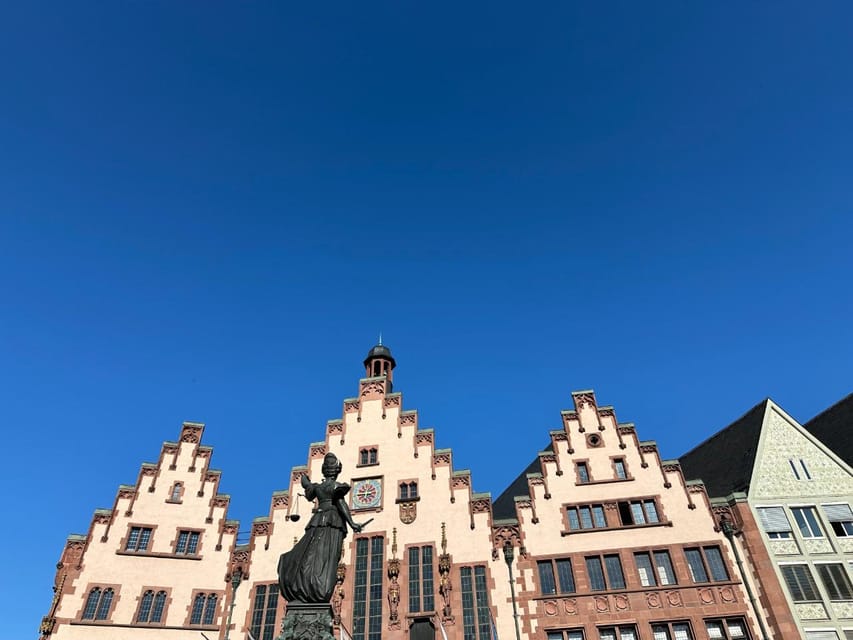
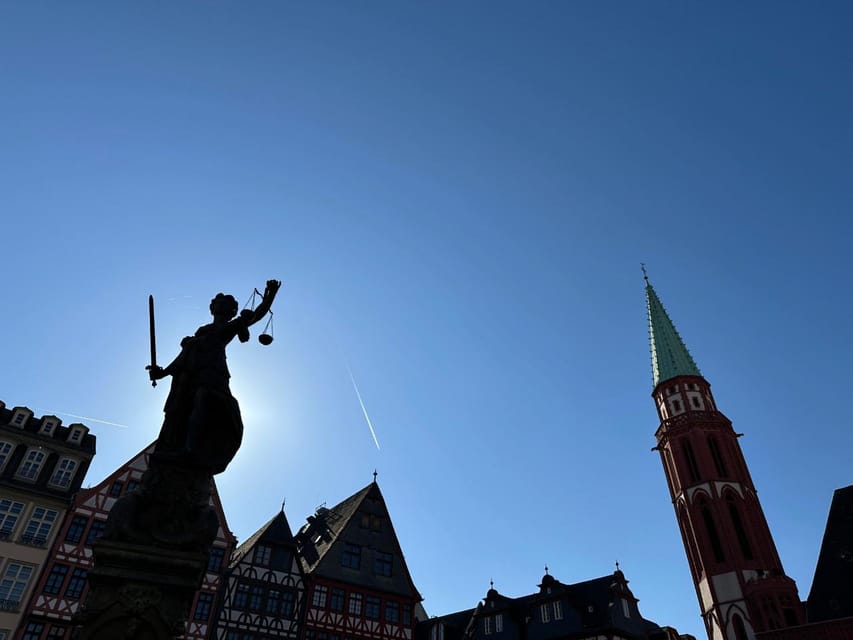
The Römer is Frankfurt’s city hall and has served that role since 1405. Its stepped gables make it one of the city’s most familiar buildings, while Römerberg provides the broad setting for understanding old Frankfurt. Your guide uses this opening to explain how the civic center worked and why the square remains the symbolic heart of the city.
From here, the tour moves into the New Altstadt. This rebuilt quarter is one of the most important parts of the experience. It can look old at first glance, but much of what you see is a modern reconstruction inspired by earlier buildings and street lines. The useful question is not simply which buildings are old? It is why did Frankfurt rebuild this way?
That distinction helps you read the city more accurately. The New Altstadt offers attractive façades and a walkable historic center, but it is also part of a modern decision about how Frankfurt wanted to remember its past. Your guide explains how and why the district was rebuilt rather than presenting it as one untouched medieval neighborhood.
Churches, paintings, and the city’s older layers
Alt Nikolai Church is a Gothic church built in 1290. You see its exterior on Sundays, when entry is not part of the regular visit. The same Sunday and religious-holiday limitation applies to the exterior-only visit at St. Bartholomew Cathedral, better known as the Kaiserdom.
The Kaiserdom carries major imperial history. For centuries, elections and coronations of Holy Roman Emperors took place there. Even if you cannot enter, its exterior helps explain Frankfurt’s political importance in the medieval and early modern periods.
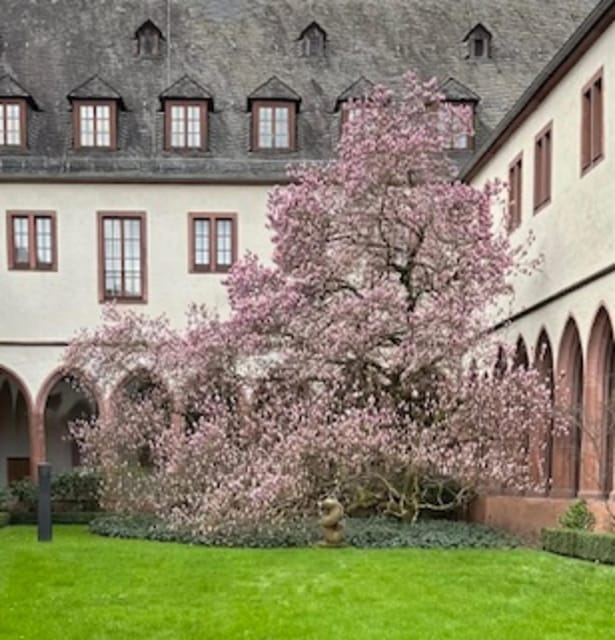
The Carmelite Cloister adds a different kind of stop. Its Jörge Ratgeb wall paintings were made in the early 1500s and are described as the largest religious wall paintings north of the Alps. They give you something that many city walks lack: an original interior art setting rather than another square or façade. The cloister is not included on some holidays, so check the date if this stop matters to you.
House Wertheim is another valuable contrast. It is described as the only original half-timbered house left in the inner city after World War II. Among all the reconstructed buildings, that surviving structure helps you picture what Frankfurt’s old center once looked like.
The route does not ask you to treat every site as an isolated monument. Instead, it shows how old religious buildings, civic spaces, surviving houses, and reconstructed streets fit together. That is where the guide matters most. A plaque can name a building, but a good explanation gives you the reason it belongs in the story.
Remembering the book burning and Frankfurt’s Jewish community
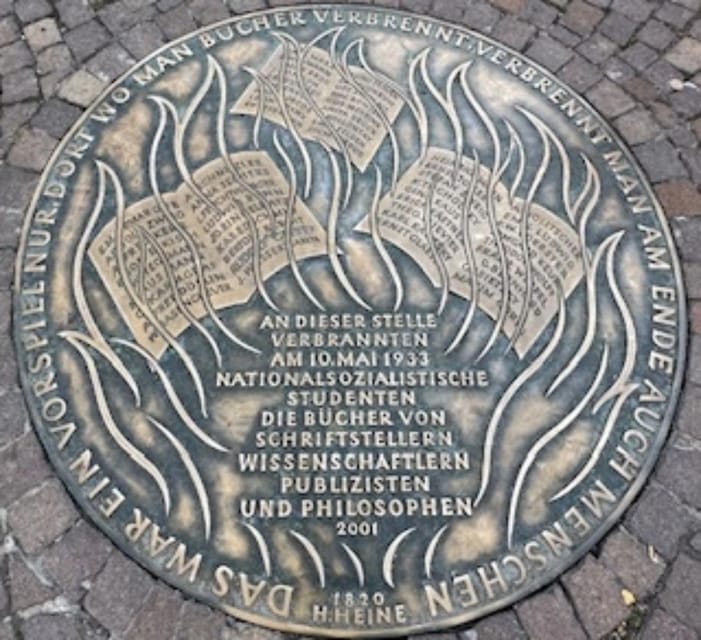
The Book Burning Memorial marks the site connected with the Nazi book burning. It is a small but serious stop, and the tour does not avoid Frankfurt’s darkest period. That is a strength. A pleasant old-town walk can become shallow if it skips the events that reshaped the city and its people.
The route then reaches the Jewish quarter and several sites of remembrance. Stolpersteine, or stumbling stones, are small memorial markers set into the pavement for people murdered under the Nazi regime. Your guide explains how this form of remembrance works and points out the markers along the route. Look down as you walk. The memorial is deliberately placed in the everyday path of the city.
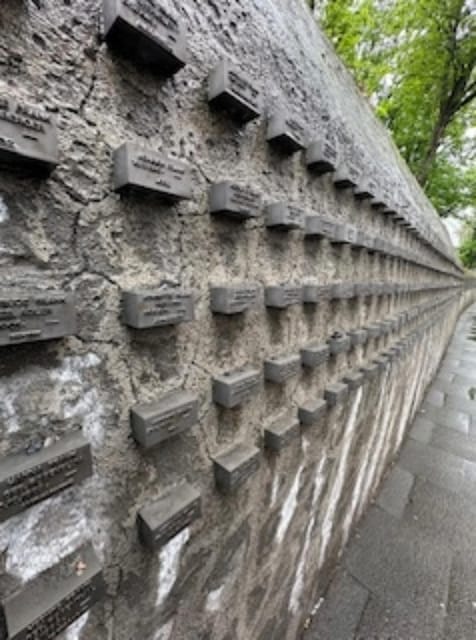
The Jewish Holocaust Memorial Wall honors around 12,000 Jewish citizens of Frankfurt murdered in the Shoah. The names include Anne, Margot, and Edith Frank. This is a personal memorial rather than a grand monument, and you should allow yourself a quiet moment here. The stop gains force because it connects individual names with Frankfurt’s local story.
You also view the medieval Jewish Cemetery from outside. It is one of Germany’s oldest and largest Jewish cemeteries. Nearby, the Jewish Ghetto Wall began as part of the city’s defenses in 1180 and later became one of the walls around the medieval Jewish ghetto.
These places make the tour more than a parade of attractive buildings. They show how Jewish life was rooted in Frankfurt for centuries, how the medieval city controlled and confined its Jewish population, and how the Nazi era destroyed much of that community. The subject is difficult, but the route handles it as a central part of the city’s identity.
Same base, a different kind of day out:
- Frankfurt: River Main Sightseeing Cruise with Commentary
★ 4.3 · 5,127 reviews - Frankfurt: Hop-On, Hop-Off Grand or Express Bus Ticket
★ 3.9 · 2,088 reviews - Frankfurt: 1-Hour Panorama Boat Cruise on the river Main
★ 4.4 · 1,822 reviews - From Frankfurt: Rhine Valley Day Trip
★ 4.4 · 1,317 reviews
Crossing the Main on the Eiserner Steg
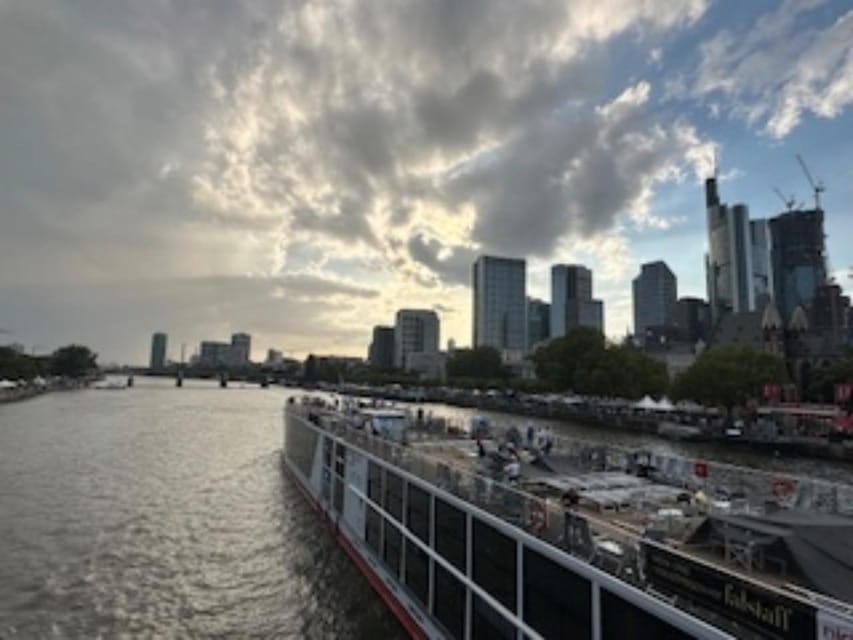
The Eiserner Steg is the tour’s best broad city view. This pedestrian bridge crosses the Main and gives you a clear look toward Frankfurt’s skyline, along with the museums lining the riverbanks.
It is also a useful change of pace. After several stops in tight historic streets, you get open space, river air, and a chance to take photographs. The bridge is one of the tour’s strongest photo locations, but it can also be busy. Keep close to the group and listen for the guide’s meeting instructions before taking time for pictures.
The skyline view helps explain Frankfurt’s unusual character. The city has a medieval core, a serious financial center, and a long museum strip along the river. From the bridge, those parts appear together instead of feeling like separate attractions.
The tour does not use transportation. That keeps the route simple and lets you notice small details along the way, but it also means the three-hour schedule depends on steady walking. If you prefer a slow stop-and-start tour with long indoor visits, this will feel active.
A short break at Kleinmarkthalle
Kleinmarkthalle is a favorite part of the route for good reason. This produce hall is filled with fruit, vegetables, chocolate, pastries, cheeses, breads, meats, fish, and specialty foods from around the world.
The stop is designed for a snack break, not a full meal. Snacks and drinks are optional and not included in the $35 price. One useful tip from the experience is to plan your expectations: the break may be enough to buy something and use the restroom, but not enough for a relaxed sit-down meal. One person found the available time tight when trying to sit for more than a few minutes.
The market is not open as part of the tour on Sundays and holidays. If food culture matters to you, a weekday or Saturday departure gives you a better chance to see this part of Frankfurt in action. You can also note down foods or stalls to revisit after the walking tour.
I like the market stop because it keeps the morning grounded in daily life. Frankfurt’s story is not only emperors, war, and reconstruction. It is also what people buy, cook, share, and carry home.
Pace, weather, and physical effort

The tour lasts three hours and covers about 7 kilometers. Several people find the pace manageable, with regular stops and time for questions. It is not described as strenuous, but it is still a substantial walk, especially if you have already spent the morning reaching the meeting point.
Wear comfortable shoes with good grip. Cobblestones can become slippery in rain, and one useful piece of advice is to bring an umbrella if the forecast looks wet. The tour runs in all weather and every day of the year, so your clothing needs to match the season.
The tour is listed as wheelchair accessible and stroller friendly. That is helpful, but accessibility on a long city walk can still depend on the day’s exact route, pavement, crowding, and weather. If you use a wheelchair or stroller, contact the operator before booking if you need details about the route on your chosen date.
Children 12 and under are free and welcome, provided they can manage the approximately 7-kilometer walk. The historical subject matter is serious in places, so parents should consider how their children respond to discussions of Nazi persecution and the Holocaust.
Restroom breaks are included. This small detail matters on a three-hour walking route, especially for families and anyone who prefers not to plan every stop independently.
How the $35 price holds up
At $35 per person, the tour is priced as an affordable introduction rather than a luxury experience. All site entries are free, so you are paying for the guide’s time, route planning, explanations, and local orientation.
The value is strongest if this is your first visit to Frankfurt. In three hours, you cover the Römer, New Altstadt, river bridge, churches, cloister, Jewish quarter, memorials, surviving medieval defenses, and market. Finding all of these places alone would take more time and would give you less context.
The tour is also useful if you have only a short stay or a free morning before a train or flight. It gives you a working map of central Frankfurt and practical ideas for what to see, eat, or revisit later. Several guides also offer suggestions for shopping and food, which adds value beyond the scheduled route.
The price does not include food or drinks, and you should not expect long interior visits at every landmark. Sunday and holiday restrictions also mean some stops are exterior-only or unavailable. If you want museum entry, an extended cathedral visit, or a private guide, you need a different kind of tour.
Who should book Frankfurt on Foot
I would choose this tour if you want a first look at Frankfurt that combines famous sights with difficult history. It suits solo visitors, couples, families with walking-ready children, and English-speaking friends who want a shared introduction to the city.
It is especially good for you if you like guides who tell stories rather than simply recite dates. Justin, Ann, Phillip, Jennifer, Hans, and the other named guides are praised for humor, clear speech, enthusiasm, personal stories, and answers to questions. The exact guide will shape the tone, but the format gives you a live human explanation of the city.
You may want to skip it if you cannot comfortably walk 7 kilometers, dislike group tours, or want to spend most of your time inside museums and churches. It is also not the best choice if you need a fully flexible pace for photography, shopping, or long meals.
Book at least 24 hours ahead if your plans might change, since cancellations made by then qualify for a full refund. You can also reserve now and pay later, which helps if you are still arranging a Frankfurt itinerary.
Final call: a strong first morning in Frankfurt
I recommend Frankfurt on Foot for most first-time visitors who can manage a long urban walk. The route gives you the Römer and skyline photos you expect, then adds the pieces that make Frankfurt more than a financial district with a reconstructed square.
The strongest reasons to book are the serious attention to Jewish Frankfurt and WWII, the useful Main River viewpoint, the Kleinmarkthalle stop, and the guides’ ability to make a complicated past understandable. Wear sensible shoes, check Sunday and holiday closures, and treat the snack break as a quick taste rather than a meal.
At $35, this is a good-value way to get your bearings, learn the city’s story, and leave with a clear list of places to explore on your own.
FAQ
What time does the Frankfurt on Foot tour start?
The tour starts at 10:00.
Where is the meeting point?
Meet directly across from the Tourist Information office on Römerberg, in front of the Binding Schirn Pub, on the street. The guide carries a Frankfurt on Foot Walking Tours sign.
How long does the tour last?
The scheduled duration is three hours.
What language is the tour in?
The tour is conducted in English only.
How much walking is involved?
Children 12 and under should be comfortable walking about 7 kilometers. Comfortable shoes are recommended for everyone.
Is the tour wheelchair and stroller friendly?
Yes. The tour is listed as wheelchair accessible and stroller friendly.
Are food and drinks included?
No. Snacks and drinks are optional and are not included. A snack break is provided during the tour.
Does the tour run on Sundays and holidays?
The tour runs 365 days a year, but some stops have limits. Alt Nikolai Church and the Kaiserdom are exterior-only on Sundays, the Carmelite Cloister may be unavailable on some holidays, and Kleinmarkthalle is not included on Sundays and holidays.
Can I cancel the booking?
Yes. You can cancel up to 24 hours in advance for a full refund. Reserve now and pay later is also available.
Just added in Frankfurt
- 2-Hour Best of Frankfurt Walking Tour (English)★ 5.0 · 55 reviews
- Frankfurt: Romantic Road & Rothenburg ob der Tauber Tour★ 4.8 · 119 reviews
- Guided Axe Throwing Experience in Frankfurt Altstadt★ 5.0 · 93 reviews
- Frankfurt: Highlights and New Old Town English-Language Tour★ 4.7 · 96 reviews
- Baden-Baden, Black Forest and Strasbourg Day Trip from Frankfurt★ 4.0 · 297 reviews
- Heidelberg Castle and City Day Tour from Frankfurt★ 4.5 · 292 reviews
- Frankfurt am Main: Night Pub Crawl Shots and Party★ 4.3 · 437 reviews
- Frankfurt: Scary Sightseeing Tour with The Hangman★ 4.2 · 452 reviews
Walking Tours, compared.



Third Reich Berlin: Hitler and WWII Walking Tour
Read our review →
Browse the lists this tour appears in