
Reviewed · HISTORICAL TOURS
Explore Berlin History and Highlights Sightseeing Walking Tour
Berlin’s story is written across a surprisingly compact stretch of central Berlin. In one morning, this walking tour connects the Brandenburg Gate, Hitler’s bunker site, the Berlin Wall checkpoint, Prussian squares, Nazi memorials, and Museum Island. The strongest part is the way the guide links these places into one clear story rather than treating each monument as a separate photo stop.
I like the small maximum group of 15, which gives you a fair chance to hear the guide and ask questions. I also like the range of subjects, from imperial Berlin and Prussia to Nazi Germany, the Cold War, and reunification. The tradeoff is simple: this is a serious 3.5-hour walk, so it is not a good fit if you have trouble walking long distances or want a quick sightseeing loop.
Key points to know before you book
- A full central Berlin route: Eleven stops take you from the Brandenburg Gate to Museum Island.
- A history-led experience: The guide explains what happened at each site and why it matters.
- Small-group format: The group is capped at 15 people, though it may be smaller.
- Strong English-language guiding: Past guides have included Aurel, Cairan, Rhys, Eugen, Steve, Paul, and Aaron.
- No entrance tickets are needed: The tour focuses on outdoor landmarks and explanations on location.
- Good first-day choice: You finish with a useful sense of where Berlin’s main historic districts fit together.
Why this route gives you Berlin’s big picture

The tour begins at 10:00 a.m. near the Brandenburg Gate and finishes on Museum Island. That route works well because it follows the political center of Berlin through several eras. You start with the Prussian and imperial capital, move into the crimes of the Nazi period, then follow Berlin through wartime destruction, division, and the Cold War.
You will not enter the Reichstag, museums, or other buildings as part of this experience. Instead, you stop outside, look closely, and listen to the guide explain what happened there. That makes the tour a good orientation walk, but you should not book it expecting interior visits or museum admission.
The route also gives you a practical map of central Berlin. Afterward, you will know where the Brandenburg Gate sits in relation to the Reichstag, Holocaust Memorial, Checkpoint Charlie, Unter den Linden, and Museum Island. That matters in a city whose major sights can seem scattered when you first arrive.
The group size is limited to 15. Some departures may be much smaller, with one report describing a group of only three and another describing a private-feeling experience when no one else booked. A smaller group usually makes it easier to ask questions and stay close to the guide, though the exact group size will vary.
Other history to see in Berlin:
- Berlin: Natural History Museum Entrance Ticket
★ 4.6 · 3,382 reviews - Berlin: World Heritage Cruise to Potsdam
★ 4.5 · 1,435 reviews - Berlin Historical Highlights Walking Tour
★ 4.9 · 657 reviews
Brandenburg Gate and the Reichstag: Berlin’s political stage
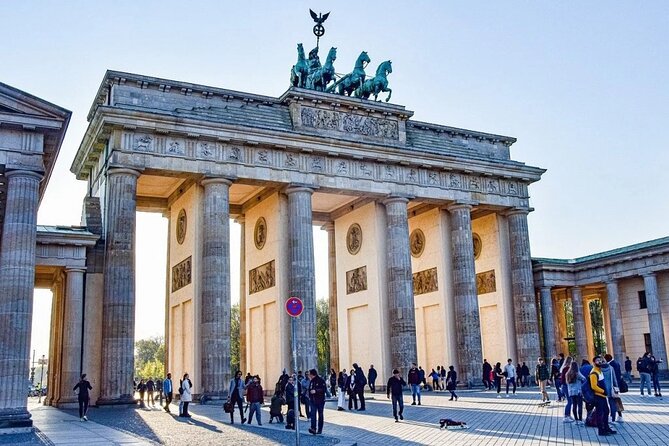
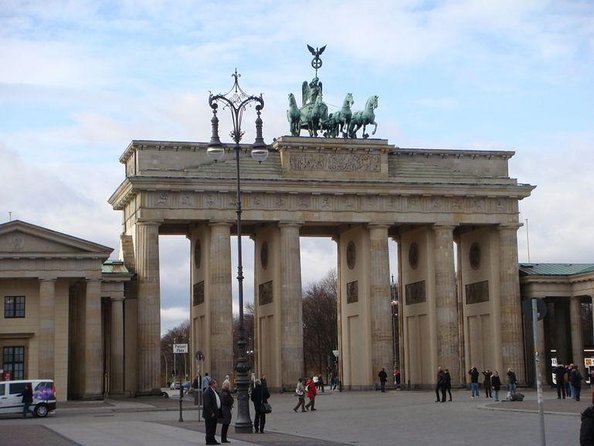
The Brandenburg Gate is the natural opening scene. You get about 20 minutes to hear how this famous gate witnessed major changes in Berlin’s political life. It is more than a handsome neoclassical landmark. Its meaning has shifted with the city, from Prussian power to Nazi spectacle, Cold War division, and reunification.
This is a busy photo location, so your time here includes practical value as well as history. If you want a quieter photograph, arriving before 10:00 a.m. or later in the day can help, although your tour meeting time is fixed at 10:00.
The short walk to the Reichstag brings you to one of Germany’s best-known public buildings. The guide covers its role during the imperial period, the infamous fire soon after Hitler became chancellor, and its importance during the Soviet assault on Berlin at the end of World War II.
You will spend about 20 minutes here. That is enough for a focused explanation and exterior views, but not for a full architectural visit. If the Reichstag dome is on your wish list, treat that as a separate activity.
The Holocaust Memorial and Hitler’s bunker site
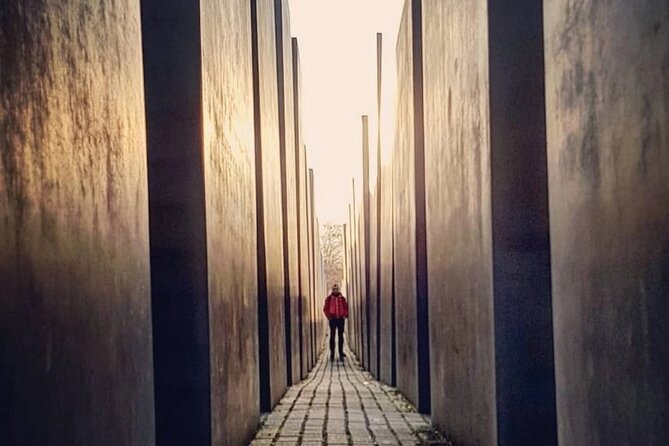
The Holocaust Memorial is one of the most powerful stops because it asks you to experience the space rather than simply look at a statue. The field of concrete blocks changes as you walk through it, creating a setting that feels difficult to grasp from a single viewpoint.
The guide uses about 15 minutes to explain the memorial and the crimes it commemorates. That context is important. Without it, you may see only an abstract arrangement of blocks. With it, the site becomes part of a larger discussion about how Berlin remembers the murder of Europe’s Jews.
Next comes one of Berlin’s most unusual historical locations: the former Führerbunker site, now an ordinary car park. There is no grand ruin to inspect. The power of the stop lies in the contrast between the unremarkable present-day setting and the events that took place below the former New Reich Chancellery gardens.
This is a short 15-minute stop, but it can prompt serious questions about memory, erasure, and the decision not to create a shrine. The guide’s explanation is the main reason to include it. On your own, you could easily walk past without realizing what happened there.
Luftwaffe headquarters and the Topography of Terror
The former Luftwaffe headquarters is now home to the Federal Ministry of Finance. The building gives the guide a chance to explain Nazi-era construction, its later use, and its place in Berlin’s Cold War story.
You get about 15 minutes here. The value is not just the façade. It is the reminder that Berlin’s surviving buildings often carry several political identities, with one period built over another. A guide can point out those layers in a way a quick photograph cannot.
The Topography of Terror follows with a more direct look at Nazi repression. The site once housed the headquarters of the SS, Gestapo, and SD. Today, it is a place of documentation and remembrance, and the guide discusses both the history of the institutions and the later work of memorializing their crimes.
Allow about 20 minutes. If you want to study the exhibitions in detail, you may need to return independently. The walking tour gives you the setting and essential context, but it is not designed as a long indoor museum visit.
Other walks around Berlin:
- Discover Berlin Half-Day Walking Tour
★ 5.0 · 9,624 reviews - Berlin: Third Reich and Cold War 2 Hour Walking Tour
★ 4.9 · 6,830 reviews - Berlin: Discover Berlin Walking Tour
★ 4.9 · 5,998 reviews - Berlin’s Best: 2 Hour Walking Tour Third Reich and the Cold War
★ 5.0 · 5,486 reviews
Checkpoint Charlie and the meaning of a divided city
Checkpoint Charlie is one of the most recognizable Cold War sites in Berlin. It can feel touristy today, with signs, photographs, and visitors stopping for pictures, but the guide helps place it within the larger story of a city split between rival political systems.
The stop lasts around 20 minutes. You will hear about the checkpoint and Berlin’s division, rather than simply posing beside the famous sign. That distinction matters. The present-day appearance can make the site seem like a stage set unless you understand the tension that once surrounded the crossing.
This is also one of the route’s clearest transitions. Earlier stops focus on dictatorship and wartime destruction. Checkpoint Charlie shifts the story toward the postwar occupation, the Berlin Wall, and the long division between East and West. The walk works best when you pay attention to those connections.
Gendarmenmarkt and Bebelplatz: Prussian Berlin and Nazi crime
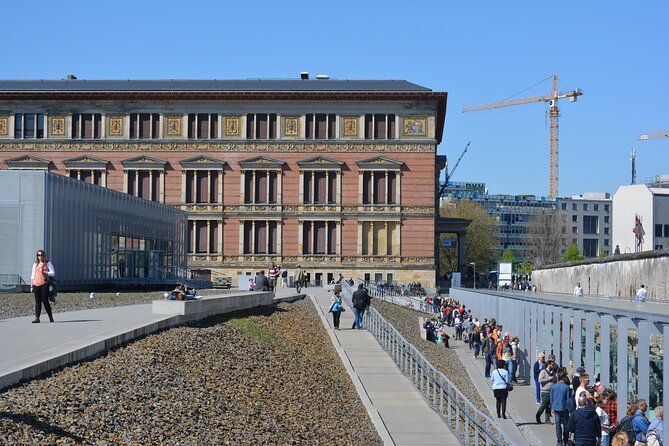
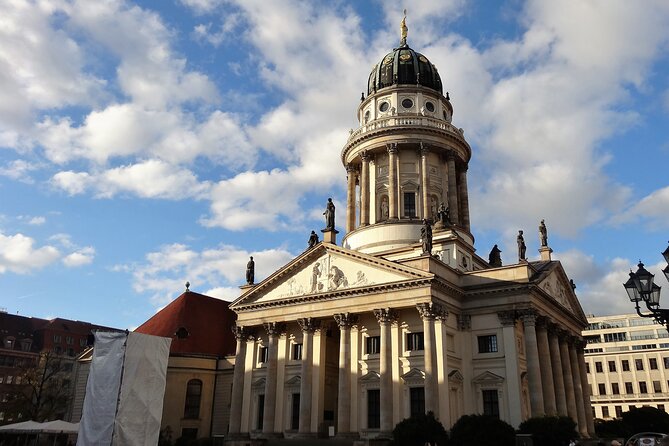
Gendarmenmarkt gives the tour a change of mood. Its grand 18th and 19th-century architecture reflects the ambition of Prussia’s capital. The guide explains how the square developed and points out the buildings that give it such a formal character.
You spend about 15 minutes here. This is a good place to look up and notice how architecture expresses power. After several stops about war and dictatorship, the square also helps you understand the city that existed before those darker chapters.
At Bebelplatz, the focus turns to the 1933 Nazi book burning. The square is surrounded by impressive buildings connected with Frederick the Great’s Prussian capital, yet it also carries a memorial to an early and chilling act of Nazi repression.
The stop lasts about 15 minutes. The contrast between the elegant square and the event remembered there is the point. I appreciate that the route does not isolate Nazi history in one memorial district. It shows how it unfolded amid the institutions and public spaces of ordinary Berlin.
Unter den Linden and the route toward Museum Island
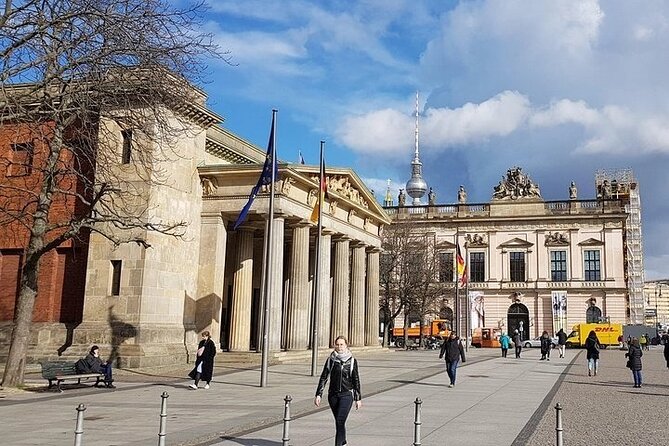
The walk along the eastern end of Unter den Linden brings together several important sights. You hear about Humboldt University, the Memorial to the Victims of War and Tyranny, and the German History Museum.
The allotted time is about 20 minutes. This stretch is especially useful for understanding Berlin as a capital shaped by education, monarchy, war, and public memory. The guide can also explain how the buildings relate to one another, which is easy to miss when you visit them separately.
The route ends on Museum Island, the site of medieval Berlin and the former City Palace. The island is now home to five world-class museums, along with Berlin Cathedral and major views toward Alexanderplatz, the center of former East Berlin.
You spend roughly 20 minutes at the final stop. That is enough to discuss the island’s development and look across toward Alexanderplatz, but not enough to visit the museums. The ending is practical: you finish in one of Berlin’s best areas for continuing your own sightseeing.
How the guiding affects the experience
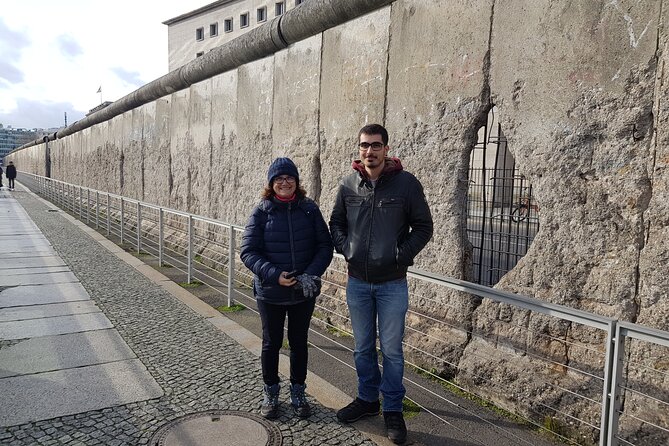
The route covers a lot, so the guide matters. Several guides have led this experience, including Aurel, Cairan, Rhys, Eugen, Steve, Paul, and Aaron. Their individual style will vary, but the strongest feedback points to clear explanations, enthusiasm, patience, and a willingness to answer questions.
Cairan is praised for connecting Berlin’s history with wider German and world events, using photographs and occasional exercises to make difficult subjects more personal. Aurel is described as especially strong on architecture, rebuilding, and the practical layout of the city. Rhys is noted for an entertaining approach that worked well for a family group, including someone with only basic English.
Steve is credited with arranging the story in a chronological way, from Prussia through modern Berlin. Paul is described as patient with children and easy to understand. These details suggest that the experience is not just a list of dates. The best guides use buildings, memorials, and street corners to build a story you can follow.
Because the tour is offered in English, it suits visitors who want historical context without needing German. Still, the subject matter is dense. Bring water and a small snack if you need one, since several hours of walking and listening can be tiring.
Price, pace, and who will get the most from it
At $32.58 per person, this is a strong value if you want a guided overview rather than a private tour. You are paying for about 3.5 hours of guiding across eleven major stops, with no added entrance fees required during the walk.
The value is highest for a first visit, a short stay, or anyone who finds Berlin’s history hard to organize. You can later return to the Reichstag, Topography of Terror, German History Museum, or the museums on Museum Island with a clearer idea of what you are seeing.
The main cost is physical effort. This is explicitly a walking tour, and it covers substantial ground. Most people can participate, and service animals are allowed, but the experience may not suit anyone who cannot walk that far. One disappointed customer had misunderstood the walking format, so read that detail carefully before paying.
The meeting point is Wurst 🙂 am Brandenburger Tor, at Ebertstraße and Scheidemannstraße. The tour starts at 10:00 a.m. and ends at Museum Island, giving you a useful place to continue exploring or find lunch afterward.
Free cancellation is available up to 24 hours before the start time. Changes or cancellations inside that window are not accepted for a refund, so check your plans before the deadline.
Should you book this Berlin history walk?
Book it if you want a broad, guided introduction to central Berlin and are comfortable walking for 3.5 hours. The route covers more historical ground than a casual stroll, and the small group can make the experience personal, especially when the group is below the 15-person limit.
I would choose it early in a Berlin visit. You will see the city’s key political and memorial sites, learn how they connect, and finish near Museum Island, where you can continue on your own.
Skip it if you need frequent rest, want extensive indoor visits, or prefer a tour focused mainly on architecture, food, or modern culture. For everyone else, the price, route, and quality of the guiding make this a sensible way to get your bearings and understand why Berlin looks the way it does.
FAQ
How long does the tour last?
The tour lasts approximately 3 hours and 30 minutes.
What time does the tour start?
The tour starts at 10:00 a.m.
Where does the tour begin?
It begins at Wurst 🙂 am Brandenburger Tor, at Ebertstraße and Scheidemannstraße, 10117 Berlin, Germany.
Where does the tour end?
The tour ends on Museum Island in Berlin.
How many people can join the tour?
The maximum group size is 15 travelers.
Is the tour offered in English?
Yes. The experience is offered in English.
Does the price include entrance tickets?
The tour includes an expert guide, and the listed stops have no admission charge. It is an outdoor walking tour, so interior museum or building admission is not included.
Is this a walking tour?
Yes. Walking is the central part of the experience, and the route covers many historic sites across central Berlin.
Can I cancel for a full refund?
Yes. You can cancel at least 24 hours before the start time for a full refund. Cancellations or changes made less than 24 hours before the start time are not accepted for a refund.
Just added in Berlin
- Private One way Airport Transfer Berlin Airport To Berlin★ 3.5 · 17 reviews
- Private Walking Tour: Berlin Wall, Cold War and Checkpoint Charlie★ 5.0 · 37 reviews
- Modern Berlin Private Walking Tour: Diverse, Vibrant and Exciting German Capital★ 5.0 · 13 reviews
- City Explorer: Potsdam Private Day Trip★ 4.5 · 10 reviews
- Private Day Trip to Potsdam from Berlin by Train★ 4.5 · 27 reviews
- Berlin Private Custom 5-Hour Tour by Car★ 5.0 · 30 reviews
- Private Half-Day Sightseeing Tour in Berlin★ 3.5 · 6 reviews
- Berlin Private Custom Tour in a Minivan, East and West★ 5.0 · 123 reviews
Historical Tours, compared.
City History Canal Sightseeing Tour on a Motorboat
Read our review →

Browse the lists this tour appears in