
Reviewed · HISTORICAL TOURS
Berlin History Walking Tour with a French-Speaking Guide
Berlin’s history is written into its streets, and this walk puts the hardest chapters right in front of you. You’ll stand at the Holocaust Memorial, the site of Hitler’s Bunker, Checkpoint Charlie, and the Brandenburg Gate, while a French-speaking guide explains how Berlin moved from dictatorship to division and then reunification. I especially like the clear route from Potsdamer Platz to Museum Island, and the chance to ask questions along the way.
The two strongest points are the human guidance and the broad sweep of the morning. Guides including Anouk, Martin, Arthur, Paul, and Céline are repeatedly praised for clear explanations, humor, and useful local advice. The main drawback is that this is a walking tour with no audio receivers, so you’ll need to stay close to the guide in a group of up to 25 people.
Key points at a glance
- Berlin’s major historic sights in three hours: See Potsdamer Platz, Checkpoint Charlie, the Holocaust Memorial, Bebelplatz, the Brandenburg Gate, and Museum Island.
- French-speaking guidance: Guides such as Anouk, Martin, Arthur, Paul, and Céline explain the city in French and answer questions.
- A sober look at Nazi history: The route includes the Holocaust Memorial, the former Hitler’s Bunker site, and the book-burning square at Bebelplatz.
- Cold War context: Checkpoint Charlie, Potsdamer Platz, and the Brandenburg Gate help explain Berlin’s division and reunification.
- Useful first morning in Berlin: The 10 a.m. start and roughly three-hour length leave the rest of the day open.
- Good value at $27.81: You pay for a guided introduction to several central landmarks without adding transport or meal costs.
Why this route works for a first morning in Berlin
I like this tour because it gives you a usable map of central Berlin without trying to cover the whole city. The route links places that can seem scattered when you first arrive, then ties them together through the big story of Berlin: imperial power, Nazi rule, war, division, and reunification.
You meet at 10 a.m. at Potsdamer Platz 10, on the corner of Gabriele-Tergit-Promenade. That is a sensible starting point. Potsdamer Platz is one of the clearest examples of Berlin’s modern rebuilding, so you begin with the new city before walking into older streets and heavier history.
The experience lasts about three hours, though one reported outing ran closer to three and a half. You should plan for a full morning rather than treating the published time as exact. The tour finishes near Museum Island, close to Alexanderplatz, so you can continue sightseeing, stop for lunch, or use public transport to reach another part of town.
Other history to see in Berlin:
- Berlin: Natural History Museum Entrance Ticket
★ 4.6 · 3,382 reviews - Berlin: World Heritage Cruise to Potsdam
★ 4.5 · 1,435 reviews - Berlin Historical Highlights Walking Tour
★ 4.9 · 657 reviews
Potsdamer Platz and the modern face of Berlin
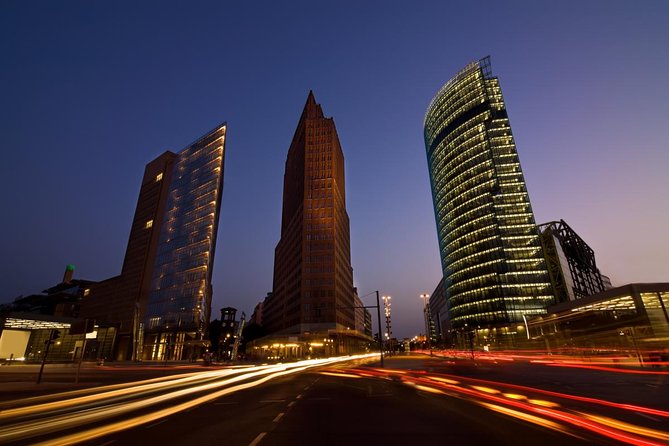
Potsdamer Platz is a good place to begin because it shows how sharply Berlin has changed. The area is associated with the modern city and includes the Sony Center, one of the recognizable pieces of post-reunification architecture.
Your guide uses the square to set up the city’s larger story. Berlin did not simply grow in one steady line. Its buildings and open spaces reflect war damage, Cold War division, and the push to create a new capital after reunification.
The stop is listed at about 10 minutes, so do not expect a detailed architectural tour of every building. Its value is as an orientation point. If you are staying in Berlin for several days, this first explanation helps you read the city more intelligently later.
Checkpoint Charlie and the Cold War
From Potsdamer Platz, the route moves to Checkpoint Charlie. This former crossing point became a symbol of the confrontation between East and West Berlin, and the guide explains its role during the decades when the city was divided.
You should keep your expectations in check. The stop is brief, around 10 minutes, and the tour does not include museum admission or a long visit inside an exhibition. Still, the site matters because it gives the Cold War a physical location rather than leaving it as an abstract chapter in a textbook.
I find guided explanation especially useful here. A checkpoint can look like a quick photo stop if you do not know what you are seeing. With context, it becomes part of the larger story of borders, control, and the divided city.
The former Hitler’s Bunker site
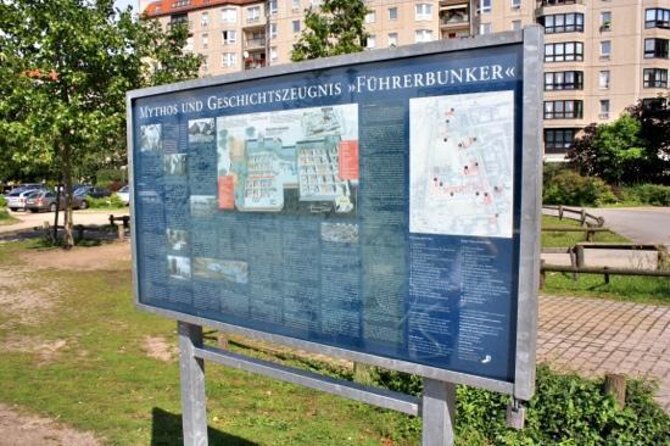
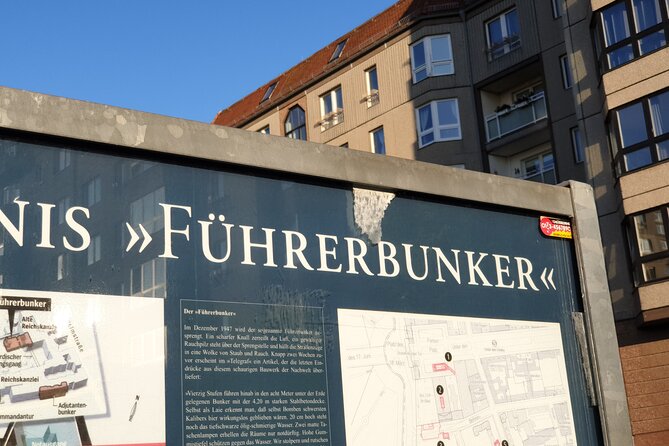
The stop at Hitler’s Bunker is handled as a visit to the place where the bunker stood. The guide explains where Hitler spent his final days, why the site has its present appearance, and how Berlin deals with a location tied to Nazi leadership.
This is an important distinction when you book. The tour description uses admission-included language, but the itinerary describes a 10-minute stop at the former bunker location, not a walk through an underground bunker interior. You should expect an explanation of the site and its meaning, not a dramatic historic attraction.
That restraint is part of the value. The point is not to turn the location into a spectacle. The guide’s role is to explain the place within the history of the Nazi dictatorship and the final days of the war.
Other walks around Berlin:
- Discover Berlin Half-Day Walking Tour
★ 5.0 · 9,624 reviews - Berlin: Third Reich and Cold War 2 Hour Walking Tour
★ 4.9 · 6,830 reviews - Berlin: Discover Berlin Walking Tour
★ 4.9 · 5,998 reviews - Berlin’s Best: 2 Hour Walking Tour Third Reich and the Cold War
★ 5.0 · 5,486 reviews
The Holocaust Memorial calls for a slower pace
The Memorial to the Murdered Jews of Europe is one of the most serious stops on the walk. The tour allows about 15 minutes here, with the guide explaining the memorial and the Nazi state’s murder of Europe’s Jews.
You will have time to look across the field of concrete blocks and listen, but this is not a museum visit with a long indoor exhibition. The stop works best if you give it your full attention and do not rush to take photographs.
This is also a useful point to judge the guide’s style. The strongest guides on this tour are praised for clear, well-supported explanations and for making room for questions. On a subject this painful, tone matters as much as facts. The guide should help you understand without turning tragedy into entertainment.
Unter den Linden connects old Berlin to new Berlin
The walk continues along Unter den Linden, Berlin’s great central avenue. The guide points out how to read different periods of construction and where war left visible marks on the city.
This is one of the more valuable parts of the route for anyone who wants more than a list of famous locations. Buildings do not all belong to the same era, and the avenue gives you a chance to see how imperial Berlin, wartime destruction, and later rebuilding overlap.
The stop lasts about 20 minutes, one of the longer pauses on the tour. You should expect to keep moving, though. This is still a walking introduction rather than a detailed tour of each building along the avenue.
Bebelplatz and the memory of book burning
Bebelplatz adds another layer to the Nazi period. The square is remembered for the book burning carried out under the dictatorship, but it is also home to Humboldt University and the Catholic Cathedral.
That combination makes the stop especially useful. You are not looking at a single-purpose memorial space. You are standing in a working part of Berlin where university life, religious architecture, and a painful political memory share the same setting.
The tour allows around 10 minutes here. Your guide can connect the square’s cultural importance with the Nazi attack on independent thought and public life. If you like history that explains how places functioned before, during, and after a political event, this is a strong stop.
The Brandenburg Gate changes meaning over time
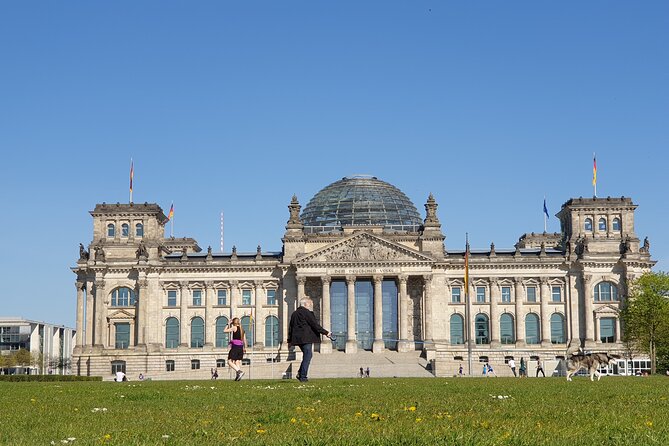
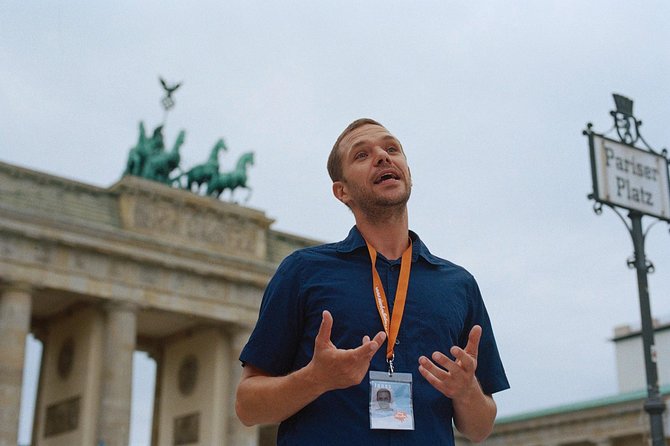
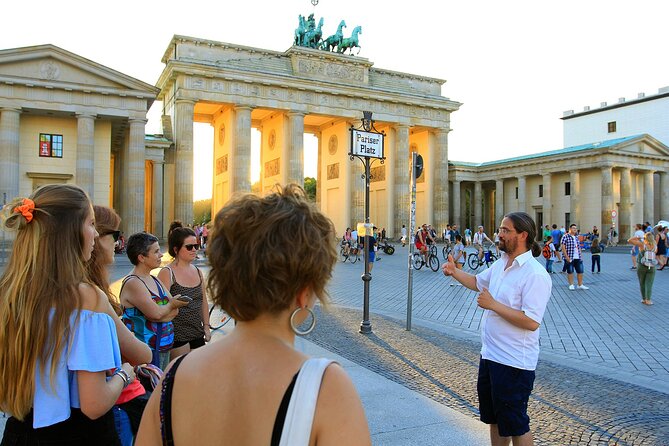
The Brandenburg Gate is the route’s best-known landmark. It began as a symbol of royal strength, later became linked with the Cold War, and now represents German reunification.
That change in meaning is the reason a guide adds value. You can photograph the gate on your own in a few minutes, but the history of what it represented at different times is harder to grasp without context.
The stop is scheduled for about 10 minutes. Since the gate is one of Berlin’s most photographed sights, expect an open public setting rather than a quiet monument visit. Listen first, then take your pictures.
The itinerary places the Brandenburg Gate after Museum Island, although the exact walking order may vary with the guide and group. Either way, it belongs to the central portion of the route and helps tie together the earlier discussion of monarchy, dictatorship, division, and reunification.
Museum Island provides a fitting finish
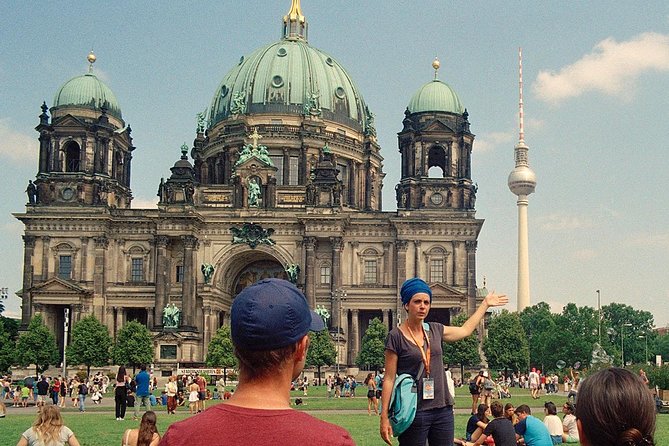
The tour ends near Museum Island, where you see the Berliner Dom and the reconstructed Humboldt Forum. This is a convenient finish because you are close to major cultural sights and Alexanderplatz.
The Berliner Dom gives you a strong example of Berlin’s grand Protestant architecture. The Humboldt Forum represents the city’s effort to rebuild and reinterpret a major historic site, while also bringing modern museum use into the center of Berlin.
You do not receive museum admission as part of this walking experience. The stop is listed as free admission and lasts about 15 minutes, so think of it as an exterior introduction and a useful starting point for a later museum visit.
Ending here also gives you choices. You can continue with Museum Island, walk toward Alexanderplatz, or stop for lunch before taking on another attraction. That makes the morning format practical.
The guides are the heart of the experience
The tour operates in French, and the guide can make a large difference. Anouk is praised for answering individual questions and giving precise explanations. Martin is described as passionate about Berlin and his work, while Arthur is singled out for his knowledge of the city, clear speaking style, and humor.
Paul receives similar praise for a friendly, competent half-day walk. Céline is noted for making the city feel more immediate than a book or a web page. These comments point to a useful strength: the tour is not built only around memorized speeches. The guides appear to adjust to the group and make time for questions.
You should still remember that different guides may have different styles. One guide may use more humor, another may spend more time on political history, and another may offer more practical suggestions for restaurants or less obvious places to visit.
There is one important limitation. The tour does not provide audio receivers. One participant specifically wanted that added, and the operator explained that keeping the price accessible was part of the reason. If you have hearing difficulties or dislike standing close to a guide in a group, ask about this before booking.
How much walking and effort should you expect?
The entire visit is on foot. A moderate level of physical fitness is recommended, and the route includes several stops spread across central Berlin.
The itinerary gives stop times totaling less than the full three hours, which leaves room for walking between locations, explanations on the move, and pauses for questions. You should wear comfortable shoes and dress for the weather. The tour runs in all weather conditions, so rain or cold can change the feel of the morning.
There is no transportation to or from the sights, and food and drinks are not included. That is easy to manage in central Berlin, but bring water and plan your lunch afterward. The 10 a.m. start is helpful if you want to avoid an early morning, though it does mean the tour begins after the first rush of sightseeing.
The maximum group size is 25. That is not a private walk, but it is small enough to remain manageable if the group stays together. Without audio equipment, your position matters. Stay near the guide, especially at busy public squares.
Is $27.81 a fair price?
At $27.81 per person, this is a good-value introduction to central Berlin if you want historical interpretation rather than simple sightseeing. The price covers a local professional French-speaking guide and local taxes. You are paying to connect many important locations in one morning.
The value is strongest for a first visit. A guide helps you understand why a modern office district, a former border crossing, a memorial, a university square, and a royal avenue belong in one story. You can then return to the places that interest you most with better questions.
The price does not cover meals, drinks, transportation, or optional tips. It also does not function as a museum pass. Budget separately if you plan to enter the museums around Museum Island after the walk.
The tour earns a 4.9 rating from 240 reviews, with 99 percent recommending it. That record suggests a dependable experience, but it does not remove the normal trade-offs of a group walking tour: fixed pacing, outdoor conditions, and limited time at each landmark.
Who should book this French-language walk?
I would choose this tour if you are visiting Berlin for the first time and want a strong historical framework before exploring alone. It also suits French-speaking visitors who want to ask questions naturally rather than follow an English-language tour or depend on written information.
It is a good match for solo visitors and couples, since the group format gives you company without requiring a full private tour. Families may also appreciate the accessible price, though the serious subject matter and three hours of walking may not suit very young children.
You should look elsewhere if you want long indoor visits, extensive museum time, or a specialist tour focused on one period. This route moves quickly across several subjects. It gives you the city’s main historical outline, then leaves you to pursue the details.
Free cancellation is available if you cancel at least 24 hours before the 10 a.m. start time. Changes or cancellations made later are not accepted for a refund.
Should you book it?
Book this tour if you want a clear French-language introduction to Berlin’s central history, especially the Nazi and Cold War periods. The route is well chosen, the morning timing leaves room for lunch and more sightseeing, and the guides are praised for being friendly, precise, and able to answer questions.
Go in knowing what you are buying: a serious outdoor walk, not a museum tour or a visit inside Hitler’s Bunker. Stay close to the guide because there are no audio receivers, wear suitable shoes, and allow a little flexibility beyond the advertised three hours. For $27.81, it is a sensible first step into a city that makes much more sense once someone helps you read its streets.
FAQ
Where does the tour start?
The tour starts at Potsdamer Platz 10, 10785 Berlin, at the corner of Gabriele-Tergit-Promenade.
What time does the tour begin?
The start time is 10 a.m.
Where does the tour end?
The tour ends next to Museum Island, near Alexanderplatz.
How long does the walking tour last?
The scheduled duration is approximately three hours. One reported outing lasted about three and a half hours, so allow some extra time.
Is the tour conducted in French?
Yes. A professional French-speaking guide leads the tour.
Is transportation included?
No. Transportation to and from the attractions is not included. The tour itself is conducted on foot.
Can I cancel for a full refund?
Yes, if you cancel at least 24 hours before the experience start time. Cancellations or changes made less than 24 hours in advance are not refunded.
Just added in Berlin
- Private One way Airport Transfer Berlin Airport To Berlin★ 3.5 · 17 reviews
- Private Walking Tour: Berlin Wall, Cold War and Checkpoint Charlie★ 5.0 · 37 reviews
- Modern Berlin Private Walking Tour: Diverse, Vibrant and Exciting German Capital★ 5.0 · 13 reviews
- Private Day Trip to Potsdam from Berlin by Train★ 4.5 · 27 reviews
- City Explorer: Potsdam Private Day Trip★ 4.5 · 10 reviews
- Private Half-Day Sightseeing Tour in Berlin★ 3.5 · 6 reviews
- Berlin Private Custom Tour in a Minivan, East and West★ 5.0 · 123 reviews
- Berlin Private Custom 5-Hour Tour by Car★ 5.0 · 30 reviews
Historical Tours, compared.
City History Canal Sightseeing Tour on a Motorboat
Read our review →

Browse the lists this tour appears in