
Reviewed · RICKSHAW & PEDICAB TOURS
One Up to 3 Rickshaws(6 GUESTS)-Taylor Made Rickshaw Berlin Tour
Berlin’s center is spread across a wide sweep of history, from the Prussian court to the Nazi era and the divided city of the Cold War. This private three-hour rickshaw tour gives you a fast, comfortable way to connect the main sights without wrestling with a map or public transport.
I like the flexible route and the close-up access. You can spend more time at a place that matters to you, stop for photos almost anywhere, and ride close to monuments without a long walk. I also like that guides such as Levent Aydin and Tille are named in the feedback, with personal explanations rather than a set script. The possible drawback is time: thirteen stops in three hours means most places are brief photo and orientation stops, not full museum visits.
Key points to know before booking
- Three hours, thirteen major sights: The route covers a remarkable amount of central Berlin, but several stops last only five minutes.
- A private ride for your group: The experience is not shared with strangers, and the advertised setup can use one to three rickshaws for up to six people.
- Flexible pickup and finish: You can start at a hotel or another agreed point and finish at a hotel, monument, restaurant, cafe, market, or boat-tour departure point.
- A useful option for limited mobility: The rickshaw brings you close to monuments, and the guide can stop for photographs without requiring you to walk far.
- Strong personal guiding: Levent Aydin and Tille are specifically associated with friendly, informative tours and a relaxed approach.
- A sightseeing tour, not a museum tour: Admission is not included, and the short stops are designed to show you Berlin’s layout and major stories.
Why a rickshaw works well in central Berlin
Berlin rewards a wide-angle view. Its major sights are not gathered around one compact old town. Alexanderplatz, Museum Island, Bebelplatz, Checkpoint Charlie, Potsdamer Platz, the Brandenburg Gate, and the government district form a long route through the center.
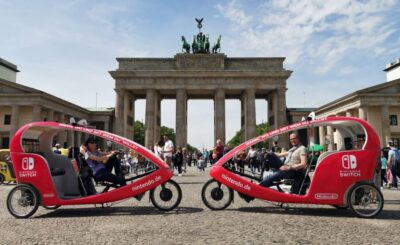
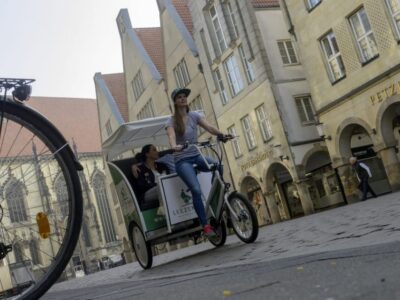
A rickshaw solves part of that problem. You sit above street level, move between areas without changing trains, and can pause when a building or memorial deserves a closer look. You also avoid the tiring business of walking the whole route in one stretch.
The experience is private, which matters here. You can ask why a place is important, change the order of stops, or tell the guide that you have already seen one area. The guide can then spend more time on your interests. That flexibility is more useful than it may sound, especially if you have only a short stay in Berlin.
The ride is not designed for long explanations at every stop. The published timing gives five minutes at several locations and ten minutes at others. Think of it as a moving introduction to Berlin, with enough time to photograph major sights and decide where you want to return later.
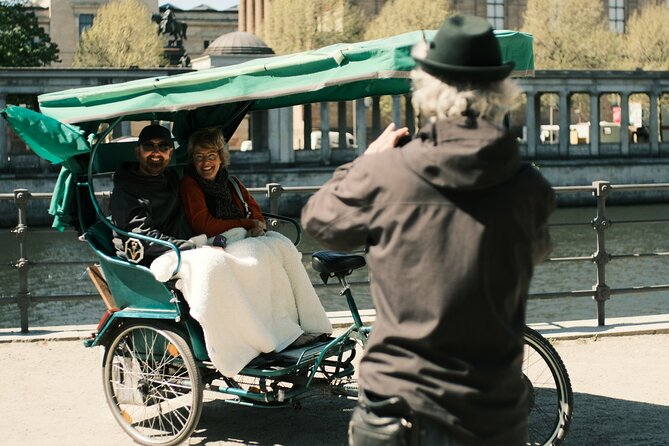
A cosy blanket is available with the rickshaw transport. WiFi is also included. The guide is described as a professional photographer, so you can ask for help with memorable group photographs during the route.
Other short rides around Berlin:
- Berlin: Private Guided E-Rickshaw Tour
★ 4.9 · 157 reviews - Individual City Tour – Rickshaw Sightseeing in Berlin
★ 5.0 · 120 reviews - Berlin Express: Private 1-Hour E-Rickshaw Ride
★ 5.0 · 116 reviews
Alexanderplatz and the route toward Museum Island
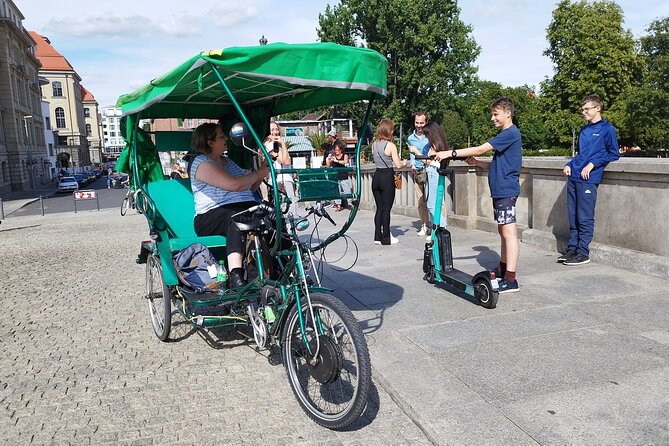
The tour begins at the Berliner Fernsehturm, Berlin’s famous television tower on Alexanderplatz. At 368 metres, it is Germany’s tallest structure and one of the easiest landmarks to spot across the city.
Five minutes here is enough for an introduction and photographs, not a tower visit. Admission to the tower is not included, so you should treat this as an exterior stop unless you arrange a separate visit. Starting here gives you a clear sense of Berlin’s former East German center.
From Alexanderplatz, the rickshaw passes the Rotes Rathaus, or Red Town Hall. You also see Marien Church and Neptune Fountain before reaching Museum Island. These short views help connect the open space of Alexanderplatz with the older civic and royal center nearby.
Museum Island deserves more than ten minutes if museums are your priority. The complex is a UNESCO World Heritage Site and includes the Berlin Cathedral, the reconstructed City Palace area, the Old Museum, the Old National Gallery, the Pergamon Museum, and the Bode Museum.
You can photograph the buildings from the streets and hear how the island fits into Berlin’s story. You will not tour the collections during this ride, and admission to the museums is not included. I see this stop as a useful preview. It lets you choose which museum deserves a separate visit.
The route then follows Unter den Linden, Berlin’s grand historic boulevard. This is one of the best parts of the trip for understanding how the city’s major monuments line up. The rickshaw lets you take in the sequence without spending much of your limited time crossing streets on foot.
Bebelplatz and Gendarmenmarkt
Bebelplatz is a compact but serious stop. It sits within the Forum Fridericianum, surrounded by the State Opera, Humboldt University, the State Library, and St. Hedwig’s Cathedral, Berlin’s first Catholic church.
The square is also linked to the Nazi book burning of 1933. A memorial beneath the pavement recalls the event. The five-minute stop will not provide a full lesson, but it gives you the location and the chance to see the memorial before moving on.
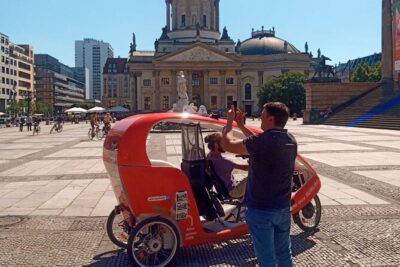
Gendarmenmarkt is one of the tour’s strongest architectural stops. The former Royal Concert Hall sits between the German Cathedral and French Cathedral. Ten minutes gives you time to take in the symmetry of the square and photograph the buildings.
Restoration work or access conditions can affect what you see at Berlin monuments, so the guide’s current view of the square is useful. This is also a good place to ask questions about the Prussian capital, since the buildings make the old royal city easier to picture than a history book does.
Checkpoint Charlie and the former Wall border
Checkpoint Charlie is one of Berlin’s best-known Cold War sites. It was a border crossing between East and West Berlin and became a tense symbol of the divided city.
The stop lasts about five minutes. That is enough for a photograph and a short explanation, but not enough for a full museum visit. The nearby Wall Museum and other paid attractions are not part of the tour, and no admission is included.
The practical value here is the larger route. You are not seeing Checkpoint Charlie as an isolated photo spot. You are moving along the former border, which helps you understand that the Wall cut through ordinary streets and neighborhoods, not just a single guarded gate.
Next comes the Topography of Terror, located beside original sections of the Berlin Wall. The site was once the headquarters of the SS and Gestapo and is now a major documentation center about National Socialism.
Five minutes allows an exterior look and a quick introduction. If you want to read the exhibits carefully, return on your own. The same stop also brings you near Martin-Gropius-Bau, known for international exhibitions, and the former Prussian Parliament. The mix of surviving Wall sections, government buildings, and museum spaces makes this one of the most meaningful stretches of the route.
Same base, a different kind of day out:
- Berlin: Reichstag, Dome and Government District Guided Tour
★ 4.7 · 18,288 reviews - Berlin: 1-Hour City Tour by Boat with Guaranteed Seating
★ 4.3 · 16,993 reviews - Berlin: Boat Tour Along the River Spree
★ 4.4 · 11,252 reviews - Discover Berlin Half-Day Walking Tour
★ 5.0 · 9,624 reviews
Potsdamer Platz and the Holocaust Memorial
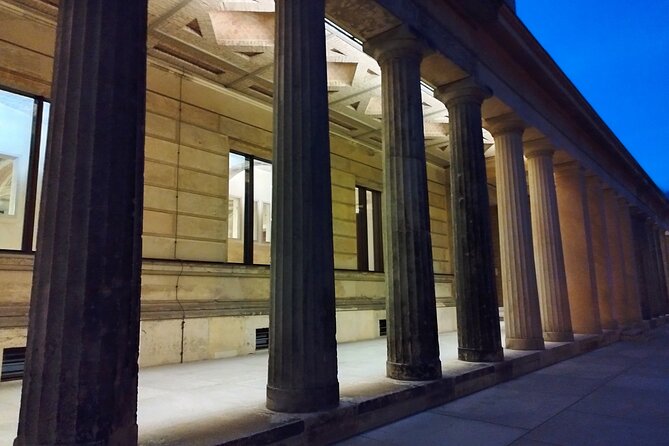
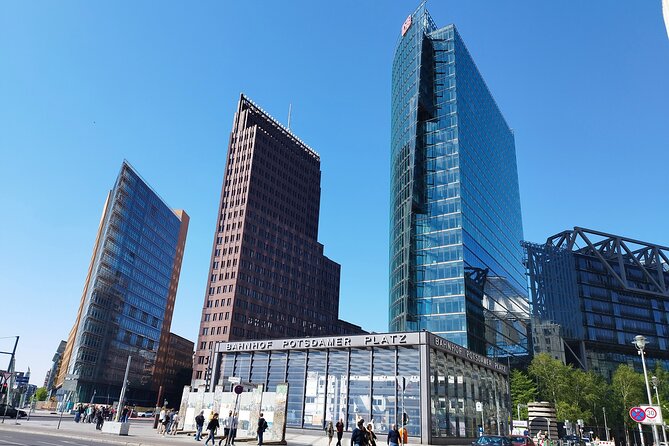
Potsdamer Platz shows a different Berlin. Once divided by the Wall, it became a huge building site after reunification. Today, its high-rise buildings and Sony Center represent the city’s modern commercial side.
The ten-minute stop gives you a chance to see the contrast between old Berlin and the rebuilt center. You can photograph the futuristic architecture, but keep your expectations realistic. This is a brief orientation stop, not a detailed architectural tour.
The route then follows the former border to the Memorial to the Murdered Jews of Europe, usually called the Holocaust Memorial. Its field of concrete slabs commemorates the murder of more than six million Jews under National Socialism.
You have ten minutes here. That is enough to walk among some of the slabs and take in the scale of the memorial, but you should not rush the underground information center if you want to read it carefully. The ride gives you the location and the chance for quiet reflection, while a separate visit allows more time for context.
This is one place where a good guide’s tone matters. The site calls for clear information and respect, not hurried entertainment. The tour description presents the stop as part of Berlin’s central historical route, so you should expect a concise introduction rather than an extended guided visit inside the memorial.
Brandenburg Gate and the government district
Brandenburg Gate is the classic Berlin stop. Its columns and four-horse chariot have witnessed royal processions, Nazi spectacles, the division of the city, and reunification.
Ten minutes is a sensible amount of time for photographs and a short explanation. The gate is often crowded, and the rickshaw’s close access can save you a long walk from another part of the center. You can also see how the gate relates to Pariser Platz and the former Wall route.
The ride continues to the Reichstag and the government district. The Reichstag is home to the German parliament, the Bundestag. Nearby are the Chancellery and the Memorial to the Murdered Sinti and Roma.
The listed stop lasts five minutes, so this is another exterior overview. Entry to the Reichstag dome is not included, and no visit inside the government buildings is promised. If you want to see the dome, arrange that separately and allow extra time.
This part of the route helps you connect modern German government with the difficult political history seen earlier. You move from the Nazi period and the Wall to the institutions of present-day Germany in just a few minutes.
The Führerbunker site and Berliner Dom
The former Führerbunker site is now beneath a parking area. The plain setting can feel surprising, since the place carries such heavy historical associations. The ten-minute stop provides context and a chance to understand how the site appears today.
There is no preserved bunker interior to tour as part of this experience. The value lies in seeing the location and learning why the site matters, while also recognizing that the physical remains are not presented as a dramatic attraction.
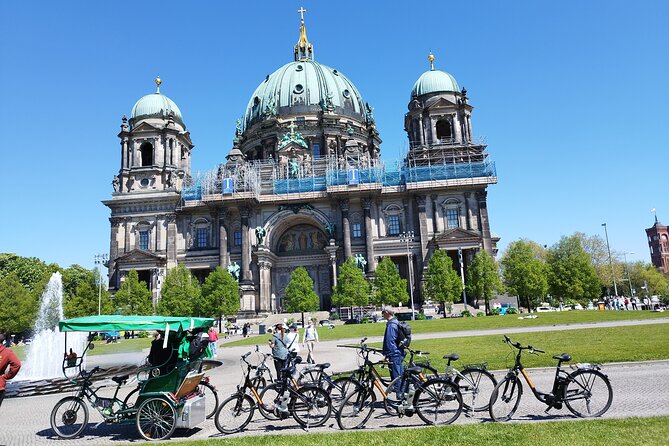
The final listed stop is Berliner Dom, Berlin Cathedral. Its large dome and riverfront position make it one of the city’s most recognizable buildings. Ten minutes gives you time for photographs and an exterior view.
The tour can finish according to your plans. You may return to your hotel or end near a monument, restaurant, cafe, market, or boat-tour starting point. That is especially handy if you are using the ride as a first look at Berlin and want to continue exploring from a central location.
What the $420.08 group price means
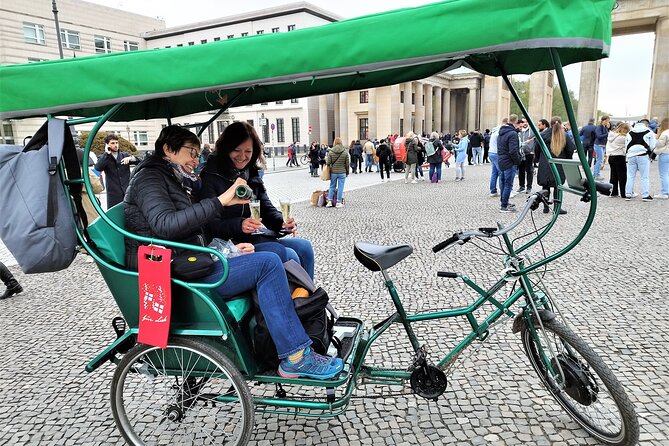
The advertised price is $420.08 per group for up to two people. For two people, that works out to about $210 per person for three hours. That is not a budget sightseeing ride, but the comparison should be with a private guide and vehicle, not with a large public bus.
The experience is listed as supporting one to three rickshaws and up to six people. Because the displayed price is for a group of up to two, you should confirm the total cost for three to six people before booking. A larger group may improve the value if the price scales reasonably, but the supplied price alone does not establish that.
I would consider the cost worthwhile if you value time, personal attention, and door-to-door flexibility. It is less attractive if you want long museum visits, extensive walking tours, or a low-cost overview. The guide, private arrangement, WiFi, blanket, and flexible end point add convenience, but the tour does not include museum admission or tips.
The experience is often booked well ahead, with an average booking time of 43 days in advance. That suggests you should plan early if your Berlin dates are fixed, particularly because this is a private activity rather than a large scheduled group departure.
Who will get the most from this tour
I would recommend it first to people visiting Berlin for a short time. You can see the city’s major political, royal, Nazi-era, Cold War, and modern landmarks in one connected ride.
It also suits anyone who finds long walks difficult. The rickshaw can bring you close to the monuments, and the guide can stop for photographs. The information states that less mobile participants can enter the rickshaw in a few steps, but you should still discuss your needs when arranging the pickup.
Families and small groups may like the private format. You can ask for explanations suited to your interests, choose where to linger, and avoid slowing down for strangers. The ride can also work well on a first day in Berlin, since it shows you where the main districts sit in relation to one another.
History-focused visitors should see it as a framework for later exploration. The route touches many major sites, but five or ten minutes is not enough for detailed interpretation at every one. Use the ride to mark places for return visits, especially Museum Island, the Topography of Terror, the Holocaust Memorial information center, and any paid attraction near Checkpoint Charlie.
Practical details worth knowing
Pickup is offered, and the start and finish can be arranged around your plans. The experience may end at a hotel, monument, restaurant, cafe, market, or boat-tour departure point, rather than returning automatically to the starting place.
The tour is offered in English. A professional licensed guide is included, along with WiFi on board and a cosy blanket if you choose rickshaw transport. Tips are not included.
Service animals are allowed, and the meeting area is near public transportation. Most people can participate, though you should explain any mobility concern in advance.
Free cancellation is available when you cancel at least 24 hours before the local start time. Cancellations or changes made less than 24 hours before the start are not accepted for a refund.
Should you book the Berlin rickshaw tour?
Book this tour if you want a private, efficient first look at Berlin and prefer a guide to handle the route. It is particularly useful for short stays, small groups, people with limited walking ability, and anyone who wants flexible pickup and drop-off.
Skip it if your main goal is to spend hours inside museums or examine each memorial at length. In that case, use this ride only if you want a city orientation, then return to the places that deserve more time.
The best way to approach it is to choose two or three priorities before you start. Tell the guide if Museum Island, Cold War history, Nazi-era sites, architecture, or photography matters most. That turns a long list of landmarks into a personal three-hour introduction, which is where this experience offers its clearest value.
FAQ
How long does the Berlin rickshaw tour last?
The tour lasts approximately three hours.
How many people can join the experience?
The activity is described as using one to three rickshaws for up to six people. The displayed price is for a group of up to two, so confirm the price for a larger group before booking.
Is hotel pickup available?
Yes. Pickup is offered, and the starting point can be arranged according to your plans.
Where can the tour finish?
You can arrange to finish back at your hotel, by a monument, at a restaurant, cafe, market, or near one of the starting points for a boat tour.
Is museum admission included?
No. Admission tickets are not included. The tour shows you the exterior settings and provides short introductions to places such as Museum Island and the Topography of Terror.
Is the tour suitable for people with limited mobility?
The experience is described as suitable for less mobile participants. You can enter the rickshaw in a few steps, and the guide can stop close to monuments and for photographs.
What happens if I need to cancel?
You can receive a full refund if you cancel at least 24 hours before the local start time. Changes or cancellations made less than 24 hours before the start are not accepted.
Just added in Berlin
- Romantic Berlin Rickshaw City and Photo Tour – incl. pick-up★ 4.0 · 9 reviews
- Private taxi tour to Potsdam and Sanssouci 6-8h★ 5.0 · 30 reviews
- Moonshine Comedy – English Stand Up Comedy by the bay★ 5.0 · 11 reviews
- Berlin Protest History Tour: Rebels, Resistance, and Revolution★ 5.0 · 7 reviews
- Private Half-Day Berlin Sightseeing Tour with a Minivan Including Short City Walks★ 5.0 · 31 reviews
- Private tour of Berlin★ 5.0 · 15 reviews
- Private City Kickstart Tour: Berlin★ 4.5 · 71 reviews
- Berlin Private Custom Walking Tour With A Guide (Private Tour)★ 4.5 · 8 reviews
Rickshaw & Pedicab Tours, compared.
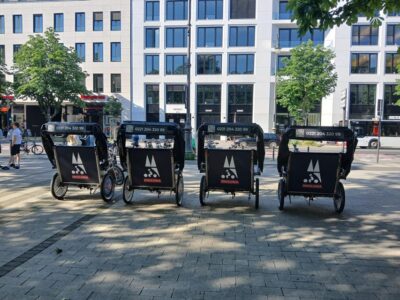

Individual City Tour – Rickshaw Sightseeing in Berlin
Read our review →
Browse the lists this tour appears in