
Reviewed · LOCAL LIFE & HIDDEN GEMS
Explore Berlin: See All The Iconic Sights & Some Hidden Gems
Berlin’s story comes into sharp focus on this three-hour walking tour, which links the Palace of Tears, Museum Island, Checkpoint Charlie, the former Führerbunker site, the Holocaust Memorial, and Brandenburg Gate. It is a brisk lesson in how dictatorship, war, division, and reunification shaped the city.
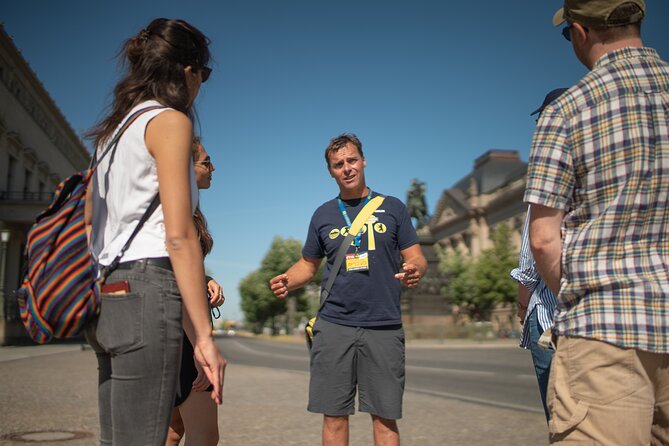
I like the route for two reasons. First, it puts Berlin’s Nazi and Cold War landmarks in one connected story rather than treating them as isolated sights. Second, the guides often make difficult subjects clear and human. Joseph, Tina, Jimmy, Hannah, Paul, Jef, and others have been praised for strong explanations, good pacing, and a willingness to answer questions.
The trade-off is simple: this is a long walk, roughly three miles according to one detailed account, with much of the time spent outdoors. One person became separated from the group, and another found the group too large and the guide too quiet, so staying close and arriving early matters.
Key points at a glance
- Three hours on foot: Expect a brisk route of about three miles, with many short stops rather than long visits inside buildings.
- Berlin’s hardest history: The tour covers the Third Reich, the Holocaust, Hitler’s bunker, the Berlin Wall, and life during the Cold War.
- Major sights in one sweep: You see Brandenburg Gate, the Reichstag area, Checkpoint Charlie, Gendarmenmarkt, Museum Island, and the Holocaust Memorial.
- English-speaking local guide: Guide quality is central to the experience, with Joseph, Tina, Jimmy, Hannah, Paul, and Jef among the names praised for clear and engaging talks.
- Outdoor sightseeing: Admission to most stops is free because you are viewing them from outside. Museum entry is not included.
- Small enough to manage, but not private: The maximum group size is 25 people, so you should still expect a shared walk rather than a personal tour.
Why this route works for a first look at Berlin
Berlin can feel scattered. A former border crossing sits beside modern shops. A memorial appears between government buildings. A reconstructed palace faces museums filled with ancient treasures. Without a guide, the city’s pieces do not always explain themselves.
This walk gives you a useful map of the center. It begins near Friedrichstrasse and moves through sites tied to Prussian Berlin, Nazi rule, the Second World War, the Cold War, and reunification. You do not spend long inside any one attraction, but you gain a strong sense of where the major events took place.
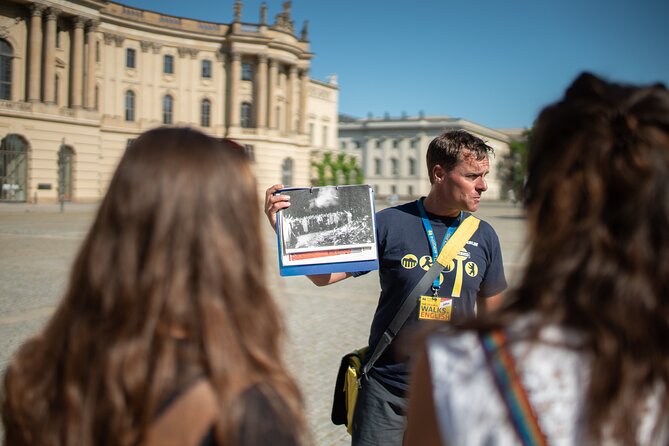
The guide’s job matters more here than on a simple photo walk. Much of Berlin’s history is invisible. The bunker is underground and gone. The Wall survives only in fragments. The former crossing points are now ordinary city streets. A good guide fills in what you cannot see.
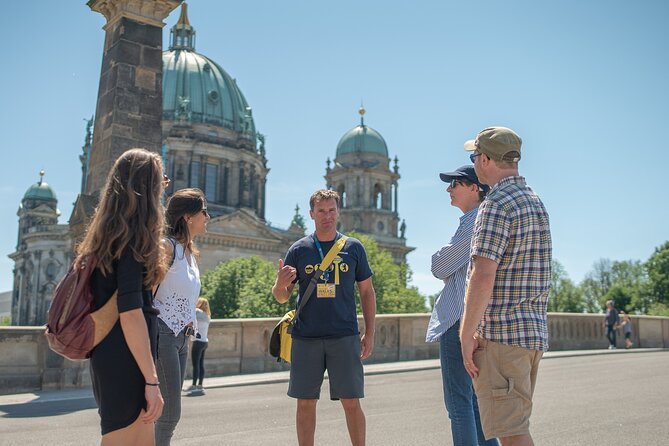
The strongest accounts of the tour praise guides who make complicated subjects easy to follow. Tina was noted for explaining centuries of history in plain terms while keeping the walk on schedule. Joseph welcomed questions and kept the information entertaining. Hannah was praised for a steady pace and sensible warm-up stops in cold weather. Jimmy was described as friendly, clear, and fun, while Paul offered both historical detail and practical recommendations.
Other trips with a local in Berlin:
- Berlin: Sights and Highlights Bike Tour with a Local Guide
★ 4.8 · 2,698 reviews - Private Berlin: Iconic Sights and Hidden Gems Walking Tour
★ 5.0 · 292 reviews - Cologne: Guided Highlights Tour with a Local
★ 4.5 · 975 reviews
From Friedrichstrasse to the Palace of Tears
Your meeting point is given as Reichstagufer 17, near Friedrichstrasse Station in central Berlin. The tour information also describes the start as outside Friedrichstrasse train station. Because those directions are not perfectly identical, read the confirmation carefully and arrive 15 minutes early.
The first stop is the Palace of Tears, or Tränenpalast. This former border facility handled departures between East and West Berlin. Its name comes from the farewells that took place there, when people from the divided city and country had to part after short visits.
You spend only a few minutes here, so do not expect a full museum visit. The value comes from the guide’s explanation of how the crossing system affected ordinary families. This is an early reminder that the Cold War was not just a contest between governments. It shaped daily movement, work, travel, and family life.
War memorials, university squares, and Museum Island
The route then reaches Neue Wache, a memorial to victims of war and tyranny. Its stark interior and single central sculpture create a quiet pause after the busy opening section. Your guide can help place the memorial within Germany’s changing political eras.
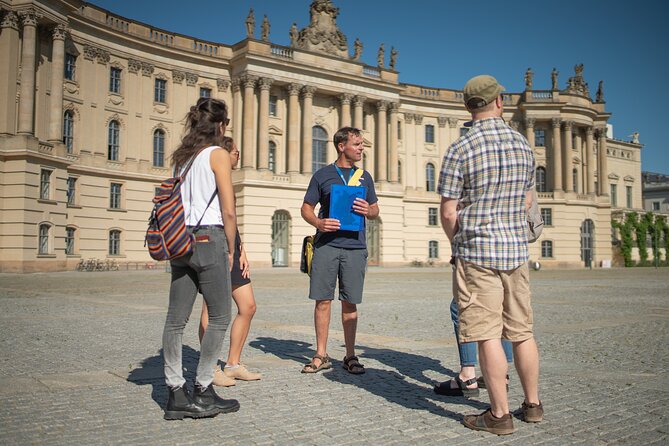
Nearby, Humboldt University recalls the intellectual life of Berlin. Marx, Engels, and Einstein studied or taught here, giving the stop a different tone from the political sites. It is a short exterior visit, but it helps show that Berlin is more than a city of twentieth-century conflict.
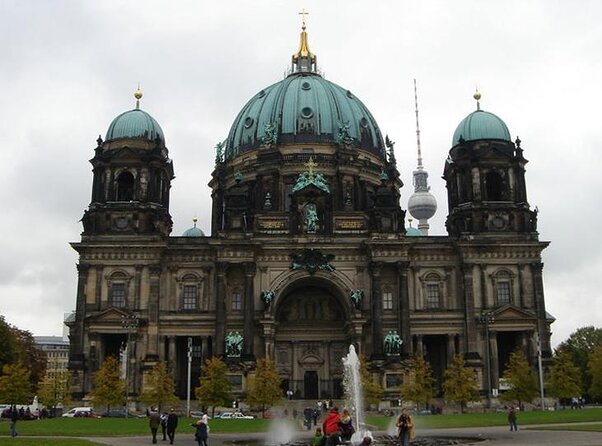
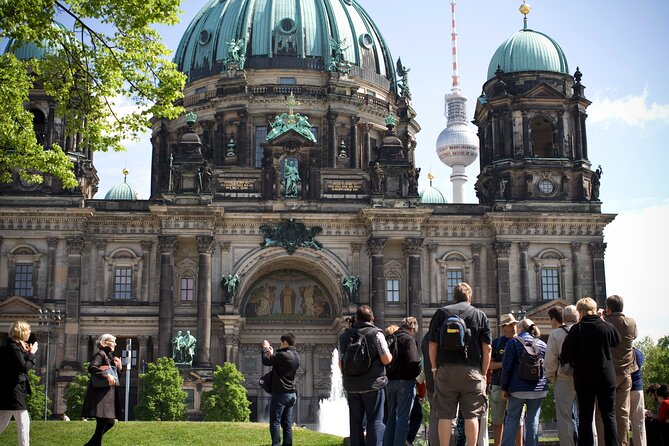
Next comes Museum Island and the Berliner Dom. You see the cathedral, Lustgarten, the City Palace, and the Humboldt Forum. This is one of the most visually varied parts of the route, with monumental architecture gathered around open public space.
The tour also points out the Pergamon Museum, Neues Museum, and Altes Museum. The subjects range from Islamic art and the Ishtar Gate to ancient Egypt and the work of architect Karl Schinkel. Admission is not included, and the stops last only about five minutes each, so treat them as orientation rather than museum visits.
That limitation is worth understanding before you book. If you want to study Nefertiti, ancient gateways, or the museum collections, return on another day with a timed entry. On this walk, the museums provide architectural and cultural context while your guide keeps the larger city story moving.
The reconstructed Berlin Palace, now the Humboldt Forum, adds another layer. Its exterior recalls the Hohenzollern family palace, while the modern institution inside reflects Berlin’s effort to deal with its imperial and colonial past. The tour does not provide an interior visit, but the building is an important part of the city center’s changing appearance.
Bebelplatz and the memory of Nazi book burning
Bebelplatz is one of Berlin’s most elegant squares, surrounded by buildings linked to the former Prussian court and state. Its beauty makes the history beneath it especially unsettling.
In 1933, Nazi supporters burned tens of thousands of books here. The memorial is set into the pavement, where an underground room of empty bookshelves can be seen through glass. It is easy to miss if you do not know where to look, which is exactly why the guide adds value.
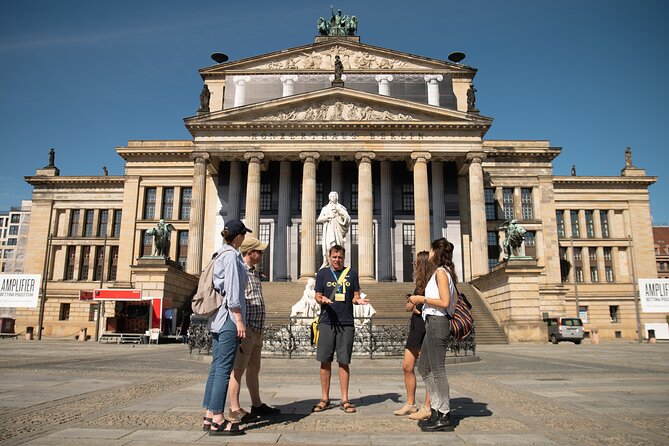
The walk continues past the Staatsoper, built under Frederick the Great in 1743, and the Konzerthaus, completed in 1821 and designed by Schinkel. These buildings make the point that Berlin’s artistic and royal identity existed long before the twentieth-century dictatorships.
At Gendarmenmarkt, you see the French Cathedral, the German Cathedral, and the concert hall. The square reflects a period of religious tolerance and careful civic design. It is also a pleasant place to pause, take photographs, and catch your breath before the route turns toward the darker twentieth century.
Same base, a different kind of day out:
- Berlin: Reichstag, Dome and Government District Guided Tour
★ 4.7 · 18,288 reviews - Berlin: 1-Hour City Tour by Boat with Guaranteed Seating
★ 4.3 · 16,993 reviews - Berlin: Boat Tour Along the River Spree
★ 4.4 · 11,252 reviews - Discover Berlin Half-Day Walking Tour
★ 5.0 · 9,624 reviews
Checkpoint Charlie and a surviving piece of the Wall
Checkpoint Charlie is the tour’s most famous Cold War stop. It was the best-known crossing point between East and West Berlin and the location of a tense 1961 tank confrontation between Soviet and American forces.
Today, the setting can feel surprisingly commercial. The original border system is gone, and the crossing is surrounded by modern streets and businesses. That contrast is part of the lesson. Your guide helps you picture the barriers, armed guards, escape attempts, and political danger that once defined this place.
Do not expect the checkpoint itself to look like a preserved historical site. Its importance comes from the explanation and the surrounding context. If you want a more substantial Wall experience, the route later reaches the Topography of Terror, where you see a roughly 200-meter section of the original Wall.
The Topography of Terror is located beside the former headquarters of the Gestapo and SS. The outdoor section of Wall here connects Nazi terror with the later dictatorship in East Germany. The tour only allows a short stop, but it is an important visual reminder that the Wall was not an abstract symbol. It cut through streets, neighborhoods, and lives.
The former air ministry and Hitler’s bunker site
The former Aviation Ministry offers another useful example of Berlin’s layered past. The building was associated with Hermann Göring’s air force ministry, later served as the East German house of ministers, and now houses Germany’s Finance Ministry.
The architecture survives, but its political meaning changed repeatedly. This is one of the city’s recurring themes: buildings remain while governments, symbols, and public memory change around them.
A short walk brings you to the site of Hitler’s former bunker. There is no grand entrance or dramatic ruin to see. The bunker was buried, and the location is marked in an ordinary urban area. That plain setting is deliberate and helps avoid turning the site into a shrine.
Your guide explains Hitler’s final days in the Second World War and the circumstances surrounding the bunker. This is a sensitive stop, and the best approach is factual rather than theatrical. The strongest guide accounts describe the Holocaust and Nazi period with care, especially when explaining how ideology became state violence.
The Holocaust Memorial and the final approach
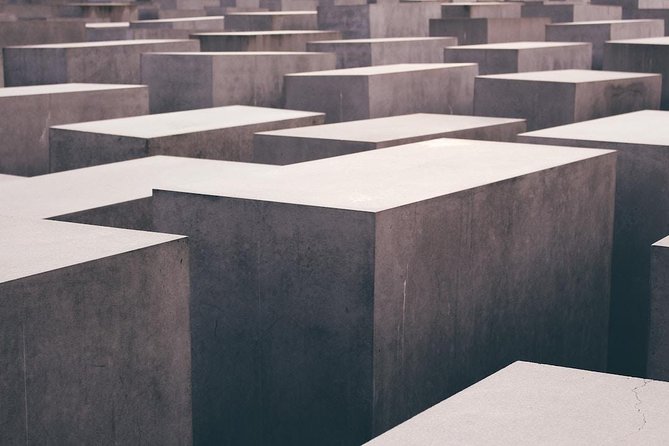
The Memorial to the Murdered Jews of Europe is one of Berlin’s most powerful public spaces. Rows of concrete blocks form a field that changes as you walk through it. From outside, the memorial looks orderly. Inside, the ground shifts and the blocks rise around you, creating a more uncertain experience.
The tour gives you time to walk through the memorial, but it is still a guided route with a schedule to keep. You may want to return later for the underground information center, which is not part of the included walk.
The route then moves toward the German Parliament and government quarter. The Reichstag Building is the meeting place of the German Parliament and one of Berlin’s best-known modern political landmarks. The tour presents it from the outside rather than including a dome visit or interior admission.
Finally, you reach Brandenburg Gate and Pariser Platz. The gate was once a symbol of a divided Berlin and divided Germany. Today it represents peace, unity, and the country’s reunification. The square also gives you views of the American and French embassies, the Hotel Adlon, and the Academy of Fine Arts.
The supplied tour details describe the finish around Brandenburg Gate and Pariser Platz, while the overview also refers to the Reichstag as the ending area. Check your confirmation for the precise final meeting point. Either way, the route closes at the heart of Berlin’s government quarter, a fitting place to continue exploring on your own.
How the pace and group size affect the day
The tour lasts about three hours and includes around 20 numbered stops, although several are brief exterior viewpoints. That means you are constantly moving. The guide may speak for a few minutes, allow photographs, then lead the group onward.
This format works well if you want a clear first-day orientation. It is less suitable if you prefer slow photography, long museum visits, or extended time at memorials. One person specifically found the walk long for older adults, while another estimated the distance at about three miles.
The group limit is 25 people. That is not a private experience, and the guide may need to project over street noise. One account praised the route but noted that the guide spoke too softly and did not always wait for the whole group to gather. Stay near the guide, especially when crossing streets or leaving a crowded square.
Wear comfortable shoes and dress for the weather. Hannah’s steady pacing and short stops helped in cold conditions, but most of the tour remains outside. There is no included transport, meal, or museum admission.
Is $24.07 good value?
At $24.07 per person, this is a low-cost way to get a guided introduction to central Berlin. The price is especially fair if you use the walk to decide which places deserve a second visit. You see a large number of major sights without paying separate admission at each stop.
The value depends on what you want. If you need a guide to connect the Nazi and Cold War sites, the price is attractive. If you want to enter the Pergamon Museum, Neues Museum, Berliner Dom, or the Reichstag, you will need separate plans and, where applicable, separate tickets.
The tour is also a useful time-saver at the beginning of a stay. Several people found that it covered the main sights and helped them understand where to return later. Three hours can feel short when the guide is engaging, but it also prevents the experience from becoming an all-day history lecture.
Free cancellation is available up to 24 hours before the start time. Changes or cancellations inside that window are not refunded, so keep the local cut-off time in mind.
Who should book this Berlin walk?
I would choose this tour if you are visiting Berlin for the first time, have a strong interest in modern European history, or want a guide to make sense of places that otherwise look ordinary. It is also a good choice early in your visit, since you can mark the museums, memorials, and neighborhoods you want to explore more fully.
It suits adults and older children who can manage several miles on foot and pay attention during frequent outdoor talks. The subject matter is serious, especially at the Holocaust Memorial, the bunker site, and the Topography of Terror. It is not designed as a light sightseeing stroll.
You may want another option if you need a slow pace, have limited mobility, want interior visits, or prefer a small private group. The 25-person maximum is reasonable, but the guide’s volume and group control can affect the experience.
Final verdict: a strong first chapter for Berlin
This walk gives you a lot for the money: major landmarks, difficult history, architectural context, and a guide who can connect the pieces. Its greatest strength is the route itself, which moves from the Palace of Tears and Museum Island through Nazi and Cold War Berlin to Brandenburg Gate.
Book it if you want orientation and context more than detailed museum time. Arrive early, stay close to the group, wear good shoes, and save time afterward for the sites that catch your attention. With a clear guide such as Tina, Joseph, Jimmy, Hannah, Paul, or Jef, this can give you the framework you need to understand the city before exploring it at your own pace.
FAQ
How long does the Berlin walking tour last?
The tour lasts approximately three hours.
What language is the tour offered in?
The tour is offered in English and includes a local English-speaking guide.
Where does the tour begin?
The meeting details identify Reichstagufer 17 in Berlin, near Friedrichstrasse Station. The tour information also describes the start as outside Friedrichstrasse train station, so check your confirmation for the exact meeting spot.
Where does the tour finish?
The route finishes in the Brandenburg Gate and Pariser Platz area. The tour description also refers to the Reichstag and government quarter near the end of the walk.
Are museum admissions included?
No. The tour points out the Berliner Dom, Pergamonmuseum, Neues Museum, and Altes Museum, but admission is not included.
How many people can join the tour?
The maximum group size is 25 people.
Can I cancel for a full refund?
Yes. You can cancel at least 24 hours before the experience start time for a full refund. Cancellations or changes made less than 24 hours before the start are not refunded.
Just added in Berlin
- Berlin: Energizing 2-Hour Morning Segway Tour★ 4.7 · 35 reviews
- Berlin: Thrilling E-Scooter Adventure Tour★ 4.4 · 66 reviews
- Beelitz-Heilstätten: Baum&Zeit Tree Top Walk Entry Ticket★ 4.9 · 7 reviews
- Beer Bike & Party Bike: Unforgettable Berlin City Tour incl. pickup★ 5.0 · 5 reviews
- AXE THROWING EXPERIENCE IN BERLIN★ 4.7 · 24 reviews
- Alternative Berlin / Street art tour – Private group★ 5.0 · 6 reviews
- Berlin: Alternative & Street Art Tour★ 4.5 · 6 reviews
- Berlin: 2.5-Hour Beer & Sunset Sightseeing Boat Cruise★ 4.6 · 61 reviews
Local Life & Hidden Gems, compared.

Sights and Highlights Bike Tour with a Local Guide
Read our review →

Munich Private Tour with a Local – Highlights & Hidden Gems
Read our review →
Lunch Like a Local: Munich’s ORIGINAL Viktualienmarkt Food Tour
Read our review →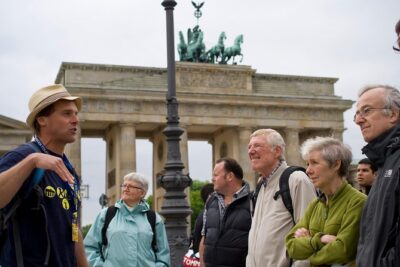
Private Berlin: Iconic Sights and Hidden Gems Walking Tour
Read our review →
Browse the lists this tour appears in