
Reviewed · HISTORICAL TOURS
Karl-Marx-Allee Walking Tour: Berlin’s Socialist History
Karl-Marx-Allee was built to make socialism look permanent. Its vast apartment blocks, formal towers, and broad ceremonial avenue were meant to show that East Germany could rebuild Berlin with order and confidence. Instead, the street also became the setting for a workers’ revolt that nearly brought down the young government.
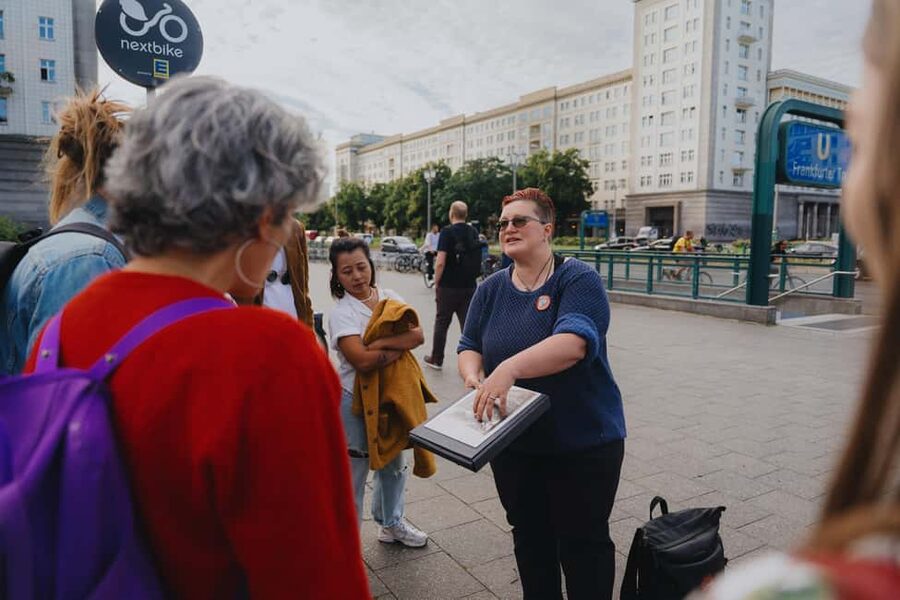
I like this tour for two reasons: it connects architecture with Cold War politics, and it does not stop at the polished facade. You also get the human side, from East Berlin’s carefully managed shops and cafes to the hidden wiretaps and listening posts of the Stasi. The main thing to consider is that this is a serious history walk, not a general sightseeing tour, and the two-hour route calls for comfortable shoes.
Key points to know before you go
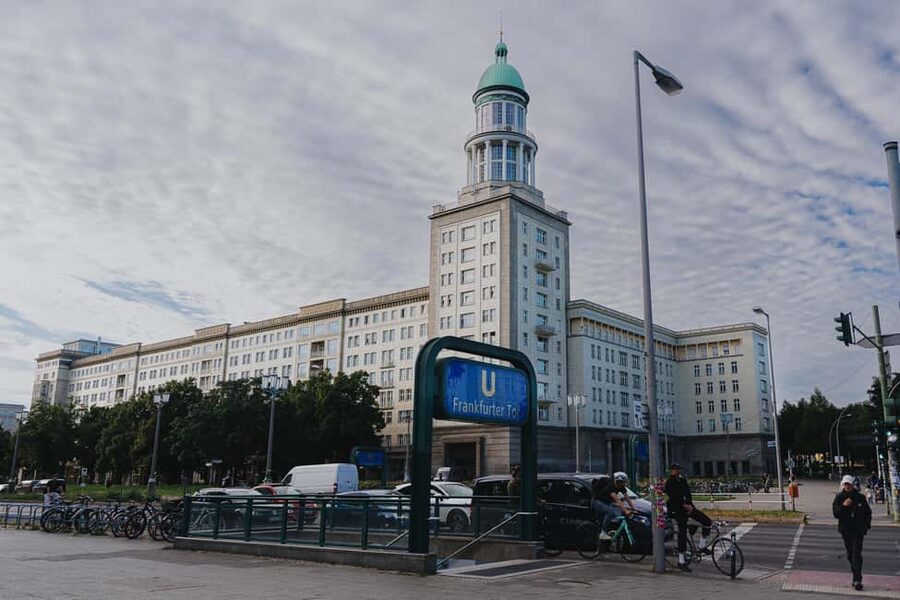
- Start at U Frankfurter Tor: Meet outside the station at the corner of Warschauer Straße and Karl-Marx-Allee, looking for an orange umbrella.
- Walk through socialist classicism: The giant housing blocks were East Germany’s boldest postwar building project.
- Hear about the 1953 uprising: The avenue’s construction helped fuel anger among workers who were already under pressure.
- Look beyond the grand facade: The tour explains how Stasi surveillance operated inside supposedly ideal homes.
- Spot screen locations: Karl-Marx-Allee appears in The Lives of Others and The Queen’s Gambit.
- Plan for a serious history lesson: The tour lasts two hours and is offered in English or German.
Why Karl-Marx-Allee tells East Germany’s story so well
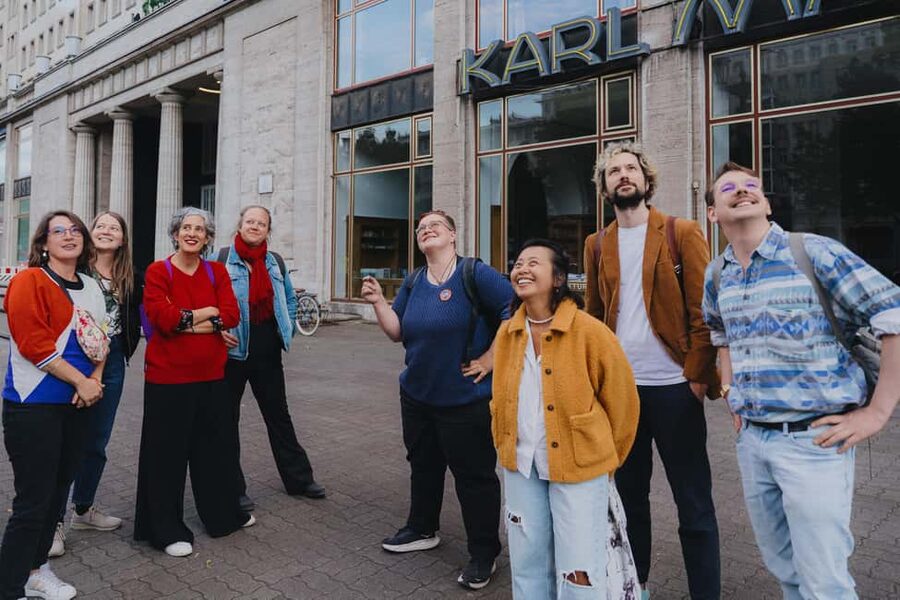
Karl-Marx-Allee is not just a long street lined with old apartments. It is a political statement built in stone.
After World War II, Berlin lay in ruins. East Germany’s new socialist government wanted a major rebuilding project that would provide homes, display state power, and give ordinary workers a grand setting for the new society. The result was a monumental avenue that once carried the name Stalinallee.
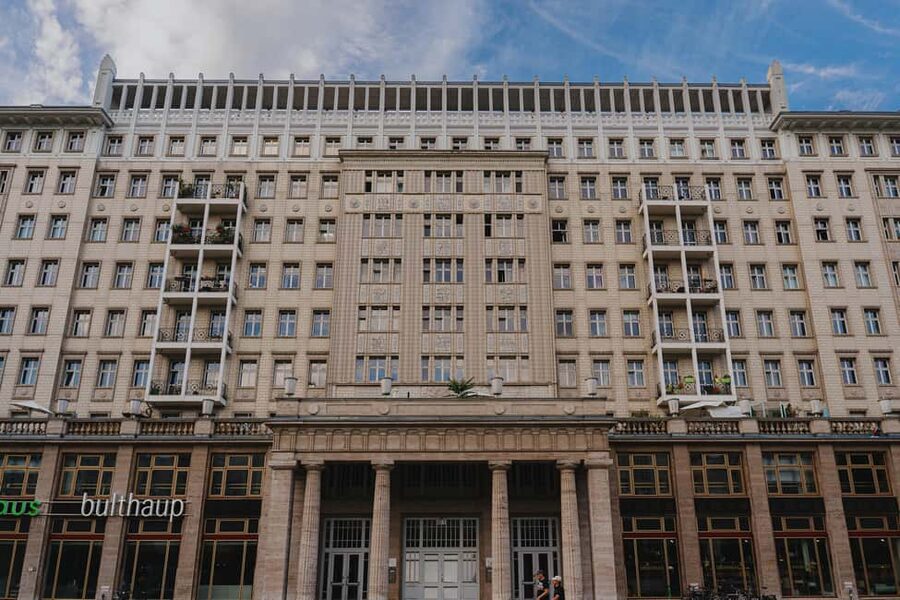
The buildings were designed in socialist classicism, a style that used symmetry, repeated windows, formal details, and imposing scale. As you walk beside them, you may feel intentionally small. That is part of the point. The avenue was built to make the state look strong and its promises look solid.
I find the route valuable because the buildings are not treated as decoration. Your guide helps you read them as evidence of competing ideas. Early postwar modernism favored practical, utopian housing ideas. The East German regime later rejected that approach and chose a more ceremonial style that could communicate authority from a distance.
Fast-growing poplar trees later hid some of the earlier modernist buildings from passersby. That detail gives the tour a useful edge. Architecture here was not only about construction. It was also about which ideas the government wanted people to see.
Other history to see in Berlin:
- Berlin: Natural History Museum Entrance Ticket
★ 4.6 · 3,382 reviews - Berlin: World Heritage Cruise to Potsdam
★ 4.5 · 1,435 reviews - Berlin Historical Highlights Walking Tour
★ 4.9 · 657 reviews
Meeting at U Frankfurter Tor
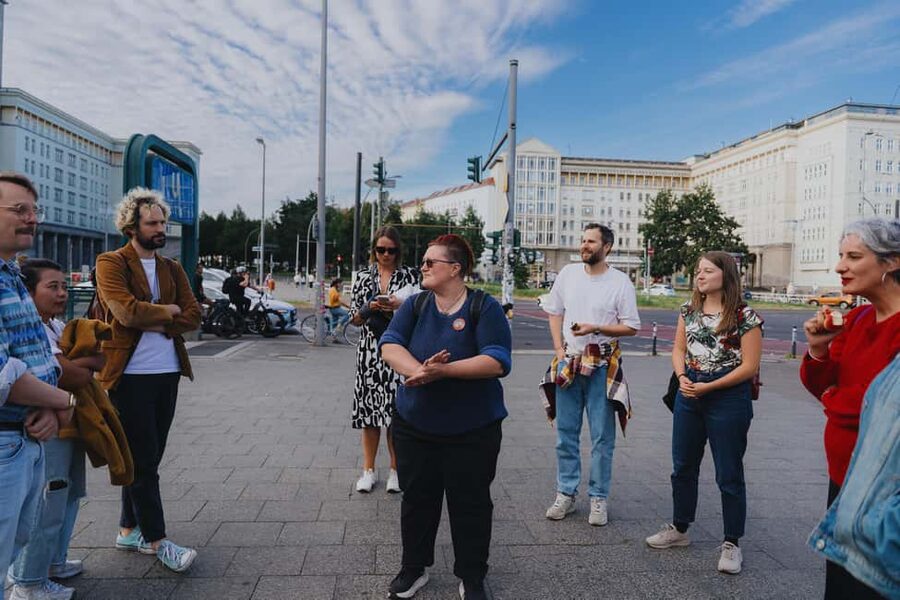
The tour begins outside U Frankfurter Tor, at the corner of Warschauer Straße and Karl-Marx-Allee. Look for the guide holding an orange umbrella. That is a simple but useful detail in a busy city, and it saves you from wandering around the station entrance trying to spot a stranger.
Frankfurter Tor is a fitting starting point because the monumental avenue becomes immediately legible from here. You are not eased into the subject with a long museum introduction. The street itself supplies the opening lesson.
The walk then follows Karl-Marx-Allee for about an hour and a half, with the full activity lasting two hours. That timing gives the guide room to explain the architecture and its political setting without turning every building into a separate lecture.
The route is accessible for wheelchair users, though you should still wear comfortable shoes. This is an urban walking tour, and the subject rewards looking carefully at buildings, trees, public spaces, and the relationship between the avenue and its housing blocks.
The grand housing blocks and the promise of socialist living
East Germany presented Karl-Marx-Allee as proof that socialism could provide a good life. The avenue included cafes, restaurants, and well-stocked shops, creating a public picture of comfort and abundance.
That image mattered. The government did not want the street to look merely functional. It wanted the best of East Berlin gathered along one impressive boulevard. The housing blocks were part of a larger promise: workers would receive modern homes, public services, and a city designed around collective life.
As you walk, listen for the gap between the public message and daily reality. The street could look prosperous while the wider system remained tightly controlled. A polished shopfront did not mean freedom of speech. A large apartment did not mean privacy from the state.
This is one of the strongest parts of the experience. You are not asked to choose between admiring the buildings and criticizing the government. You can do both. The architecture is imposing and carefully planned, yet the ideology behind it brought restrictions that affected nearly every part of life.
The scale also helps you understand how public space worked in East Germany. Karl-Marx-Allee was built for more than residents going home. It was the main stage for socialist parades and official display. The avenue’s size gave the state room to perform power in front of its citizens.
The 1953 workers’ uprising
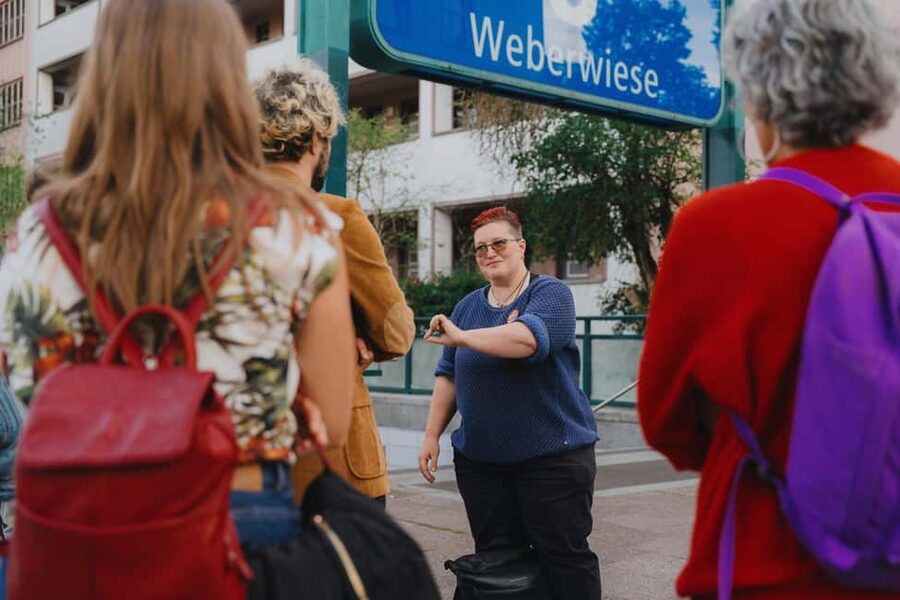
The most important historical turn on the walk is the East German uprising of June 1953.
The building program was meant to strengthen the new country, but it also placed heavy demands on workers. Discontent grew, and workers began a mass uprising. The revolt spread far enough to threaten the socialist government’s survival.
That contrast gives Karl-Marx-Allee its dramatic force. The street was supposed to demonstrate that the government had rebuilt society after the war. Instead, its construction helped expose the anger beneath the official message.
You will hear how the uprising changed the meaning of the avenue. A project intended to represent unity became linked to protest and political danger. The story also prevents the tour from becoming a simple architecture lesson. You are looking at a place where policy affected wages, work, housing, and public trust.
For me, this is the point where the avenue stops looking like a frozen relic. The buildings may appear quiet now, but their creation was tied to real pressure on workers. The tour gives you a way to see the human cost behind a state project that can otherwise seem grand and remote.
Other walks around Berlin:
- Discover Berlin Half-Day Walking Tour
★ 5.0 · 9,624 reviews - Berlin: Third Reich and Cold War 2 Hour Walking Tour
★ 4.9 · 6,830 reviews - Berlin: Discover Berlin Walking Tour
★ 4.9 · 5,998 reviews - Berlin’s Best: 2 Hour Walking Tour Third Reich and the Cold War
★ 5.0 · 5,486 reviews
The hidden machinery of Stasi surveillance

Karl-Marx-Allee’s official image was orderly, bright, and ideal. Its private reality could be far more threatening.
The tour covers the surveillance system run by the Stasi, East Germany’s secret police. Wiretaps in apartments and listening stations in attics were hidden from view. The people living in the grand housing blocks could not assume that their homes were truly private.
This part of the walk adds weight to the architecture. A home was supposed to be a reward of socialist progress, but the state could also turn that home into a monitored space. The polished facade and the hidden listening equipment belonged to the same system.
You will not simply hear that surveillance existed. The route focuses on how it was concealed within ordinary residential life. That makes the subject easier to grasp than a list of police agencies or political dates. The question becomes personal: who could hear what was said, and where could residents speak freely?
The tour also connects the avenue to The Lives of Others, whose filming locations are found along the route. If you know the film, the setting may feel familiar. If you do not, the reference still shows how Karl-Marx-Allee’s architecture continues to communicate control, isolation, and political tension on screen.
Film locations and the street’s afterlife

The avenue has found a second life in film. Locations connected with The Lives of Others and The Queen’s Gambit appear on the route, giving you another way to notice its design.
Film crews value the street because its architecture still looks distinct. The long blocks and formal spaces create an atmosphere that is hard to confuse with another part of Berlin. The buildings can suggest power, discipline, or a vanished future without much explanation.
The Queen’s Gambit connection may surprise you, especially if you associate the series with chess rather than East Berlin. The tour uses these screen locations as a bridge between history and popular culture. This is a useful touch for visitors who want more than dates and political slogans.
Still, do not book the walk mainly for film trivia. The filming locations are part of the route, not its whole purpose. The stronger experience comes from understanding why directors choose these buildings and what the architecture communicates.
From forgotten boulevard to housing protest

After the Berlin Wall fell, Karl-Marx-Allee lost much of its old political role. The avenue was no longer the main stage for socialist parades, and its buildings began to look like leftovers from a failed system.
Some of the street fell into disrepair. For a time, it could seem like an odd curiosity from East Germany’s past. That changed as Berlin’s housing market tightened and real estate interest grew.
The avenue now carries a new kind of political energy. Local protests focus on gentrification and rising living costs. The subject has changed, but the basic question remains familiar: who gets to live in these homes, and who controls the city?
I appreciate this final chapter because it keeps the tour from ending in nostalgia. Karl-Marx-Allee is not presented as a museum street sealed off from present-day Berlin. Its housing blocks still matter to people dealing with rents, redevelopment, and the loss of local communities.
The connection between past and present is clear without being forced. In the 1950s, the state used the avenue to present a model of socialist living. Today, the street can become a place where residents protest changes in the housing market. The political banners may be different, but public space still carries arguments about who Berlin is for.
What the guide adds to the walk
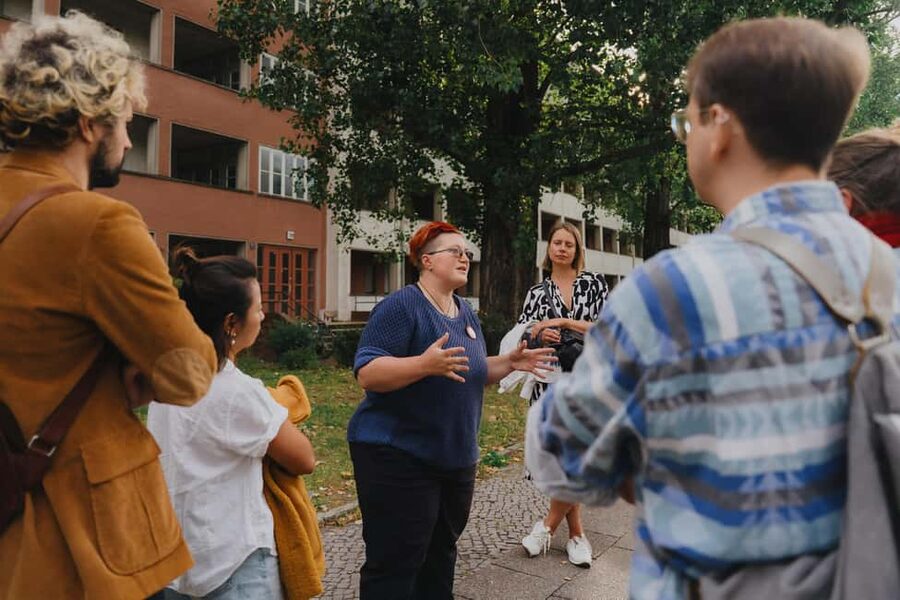
This tour depends heavily on the guide. The buildings are impressive on their own, but their meaning is not always obvious. A good explanation connects a facade to policy, a housing block to surveillance, and a public boulevard to worker unrest.
Martina is specifically praised for being attentive to curious questions rather than rushing through a fixed script. That is worth noting if you like tours that allow room for discussion. Karl-Marx-Allee raises natural questions about everyday life, architecture, propaganda, and the difference between public image and private experience.
The tour is offered in English or German, so choose the language in which you can follow political and historical detail most easily. This is not a walk where missing a few words only means missing a building name. The important points involve cause and effect, and a clear explanation makes a real difference.
Because there are only five ratings available, I would not treat the perfect score as a guarantee of a perfect experience for everyone. The more useful clue is the specific praise for Martina’s attention to curious participants. If you value a guide who engages with questions, that is a positive sign.
Is $23 a fair price?
At $23 per person, this is a reasonable price for a two-hour guided history walk in Berlin. You are paying for interpretation, not entry to a museum or a major monument. The value depends on how much context you want from the street.
If you already know East German history well and prefer to explore on your own, you may find the price less compelling. Karl-Marx-Allee is public space, and you can see the buildings without joining a tour.
If the Cold War, socialist architecture, or the Stasi are new subjects for you, the cost makes more sense. The guide helps turn a long avenue into a connected story. You leave with more than photographs of large housing blocks.
The reserve-now-and-pay-later option also gives you some flexibility. You can cancel up to 24 hours before the tour for a full refund, which is useful when Berlin plans are still shifting.
Who should book this Karl-Marx-Allee walk?
I would recommend it to you if you enjoy architecture with a political story attached. It suits visitors who want to understand East Berlin beyond the Wall and the usual Cold War photo stops.
It is also a good match if you are interested in housing, city planning, surveillance, or the way governments use public buildings to shape public opinion. The route connects all of those subjects without requiring a separate museum visit.
Film fans may enjoy the locations from The Lives of Others and The Queen’s Gambit, but the tour is not designed as a film-only walk. You should book it for the history first.
Children under 10 are not suitable for this activity. Older children and teenagers may follow it well if they already have an interest in modern European history, but the subject includes political repression and state surveillance.
Practical details for a smoother walk
Meet outside U Frankfurter Tor, at the corner of Warschauer Straße and Karl-Marx-Allee. Look for the orange umbrella, and arrive ready to walk rather than expecting a seated talk.
The guided portion along Karl-Marx-Allee lasts about one and a half hours, while the total activity lasts two hours. Bring comfortable shoes. The tour is wheelchair accessible and available in English or German.
The route is described as finishing at U Strausberger Platz. The meeting details also say the activity ends back at the meeting point, so confirm the exact finishing point when you book if your onward transport depends on it.
Should you book it?
Book this tour if you want Karl-Marx-Allee to make sense rather than simply look imposing. For $23, you get a focused explanation of socialist classicism, the 1953 uprising, Stasi surveillance, film locations, and the street’s current role in housing protests.
Skip it if you want a light, general city walk or if you are not interested in political history. For everyone else, this is a useful way to read one of Berlin’s most striking avenues as both a grand building project and a record of the people who lived under it.
FAQ
Where does the Karl-Marx-Allee Walking Tour start?
It starts outside U Frankfurter Tor, on the corner of Warschauer Straße and Karl-Marx-Allee.
How do I find the guide?
Look for the guide holding an orange umbrella outside the U Frankfurter Tor station.
Where does the tour finish?
The route is described as finishing at U Strausberger Platz. The meeting details also state that the activity ends back at the meeting point, so confirm the final location when booking.
How long does the experience last?
The full activity lasts two hours. The guided walk along Karl-Marx-Allee lasts about one and a half hours.
What languages are available?
The tour is offered with a live guide in English or German.
Is the tour wheelchair accessible?
Yes, the activity is listed as wheelchair accessible.
What should I bring?
Bring comfortable shoes, since the experience is a walking tour.
Is the tour suitable for children?
It is not suitable for children under 10.
What subjects does the tour cover?
It covers socialist architecture, the East German rebuilding program, the 1953 workers’ uprising, Stasi surveillance, and present-day housing protests.
Does the tour include film locations?
Yes. The route includes filming locations connected with The Lives of Others and The Queen’s Gambit.
How much does the tour cost?
The listed price is $23 per person.
Can I cancel for a full refund?
Yes. You can cancel up to 24 hours in advance for a full refund.
Just added in Berlin
- Modern Berlin Private Walking Tour: Diverse, Vibrant and Exciting German Capital★ 5.0 · 13 reviews
- Private One way Airport Transfer Berlin Airport To Berlin★ 3.5 · 17 reviews
- Private Walking Tour: Berlin Wall, Cold War and Checkpoint Charlie★ 5.0 · 37 reviews
- Private Day Trip to Potsdam from Berlin by Train★ 4.5 · 27 reviews
- City Explorer: Potsdam Private Day Trip★ 4.5 · 10 reviews
- Berlin Private Custom 5-Hour Tour by Car★ 5.0 · 30 reviews
- Private Half-Day Sightseeing Tour in Berlin★ 3.5 · 6 reviews
- Berlin Private Custom Tour in a Minivan, East and West★ 5.0 · 123 reviews
Historical Tours, compared.
City History Canal Sightseeing Tour on a Motorboat
Read our review →

Browse the lists this tour appears in