
Reviewed · OLD TOWN WALKING TOURS
Frankfurt – Old Town Historic Walking Tour
Frankfurt’s old center packs imperial ceremony, German literature, modern finance, and everyday food shopping into a short walk. You’ll begin at the Römer, cross the Iron Footbridge over the Main, and finish near the grand Alte Oper, with plenty of city context along the way.
I like the private format, which lets your group ask questions instead of following a crowd. I also like the mix of major sights and ordinary city life, especially the Kleinmarkthalle and the river crossing. The main drawback is pace: 1.5 hours is short for ten listed stops, and entrance fees are not included.
Key points to know before booking
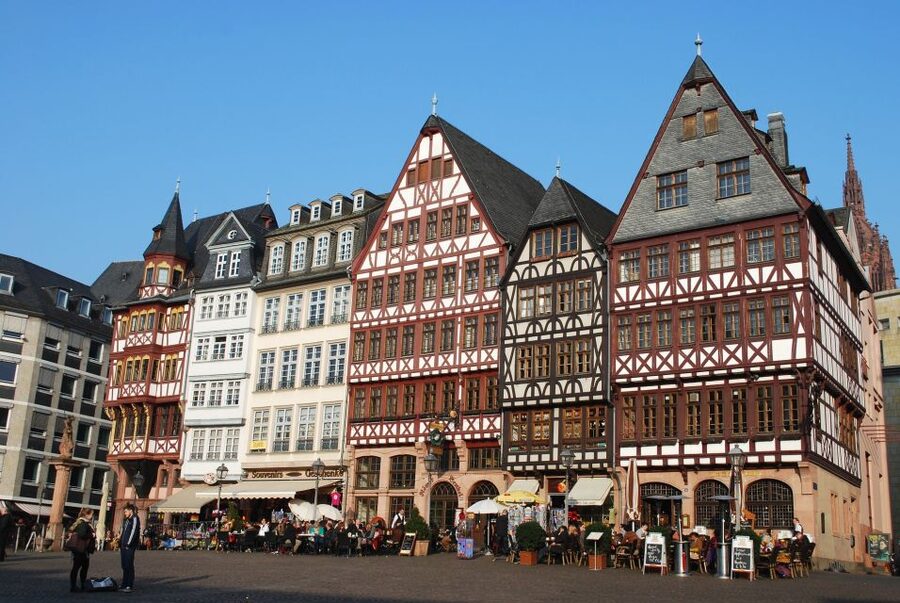
- The Römer begins the walk: Frankfurt’s city hall has occupied this medieval group of houses for more than 600 years.
- The Iron Footbridge gives you a river view: Eiserner Steg crosses the Main on foot and stretches about 170 meters.
- Goethe House adds a literary highlight: You can see the birthplace of Johann Wolfgang von Goethe and his early writing desk.
- The route covers a lot quickly: Expect a brisk overview rather than long visits inside every sight.
- The food stop is useful and local: Kleinmarkthalle has 156 stalls, including Frankfurt’s famous green sauce and imported foods.
- The $397 price works best for a full group: The fee covers up to 20 people, so the value improves sharply when shared.
Starting at the Römer and Fountain of Justice
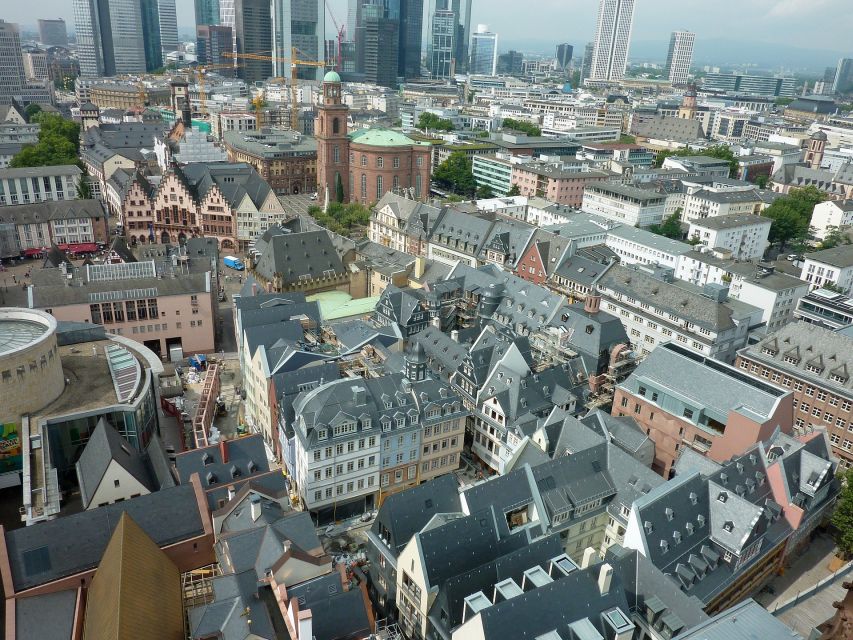
Your meeting point is the Fountain of Justice, where the guide waits with a signboard. This puts you right in Frankfurt’s historic center, beside the Römer and its handsome square.
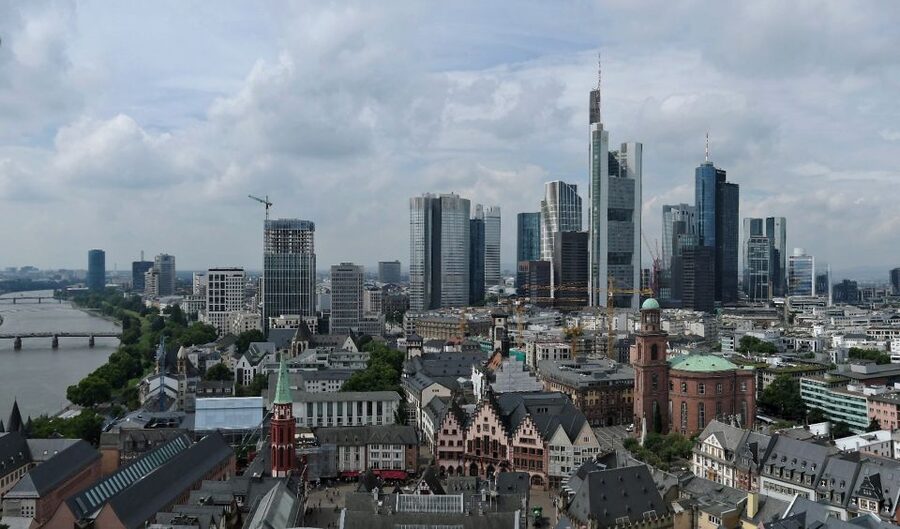
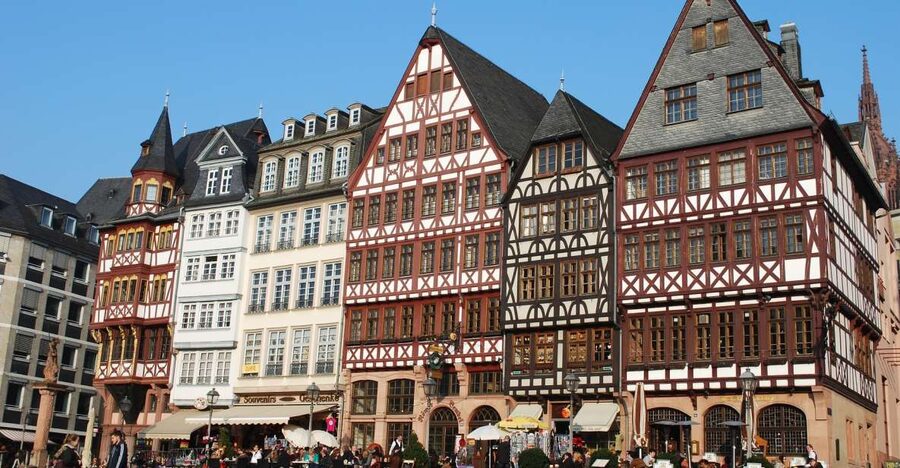
The Römer is not one building but a group of nine medieval houses. The city has used it as its town hall for more than six centuries, and it remains one of Frankfurt’s main civic landmarks. Weddings and civil registrations still take place here, which gives the complex a practical role beyond its postcard appearance.
I like beginning here because the Römer quickly explains Frankfurt’s older identity. The city is famous for banks and skyscrapers, but this first stop places you among medieval façades, civic ceremonies, and the traditional center of local government.
Your guide can provide the background that a quick look alone will not. The short tour format means you should expect an introduction and exterior views rather than a long, detailed examination of every room.
More Old Town Walking Tours in Frankfurt
- Frankfurt: New Old Town and Highlights German-Language Tour
★ 4.7 · 1,316 reviews - Heidelberg Castle and Old Town Tour from Frankfurt
★ 4.0 · 587 reviews - Frankfurt: Highlights and New Old Town English-Language Tour
★ 4.7 · 96 reviews
Frankfurt Cathedral and the imperial past
From the Römer, the route continues to Frankfurt Cathedral, formally the Imperial Cathedral of Saint Bartholomew. It is the city’s largest Roman Gothic church, with a tall tower, vaulted ceilings, and a notable organ.
The cathedral carries more than religious importance. It became a symbol of unity during the era of the Holy Roman Empire, giving the building a national role as well as a local one. That political background helps explain why the church occupies such an important place in Frankfurt’s story.
I would pay attention to the scale of the tower and the interior vaulting if you enter. The cathedral is one of the places where the old city feels grand rather than merely picturesque.
Entrance fees are not included in the tour price. Since the itinerary gives you several major sights in a limited period, ask your guide how much time is available inside the cathedral and confirm any admission cost before entering.
Crossing the Main on the Iron Footbridge
The Eiserner Steg, or Iron Footbridge, provides one of the clearest changes of scene on the walk. It crosses the River Main and links the historic center with the southern side of the city.
The bridge was first built in 1868 and has been rebuilt more than once. It was destroyed in 1946 by the Wehrmacht and later reconstructed. The current bridge is about 170 meters long, supported by steel reinforcements and two piers.
This is a short but valuable part of the route. From the bridge, you get open views along the river and a sense of how Frankfurt is arranged around the Main. It also gives your legs a break from close streets and squares.
The bridge is not a museum stop, so the experience depends on the guide’s explanation and the view. If the weather is poor, this may be the least comfortable section. Still, I would not skip it. The river crossing gives the old-town walk a wider frame.
A look at the Städel Museum
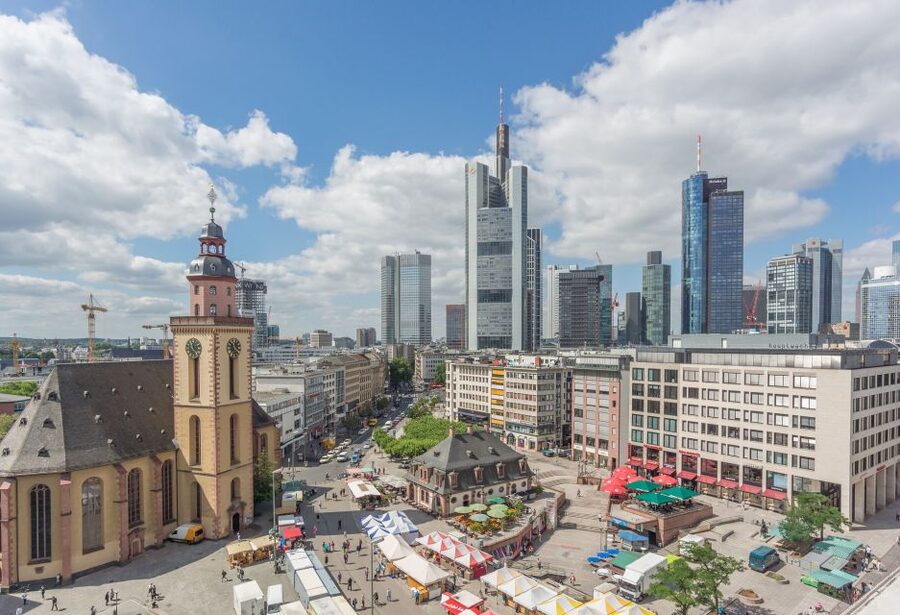
The walk passes by the Städel Museum, one of Germany’s major art museums. The collection includes about 2,700 paintings, although only around 600 are displayed at a time. The museum also has a library with more than 100,000 books.
The Städel was selected as Museum of the Year by the AICA in 2012. That detail helps explain why this is more than a passing cultural reference. You are seeing one of Frankfurt’s serious art institutions, not simply a decorative building on the route.
The tour does not include museum admission, and the schedule does not allow a full museum visit. I would treat this stop as a useful orientation point. If the Städel interests you, note its location and return later with several hours to spare.
This is one of the route’s practical strengths. You get a sample of Frankfurt’s art scene without giving up the rest of the historic-center walk.
Other walks through the old centre of Frankfurt:
- Guided Axe Throwing Experience in Frankfurt Altstadt
★ 5.0 · 93 reviews - Frankfurt: Old Town Historical Walking Tour in German
★ 4.7 · 43 reviews - Frankfurt: Main Tower with Tickets and Guided Old Town Tour
★ 5.0 · 17 reviews - Frankfurt: Old Town Crime Mystery Game
★ 4.3 · 14 reviews
Eurotower and the city’s financial identity
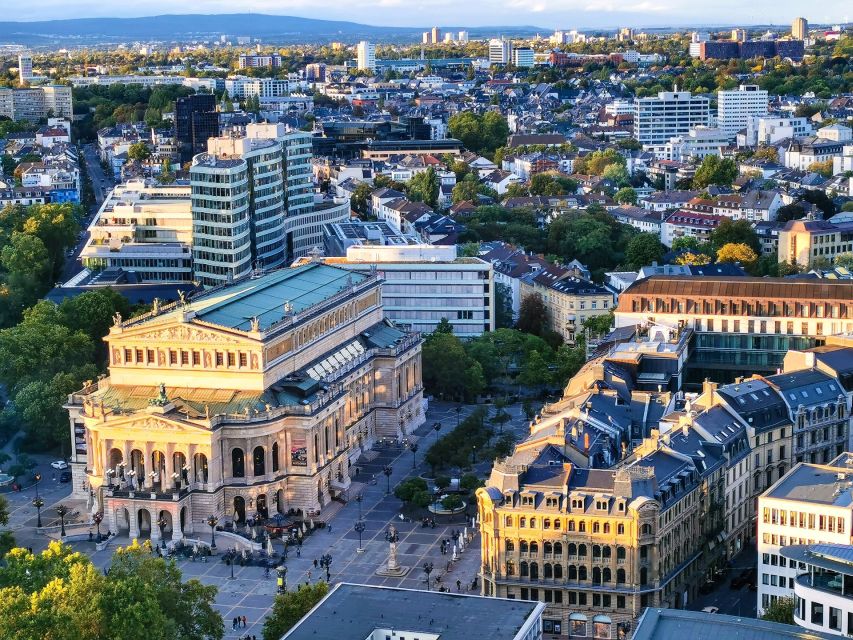
The Eurotower rises 148 meters above the city and offers a sharp contrast with the medieval Römer and cathedral. Designed by architect Richard Heil, it served as the European Central Bank’s headquarters until 2015.
That former role makes the tower part of Frankfurt’s modern European story. The city is not only a place of Gothic churches and old civic buildings. It has also been a key center of European finance and administration.
I like the route’s decision to include the Eurotower because it prevents the walk from becoming a narrow medieval history lesson. You see how Frankfurt moved from imperial institutions to modern financial power.
This is another exterior-focused stop. You will not be visiting the former central bank offices as part of the tour, but the guide can place the tower in the city’s larger story.
Goethe House and the writer’s desk
Goethe House is the literary centerpiece of the walk. Johann Wolfgang von Goethe was born here and spent his childhood in the house. Inside, you can see the writing desk connected with his early work.
That detail makes the stop unusually personal. Instead of only hearing that Goethe was born in Frankfurt, you get a physical link to the rooms and desk associated with his first writing.
The house offers a different mood from the cathedral and financial district. Here, the focus shifts from civic power to family life and German literature. If you have read Goethe, the stop will carry extra weight. If you have not, it still gives you a clear connection to one of Germany’s best-known writers.
Admission is not included, so budget separately if you plan to go inside. The advertised route says to visit Goethe House, but the 1.5-hour length means your guide may need to keep the stop focused. I would ask at the start how interior visits will fit into the timing.
St. Paul’s Church and the 1848 Parliament
St. Paul’s Church began as a Lutheran church and later became a Protestant church. Its most important political role came in 1848, when it hosted the first Frankfurt Parliament.
That gathering was a major event in Germany’s move toward representative government. The church is therefore both a religious building and a political symbol.
I appreciate this stop because it adds a serious civic layer to the route. The Römer represents long-running city government, while St. Paul’s points to national political change. Together, they show that Frankfurt’s importance has never rested on trade alone.
As with the cathedral and Goethe House, check how much time is planned inside. The route covers several landmarks, so the guide may explain the church from outside or allow only a brief interior look.
Kleinmarkthalle for a taste of daily Frankfurt
Kleinmarkthalle is the route’s most everyday stop. Open six days a week, it contains 156 stalls selling local products and food from around the world.
You may find Frankfurt’s green sauce here, along with other fresh goods and imported foods. The market gives you a chance to see how residents shop and eat, rather than only looking at monuments.
I especially like having a market on a historic walking route. It adds smell, color, and choice without requiring a formal museum visit. If you want a snack or a small food souvenir, this is the place to ask your guide for advice.
The market is also a useful dinner-planning stop. One of the guides, Alexa, has shared restaurant suggestions during the walk, so you can use the conversation to shape the rest of your day.
Timing matters here. Market hours and individual stall schedules can affect what you find, and the tour information does not promise tastings or purchases. Think of Kleinmarkthalle as a guided look at Frankfurt’s food culture, not a food tour.
Hauptwache and the old guardhouse
Hauptwache translates as Main Guardroom, and the name comes from the Baroque building constructed in 1730. Today, the area is a central meeting point surrounded by broad plazas.
The contrast is worthwhile. The old guardhouse recalls the city’s military and civic past, while the surrounding space functions as a busy modern center. It is another example of Frankfurt placing old and new uses side by side.
This stop may feel less intimate than the Römer or Goethe House, but it helps you understand the city’s layout. It also gives you a familiar central landmark for later independent exploring.
Finishing at the Alte Oper
The walk ends at the Alte Oper, or Old Opera, on Opernplatz. The building was first constructed at the end of the 19th century and later became a concert hall.
It has hosted major performances, including Carl Orff’s Carmina Burana in 1937. The building and the square in front of it provide a polished finale after the medieval streets, river crossing, food market, and political landmarks.
The stated meeting details say the activity ends back at the meeting point, while the route description places the final sightseeing stop at the Alte Oper. Those details do not fully match, so confirm the exact end point when you meet your guide. Either way, you finish in a useful central area.
What the $397 group price really means
The price is $397 per private group of up to 20 people. That is expensive for one or two people, but the calculation changes when shared across a larger group.
At the full 20-person limit, the cost works out to just under $20 per person. For ten people, it is about $40 each. For four people, it is about $99 each, before any entrance fees. This makes the tour much better suited to families, friends, or organized groups than to a solo visitor.
The fee includes a private guide, but not admissions. You are paying for a tailored walk and live explanations, not a package with museum tickets, food, or transport.
The short duration also affects value. In 90 minutes, you can get your bearings and see a large portion of central Frankfurt. You cannot expect long visits at every sight. I see this as a strong introductory walk, especially if you want help deciding which places deserve a later return.
Guide quality and language choices
The tour is available with live guides speaking English, German, Portuguese, Spanish, Italian, and French. The private group format is useful here because your questions and pace stay within your own party.
Alexa is one guide associated with the experience. She has been praised for giving useful background, using additional pictures, and offering dinner suggestions. Those are practical strengths. Extra images can help explain buildings that are hard to understand from the street, while restaurant advice makes the tour useful beyond its final stop.
Do not expect every guide to use the same approach. The information supports a private guided walk, but it does not promise a fixed guide or identical presentation. If having Alexa matters to you, request her when booking, though availability is not guaranteed by the tour details.
Who should book this Frankfurt walk?
I would recommend it to a group visiting Frankfurt for the first time, especially if you want a quick introduction before exploring alone. It suits people who value context and conversation more than a rigid audio guide.
It also works well for groups with mixed interests. One person gets Goethe, another gets churches, another gets finance, and everyone gets the river and market. The route does not force you to choose between art, politics, food, and architecture.
I would think twice if you want a slow museum visit or a food-focused outing. The Städel and Goethe House need more time than this route provides, and market shopping is not the same as a dedicated tasting tour.
The private format also makes the price hard to justify for a very small party. If you have only one or two people, compare the cost with a group walking tour or an independent visit to the same central sights.
My booking advice
Book this walk if you have a full group, want a personal guide, and need a smart first look at Frankfurt’s old center. The best features are the varied route, the river crossing, Goethe’s writing desk, and the chance to ask Alexa or another guide for practical dinner ideas.
Before paying, confirm two points: which stops include interior access, and where the walk actually ends. Also set aside money for entrance fees. If you accept the brisk pace and treat the tour as an orientation rather than a complete visit to every attraction, it offers a useful way to connect Frankfurt’s medieval center, literary past, political history, food culture, and modern finance.
FAQ
How long is the Frankfurt Old Town Historic Walking Tour?
The tour lasts 1.5 hours. Starting times vary, so you need to check availability when booking.
Where does the tour start?
The guide meets you at the Fountain of Justice and waits with a signboard.
Where does the tour end?
The route description places the final stop at the Alte Oper, while the meeting information says the activity ends back at the meeting point. Confirm the exact end point with the guide at the start.
Is this a private tour?
Yes. The tour is for a private group of up to 20 people.
Which languages are available?
Live guides are available in English, German, Portuguese, Spanish, Italian, and French.
Are entrance fees included?
No. Entrance fees are not included in the tour price.
How much does the tour cost?
The price is $397 per group of up to 20 people. The private guide is included, while entrance fees are separate.
More walking tours in Frankfurt
- Frankfurt Highlights English Walking Tour
★ 5.0 · 1,203 reviews - Frankfurt on Foot Daily Walking Tour in English
★ 4.9 · 323 reviews - Frankfurt: Private or Shared Walking Tour
★ 4.8 · 156 reviews - 2-Hour Best of Frankfurt Walking Tour (English)
★ 5.0 · 55 reviews
More history to see in Frankfurt
- Frankfurt Self-Guided Historical Walking Tour
★ 4.0 · 58 reviews - Leipzig: City History Canal Sightseeing Tour on a Motorboat
★ 4.7 · 6,232 reviews - Berlin: Natural History Museum Entrance Ticket
★ 4.6 · 3,382 reviews - Leipzig: 1.5-Hour Historical Walking Tour in German
★ 4.7 · 2,217 reviews
Just added in Frankfurt
- Day Trip to Rothenburg from Frankfurt★ 4.6 · 25 reviews
- Rhine Valley: Half Day Tour from Frankfurt★ 3.7 · 66 reviews
- Private Tour with Native English speaking Local★ 4.9 · 60 reviews
- Hohenzollern Castle: Full-Day Tour from Frankfurt★ 4.3 · 11 reviews
- From Frankfurt: Day Tour to Heidelberg with Local Guide★ 4.8 · 250 reviews
- Heidelberg and Rhine Combination Tour from Frankfurt★ 4.1 · 33 reviews
- Frankfurt: Guided walk between palm trees and skyline★ 4.8 · 9 reviews
- From Frankfurt: Heidelberg & Baden-Baden Full-Day Tour★ 4.9 · 23 reviews
Old Town Walking Tours, compared.

Old Town & Viktualienmarkt City Walk in German
Read our review →
The Night Watchman Old Town Walking Tour in German
Read our review →
New Old Town and Highlights German-Language Tour
Read our review →

Browse the lists this tour appears in