
Reviewed · MUSEUMS
Dresden: Church of Our Lady Guided Tour of Gallery
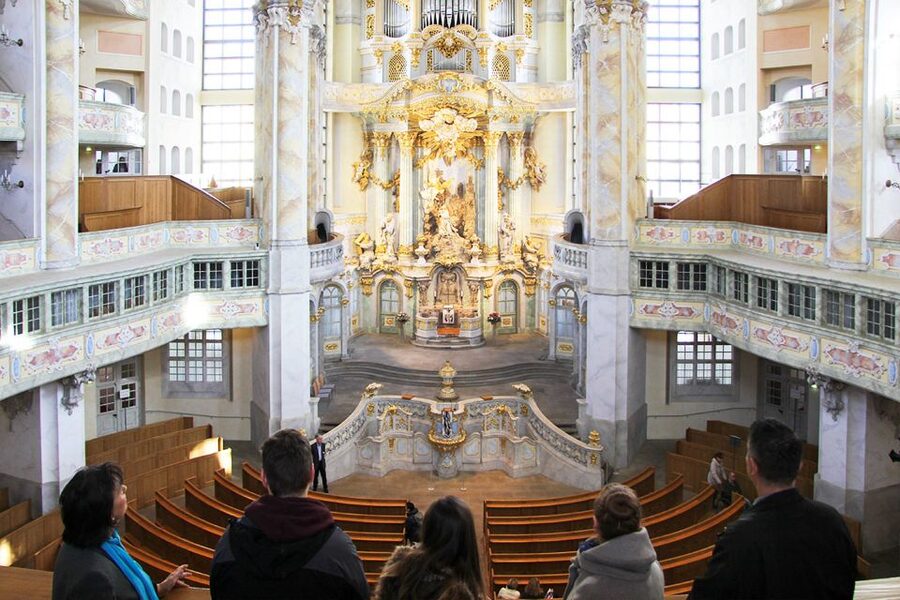
Dresden’s Frauenkirche carries its past right into the present. This one-hour tour explains how George Bähr’s 1720s church was nearly destroyed in World War II, left in ruins for decades, and rebuilt after German reunification. The most memorable part is exclusive gallery access, which gives you a different view of the church than a standard visit.
I like the clear focus on the church’s reconstruction, and I like the short, well-structured format. At $15, it is an easy add-on to a Dresden day, especially if you want more than a quick look inside. The main consideration is that English places are limited, and the tour is not suitable for wheelchair users.
Key points before you book
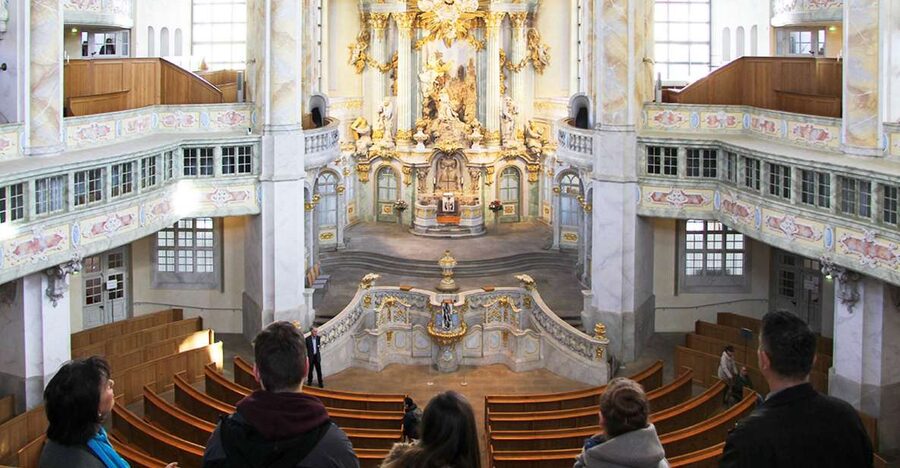
- The gallery is the special access: You go beyond the usual church interior and gain a distinctive view from the galleries.
- The story reaches from the 1720s to 2005: The tour connects George Bähr’s original design with the church’s modern rebuilding.
- It lasts one focused hour: You get a useful dose of history without giving up half your day.
- Clear explanations suit families: The content is designed to be understandable, and children can follow the story.
- Choose your language carefully: Tours are offered in German and English, but English availability is limited.
Why the Frauenkirche story matters
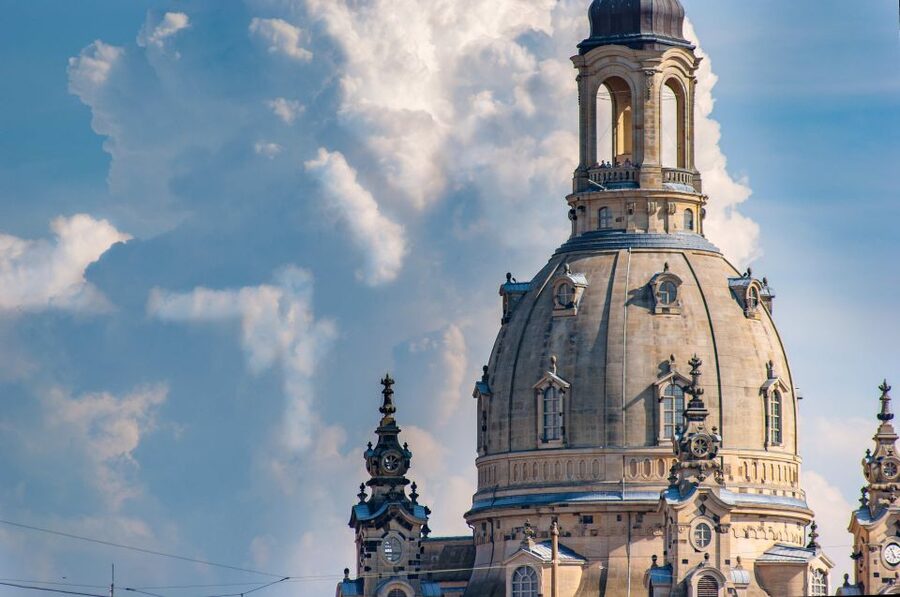
The Frauenkirche is not simply a beautiful church with a dramatic dome. Its meaning comes from the sharp break between its creation, destruction, and rebirth.
George Bähr’s original plans date to the 1720s. The church was built as an ornate Baroque house of worship, with a broad interior and an expansive cupola that still shapes Dresden’s skyline and city center. That design gives the building its visual force, but the tour adds the human and political story behind it.
During World War II, bombing left the church almost completely destroyed. The ruins were not immediately cleared away. Instead, they remained for decades, a powerful reminder of the war and of Dresden’s losses.
After German reunification, an ambitious campaign began to rebuild the church. Construction followed Bähr’s original plans, and the restoration took more than a decade. The Frauenkirche reopened in 2005, bringing a major piece of Dresden’s architectural identity back into use.
I find this timeline valuable because it keeps the visit from becoming a simple parade of dates. You see how a building can change meaning over time. It began as a Baroque church, became a ruin and a memorial, then returned as a working place of worship and a symbol of Dresden’s recovery.
Other museums and galleries in Dresden:
- Dresden: Guided Walking Tour and Chocolate Museum Ticket
★ 4.5 · 385 reviews - Berlin: Jewish Museum Berlin Entrance Ticket
★ 4.5 · 8,393 reviews - Berlin: DDR Museum Tickets
★ 4.3 · 3,443 reviews
Meeting your guide at Door C
The meeting point is at Door C of the Frauenkirche. Take a moment to check this before you arrive, since a large church with several entrances is not the place to guess at the last minute.
You will meet a live guide who leads the tour in either German or English. The English option has limited availability, so select the correct language when reserving. If you need the tour in English, do not assume that every listed departure will offer it.
The tour lasts one hour. That is long enough for a proper explanation of the building, its destruction, the reconstruction, and the gallery access, but short enough to fit around other sights in central Dresden.
At $15 per person, the price is reasonable for a guided visit with priority entry and access to an area not included in an ordinary look around. The value depends on your interests. If you only want a quiet moment inside the church, a guided tour may be more than you need. If you want the story explained and care about seeing the structure from an unusual angle, the cost is easier to justify.
Entering the rebuilt Baroque interior
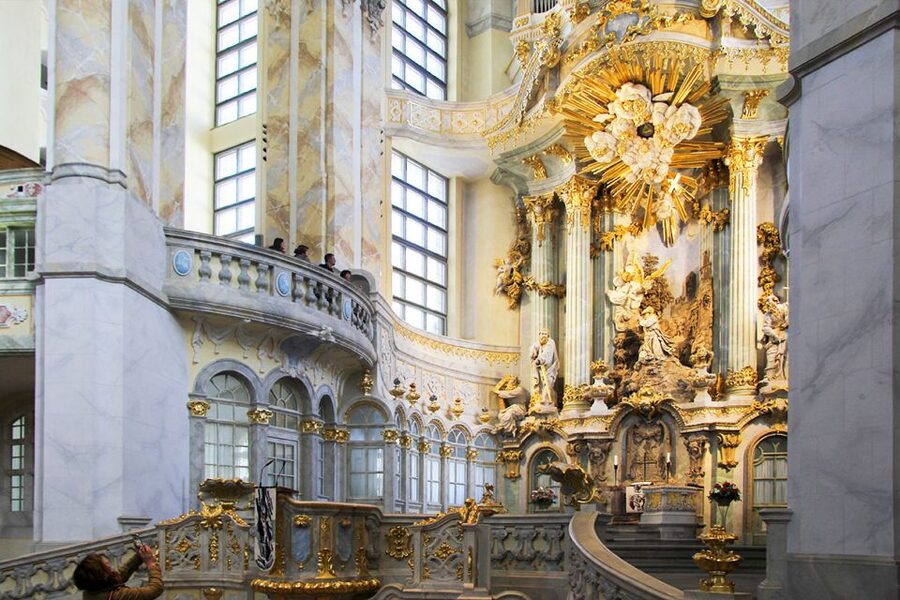
Once inside, the tour turns your attention to the Frauenkirche as a complete work of architecture. The ornate interior and large cupola are the immediate visual rewards, but the guide’s explanation helps you understand why the rebuilding was such a demanding task.
The restoration was based on George Bähr’s original plans from the 1720s. That detail matters. The church was not merely replaced by a modern copy. Its return was tied to the original design, so the rebuilt interior connects present-day Dresden with the building that existed before the war.
You can expect the guide to explain the church’s development in a clear sequence. The strongest point of the tour is its ability to make the timeline easy to follow. The available feedback repeatedly praises the explanations as detailed, informative, and easy to understand. One especially useful detail for parents is that the subject can hold children’s attention too.
That clarity makes this a good choice if you do not normally seek out church tours. You do not need to arrive with a background in Baroque architecture or German history. The guide provides the basic framework and points out why the church matters.
The interior also gives the story a physical setting. You are not hearing about the destruction and rebuilding in an abstract lecture. You are inside the restored structure, looking at the result of years of work.
The gallery view is the tour’s main extra
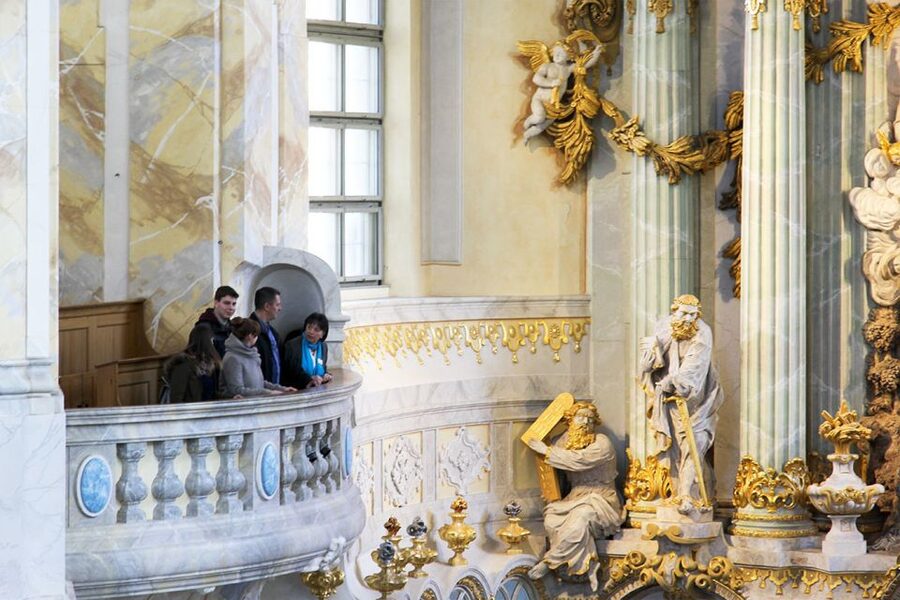
The gallery access is the part that separates this experience from a standard visit. You are given an exclusive view from the church’s galleries, offering a different sense of the interior and its scale.
The gallery is especially useful for understanding the relationship between the ornate interior and the cupola. From a higher position, you might find it easier to appreciate how the church is arranged vertically, rather than viewing it only from the floor.
The exact character of the view can depend on where the group is taken within the galleries, but the important point is that you receive access beyond the basic church visit. This is a practical reason to choose the guided tour instead of simply walking in for a brief look.
It also makes the one-hour length feel well judged. You have enough time to hear the story and see the church from an unusual position, without the visit becoming slow or repetitive.
If you are interested in photography, remember that the gallery view is part of a guided experience, not a promise of unlimited time or a private viewing. The tour is built around explanation and access, so follow the guide’s instructions inside the church.
A few more things to do in Dresden worth a look
- Dresden: Semperoper Tickets and Guided Tour
★ 4.7 · 12,102 reviews - Dresden: City & Semperoper Guided Walking Tour
★ 4.8 · 2,293 reviews - Dresden: City Sightseeing Tour with Live Guide
★ 4.6 · 1,730 reviews - Dresden: Guided City Walk with a Cup of Coffee
★ 4.7 · 1,568 reviews
Understanding destruction, ruins, and rebuilding
The most serious part of the tour is the period after World War II. The Frauenkirche was almost completely destroyed by bombing, and its ruins remained standing for decades.
That long period matters. The church was not immediately restored, and the ruins became part of Dresden’s postwar identity. The tour uses this history to show how the building came to represent more than religious architecture.
After reunification, the reconstruction campaign gathered momentum. The work took more than ten years and relied on Bähr’s original plans. The restored church was completed in 2005.
I appreciate that this part of the tour gives proper weight to the time between destruction and rebirth. A quick sightseeing stop can make reconstruction sound simple: bombed, rebuilt, finished. Here, the long delay and careful work help you understand why the project was ambitious.
The Frauenkirche also offers a way to think about Dresden’s progress as a whole. The church’s return is presented as part of the city’s recovery, not as an isolated building project. You leave with a better sense of how architecture can carry memory and renewal at the same time.
How clear is the tour for children and first-time visitors?
The strongest practical advantage is the clarity of the explanations. The guide describes the church’s historical development in a way that is easy to follow, and the positive feedback specifically notes that children listened with interest.
That does not mean the tour is a children’s program. It remains a history and architecture tour, with religious and wartime subjects. Still, the one-hour format helps. Younger visitors are not asked to sit through a long lecture, and the gallery visit adds a physical change of viewpoint.
For adults, the straightforward presentation is useful because it keeps the story organized. You hear about the original construction, the wartime destruction, the decades as ruins, and the rebuilding after reunification.
If your group includes children, I would choose this over a longer specialist tour. If everyone in your party wants a highly technical architectural analysis, the available details do not promise that level of specialization. The attraction here is a clear, human story tied to a remarkable building.
Practical details that affect your choice
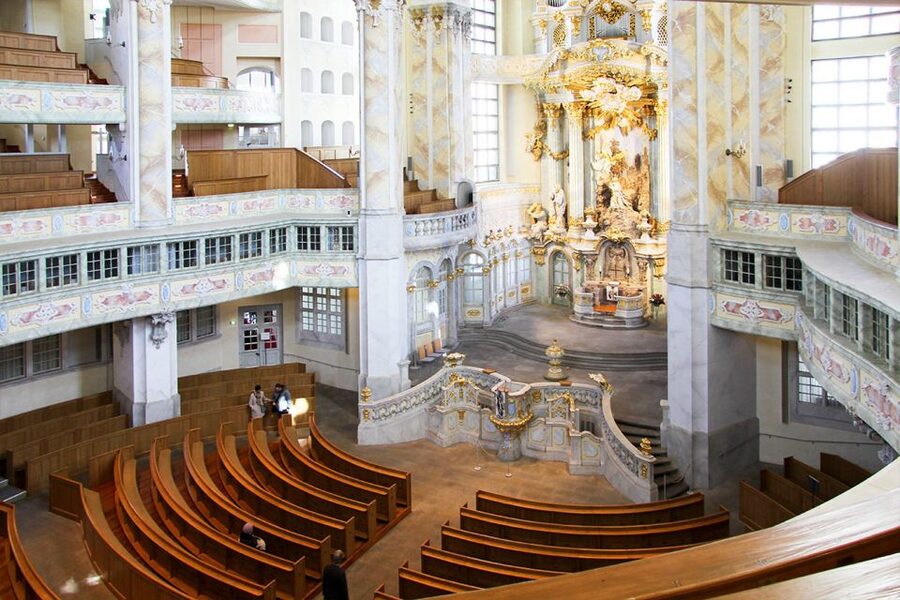
The tour includes priority entry to the Frauenkirche, the guided visit, and exclusive access to the galleries. Those inclusions matter because they combine convenience with a special viewpoint.
You can cancel up to 24 hours before the tour for a full refund. The reserve now and pay later option also lets you hold a place without paying at once, which is useful if your Dresden plans are still moving around.
Smoking and pets are not allowed. The experience is not suitable for wheelchair users, so accessibility should be considered before booking.
The tour is available in German and English, but English departures are limited. This is the most important booking detail for many international visitors. Select the correct language option rather than assuming that a German departure will switch languages for your group.
The experience provider is Dresden Information. No guide names are supplied, so I would not book this expecting a particular individual. The key choice is the language, time, and gallery access.
Who will get the most from this visit?
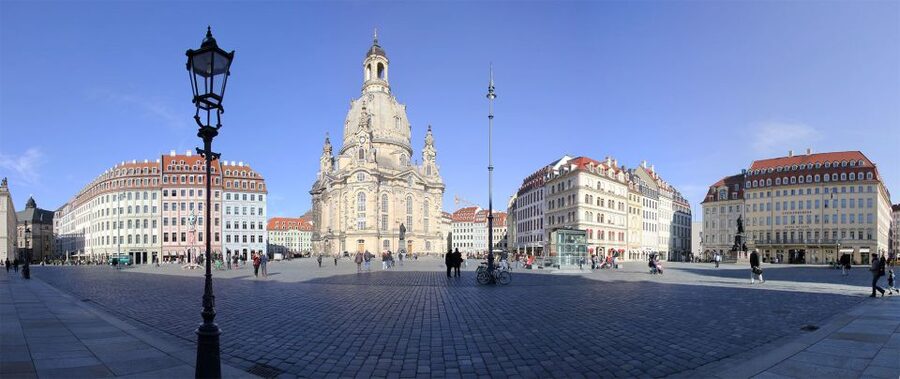
I would recommend the tour to you if you want three things in one compact stop: the Frauenkirche’s architecture, its wartime story, and a view from the galleries.
It is particularly well suited to:
- First-time visitors who want context before exploring Dresden on their own
- Families looking for a short tour with clear explanations
- History-minded visitors interested in destruction, memory, and reconstruction
- Architecture fans who want to connect the modern building with Bähr’s original plans
- Anyone who values priority entry and a special interior viewpoint
You may want to skip it if you prefer to visit churches silently and independently. It may also be a poor fit if wheelchair access is essential or if your schedule cannot accommodate one of the limited English departures.
The 4.7 rating from 2,421 reviews supports the idea that the tour delivers a clear and satisfying introduction. The most consistent praise centers on detailed explanations, understandable storytelling, and the ability to keep children interested. Those are meaningful strengths, especially for a tour built around a complicated historical timeline.
Should you book the Frauenkirche gallery tour?
Book it if you want the Frauenkirche explained, not merely photographed. The $15 price is fair for a one-hour guided visit that includes priority entry and gallery access, and the rebuilding story gives the church emotional weight beyond its ornate interior.
Choose an English departure carefully, arrive at Door C, and confirm that the accessibility limits work for you. If those details fit your plans, this is a compact, worthwhile way to understand one of Dresden’s most important buildings and see its restored interior from a less usual viewpoint.
FAQ
How long does the Frauenkirche gallery tour last?
The tour lasts one hour.
How much does the tour cost?
The listed price is $15 per person.
Where is the meeting point?
Meet your guide at Door C of the Church of Our Lady, also called the Frauenkirche.
Is the tour available in English?
Yes. The tour is offered in German and English, but English availability is limited. Select the correct language option when booking.
What is included in the tour?
The tour includes priority entry to the Frauenkirche, a guided tour of the church, and exclusive access to views from the galleries.
Can I cancel for a refund?
Yes. You can cancel up to 24 hours in advance for a full refund.
Is the tour suitable for wheelchair users or pets?
The tour is not suitable for wheelchair users. Pets are not allowed, and smoking is not allowed.
Just added in Dresden
- Bastei Bridge & Gorge Boat Ride – Day Trip from Dresden★ 5.0 · 8 reviews
- Dresden Sightseeing Treasure Hunt★ 5.0 · 57 reviews
- Big city tour hop on hop off 22 stops★ 3.5 · 100 reviews
- Dresden: Zwinger Skip-the-Line & 2-Day Hop-On Hop-Off Bus★ 4.5 · 160 reviews
- Bad Schandau: Scavenger Hunt through Saxon Switzerland★ 4.4 · 36 reviews
- Dresden: Old Town Self-Guided Scavenger Hunt Tour★ 4.5 · 151 reviews
- Dresden: Old Town Scavenger Hunt for Children★ 4.6 · 117 reviews
- Dresden: Taste of Dresden Food Walk★ 4.6 · 348 reviews
Museums, compared.
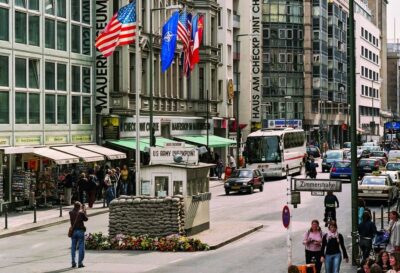
Skip-the-Line: Berlin Wall Museum at Checkpoint Charlie
Read our review →

Browse the lists this tour appears in