
Reviewed · HARBOUR & ELBE CRUISES
Hamburg: Private – Town Hall, Speicherstadt, Elbphilharmonie
Hamburg’s story comes together nicely on this private walk: grand civic power at the Town Hall, wartime loss at St. Nikolai, merchant wealth along Deichstrasse, brick warehouses in Speicherstadt, and bold modern design at the Elbphilharmonie. I like the clear change across centuries and the fact that one guide connects the sights instead of leaving you to piece them together.
I also like the private format for families and small groups, especially when you want questions answered at your pace. Guide Jutta receives particular praise for humor, historical photos, and explaining everything well in English. The main drawback is time: two hours is enough for orientation and exterior highlights, but not for a slow museum visit, a concert, or a detailed exploration of every district.
Key points at a glance
- Hamburg Town Hall begins the story with grand neo-Renaissance architecture and a look at the city’s civic traditions.
- St. Nikolai Memorial gives the walk emotional weight, preserving the ruins of a church destroyed during World War II.
- Deichstrasse offers some of the city’s oldest surviving merchant houses, with 17th-century character along the Nicolaifleet.
- Speicherstadt brings Hamburg’s trading past to life in a UNESCO World Heritage warehouse district built from red brick.
- HafenCity and the Elbphilharmonie show modern Hamburg, with ambitious planning and striking contemporary architecture.
- A private group of up to 15 makes the price reasonable for a full party, but expensive for only one or two people.
From Town Hall power to the Elbphilharmonie skyline
This tour works because Hamburg’s major sights form a compact historical route. You start at the city’s political center and finish at its modern musical landmark, with the old port and warehouse district in between.
The route is mainly a walking introduction rather than a series of long interior visits. You stop, listen, look around, and move on. That rhythm suits a first visit, a cruise stop, or a short stay when you want the city’s main story without giving up half a day.
The tour is private, with a maximum group size of 15. That matters more than it may sound. You can ask why a building looks the way it does, pause for a photograph, or ask for a clearer explanation without competing with a large crowd.
The tour has a rating of 4.8 from 27 reviews, and the strongest praise centers on the guides. Jutta is singled out for warm, humorous storytelling and for using photographs that show how Hamburg changed over time. One German-language booking also notes that she explained everything very well to English-speaking participants.
Other time on the water in Hamburg:
- Hamburg: 1.5-Hour Harbor and Speicherstadt Day Cruise
★ 4.6 · 14,200 reviews - Hamburg: 90-Minute Evening Lights Harbor Cruise
★ 4.5 · 7,728 reviews - Hamburg: Elbphilharmonie Plaza Guided Tour
★ 4.7 · 5,882 reviews
Hamburg Town Hall and the city’s proud front door
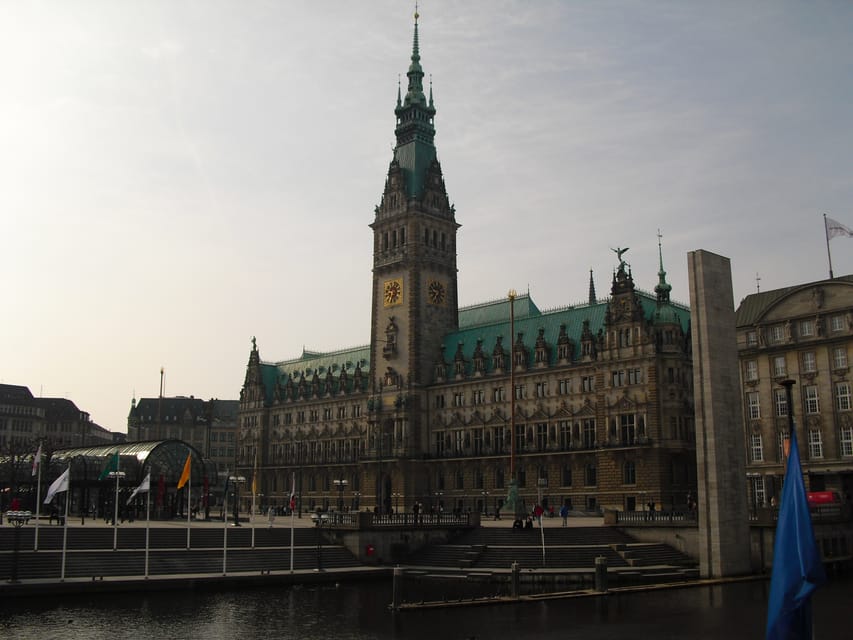
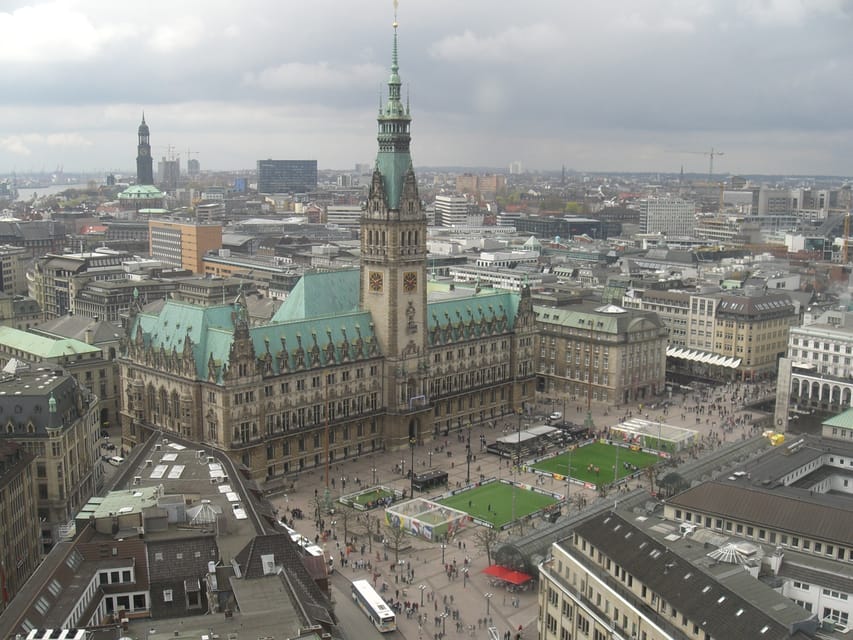
Begin in front of Hamburg Town Hall, known locally as the Rathaus. This neo-Renaissance building presents the city in grand style, and it is an effective starting point because its decoration reflects Hamburg’s former wealth and civic confidence.
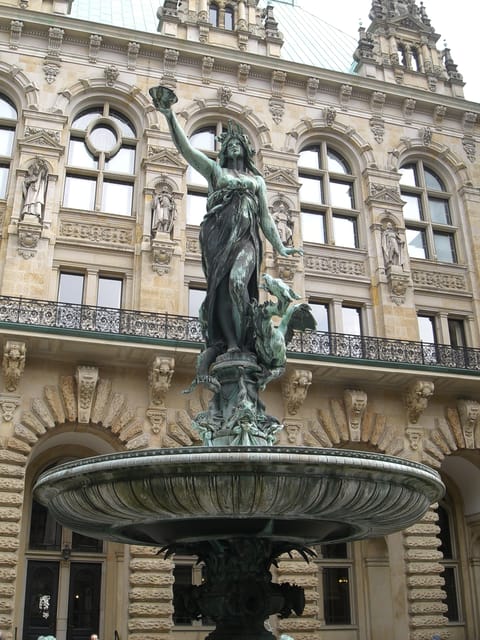
Inside the grand entrance hall, the guide explains customs connected with Hamburg’s government. You also see a fountain decorated with mythical figures, each offering a small story to attach to the architecture.
I like this opening because it gives you more than a quick photo stop. The building becomes a way to understand Hamburg as a powerful trading city with its own political identity. Look closely at the scale and detail, but keep your expectations realistic. The scheduled visit is about 15 minutes, so this is an introduction rather than a full architectural study.
The guide’s role is important here. A large historic building can blur into a collection of columns, statues, and ornate ceilings. A good explanation gives those details a purpose. Jutta’s use of old photographs is especially useful for showing how Hamburg’s public spaces and buildings changed over time.
The Chamber of Commerce and the old stock exchange
Across from the Town Hall is the former stock exchange, a building now used by the Hamburg Chamber of Commerce. The two buildings face one another, linking government and commerce in a small but telling urban arrangement.
The stop lasts about 10 minutes. You get a photo opportunity, a guided explanation, and a chance to see how the city’s business life once operated alongside its civic institutions.
This is not a stock-market tour, and no separate museum visit is included. Still, the stop helps explain why Hamburg’s center has such a formal scale. Its public buildings were built to project stability, trade, and independence.
If you enjoy economic or urban history, this may be one of the more useful short stops. If you mainly want old streets and dramatic views, it will feel more like connective history between the Town Hall and the waterfront.
Trostbrücke and Hamburg’s first port area
A short walk brings you to Trostbrücke, where the route reaches Nicolaifleet. This waterway marks the area of Hamburg’s first port, dating to the 12th century.
That date changes how you see the modern city. Hamburg’s port is not only the large industrial waterfront farther downriver. Its earliest commercial life began in these narrower channels, close to the old center.
The stop is brief, about five minutes, but it helps you read the city’s layout. Water shaped Hamburg’s growth, and the older canals and bridges reveal how closely trade once sat beside homes, churches, and civic buildings.
You should not expect a long waterfront walk here. Think of Trostbrücke as a compact history lesson and a transition to the more powerful wartime memorial nearby.
A few more things to do in Hamburg worth a look
- Your private 3-hour Hamburg driving tour with a former policeman
★ 5.0 · 304 reviews - Alternative Hamburg / Street Art Private Tour
★ 4.7 · 8 reviews - Berlin: Private Reichstag and Glass Dome Tour
★ 4.8 · 2,226 reviews - Berlin Private Complete History All Day Walking Tour
★ 5.0 · 474 reviews
St. Nikolai Memorial and the cost of war
The ruins of St. Nikolai Church are among the most serious places on the route. The church was destroyed during World War II, and what remains now serves as a memorial to the effects of the war on Hamburg and Western Europe.
The stop lasts around 10 minutes. That is enough to take in the ruined structure and hear the guide explain its place in the city’s story, but it is not a full memorial-center visit.
This stop adds needed balance to the tour. Hamburg’s grand buildings and trading wealth can make the city’s past seem polished. St. Nikolai interrupts that impression. The broken church makes destruction visible, and the contrast with the nearby Town Hall is striking.
I recommend giving this part your full attention. It is not simply another attractive photo background. The ruined church carries a solemn mood, and the guide’s historical context helps you understand why it was preserved rather than rebuilt in the usual way.
Deichstrasse and the merchant houses that survived
From St. Nikolai, the route continues to Deichstrasse, one of the most atmospheric sections of the walk. The protected merchant houses date from the 17th century and preserve a sense of Hamburg before modern redevelopment reshaped the waterfront.
The street is especially valuable because it shows how business and domestic life once occupied the same buildings. These were not grand government monuments. They were practical merchant residences tied to the canals, trade, and daily work of the city.
A floating bridge offers a view toward Nicolaifleet, although the water may be less visible at low tide. That detail matters if you are hoping for a perfect canal photograph. Tides change the scene, so the waterfront view is not identical at every hour.
You may also find places along Deichstrasse for a meal, ice cream, or whiskey tasting. These are opportunities rather than included parts of the tour, and the two-hour schedule may not allow time to stop. Still, the street gives you a useful place to return after the walk if you want to explore at a slower pace.
This is one of my favorite parts of the route because the architecture feels connected to ordinary city life. You are not only looking at a landmark. You are seeing the type of street where Hamburg’s merchants lived and worked.
Speicherstadt’s red-brick warehouses
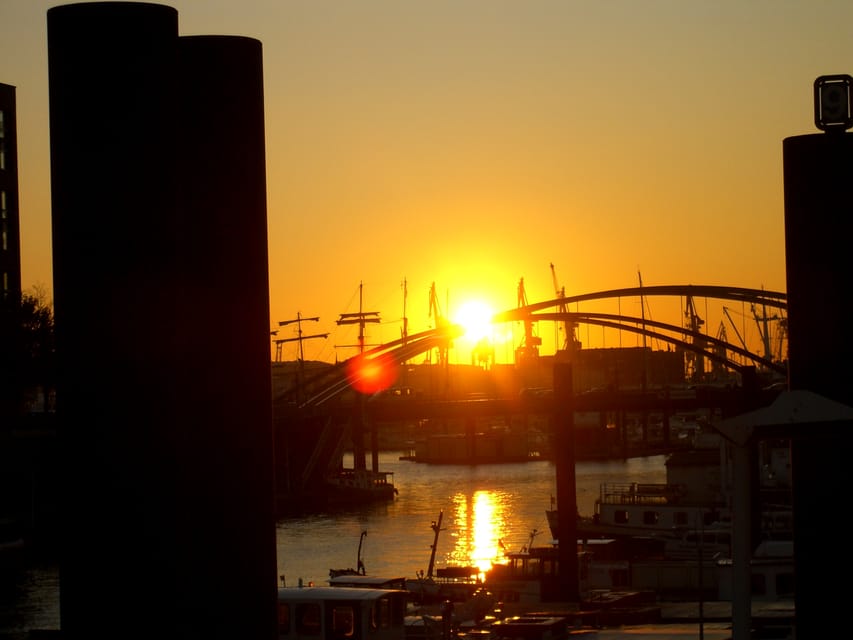
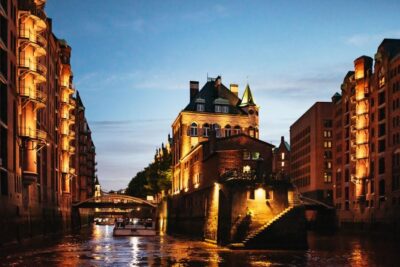
The route then moves into Speicherstadt, Hamburg’s 19th-century warehouse district and a UNESCO World Heritage site. Red-brick warehouses line the waterways, creating one of the city’s most recognizable views.
These buildings once stored goods brought in on flat-bottomed boats. The canals were not decorative features added for atmosphere. They were part of the working system that moved cargo through the district.
The guided portion here lasts about 10 minutes, so expect a focused introduction rather than a complete tour of the warehouse quarter. You may visit a coffee roastery, which adds a sensory connection to the goods once handled in Hamburg’s trading network. The wording is important: this visit may be possible, but it is not presented as a guaranteed tasting or extended stop.
Speicherstadt is a strong place for photographs, especially if you like the contrast between water, brick, ironwork, and narrow vertical windows. It can also be busy, and the short schedule means you will not have much time to wander down every canal.
The guide’s historical framing makes the district more meaningful. Without context, you might see only handsome warehouses. With context, you can understand how the buildings reflect Hamburg’s role as a major trading port.
HafenCity and the city’s next chapter
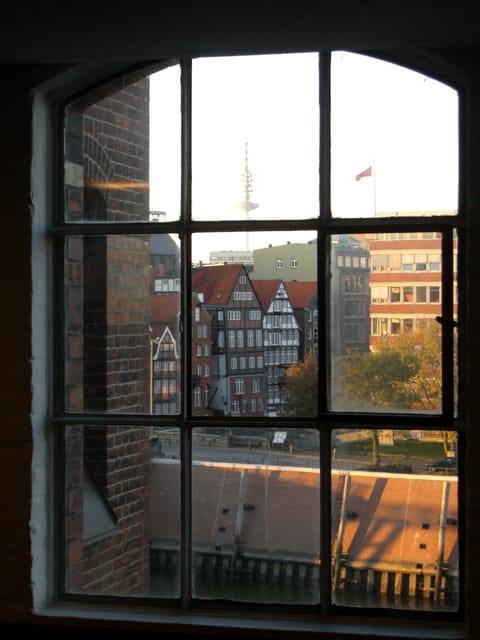
After the older warehouse district, the route moves into HafenCity, described as a major European city-planning project. This is where the tour shifts from historic preservation to current urban design.
You will see newer buildings and public spaces beside the old warehouses. That contrast is the point. HafenCity shows how Hamburg is adding homes, offices, cultural buildings, and public areas around former port land while keeping its older waterfront identity nearby.
The scheduled stop is about 10 minutes. You will hear about the planning ideas and see the change in architectural style, but you will not get a full neighborhood tour.
I find this transition useful because it stops the city from becoming a museum piece. Hamburg is still changing. The route lets you compare 17th-century merchant houses, 19th-century warehouses, and 21st-century planning within a fairly short walk.
Elbphilharmonie, the dramatic finish
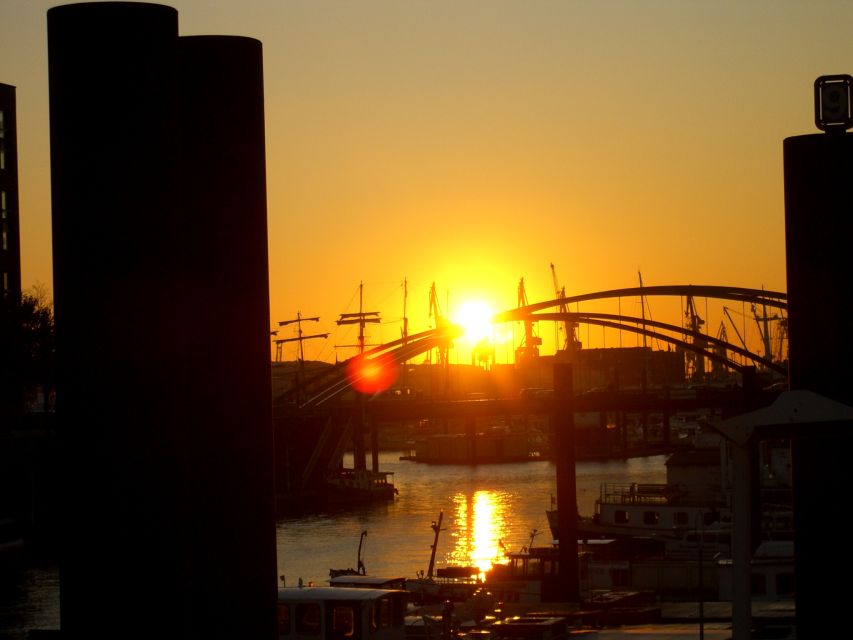
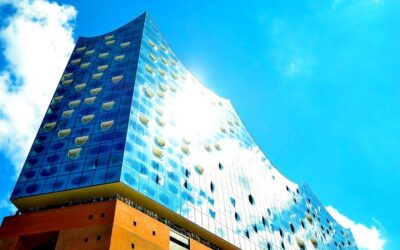
The final stop is the Elbphilharmonie, Hamburg’s concert hall, opened in 2017. Its architecture gives the tour a strong finish, particularly after the lower brick buildings and historic canals earlier in the route.
The building is known for its striking modern form and its concerts by leading musicians. On this tour, you receive a guided introduction and a photo stop lasting about 15 minutes. A concert ticket is not included, and the experience does not promise a performance or a full concert-hall visit.
That distinction is important. If you want to hear music inside the hall, you need a separate concert plan. This tour is about the building, its place in HafenCity, and the way it represents Hamburg today.
The Elbphilharmonie is also the drop-off point, at Platz der Deutschen Einheit 1. That makes the ending practical. You can continue exploring HafenCity, arrange your next activity nearby, or simply stop for photographs before moving on.
What the two-hour format really gives you
The listed stops add up to a series of short visits, while the full experience lasts two hours. The extra time allows for walking between locations, explanations, photographs, and the natural pauses that come with a private group.
You should expect a steady pace. This is a city orientation walk, not a slow architectural sketching tour. Comfortable walking shoes make sense, and you should allow for changing conditions around the canals and waterfront.
Transportation to the meeting point is not included. The usual starting point is in front of Hamburg Town Hall, although the meeting location can vary by booking option. Check your exact start point before setting out.
The tour is offered in English, German, Spanish, and French. If your group includes different language needs, confirm the chosen language when booking so the guide can plan accordingly.
Is $294 good value for a private group?
The price is $294 for a group of up to 15 people. At the full maximum, that works out to about $19.60 per person, which is a fair price for a private two-hour introduction led by a live guide.
The calculation changes sharply for smaller parties. Two people would be paying $147 each, and four people would pay $73.50 each. That makes this option much more attractive for a family, wedding group, reunion, or other party that can share the fixed cost.
You are paying for the guide’s time, flexibility, and route design rather than admission to a collection of attractions. No transportation, concert, meal, whiskey tasting, or guaranteed coffee-roastery visit is included.
I would choose it when the group wants one coherent explanation of central Hamburg and values a private pace. If you are alone or traveling as a couple on a tight budget, a standard group walk may offer better value, if available. The private price makes more sense when you can divide it among several people.
Who should book this Hamburg walk?
I would recommend it for first-time visitors who want to understand how Hamburg’s center connects to its port. It also suits families, since a private guide can adjust explanations and answer questions without holding up a large group.
It is a good match for anyone interested in architecture, urban planning, trade, or 20th-century history. You get civic architecture, merchant houses, warehouses, memorial ruins, and modern design in one compact route.
It is less suitable if you want extended time inside the Town Hall, a museum visit, a concert at the Elbphilharmonie, or a long stop for food and drinks. The experience gives you a broad view, not deep time at each site.
Jutta is a particularly appealing choice if available for your language and date. Her style combines humor, historical photographs, and flexible explanations, based on the strong feedback attached to her tours. That can make a difference on a route with several short stops.
Should you book it?
Book this tour if you want a private, efficient introduction to Hamburg that moves from the Rathaus through wartime memory and port history to the Elbphilharmonie. Its best feature is the sequence: each stop explains a different stage in the city’s development.
Think twice if your group is very small and the $294 price feels high, or if you want interior access and long visits rather than exterior orientation. For a full group of up to 15, the cost is reasonable. For a couple, it is a premium choice, justified mainly by privacy and the guide’s personal attention.
FAQ
Where does the tour start?
The usual starting point is Hamburger Rathaus, or Hamburg Town Hall. The exact meeting point may vary depending on the option booked.
Where does the tour finish?
The tour finishes at the Elbphilharmonie in Hamburg, at Platz der Deutschen Einheit 1, 20457 Hamburg, Germany.
How long does the tour last?
The tour lasts two hours.
Is the tour private?
Yes. It is offered as a private group experience for up to 15 people.
What languages are available?
The tour is offered in German, English, Spanish, and French.
Is transportation included?
No. Transportation costs to the meeting point are not included.
Does the tour include a concert at the Elbphilharmonie?
No concert is included in the tour information. The Elbphilharmonie visit is a guided stop and photo opportunity.
Can I visit a coffee roastery in Speicherstadt?
You may visit a coffee roastery during the Speicherstadt portion, but the information does not promise this as a guaranteed or extended stop.
What sights are included?
The route includes Hamburg Town Hall, the Hamburg Chamber of Commerce and former stock exchange, Trostbrücke, St. Nikolai Memorial, Deichstrasse, Speicherstadt, HafenCity, and the Elbphilharmonie.
How much does the private tour cost?
The price is $294 for a group of up to 15 people. The professional guide and two-hour tour are included.
Just added in Hamburg
- Alternative Hamburg / Street Art Private Tour★ 4.7 · 8 reviews
- 3 Hours Hamburg E-Scooter Tour★ 4.3 · 9 reviews
- 3 Hours Hamburg Segway Tour★ 4.1 · 68 reviews
- 2 Hours Hamburg Segway Tour★ 4.5 · 164 reviews
- 2 Hours Hamburg E-scooter Tour★ 4.2 · 103 reviews
- 1-Day Hop-on/Hop-off Bus Tour of Hamburg Line D★ 4.0 · 256 reviews
- “After Work” – Sailing-Yacht Cruising Event, Hamburg/Elbe★ 5.0 · 5 reviews
- Hamburg: Scavenger Hunt Self-Guided Tour around the port★ 4.6 · 77 reviews
Harbour & Elbe Cruises, compared.
1.5-Hour Harbor and Speicherstadt Day Cruise
Read our review →
1-Hour Harbor Sightseeing Cruise with HafenCity
Read our review →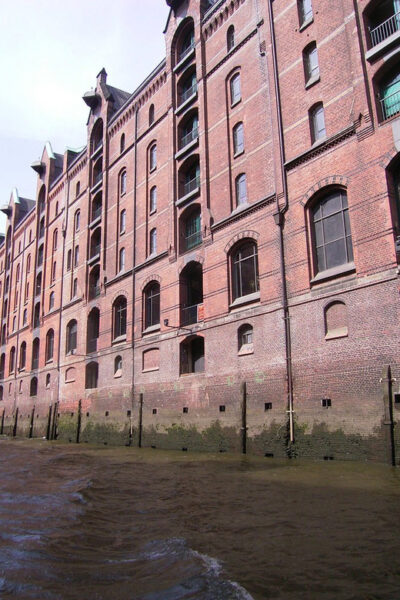
Elbphilharmonie Plaza, Highlights & Surroundings
Read our review →
Elbphilharmonie Plaza and HafenCity Food Tour
Read our review →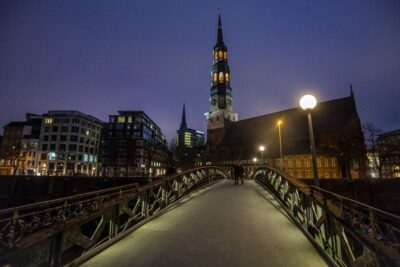
Browse the lists this tour appears in