
Reviewed · TOURS IN DUSSELDORF
Düsseldorf: E-Scooter City Tour
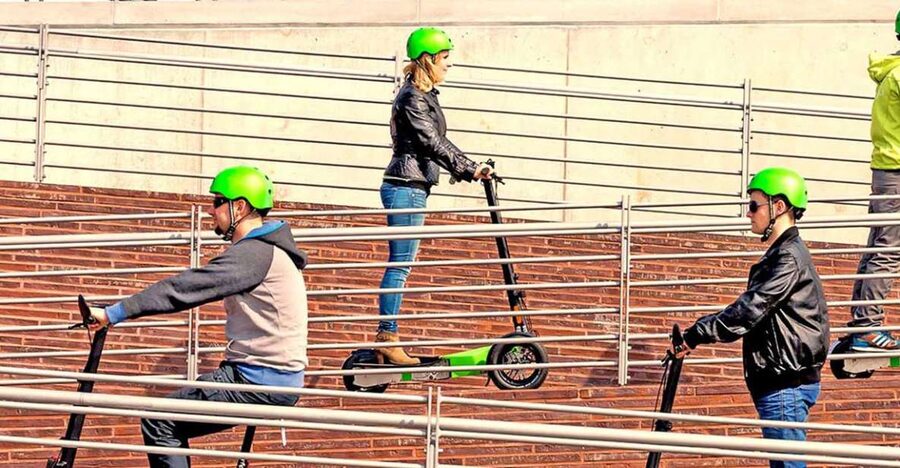
Düsseldorf looks especially good from a Scuddy, the unusual three-wheeled e-scooter used on this small-group city tour. You can ride seated or standing, glide beside the Rhine, and cover old-town sights, modern architecture, and shopping streets without wearing out your feet. I like the easy pace and the mix of Burgplatz, St. Lambertus, and Kö-Bogen II. I also like the small groups, capped at seven, which give the guide room to stop and talk. The tradeoff is clear: this is German-only, and the city commentary may feel light if you want a formal art or history tour.
- Ride beside the Rhine Tower and state parliament: The tour opens with broad river views and Düsseldorf landmarks.
- Use a sit-or-stand Scuddy: You get a playful way to move around while wearing the supplied helmet.
- See old and new Düsseldorf together: The route links Burgplatz and St. Lambertus with K20, Kö-Bogen II, and the Drei-Scheiben-Haus.
- Travel in a group of 2 to 7: The small size keeps the outing personal and easier to manage.
- Expect a relaxed German-speaking guide: Dieter has been praised for humor, regular stops, and local stories.
- Bring a valid driver’s license: You cannot join without one.
Starting at the Rhine Tower
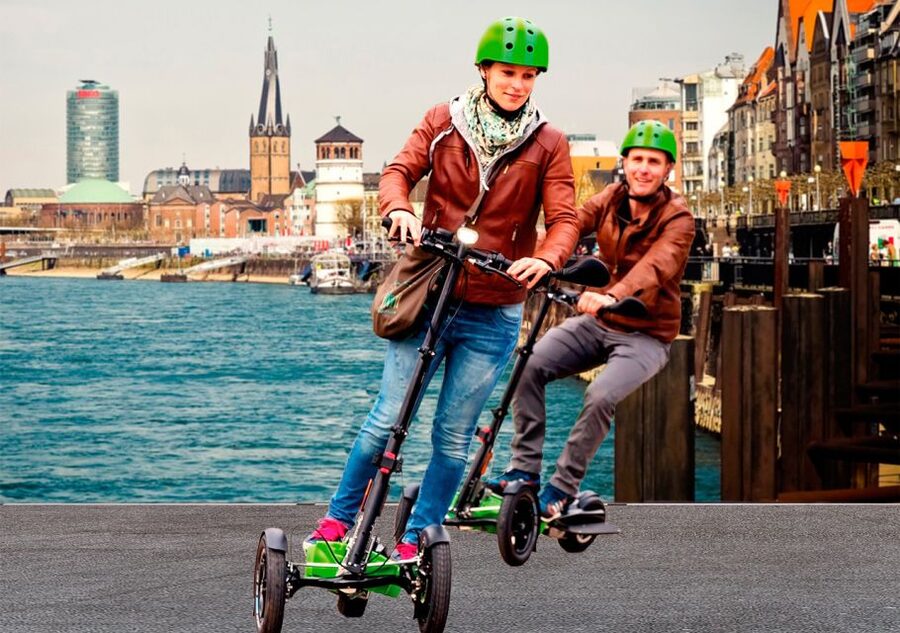
The meeting point is in the parking lot near the entrance barrier in front of the Rheinturm, or Rhine Tower. This is a useful place to begin. The tower is Düsseldorf’s tallest building, and it gives you an immediate sense of the city’s position beside the Rhine.
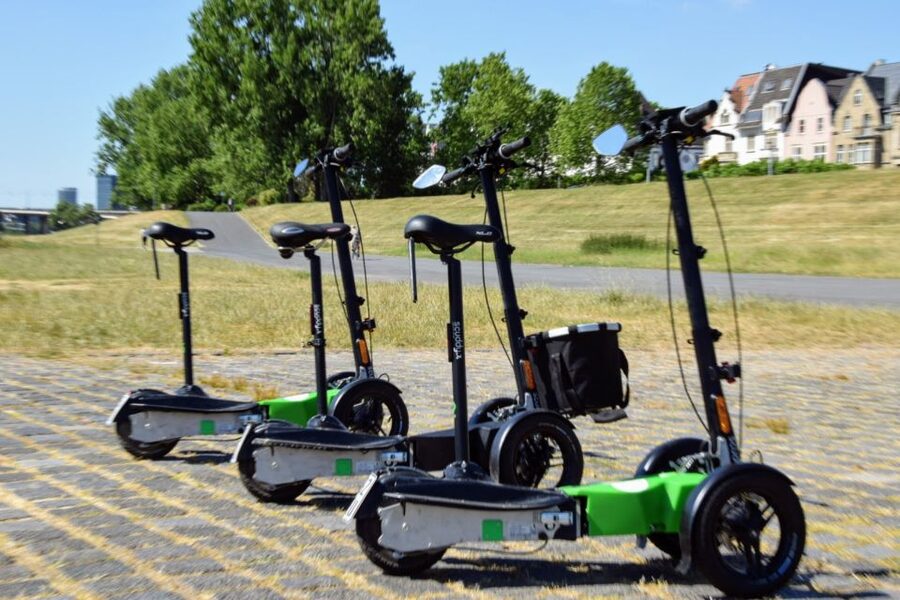
Before you set off, you receive your Scuddy and helmet. The main appeal of this vehicle is its flexibility. You can drive while sitting or standing, so you can change position during the two-hour ride. That matters on a city tour because you are not locked into one posture for the whole route.
The tour is designed for only two to seven people. I prefer this size for a vehicle-based outing. You are less likely to get lost in a large line, and the guide can pause without turning every stop into a long production. The small group also suits anyone who wants a social outing without the noise and delay of a large coach tour.
You do need a driver’s license. This is not an optional formality, so bring it with you. The provided equipment includes the Scuddy and helmet, but the supplied details do not specify any other protective gear.
Learning the Scuddy before the river ride
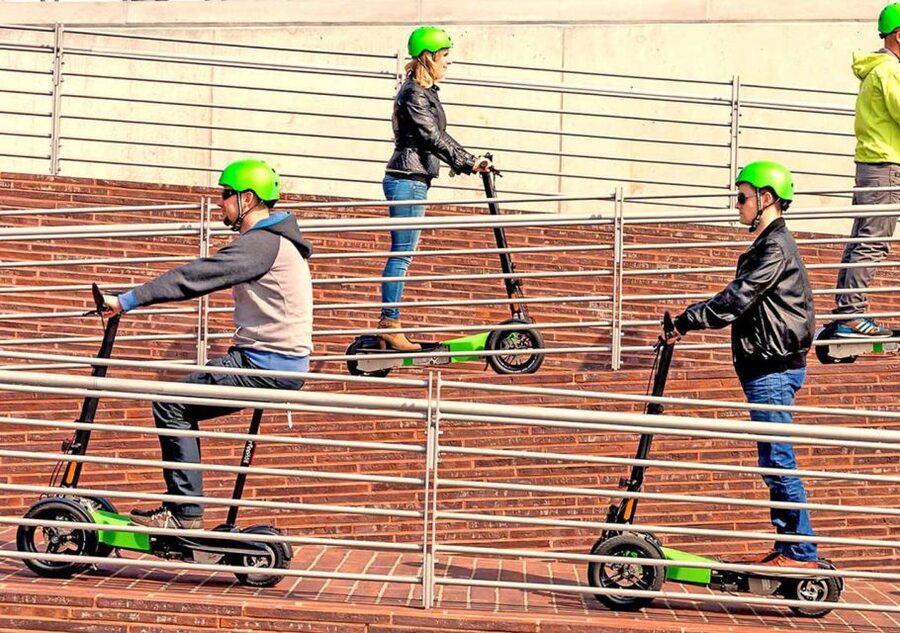
The opening ride gives you time to get comfortable with the vehicle. The route begins near the Rhine Tower, with the state parliament building and the Rheinknie Bridge nearby. The bridge makes a striking first view, while the parliament building gives the setting a clear political landmark.
The Scuddy is described as easy to handle, but you still need to pay attention as you learn its controls and balance. A sitting position may suit you if you want a steadier, more relaxed ride. Standing gives you a clearer view and may feel more active. The choice lets you adjust to your own comfort instead of treating the vehicle like a one-position rental scooter.
The guide’s tone is part of the experience. This is not meant to be a formal art-history lesson. It is a relaxed city ride with local color, humor, and short explanations. Dieter has received particular praise for keeping the outing loose, stopping often, and adding jokes along the way. He may not be your guide on every departure, but that gives you a useful picture of the intended style.
If you want dates, architectural analysis, and carefully sourced historical detail at every stop, you may find the commentary too thin. One participant specifically felt the city information was sparse and that some facts were not sufficiently verified. I would treat this tour as a lively orientation to Düsseldorf, not as a scholarly city seminar.
Other scooters to hire in Dusseldorf:
- 2 Hours Hamburg E-scooter Tour
★ 4.2 · 103 reviews - Cologne: Guided E-Scooter Tour
★ 4.7 · 90 reviews - Berlin: Thrilling E-Scooter Adventure Tour
★ 4.4 · 66 reviews
Riding past Burgplatz and the castle tower
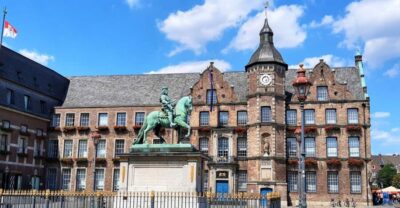
The first major part of the route follows the Rhine and crosses Burgplatz. This broad square is one of the city’s key public spaces, with the castle tower providing a visible reminder of Düsseldorf’s older center.
Burgplatz works well early in the tour because it shows how the city faces the river. You can pause, take in the open space, and hear the guide explain the setting before moving toward the old town. The Scuddy also gives you a better chance to cover nearby sights than walking alone, especially if you want a quick first look at several districts.
The tour stays close to the Rhine on the way toward the Oberkassel Bridge. This keeps the first stretch open and scenic rather than sending you immediately into narrow city streets. You will see the river from several angles, with the bridge and central Düsseldorf providing a changing backdrop.
The route is not presented as a long stop-and-study program. It is a moving tour, with regular pauses for explanation. That balance will suit you if you like to keep going. It may frustrate you if your priority is extended time at each monument.
St. Lambertus and the old town
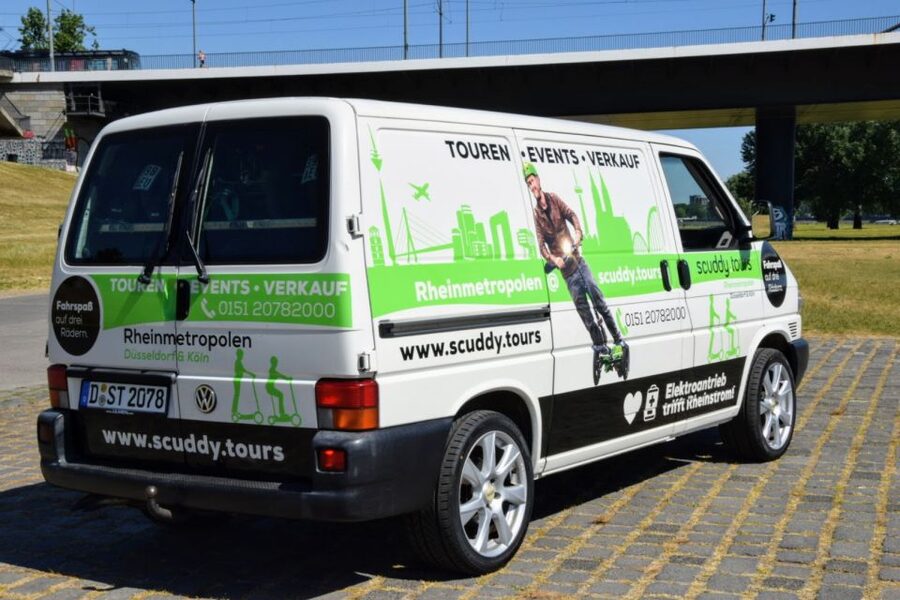
The ride continues toward St. Lambertus Church, one of Düsseldorf’s most recognizable old-town landmarks. Its leaning tower is the detail to watch for. The tilt gives the church an instantly memorable profile and adds character to the route.
This is one of the strongest points for visitors who want to see Düsseldorf’s older side without spending a full day on foot. You get the church, the riverfront, Burgplatz, and the surrounding center in one compact outing. The guide can provide context at the stop, but the amount of detail depends on the person leading your departure and the flow of the group.
The old town is often associated with restaurants, bars, and busy pedestrian streets, but this ride focuses on selected sights rather than trying to cover every corner. That keeps the two-hour schedule realistic. You should not expect a complete tour of every old-town lane or museum.
Andreas Quartier, where old center meets new life
From St. Lambertus, the route heads to Andreas Quartier. This district brings together housing, art, culture, and food in a renovated part of the center. It is a useful contrast to the church and castle tower because it shows how Düsseldorf has reshaped older urban spaces for present-day use.
I like this stop for the way it broadens the idea of Düsseldorf. The city is not only a riverfront old town or a shopping destination. It also has quarters where daily life, galleries, restaurants, and design share the same setting.
The stop is best understood as a quick look rather than a long cultural visit. The tour does not include admission to museums or exhibitions. You are seeing the district from the outside while the guide explains its role in the city.
A few more things to do in Dusseldorf worth a look
- Düsseldorf: City Sightseeing Cruise on the Rhine
★ 4.1 · 2,954 reviews - Düsseldorf: Classic City Segway Tour
★ 4.8 · 132 reviews - Düsseldorf: Guided City Architecture Walking Tour
★ 4.6 · 61 reviews - Berlin: 1-Hour City Tour by Boat with Guaranteed Seating
★ 4.3 · 16,993 reviews
K20, Hofgarten, and the green wall at Kö-Bogen II
The route then passes the K20 art collection and moves through the Hofgarten. K20 is one of the city’s major art references, while the Hofgarten gives the ride a quieter change of pace after the denser central streets.
The tour does not offer an art-historical program, so do not book it expecting a detailed introduction to the K20 collection. You will see the building and its place in the city route, but the focus remains on movement and orientation. If you want to visit the art collection inside, plan that separately.
The next highlight is Kö-Bogen II, known for what is currently described as Europe’s largest green façade. This is one of the most unusual modern sights on the route. Instead of presenting Düsseldorf only through historic buildings, the tour shows how recent architecture has changed the central shopping district.
Kö-Bogen II is especially worthwhile for anyone interested in urban design, sustainability features, or contemporary Düsseldorf. The green façade gives you a memorable visual stop, even if you have little interest in formal architecture. The guide’s explanation can add meaning, but the tour does not promise technical details about the building or its planting system.
Schauspielhaus and the Drei-Scheiben-Haus
After Kö-Bogen II, the Scuddys make a detour to the Schauspielhaus, Düsseldorf’s major theater building. This adds another cultural marker to the route and helps connect the shopping area with the city’s performing arts scene.
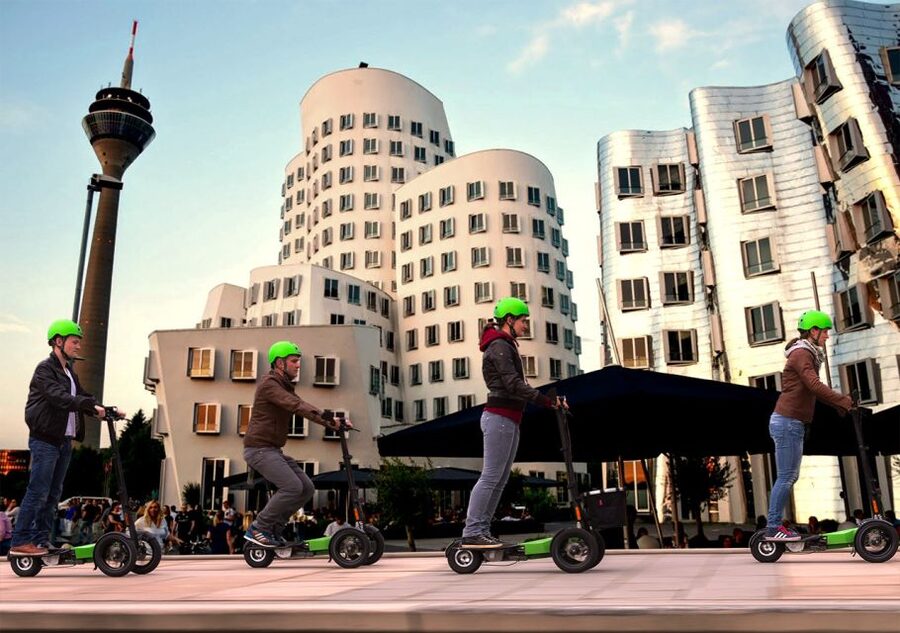
The ride then reaches the Drei-Scheiben-Haus, an impressive 1960s example of modern architecture. Its name refers to its three-part, blade-like form. It is a good counterpoint to St. Lambertus: one is an old church with a leaning tower, the other is a sharp mid-century office design.
This pairing is one of the tour’s best ideas. In a short time, you move from medieval-looking streets and riverfront landmarks to postwar architecture and a large green building. I find that more useful than a route that only checks off famous old buildings. You get a sense of how Düsseldorf has changed over time.
Still, the presentation remains informal. You may hear a few practical facts and local observations, but the tour is not built around a full architectural lecture. If design is your main reason for booking, consider this a good introduction rather than a specialist tour.
Returning along Schadowstraße and the Rhine promenade
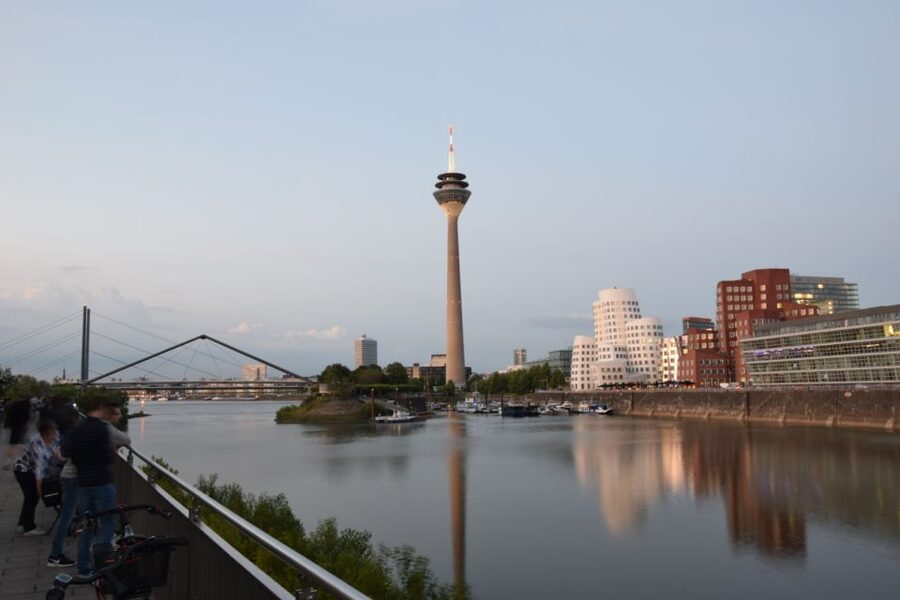
The final section moves slowly through Schadowstraße, a major pedestrian shopping area. This is a calmer return leg, giving you another view of central Düsseldorf after the sights and bridges earlier in the route.
Schadowstraße helps show the city as a place for everyday shopping and city life, not only monuments. The route then returns to the Rhine promenade at a relaxed pace and heads back to the Rhine Tower.
The return matters because it avoids ending abruptly after the modern architecture stops. You get time to settle into the Scuddy again, enjoy the central streets, and finish where you began. At two hours, the schedule is long enough to feel like a proper city outing but short enough to fit around a museum visit, meal, or evening plan.
What the two-hour format really gives you
Two hours is a good length for this route. Düsseldorf’s center has enough sights to fill a full day, but the Scuddy lets you sample several areas without committing half a day to transport. You will see the Rhine, old town, civic buildings, art-related sites, parks, shopping streets, and modern architecture.
The pace is not a race. The route includes regular stops, and the return portion is described as relaxed. Even so, you should not expect long visits inside buildings. The focus is on seeing the city from the outside and getting a friendly explanation as you go.
The small group improves the value of those two hours. At a maximum of seven people, the guide can keep the group together and respond to questions more easily than on a large tour. The minimum group size is two, so a departure may be very intimate.
The language is the biggest practical limit. The guide speaks German, and the tour is offered only in German. If you do not understand German, you will miss much of the experience even if you enjoy the ride itself. I would choose this only if you can follow spoken German comfortably or are joining someone who can help interpret.
Is $69 a fair price?
At $69 per person, this is not the cheapest way to see central Düsseldorf. You are paying for the vehicle, helmet, guide, and a small group rather than simply renting a scooter and following your own map.
The price makes more sense if you value the route and the ease of covering several districts in two hours. The Scuddy is the special feature, and the sitting or standing option adds comfort that a standard walking tour cannot offer. You also avoid planning the route yourself and get local stories along the way.
The value is weaker if you mainly want detailed history. A self-guided walk through the old town costs less, and a museum visit may offer more depth in one subject. The tour’s strongest value is its combination of transport, views, modern design, and informal local character.
A highly rated transport experience, with 86 percent of participants giving it a perfect score, supports the idea that the vehicle itself is a major reason to book. The overall score is 4.5 from 70 ratings, which suggests a strong experience with some limits around commentary. I would pay the price for the Scuddy ride and compact route, not solely for the historical information.
Free cancellation up to 24 hours before the start and the option to reserve now and pay later reduce the risk if your schedule is still changing. Check the available starting times before you commit, since the tour lasts two hours.
Who should book this Düsseldorf Scuddy tour?
I would recommend it to you if you enjoy trying unusual local transport, want a quick city orientation, and can follow German. It is also a good fit for couples, friends, or a small family group who prefer a moving experience to a long walking tour.
The tour suits first-time visitors who want to identify places to revisit later. You can note the Rhine promenade, K20, Andreas Quartier, Schadowstraße, or the old town and return on foot afterward.
I would be more cautious if you need an English-language guide, have no driver’s license, or want a detailed account of Düsseldorf’s art and history. The city information can be limited, and one participant found some of it insufficiently checked. That is a fair warning, not a deal-breaker, as long as you book for the relaxed ride and broad city view.
My take on the booking decision
Book this tour if the idea of seeing Düsseldorf from a Scuddy sounds more appealing than walking from landmark to landmark. The route is well chosen, the group is small, and the mix of Rhine views, old-town sights, green architecture, and 1960s design gives you a lively two-hour introduction.
Skip it if German is not useful to you or if your main goal is expert art history. For the right audience, this is a cheerful and practical way to get oriented, with enough unusual transport and local humor to make the city memorable.
FAQ
How long is the Düsseldorf E-Scooter City Tour?
The tour lasts two hours.
What does the tour cost?
The price is $69 per person.
Where does the tour meet?
Your guide waits in the parking lot near the entrance barrier, in front of the Rheinturm, or Rhine Tower.
Is a driver’s license required?
Yes. You must bring a driver’s license to join the tour.
What language is the tour offered in?
The tour is offered only in German, with a live German-speaking guide.
How many people are in each group?
Groups range from two to seven people.
Is a helmet included?
Yes. The e-scooter and helmet are included.
Can I ride sitting down?
Yes. The Scuddy can be ridden in a sitting or standing position.
What sights does the route include?
The route includes the Rhine Tower, state parliament building, Rheinknie Bridge, Rhine, Burgplatz, castle tower, Oberkassel Bridge, St. Lambertus Church, Andreas Quartier, K20, Hofgarten, Kö-Bogen II, Schauspielhaus, Drei-Scheiben-Haus, Schadowstraße, and the Rhine promenade.
Can I cancel for a full refund?
Yes. You can cancel up to 24 hours in advance for a full refund.
Just added in Dusseldorf
- (H)Alt! 4 Bier! Brauhaus! Führung!★ 4.3 · 27 reviews
- Filmtour Düsseldorf: From Hollywood to Netflix★ 4.9 · 4 reviews
- Explore Düsseldorf with Passionate tour guides!★ 4.0 · 69 reviews
- DüsseldorfCard Plus★ 4.1 · 14 reviews
- Düsseldorf: Private pub crawl with insider-guide & shots★ 4.1 · 18 reviews
- Düsseldorf: The Wehrhahn Line Metro Guided Tour★ 4.5 · 29 reviews
- Düsseldorf: The Ultimate Team event (3 rooms – 9 games)★ 3.4 · 5 reviews
- Düsseldorf: Old Town Interactive Crime Tour with actor★ 4.9 · 22 reviews
Tours in Dusseldorf, compared.


Browse the lists this tour appears in