
Reviewed · OLD TOWN WALKING TOURS
Dresden: Classic Old Town Tour
Dresden’s old town packs an extraordinary number of landmarks into a walkable center, and this tour gives you the main chapter headings in two hours: the Zwinger, Semperoper, Frauenkirche, castle, and Brühl’s Terrace. I like the clear route and the private-group format, which lets you ask questions instead of trailing behind a crowd.
I also like that the walk includes more than the standard postcard stops, including the Fürstenzug, Taschenbergpalais, New Synagogue, and the state ministries viewed from Brühl’s Terrace. The main consideration is cost: $212 is reasonable for a private group of up to 20, but expensive for one or two people, especially since entry fees are not included.
Key points at a glance
- A compact old-town route: In two hours, you cover Dresden’s central landmarks without arranging separate visits.
- A private group of up to 20: Your guide can focus on your group rather than a large public crowd.
- Frau Tröster is a notable guide: A December 2025 review specifically praises her unusually deep knowledge of Dresden’s history.
- The Frauenkirche is part of the route: The tour includes an interior visit, though entry fees are not included.
- Brühl’s Terrace adds a wider view: You look toward the state ministries while learning how Dresden’s center fits together.
- Flexible planning: You can cancel up to 24 hours ahead for a full refund, and reserve now while paying later.
Why Dresden works so well on foot
Dresden’s historic center is unusually rewarding for a short walking tour. Its main sights sit close together around Theaterplatz, the castle quarter, Neumarkt, and the Elbe-side Brühl’s Terrace. You are not spending your two hours crossing town in a bus or waiting for transfers.
That compact layout also lets your guide explain how Dresden’s architecture fits together. The route moves through grand baroque buildings, royal residences, religious sites, civic structures, and newer reconstructions. You get a sense of the city as a whole rather than seeing isolated monuments with no connection between them.
The tour is presented as a spirited and humorous introduction to Saxon lifestyle, architecture, culture, and Dresden’s past. That matters because Dresden can feel like a succession of ornate façades if you only walk through it alone. A guide helps you notice why the buildings are grouped where they are and which details deserve your attention.
You should expect a walking tour, not a museum visit with long indoor stops. The value lies in orientation, explanation, and seeing the major sights in a sensible order.
More Old Town Walking Tours in Dresden
- Dresden: Semperoper and Old Town Tour
★ 4.8 · 5,735 reviews - Görlitz: Old Town Guided Walking Tour
★ 4.7 · 723 reviews - Dresden: Segway Tour Along the Elbe and Old Town
★ 4.9 · 392 reviews
The Zwinger and Kronentor begin the architectural show
The baroque Zwinger is one of Dresden’s essential sights, and the tour includes its famous Kronentor gate. The complex is known for its theatrical design, spacious courtyards, and decorative details. Even if you do not enter its museums, the exterior gives you an immediate feel for the courtly ambition that shaped central Dresden.
The Kronentor is especially useful as a visual anchor. Its crown-topped form is easy to recognize, and your guide can use it to explain the Zwinger’s role in the city’s royal past. Take a moment to look beyond the central outline. Sculptures, balustrades, arches, and changing views across the courtyards reward a slower glance.
The tour does not include entry fees, so do not assume you will have time or admission for every museum inside the Zwinger. If you want to visit its collections, treat this walk as your orientation and plan a separate museum visit.
Theaterplatz brings together Dresden’s grandest façades
From the Zwinger, the route continues to Theaterplatz and the Semperoper. This is one of Dresden’s most impressive urban spaces because several major buildings face one another within a short distance. The setting gives you a strong sense of Dresden as a former royal and cultural center.
The Semperoper is the visual star here. Its elaborate exterior rewards close attention, but the important point is how it works with the surrounding Zwinger, cathedral, and castle buildings. A guide can help you read the square as a planned group rather than a collection of unrelated monuments.
You will also see Dresden Cathedral, known in German as the Hofkirche, and Dresden Castle. Their presence makes this part of the walk particularly useful for first-time visitors. You get the main royal quarter quickly, with enough explanation to decide which buildings deserve a return visit.
Do not expect a full performance-house or castle tour during this two-hour route. The emphasis is on the outside architecture and the story of the historic center.
Taschenbergpalais, castle quarter, and the Fürstenzug
The Taschenbergpalais adds another layer to the royal district. Its location near the castle and theater quarter helps show how closely court life, ceremonial spaces, and government buildings were tied together.
The route then reaches the Fürstenzug, one of Dresden’s most memorable public artworks. This long procession of rulers is displayed on the exterior wall of the former royal stables. It is not just another decorative wall. It gives you a visual roll call of Saxon rulers and a direct link between the city’s streets and its dynastic past.
This is a place where a guide adds real value. Walking past the artwork alone, you might admire its scale and repeated figures without knowing what you are seeing. The tour’s focus on Dresden’s past and Saxon culture gives the scene a clearer purpose.
The Fürstenzug is also easy to combine with the castle and cathedral, so you are not making a special detour for one attraction. That efficient routing is one reason the tour can cover so much in two hours.
Other walks through the old centre of Dresden:
- Dresden: Old Town Self-Guided Scavenger Hunt Tour
★ 4.5 · 151 reviews - Dresden Old Town – Guided Walking Tour in English
★ 4.8 · 135 reviews - Dresden: Old Town Scavenger Hunt for Children
★ 4.6 · 117 reviews - Historical tour of the old town including a Saxon dinner
★ 4.7 · 23 reviews
Frauenkirche and the rebuilt Neumarkt
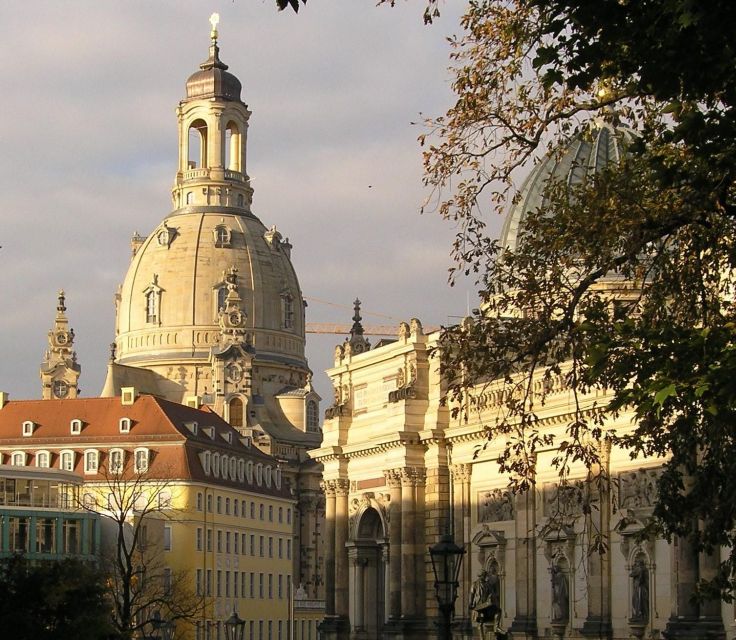
The Frauenkirche is the emotional center of many visits to Dresden. Its large dome dominates the Neumarkt, and the tour includes an interior visit. The contrast between the church’s ornate design and the city’s difficult past makes this stop more than a quick photograph.
The surrounding Neumarkt has been rebuilt, creating a historic-looking square that feels more complete than it did for many years. You should look at the relationship between the Frauenkirche and the surrounding façades. The area is meant to recall the old city center, but the rebuilding also raises useful questions about restoration, memory, and what it means to recreate a lost urban setting.
Because entry fees are not included, confirm with the guide how the interior visit will work on your date. The tour description specifically includes the Frauenkirche interior, but paid admissions remain outside the tour price. This is the one detail I would clarify before booking if seeing inside the church is essential to you.
The Neumarkt stop is valuable even if you have limited interest in church architecture. It gives you a clear picture of Dresden’s changing center and shows how the city presents its past today.
Brühl’s Terrace and the view toward the ministries
Brühl’s Terrace provides a welcome change from close-up façades and narrow streets. The elevated terrace runs along the Elbe and offers a view toward the state ministries. It is a good place to pause, orient yourself, and see how Dresden’s center sits beside the river.
The view is part of the tour’s strength. You are not only being led from one famous building to another. You also get a broader sense of the city’s public institutions and its position along the Elbe.
Brühl’s Terrace is sometimes called the balcony of Europe, a name that reflects its broad river outlook and grand urban setting. The supplied tour details do not promise a long rest stop, so expect a viewing point within a moving walking route rather than a leisurely terrace break.
Wear comfortable shoes. Two hours is not a long tour, but the route covers several parts of the old town and includes outdoor stops where good footwear and weather-ready clothing will make the experience easier.
New Synagogue, Altmarkt, and the modern city center
The New Synagogue adds an important religious and civic dimension to the walk. Its inclusion means the route is not limited to royal buildings and baroque showpieces. You see another part of Dresden’s architectural and cultural story.
The walk also reaches Altmarkt and the Kulturpalast. Altmarkt helps connect the older royal center with the city’s broader public life, while the Kulturpalast represents a more modern chapter in Dresden’s central architecture.
These stops make the itinerary feel more balanced. The Zwinger, Semperoper, and Frauenkirche are the obvious highlights, but the New Synagogue, Altmarkt, and Kulturpalast help you see Dresden as a living city rather than a preserved monument district.
The route includes much more than the listed sights, but the exact order can vary with the guide, starting time, and conditions. The important point is that the tour covers the historic heart and gives you a working map for the rest of your stay.
What the private format means for value
The price is $212 per group of up to 20 people. That is not a per-person rate, so the value changes sharply with group size.
For a larger family group, two couples traveling together, or a small organization, the cost can be sensible. You are paying for a private guide and a focused route rather than buying 20 separate tickets. The private format also gives your group more freedom to ask questions about the buildings, Saxon culture, and Dresden’s past.
For one or two people, the price is harder to justify. A shared walking tour would normally spread the guide cost across more people, but this experience is specifically designed as a private group. You should compare the total price with how much personal attention and scheduling flexibility matter to you.
Entry fees are not included. That keeps the base price clearer, but you need to budget separately if the route includes a paid interior visit or if you want to return to a museum after the walk.
Guide quality and languages
The tour is available in English, French, Italian, and German. That is useful in a city where architectural and historical details can become hard to follow if the language is not comfortable for you.
The guide is meant to explain Saxon lifestyle, architecture, culture, and Dresden’s past in a spirited style. One specifically named guide, Frau Tröster, received praise in December 2025 for her very deep knowledge of Dresden’s history. If you are able to request her, it is worth asking when you book, though the supplied details do not promise that she will lead every departure.
A good guide matters most at the Fürstenzug, Dresden Castle, the Frauenkirche, and the rebuilt Neumarkt. These places contain layers of information that are easy to miss if you only take photographs. I would use the walk to ask for context, then return to the sights that catch your interest.
Timing, access, and practical planning
The tour lasts two hours, with starting times based on availability. You can request pick-up from a centrally located hotel, which is useful if you are staying near Dresden’s old town and want to begin without finding a meeting point.
The experience is wheelchair accessible. Since it is a walking tour through the historic center, you should still confirm the exact route and any access details with the provider if someone in your group has specific mobility needs.
The tour includes a live guide and is offered to a private group. You can cancel up to 24 hours in advance for a full refund, and the reserve-now, pay-later option gives you some flexibility while finalizing your Dresden plans.
I would schedule this early in your visit. The route gives you a useful map of the center, and you can then decide where to spend more time on your own. If you have only one day in Dresden, the walk is also a practical way to see the main sights without wasting time finding them.
Who should book this Dresden walk?
I would recommend this tour to first-time visitors who want a clear introduction to Dresden’s old town, especially if they prefer a private guide and have a group large enough to share the cost.
It also suits families and mixed-interest groups. The route combines royal architecture, religious buildings, public squares, river views, and modern civic sights, so no one has to spend two hours looking at only one type of monument.
You may want something else if you prefer long interior visits, museum time, or a slow photography walk. This is a brisk overview. It shows you the key places and supplies context, but it does not replace a full visit to the Zwinger museums, Semperoper, castle collections, or any other paid attraction.
Should you book it?
Book this Dresden old-town tour if you value a private guide, want the major sights explained in one compact route, and can share the $212 group price with several people. The combination of the Zwinger, Semperoper, Frauenkirche, Fürstenzug, Brühl’s Terrace, New Synagogue, and Altmarkt gives you an unusually complete first look at central Dresden.
Ask about Frau Tröster if her detailed historical approach appeals to you, and confirm the Frauenkirche entry arrangements because admission fees are not included. For a solo visitor or couple on a tight budget, the cost may be high. For a family or larger private group, it offers a practical and well-focused introduction to Dresden’s most important center.
FAQ
How long is the Dresden Classic Old Town Tour?
The walking tour lasts two hours.
What major sights are included?
The route includes the Zwinger and Kronentor, Semperoper, Taschenbergpalais, Dresden Cathedral, Dresden Castle, the Fürstenzug, Frauenkirche, rebuilt Neumarkt, Brühl’s Terrace, New Synagogue, Altmarkt, and Kulturpalast.
Is the Frauenkirche interior included?
The tour description includes an interior visit to the Frauenkirche. Entry fees are not included, so confirm the admission arrangements before booking.
Are entry fees included in the price?
No. Entry fees are not included.
How much does the tour cost?
The price is $212 per group of up to 20 people.
Is this a private tour?
Yes. It is offered as a private-group experience.
Which languages are available?
The live tour guide is available in English, French, Italian, and German.
Is the tour wheelchair accessible?
Yes. The experience is listed as wheelchair accessible.
Can I be picked up from my hotel?
Pick-up is possible from centrally located hotels.
Can I cancel the booking?
Yes. You can cancel up to 24 hours in advance for a full refund. You can also reserve now and pay later.
Just added in Dresden
- Test Drive Electric Vehicles from the VW brand (ID. model)★ 4.8 · 190 reviews
- SRF CoBi | City Tour by ConferenceBike★ 4.7 · 38 reviews
- Dresden: Scavenger Hunt to Elbe River & Castles★ 4.7 · 15 reviews
- Dresden: Bike Rental – City Bike with Option Children Seat★ 4.5 · 13 reviews
- Moritzburg: Scavenger Hunt Self-Guided Walking Tour★ 4.8 · 12 reviews
- Historical tour of the old town including a Saxon dinner★ 4.7 · 23 reviews
- Görlitz: Scavenger Hunt Self-Guided Tour★ 4.6 · 22 reviews
- Görlitz: Ghosts and Spooky Historical Night Walking Tour★ 4.8 · 197 reviews
Old Town Walking Tours, compared.

Old Town & Viktualienmarkt City Walk in German
Read our review →

The Night Watchman Old Town Walking Tour in German
Read our review →
New Old Town and Highlights German-Language Tour
Read our review →

Browse the lists this tour appears in