
Reviewed · PALACE & RESIDENCE TOURS
Private taxi tour to Potsdam and Sanssouci 6-8h
Sanssouci is not just a palace. It is a royal retreat spread across a huge park, with vineyard terraces, fountains, an ornate Chinese tea house, Roman-style buildings, and a guest palace that Frederick the Great used to impress his family. Gunter Bauer takes you there by private taxi, then links the park to Potsdam’s old streets and royal landmarks.
I like the door-to-door pickup and the chance to shape the day around your interests. I also like the human scale of the tour: Gunter drives, explains the buildings, takes photos, and can add places such as the Russian colony of Alexandrowka or a café stop. The main drawback is that palace admissions are not generally included, and six to eight hours can feel tight if you want to enter several buildings.
Key points to know before booking
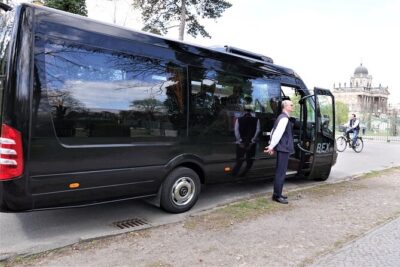
- Private sightseeing by taxi: Your group travels in an air-conditioned vehicle, with pickup from your hotel or apartment in Berlin.
- Gunter Bauer leads the day: Expect a guide who focuses on architecture, royal history, war damage, rebuilding, and the stories behind each site.
- Sanssouci Park is the heart of the tour: The park links palaces, terraces, fountains, pavilions, and wooded paths across a large area.
- You can see more than Sanssouci: The route can include the New Palace, Dutch Quarter, Nauen Gate, Cecilienhof, Russian colony, and Glienicke Bridge.
- Walking shoes matter: Many paths around the palaces are unpaved, and the park covers a lot of ground.
- Admission needs planning: Park entry is included, but palace interiors require tickets, with the Sanssouci+ option available only when selected at booking.
Why a private taxi makes Potsdam easier
Potsdam lies outside central Berlin, and its sights are spread widely across the city and its parks. Public transport can get you there, but it does not solve the problem of moving efficiently between Sanssouci, the New Palace, Cecilienhof, the Dutch Quarter, and the bridges and gates near the city center.
This tour removes that puzzle. Gunter picks you up at your accommodation at about 10:30 a.m. You do not need to find a station, work out a ticket, or lose time changing vehicles. The taxi ride is part of the guided experience, with commentary on places along the way.
I especially like this setup for a first visit to Berlin. You get a broad look at Potsdam without spending the day studying maps. Since it is a private activity, your group can ask questions, linger at a favorite site, or request an extra stop if time allows.
The vehicle is air-conditioned, parking fees are covered, and both the taxi ride and city tour are included. The advertised length is six to eight hours, though the day can run longer when the route includes more sights or a relaxed meal stop. One group spent about nine hours with Gunter, so ask about timing if you have an evening booking.
More Palace and Residence Tours in Berlin
- Berlin: Charlottenburg Palace Entry Ticket
★ 4.4 · 2,076 reviews - From Berlin: Potsdam and Sanssouci Palace Tour with Entry
★ 4.5 · 1,094 reviews - Potsdam Tour from Berlin With Guided Sanssouci Palace Visit
★ 4.5 · 364 reviews
Sanssouci Palace, Frederick’s small retreat
Sanssouci Palace is the emotional center of the visit. Frederick the Great built this rococo retreat on a vineyard, away from the formal demands of Berlin and court life. The building is surprisingly small, with only eight main rooms, and each room opens toward the garden.
That small size tells you something about Frederick. This was not meant to be a huge ceremonial palace. It was a private place for the king, his dogs, music, and selected male visitors such as the philosopher Voltaire. French was the language of conversation, and Frederick played and composed music on the flute.
The rooms are richly decorated, but the palace does not feel like a giant royal machine. I find the contrast useful: Frederick could rule as an absolute monarch, yet his personal retreat was designed around music, gardens, conversation, and a carefully controlled circle of friends.
The standard stop at the palace is listed as about 30 minutes. That is enough for an introduction, but not enough for a slow, detailed visit if you want to study every room. Admission is not included unless you choose the Sanssouci+ option, which covers the palace tours. Check your selection carefully before paying, since the basic tour and the palace ticket are not the same thing.
Vineyard terraces and the postcard view
The Weinbergterrassen, or vineyard terraces, give you the classic view of Sanssouci: the palace above the stepped vines, with the large fountain below. This is the spot for the photograph most people carry in their minds before arriving.
The vineyards were not simply decoration. Potsdam was far north for reliable wine growing, so gardeners protected the vines behind glass. The covers helped shield them from winter cold and spring frost. Frederick also arranged for wine from France and Italy when local production was not enough.
The fountain below depended on a higher pond. To hide the technical system, the royal designers created the Ruinenberg, a romantic group of artificial ruins. The ruin made the waterworks look like an ancient spectacle. It also gave the park another place for the eye to rest.
You get about 15 minutes at the terraces, with free admission to this outdoor stop. That is practical for a first visit, but the area can reward more time if photography matters to you. The paths are mostly unpaved, so good walking shoes are a real need, not a polite suggestion.
The windmill, Orangery, and Chinese House
The Historic Windmill adds a pleasing bit of resistance to the royal story. Its owner went to court after a dispute with the king and won the first case. The mill survived, and grain can still be ground there today.
That detail gives Sanssouci a welcome change of tone. The park is full of royal power, but this building recalls a legal system in which even a king could face opposition. The visit is brief, around 10 minutes, and admission is not included.
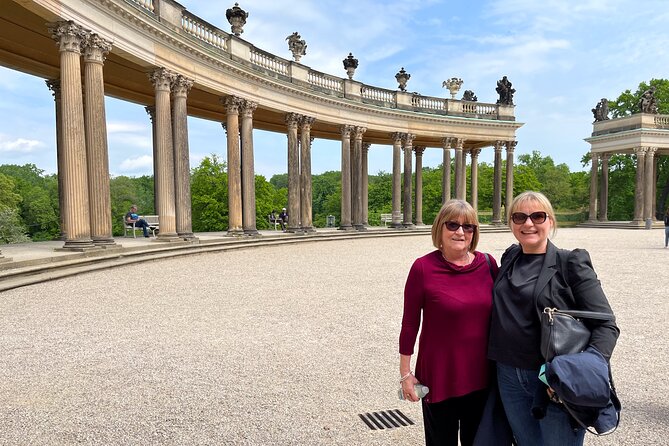
The Orangery Palace occupies a high position with a broad view over the park. Exotic plants were brought indoors there during winter, while the building itself added another grand Roman-style feature to the ridge.
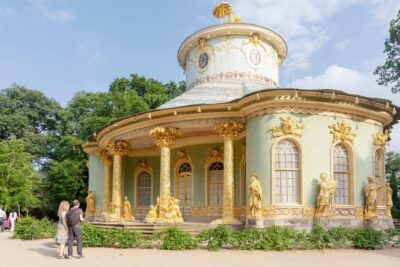
Nearby, the Chinese House is far more than a tea pavilion. It was designed in the 18th-century fashion for all things Chinese, with gilded decoration, delicate porcelain, and figures that make the small building feel theatrical. I would not rush this stop. It is compact, but the decoration is easy to miss if you only glance inside.
You may also see the Roman Baths, another example of the period’s love of classical forms. They were built more for the pleasure of the eye and the imagination than for regular bathing. The same is true of the park’s grotto, which offered cool shade and a romantic setting.
Other palaces and grand rooms in Berlin:
- Small group Potsdam: A Journey Through History and Palaces
★ 4.7 · 317 reviews - From Berlin: Gardens & Palaces of Potsdam Bike Tour
★ 5.0 · 61 reviews - Charlottenburg Palace with an excursion to Potsdam
★ 5.0 · 23 reviews - Berlin: Palace of Köpenick Entrance Ticket
★ 4.3 · 21 reviews
Sanssouci Park is the real attraction
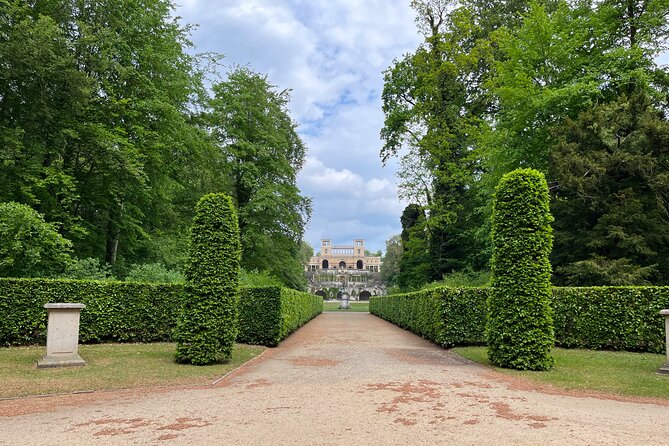
The palace gets the name, but the park gives the visit its shape. Paths connect the vineyard, fountains, terraces, small buildings, and the New Palace over a distance of roughly two kilometers. Planting and viewpoints keep changing as you walk.
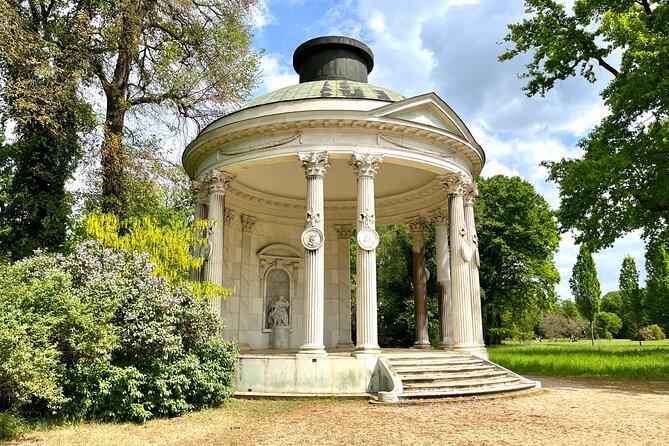
The park was designed as a series of experiences rather than one straight route. You might pass the Friendship Temple, a small and intimate building meant for a quiet pause, or spot a hilltop structure designed mainly as an eye-catching addition.
Friedrich Wilhelm IV added his own Italian mood to the grounds with the Friedenskirche. Its separate campanile gives it the look of an Italian church, while a small artificial pond reflects the building. Frederick Wilhelm IV is buried here, away from the formal Hohenzollern burial place in Berlin Cathedral.
The tour allows about 45 minutes for Sanssouci Park, with admission included. That is useful, but remember that 45 minutes is a guided overview, not a full walk through every path. If you love gardens, architecture, or photography, you may need to decide what matters most before the day begins.
The New Palace and royal family politics
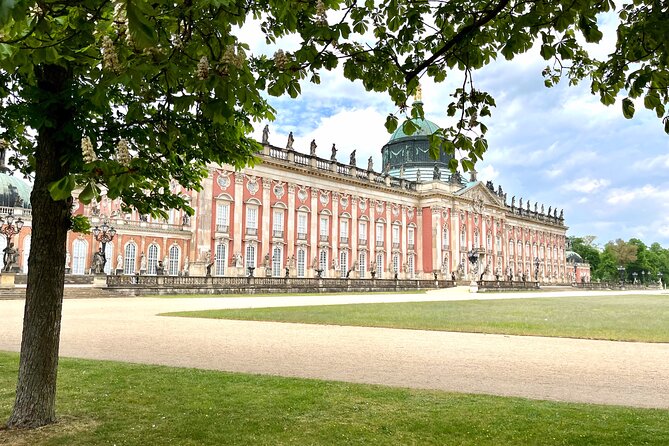
At the far end of the park, the New Palace is the grand counterpoint to Sanssouci. Frederick the Great called it fanfanery, a word aimed at display and boasting. He wanted to impress relatives and visiting royalty, and the building answered with about 600 rooms.
The palace was arranged as a collection of apartments for royal family members. There were reception rooms, music rooms, bedrooms, writing rooms, and some early bathrooms tucked into small adjoining spaces. Kitchens were placed in separate service buildings, called the Communs, to keep cooking smells away from the main palace.
This arrangement offers a useful glimpse into court life. A royal visit meant more than giving someone a bedroom. It required a full apartment, servants, food service, guards, and a clear division between the people being served and the people doing the work.
The Communs now house part of the University of Potsdam. Their arcades frame a large courtyard, and the buildings remain an important part of the palace complex.
The New Palace is one of the places where an interior ticket matters. If you want to enter several buildings, the Sanssouci+ option may offer better value than buying separate admissions, but confirm exactly what your selected option includes.
Potsdam’s gates, streets, and Dutch Quarter
The tour shifts from royal parkland to Potsdam’s city center. Nauen Gate is the most dramatic of the surviving city gates, with a medieval Romanesque look that contrasts with the lower town buildings around it. The square has cafés and restaurants, making it a sensible place for a break.
The Dutch Quarter was built for Dutch workers brought to Potsdam for their building skills, especially canal work. Its red brick houses create a sudden change of mood. Small shops, cafés, bars, craft stores, and antique businesses fill the streets, and the area feels like a real neighborhood rather than a palace annex.
You may also pass the Brandenburg Gate in Potsdam, built in a classical style and much smaller than Berlin’s famous gate. The Jägertor once led toward hunting grounds, while the Nauener Tor pointed toward Nauen. These gates make more sense when you think of Potsdam as a planned royal residence with roads leading in set directions.
The city center includes a broad pedestrian street lined with town houses, small shops, and older baroque buildings. A small department store with an Art Nouveau glass roof adds another architectural detail. I like this part of the route because it shows Potsdam as a living town, not only a collection of royal properties.
Cecilienhof and the 1945 Potsdam Conference
Cecilienhof Palace is easy to miss because it sits away from the main Sanssouci group. It is worth the detour for two different reasons.
First, it was the last major Prussian palace, built for Crown Prince Wilhelm and Crown Princess Cecilie shortly before the First World War. It looks like an English country house rather than a formal baroque palace. Inside, it had modern comforts such as central heating and bathrooms, along with a room styled like a ship’s cabin for Cecilie’s love of sea travel.
Second, Cecilienhof hosted the 1945 conference attended by Stalin, Truman, and Churchill. The conference rooms and outdoor areas preserve the setting of that meeting, giving the building a direct connection to the postwar division of Europe.
This is one of the strongest reasons to include Cecilienhof if modern history matters to you. Sanssouci is about monarchy, taste, and royal retreat. Cecilienhof connects Potsdam to the political decisions that shaped the decades after the Second World War.
Alexandrowka, Glienicke Bridge, and extra stops
The route can extend beyond the main palace group. The Russian colony of Alexandrowka is an especially useful addition if you want to see how royal diplomacy shaped ordinary housing. Russian singers were brought to Prussia, and the settlement was created for them in a style unlike the surrounding city.
One group requested a visit to the colony and a meal there, and Gunter added it to the day. That shows the value of a private itinerary, though you should ask in advance if a particular extra stop is important to you.
Glienicke Bridge adds a different kind of history. It was closed for decades as the border between West Berlin and East Germany, and it became famous for secret exchanges of spies and prisoners between the United States and the Soviet Union. Its film history adds a touch of Cold War drama.
On the Berlin side, Glienicke Palace sits near the bridge beside the water. Its Italian design, formal courtyard, and view toward Potsdam make it a worthwhile roadside sight. Other possible views include the Marble Palace in the New Garden, the mosque-like building that hides the chimney of a power station, and the Belvedere structures on the hills.
The tour cannot linger at every one of these places. Think of them as optional additions or drive-by context, not guaranteed long visits.
What the guide adds to the day
Gunter’s strongest role is connecting buildings to people and events. He explains architectural styles, points out war damage and rebuilding, and makes the royal families less distant by describing their habits, rivalries, tastes, and practical needs.
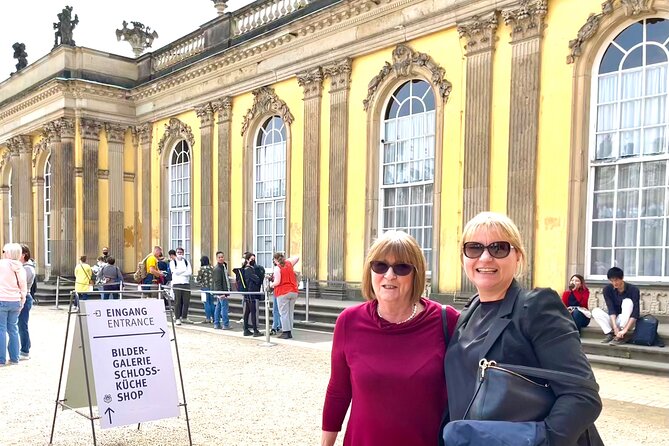
He also takes photographs for the group and sends them afterward. That is particularly helpful for solo visitors or anyone who wants a proper picture at the terraces, gates, and palace grounds without asking strangers.
The guiding style is energetic and conversational. If you prefer silence and long stretches of independent wandering, the constant commentary may feel like too much. If you want a day full of context and questions, it is a strong match.
Price, timing, and practical value
At about $179.01 per person, the cost is not cheap for a day trip. The value improves when you are traveling with several people, since the private vehicle, driver-guide, parking, and door-to-door pickup are shared benefits rather than separate transport costs.
You are also paying for time saved. A taxi takes you between scattered sites, and Gunter can adjust the route instead of following a large group’s fixed schedule. The price is harder to justify if you only want to see Sanssouci Palace and its terraces, since public transport and a shorter visit may be enough.
The tour is offered in English. Pickup is from your hotel or accommodation, but wait on the street until Gunter sends an SMS or WhatsApp message. Include a working mobile number when booking.
Wear sturdy walking shoes. Sandals are a poor choice for the park paths. A baby car seat can be requested, and service animals are allowed. Medium-sized dogs can lie on the rear floor, while large dogs may take the rear area and leave no room for luggage.
Free cancellation is available up to 24 hours before the start time. Cancellations or changes inside that window are not refunded or accepted.
Should you book this Potsdam tour?
Book it if you want Potsdam explained rather than simply visited. It suits couples, families, solo visitors, and small groups who value a private vehicle, a flexible route, and a guide who can move between royal architecture, Cold War history, city streets, and local stories.
It is especially good for a first Potsdam visit, for anyone staying in Berlin without a rental car, and for people who want photographs taken along the way. Choose the palace admission option carefully, and allow enough time if you want to enter both Sanssouci and the New Palace.
Skip it if you want a quiet, self-guided garden day or plan to spend hours inside every palace. For that kind of visit, the six to eight hour schedule may feel rushed. For a broad, personal introduction to Potsdam with efficient transport and plenty of explanation, this is a strong use of a Berlin day.
FAQ
Where does the tour start?
Pickup is offered from your hotel, apartment, or other accommodation in Berlin. The listed start time is 10:30 a.m.
How long does the tour last?
The advertised duration is approximately six to eight hours. The day may run longer if the route includes additional stops or a relaxed break.
Is palace admission included?
Admission to Sanssouci Palace and other palace interiors is not included in the basic arrangement. The Sanssouci+ admission option, covering all castle tours, is available only when selected at booking. Sanssouci Park admission is included.
Is this a private activity?
Yes. Only your own group participates in the tour.
Is the tour offered in English?
Yes. The experience is offered in English.
What should I wear?
Wear good walking shoes because many paths in the park and around the palaces are unpaved. Sandals are specifically discouraged.
Just added in Berlin
- Romantic Berlin Rickshaw City and Photo Tour – incl. pick-up★ 4.0 · 9 reviews
- Moonshine Comedy – English Stand Up Comedy by the bay★ 5.0 · 11 reviews
- Berlin Protest History Tour: Rebels, Resistance, and Revolution★ 5.0 · 7 reviews
- Private Half-Day Berlin Sightseeing Tour with a Minivan Including Short City Walks★ 5.0 · 31 reviews
- One Up to 3 Rickshaws(6 GUESTS)-Taylor Made Rickshaw Berlin Tour★ 5.0 · 20 reviews
- Private City Kickstart Tour: Berlin★ 4.5 · 71 reviews
- Berlin Private Custom Walking Tour With A Guide (Private Tour)★ 4.5 · 8 reviews
- Private tour of Berlin★ 5.0 · 15 reviews
Palace & Residence Tours, compared.
Sanssouci Palace and Prussian Palaces Entry Ticket
Read our review →
Neuschwanstein Castle and Linderhof Palace Day Trip from Munich
Read our review →
Potsdam Tour from Berlin With Guided Sanssouci Palace Visit
Read our review →Browse the lists this tour appears in