
Reviewed · TOURS IN HAMBURG
Hamburg: Private Tour Down Town around City Hall
Hamburg’s old town has more layers than its handsome City Hall suggests. In two hours, you connect the Great Fire of 1842, the city’s first harbor basin, its pneumatic post, its huge underground bunker network, and the sharp brick prow of Chilehaus. The most surprising thread is how quickly Hamburg changed from cramped medieval lanes to a modern commercial city.
I like the way this tour joins big landmarks with small historical details, such as the first pneumatic post from 1864. I also like the private format: your group of up to 15 people can get a guide’s attention instead of being folded into a large crowd. The main consideration is pace. Two hours is enough for an excellent introduction, but not enough for long visits inside every church or museum.
Key points to know before you go
- The Great Fire explains modern Hamburg: Learn how four days of fire in 1842 destroyed much of the old town and changed its streets and buildings.
- Chilehaus is a visual highlight: The famous brick office building has an imposing, ship-like form and makes a fine photo stop.
- The tour links old and new Hamburg: Mönckebergstraße, the Kontorhausviertel, churches, City Hall, and the Africa House all appear in one compact route.
- Bunker history is unusually prominent: Hamburg’s underground defense system included more than 700 bunkers.
- A private group adds value: The $294 price covers up to 15 people, so the per-person cost falls sharply with a full group.
- Guides bring different personalities: Birgit, Jörn Löding, and Frau Stange are among the named guides praised for humor, preparation, and clear links between past and present.
Hamburg’s story begins with fire, trade, and water
This is not just a parade of pretty façades. The tour gives you a usable framework for understanding Hamburg. You hear how a medieval Hanseatic trading city became a modern center of commerce, and how fire, trade, war, and rebuilding all left marks on the streets.
One useful date is 1189, when Hamburg’s first harbor basin was inaugurated. That early harbor connection helped shape the city’s fortunes, even though the modern port and waterfront are not the main focus of this route. You get the point without spending half the day on transport.
The Great Fire of 1842 is another key piece. It burned for four days and destroyed large sections of the old town. As you walk, your guide can explain why Hamburg changed from narrow lanes lined with half-timbered houses to a city of wider streets, commercial buildings, and more regular planning.
I find this kind of explanation more useful than a list of dates. It helps you look at a street corner and ask why it has that shape. The past is not sealed away in a museum here. It is part of the city’s buildings and street plan.
A few more things to do in Hamburg worth a look
- Your private 3-hour Hamburg driving tour with a former policeman
★ 5.0 · 304 reviews - Hamburg: Private Tour Red Light District Walking Tour
★ 4.7 · 227 reviews - Hamburg: Private Couples’ Photoshoot and Walking Tour
★ 4.9 · 212 reviews
Mönckebergstraße brings you into present-day Hamburg
Mönckebergstraße is a practical starting point because it is one of Hamburg’s best-known shopping streets. Locals affectionately call it Mö, and the route uses it to show how the old city connects with modern daily life.
Expect a short guided stop of about 10 minutes. That is enough to learn why the street matters and to get your bearings, but not enough for serious shopping. If you want to browse its shops, save that for after the tour.
The street also helps explain Hamburg’s shift toward a modern commercial city. The contrast matters: the narrow old lanes and merchant buildings came from one era, while broad shopping streets and larger commercial blocks belong to another.
St. James’ Church offers a quieter historic pause
The tour then reaches St. James’ Church, or St. Jacobi, for another short stop of about 10 minutes. This gives you a change of mood from the busy shopping street.
A church stop can be especially useful if you like architecture, local religious history, or places where the city’s pace slows down. The schedule suggests a guided look rather than a long interior visit, so keep your expectations sensible. You will hear the church’s place in Hamburg’s story, but this is not a full art or organ tour.
This part of the route also shows why a guide matters. Without context, a church can look like one more attractive building. With a clear explanation, you begin to see how churches helped anchor the old city and its communities.
The Kontorhausviertel and Chilehaus show Hamburg’s commercial face
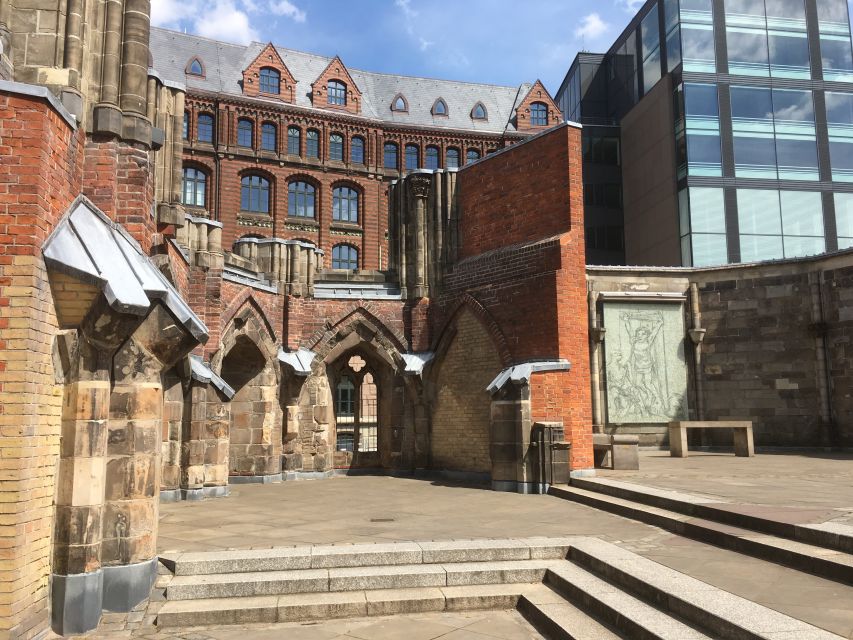
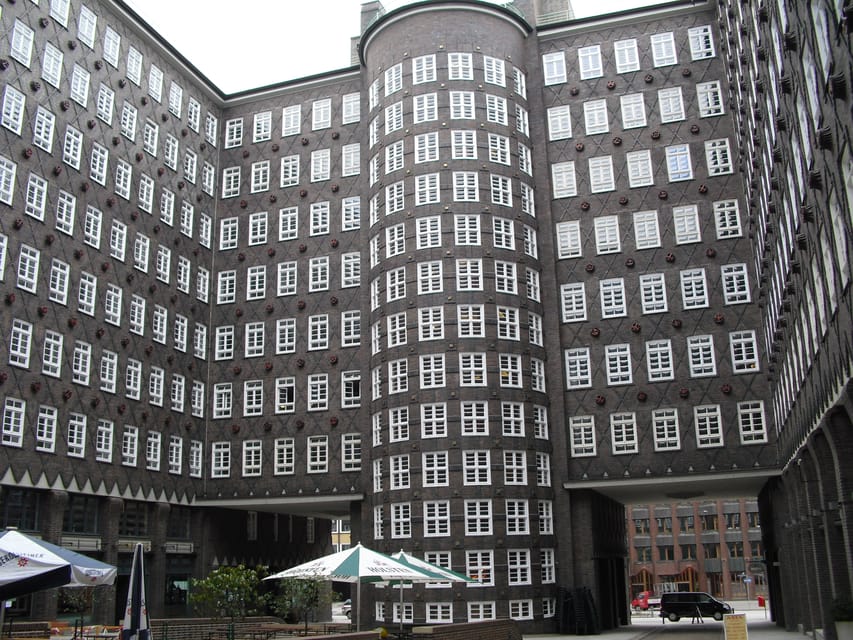
The Kontorhausviertel is one of the strongest sections for architecture lovers. This district reflects Hamburg’s move toward large-scale office and trading buildings, replacing much of the older residential fabric after the city’s earlier disasters and changes.
The stop at Chilehaus lasts about 10 minutes. The building is famous for its pointed, ship-like shape and dark brick exterior. Its appearance is hard to miss, and it gives you one of the tour’s best photo opportunities.
I like this stop because it explains more than a building’s style. Chilehaus helps show Hamburg as a business city tied to overseas trade. The architecture feels practical, dramatic, and very different from the half-timbered image many people expect from an old European center.
You also pass the Sprinkenhof and Reichenstraßen area. The route does not provide long interior visits, so you should come ready to look up, listen, and notice details on the façades. If you want a full architectural study, you will need extra time on your own after the tour.
Same base, a different kind of day out:
- Hamburg: Sex and Crime in St. Pauli Tour for Ages 18+
★ 4.7 · 15,447 reviews - Hamburg: 1.5-Hour Harbor and Speicherstadt Day Cruise
★ 4.6 · 14,200 reviews - Hamburg: 90-Minute Evening Lights Harbor Cruise
★ 4.5 · 7,728 reviews - Hamburg: 2-Hour XXL Port of Hamburg Cruise Tour
★ 4.7 · 6,979 reviews
The Africa House and the city’s global connections
The Africa House adds an overseas and commercial angle to the walk. Its inclusion helps broaden the story beyond local politics and church buildings. Hamburg grew through international trade, and this stop points you toward the city’s connections with Africa and the wider world.
The route presents the Africa House as a place to learn and take photographs. Do not expect a separate museum visit based on the information provided. Instead, treat it as one part of a street-level tour that shows how Hamburg’s business identity appeared in its buildings.
This is also where the tour’s idea of wanderlust makes sense. Hamburg’s old center may be inland from the main port, but its architecture and commercial history repeatedly point outward.
St. Nicholas’ Church carries the weight of wartime memory
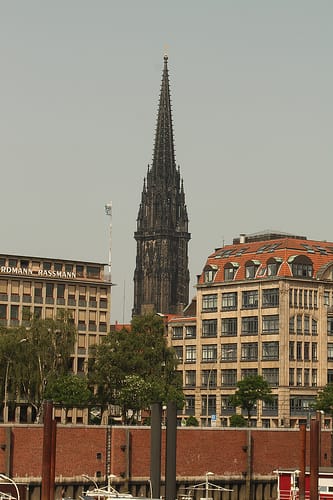
St. Nicholas’ Church is one of the most serious stops. Its remains recall the destruction Hamburg suffered during the Second World War, and its presence gives the tour a strong reminder that the city’s story includes loss as well as trade and prosperity.
The schedule gives roughly 15 minutes for this part of the route. That is enough for a focused explanation and photographs. You may want to return later if you prefer a longer visit or want to spend more time with the memorial setting.
This stop also links to the tour’s discussion of Hamburg’s bunker system. The city had more than 700 bunkers, making it one of the largest underground bunker networks in Germany. That is an unusual subject for a short old-town tour, and it adds real substance to the walk.
You should not expect to enter a bunker as part of the stated route. The value here is the historical explanation: your guide helps you understand how wartime construction and memory remain part of Hamburg’s urban fabric.
Trostbrücke and the older city around it
Trostbrücke is a compact but atmospheric stop. The name and setting invite a look back at Hamburg before the city became dominated by broad commercial streets and large office blocks.
The tour allows about 10 minutes here. That is enough to connect the bridge with the old town and the city’s earlier passageways. I would pay attention to the surrounding street pattern, since this is where the contrast between older Hamburg and rebuilt Hamburg becomes easier to see.
The route also includes the Chamber of Commerce. That is a useful link to the city’s Hanseatic trading past and its continuing business role. You are not simply moving from landmark to landmark. The stops build a picture of how merchants, trade, government, and urban planning shaped the center.
Hamburg City Hall is the natural finish
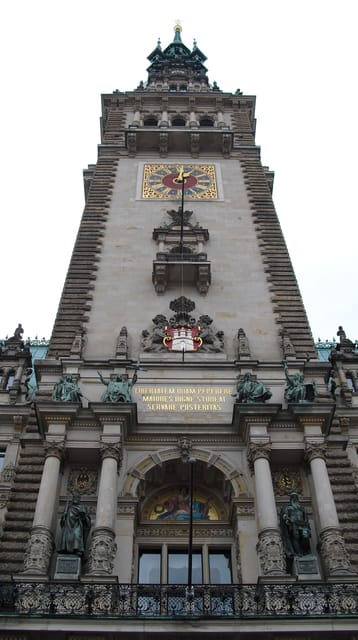
The final major stop is Hamburg Rathaus, or City Hall, with about 15 minutes of guided attention. Its grand exterior makes a fitting end to a tour centered on Hamburg’s civic and commercial power.
The City Hall stop is best for orientation and historical context. You can learn how the city governed itself and how its political identity developed alongside its trading wealth. The route ends here, making it easy to continue exploring the center on your own.
The listed drop-off point is Hamburg City Hall. Since the meeting point can vary by booking option, confirm the exact starting place before you set out. The supplied route names StadtRAD as the starting option, so check the final meeting instructions rather than assuming you should meet at the Rathaus.
What two hours really gets you
Two hours is a good length for a first look at central Hamburg. You cover Mönckebergstraße, St. James’ Church, the Kontorhausviertel, Chilehaus, Reichenstraßen, the Africa House, St. Nicholas’ Church, Trostbrücke, the Chamber of Commerce, and City Hall.
The schedule is fairly full. Several stops last only 10 minutes, while the Kontorhausviertel, St. Nicholas’ Church, and City Hall receive closer to 15 minutes. That means the tour favors explanation and movement over long indoor visits.
You should wear comfortable shoes and arrive ready to walk between points. The exact distance and meeting point are not specified, so do not plan a tight connection immediately afterward. Alternative tour times can be requested through the booking provider.
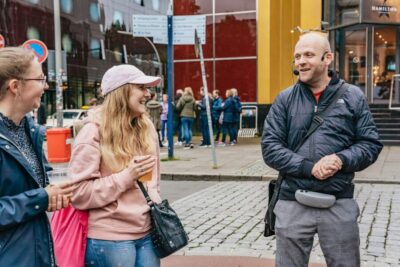
The live guide can conduct the tour in English, German, French, or Spanish. Named guides who have led this experience include Birgit, Jörn Löding, and Frau Stange. The strongest praise attached to the guiding style is consistent: good preparation, humor, openness, and a talent for connecting Hamburg’s past with its present.
That matters. A private tour rises or falls on the person leading it. Birgit was praised for keeping the group connected with humor. Jörn Löding was noted for strong factual knowledge of the old town. Frau Stange was credited with linking history to modern Hamburg. Guide assignments can change, so book for the route and format rather than expecting one particular person unless the provider confirms it.
Is $294 a fair price for a private group?
At $294 per group, the price needs to be judged by group size. One person would pay a lot for a two-hour tour, but a group of 10 pays about $29.40 each, and a full group of 15 pays about $19.60 each.
That is a reasonable private-tour price if you value direct contact with a guide and want a set route through central Hamburg. You are paying for the guide and the private city tour, not for museum tickets or a long indoor attraction visit. The value is strongest for families, friends, or small organizations who can share the fixed fee.
A public walking tour may cost less for solo visitors, but it will not offer the same private format. If your group has different interests, you can also ask questions more freely than you usually can in a large crowd.
The rating is 4.7 from 33 reviews, which supports the idea that the guiding quality is a major part of the experience. Still, the tour is best understood as a compact introduction, not a full-day examination of Hamburg.
Who should book this Hamburg walk?
I would recommend it to first-time visitors who want a clear introduction before exploring on their own. It also suits history-minded people who enjoy learning why a city looks the way it does.
Architecture fans will get plenty from Chilehaus, the Kontorhausviertel, City Hall, and the old churches. Shoppers may like beginning on Mönckebergstraße, though the guided portion is too short for a shopping session.
This tour is also a good fit for groups who want flexibility and a guide speaking their chosen language. The English, German, French, and Spanish options widen its appeal.
I would be less keen to book it if your main goal is to enter museums, spend long periods inside churches, or explore the harbor itself. The route is firmly centered on the old town and City Hall area. It gives you context, façades, stories, and photo stops, then leaves you with a useful map in your head.
Final verdict: book it for context, not just landmarks
I would book this tour if you want Hamburg’s center to make sense quickly. The best parts are the links between the Great Fire, the old churches, the bunker system, the Kontorhausviertel, and the city’s trading past.
The private format makes the fixed price sensible for a group, and the guide’s humor and storytelling appear to be central strengths. Just remember that two hours moves fast. You will see many important places, but you will not have time to linger at each one.
Book it early in your Hamburg stay, then use the final stop at City Hall as a springboard for further exploring. That is when the tour gives you the most value: not as the last word on Hamburg, but as a sharp and useful first chapter.
FAQ
How long does the Hamburg private tour last?
The tour lasts two hours.
How much does the private tour cost?
The price is $294 per group of up to 15 people.
Which languages are available?
The live tour guide can conduct the tour in English, Spanish, French, or German.
Is this a private group tour?
Yes. The activity is offered for a private group.
What places does the route include?
The route includes Hamburg Central Station, Mönckebergstraße, St. James’ Church, Sprinkenhof, Chilehaus, Reichenstraßen, the Africa House, St. Nicholas’ Church, Trostbrücke, the Chamber of Commerce, and Hamburg City Hall.
Where does the tour start and finish?
The meeting point may vary depending on the option booked. The listed route has two starting location options at StadtRAD, and the listed drop-off location is Hamburg City Hall.
Can I cancel the tour and receive a refund?
You can cancel up to 24 hours in advance for a full refund. Reserve now and pay later is also available.
Just added in Hamburg
- Hamburg: Historical Tour of the St. Pauli Sex Work District★ 4.4 · 215 reviews
- Hamburg: St. Pauli Food and Bier Tour★ 4.7 · 5 reviews
- St. Pauli Tour: Drag-Attack with Barbie Stupid & Lee Jackson★ 4.8 · 280 reviews
- Hamburg: Private Tour Red Light District Walking Tour★ 4.7 · 227 reviews
- St. Michael’s, Elbe Tunnel & Harbor 2-Hour Hamburg Tour★ 4.9 · 21 reviews
- Satt Pauli – der kulinarische Rundgang durch St. Pauli★ 4.8 · 12 reviews
- Hamburg: Safari tour in St. Pauli★ 4.9 · 11 reviews
- Radtour um die Alster & durch traumhafte Alsterviertel★ 4.9 · 34 reviews
Tours in Hamburg, compared.
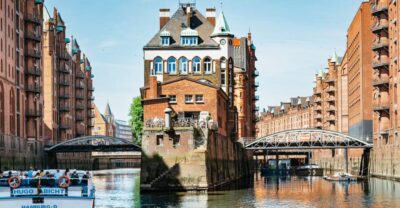
1.5-Hour Harbor and Speicherstadt Day Cruise
Read our review →

Browse the lists this tour appears in