
Reviewed · TOURS IN LEIPZIG
Federal Administrative Court Leipzig: A journey into the heart of German justice
The most surprising part of this tour is that you are not simply looking at an old courthouse. You are walking through a building that has housed major German legal institutions, survived political upheaval, served as an art museum, and now functions as Germany’s highest administrative court. The historic courtroom and former presidential apartment give the visit a human scale that a standard architecture tour often lacks.
I like the way the tour joins architecture with difficult history, from the 1907 Karl Liebknecht trial to the 1933 Reichstag fire trial. I also like the practical look at judicial life, including the crimson robes and berets worn by federal judges. The main consideration is language: tours are held in German, with English available on request, and children under 14 cannot join.
Key points to know before you go
- A working seat of German justice: The court is Germany’s highest administrative court, with judges working in 14 senates.
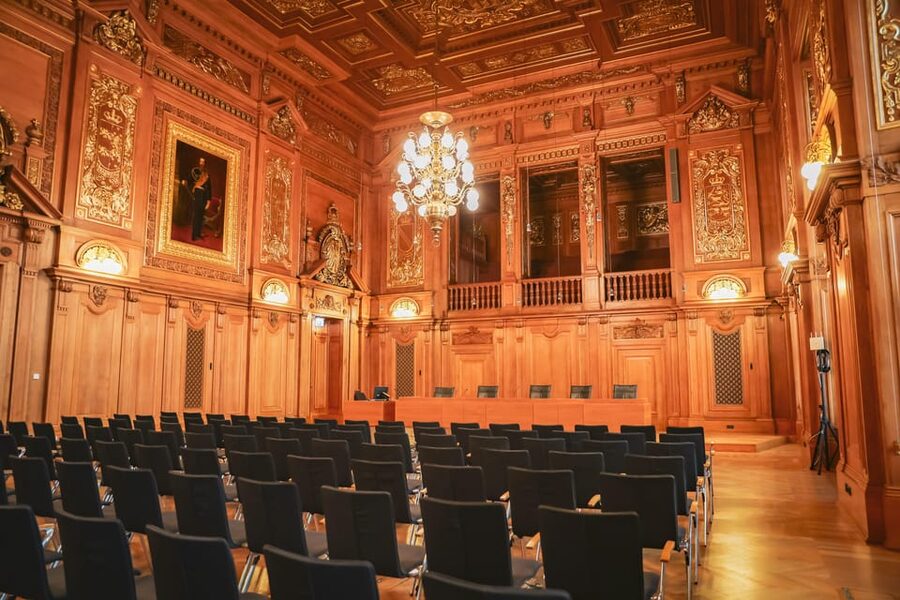
- A grand 1879 interior: Imperial paintings, national coats of arms, and a large historic courtroom give the building its formal Wilhelmine character.
- History beyond decoration: The tour covers important cases, including Karl Liebknecht’s 1907 trial and the Reichstag fire trial of 1933.
- A rare private-space visit: You enter the former presidential apartment, an unusual feature for a court tour.
- A compact 90-minute visit: The schedule is long enough for useful context but short enough to fit into a Leipzig sightseeing day.
- German first, English by request: Arrive 10 to 15 minutes early at Simsonplatz 1, and confirm language needs before booking.
Why this Leipzig court tour is different
Many historic buildings in Germany have imposing stonework and official rooms. What makes this visit worth your time is the building’s changing purpose. It was built in 1879 during the Wilhelmine era as the Imperial Court of Justice, then passed through very different chapters before becoming the Federal Administrative Court.
You get to see the place as both an architectural monument and a functioning institution. Judges still decide disputes in administrative law here, and the court continues to shape how that area of German law develops. That present-day role matters. You are not touring an empty shell preserved behind glass.
The experience costs $14 per person. I consider that a fair price for 90 minutes inside a building that is not normally part of a general city walk. The value is strongest if you care about politics, legal history, architecture, or Leipzig’s place in modern Germany. If you only want a quick look at grand rooms, you may find the historical explanations more detailed than necessary.
The tour has a rating of 4.8 from 189 reviews, and the strongest pattern is clear: visitors praise the guide’s friendly manner, good organization, and ability to keep the material lively. One useful point comes through again and again in the feedback: the time can feel short because there is a lot to cover. That is a good sign for curious adults, but it also means this is not a casual drop-in visit with only a few facts.
Other trips people book in Leipzig:
- Leipzig: City History Canal Sightseeing Tour on a Motorboat
★ 4.7 · 6,232 reviews - Leipzig: 1.5-Hour Public Tour with Night Watchman Bremme
★ 4.6 · 3,116 reviews - Combo Tour in Leipzig: Guided City Tour & City Sightseeing
★ 4.7 · 2,317 reviews
Meeting the court at Simsonplatz 1
The meeting point is directly in front of the Federal Administrative Court at Simsonplatz 1. Plan to arrive 10 to 15 minutes early. This is especially sensible for a guided visit to a working court, where the start time matters and the building may involve entry procedures.
You should not treat the meeting point as a vague city-center rendezvous. Go straight to the court’s front entrance area and allow time to get oriented. The supplied information does not give a separate transport route or parking advice, so check your own route before setting out.
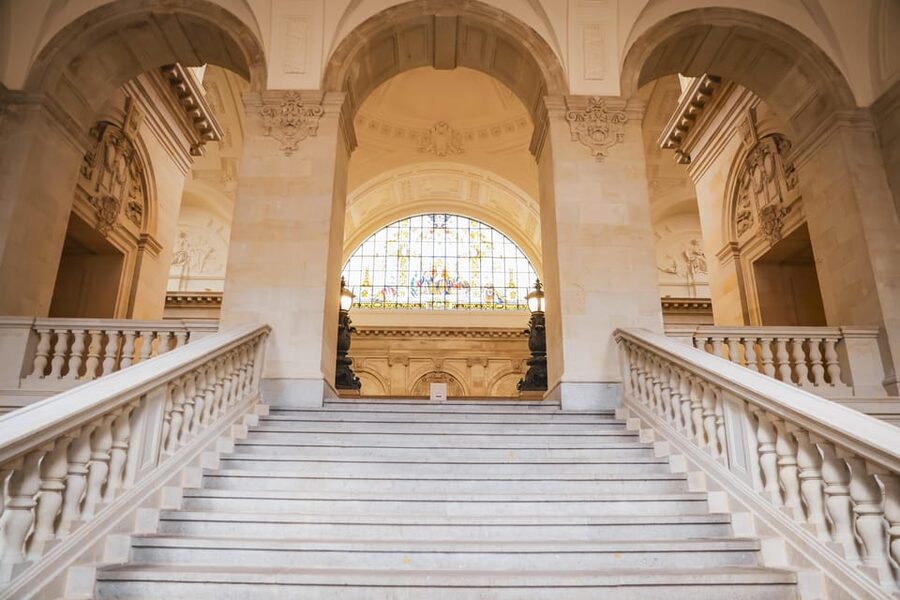
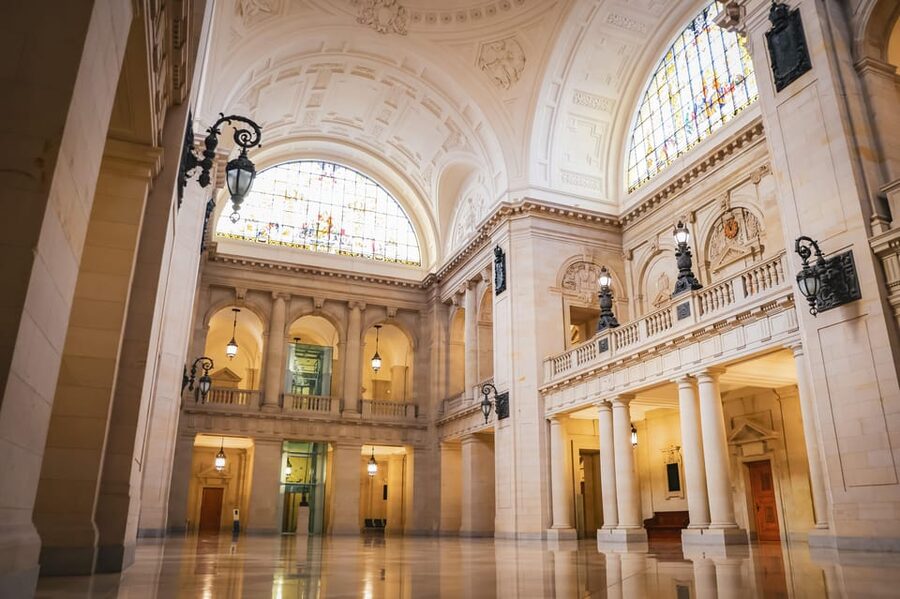
The building itself begins the tour before the guide says a word. Its scale and formal design reflect the imperial period in which it was built. The architecture was meant to project order and authority, and it still does that job rather well.
I like this opening because the tour does not begin with an abstract lecture. You first confront the institution as a physical place, then learn what it has meant through different periods of German history.
The 1879 Imperial Court of Justice

The building dates from 1879, when it served as the Imperial Court of Justice. That origin explains the grand tone inside. This is not restrained modern government architecture. You can expect a ceremonial setting shaped by the Wilhelmine era, with details intended to make the court look permanent and powerful.
The guide explains the building’s history and architecture while connecting them to the legal institution that occupied it. Look for the national coats of arms and imperial paintings in the large courtroom. These details are not just decoration. They show how law, monarchy, and state identity were presented to people entering the building.
The architecture is likely to appeal even if legal procedure is not your main interest. The courtrooms offer the strongest visual reward, while the historical explanation gives the decoration a reason to matter. Without that context, you might simply see an ornate official room. With it, you can read the building as a statement about government and authority.
You should also expect the guide to explain the official dress of federal judges. The crimson robe and beret remain recognizable symbols of the court. It is a small detail, but I find it useful because it connects the grand building to the people who still work inside it.
The courtrooms and the stories behind them
The historic courtrooms are central to the visit. You do not just pass through them as decorative interiors. The tour uses these rooms to explain legal events and the broader role of the court.
One case covered is the October 1907 trial in which Karl Liebknecht defended himself over the publication of his writings. Liebknecht is an important political figure in German history, and the case gives the building a direct connection to debates about speech, politics, and state authority.
The tour also addresses the infamous Reichstag fire trial of 1933. That subject brings the visit into one of the most tense periods of German history. The building becomes a setting for questions about power, criminal accusation, political pressure, and the use of law during dictatorship.
The supplied information does not promise a full legal reconstruction of either case, so you should not book this expecting a specialist courtroom seminar. Instead, the cases serve as key points in a wider story about German justice and the building’s role in it.
That approach suits the 90-minute format. You get enough background to understand why the cases matter, but the tour still leaves room for the rooms, architecture, and later history of the building.
Same base, a different kind of day out:
- Leipzig: 1.5-Hour Historical Walking Tour in German
★ 4.7 · 2,217 reviews - Leipzig: 2-Hour Guided Walking Tour in German
★ 4.8 · 1,612 reviews - Leipzig: 13-Stop Hop-on/Hop-off Bus Ticket
★ 4.6 · 1,468 reviews - Gruseltour Leipzig: A Haunted Guided Tour
★ 4.5 · 1,385 reviews
Entering the former presidential apartment
The former presidential apartment is one of the most unusual parts of the experience. A court can feel remote and institutional, so seeing a private living space gives you a different view of the people who once occupied the building.
The apartment helps explain the status of the court’s former president and the way official life once overlapped with private life. It is not simply another meeting room. The change from formal courtroom to presidential residence gives the tour a welcome shift in mood and scale.
The description calls this a home visit to the former president, but it does not list individual rooms or furnishings. I would therefore expect the value to come from access and context rather than from a long inventory of decorative objects.
For me, this is a strong reason to choose the guided visit over viewing the court only from outside. You see how an institution was organized around both public duty and senior officials’ private space. It adds a personal layer to a building otherwise filled with symbols of the state.
From court to GDR art museum and back again
The building’s later history keeps the tour from becoming a simple imperial-era story. During the GDR period, it served as an art museum. That change in use says a great deal about how public buildings can be assigned new meaning after political systems shift.
The tour then follows the building’s return to judicial use in 2002. Today it is the Federal Administrative Court, Germany’s highest administrative court. In 14 senates, judges decide disputes in administrative law and help guide the further development of that law.
This is where the visit connects past and present. You are not only learning what the building used to be. You are also learning what happens there now. The result is a more useful understanding of German justice than a tour focused only on old trials or grand interiors.
I especially value this chronological structure. It lets you see the court as a place that changed with Germany itself. Imperial institution, museum during the GDR era, and federal court after reunification are not separate stories. They are successive uses of the same rooms.
What the guide adds to the experience
A guide is essential here. Without one, you could admire the architecture, but you would miss why the court matters and how its past uses connect.
The strongest guide qualities reported for this experience are clear organization, strong command of the subject, and a friendly, entertaining style. That combination matters. A court can become dry very quickly if every explanation is delivered as a list of dates and legal terms.
The tour is held in German. English tours are available on request, so you should ask before reserving if you need English. Some content is presented in its original language, which may affect how much you understand if you do not speak German.
Because the tour covers architecture, legal history, political cases, official clothing, and the current court, the pace may feel brisk. I would not expect long pauses at every room. Listen closely and ask questions when the guide gives you an opening.
The feedback also points to a useful practical lesson: the visit may leave you wishing for more time. That is not a flaw for everyone. If you enjoy well-packed historical tours, the pace should keep the 90 minutes moving. If you prefer slow photography and extended room-by-room viewing, you may feel rushed.
Who should book this experience?
I would recommend this tour to adults and older teenagers interested in German politics, legal history, architecture, or the changing identity of public buildings. It is particularly useful for anyone who has already seen Leipzig’s better-known cultural sights and wants a more focused look at the city’s institutional history.
The tour is also a good choice if you prefer a serious subject presented through real places. You are not sitting in a lecture hall. You are moving through courtrooms and a former presidential residence while the guide explains the events connected to them.
It is less suitable for young children. Children under 14 are not allowed, so families with younger children need another plan. The subject matter also includes political trials and the history of justice, which may not hold the attention of every teenager.
You should also think about language before booking. German speakers will get the easiest access to the full explanation. English is possible on request, but it should not be assumed unless confirmed.
The building is wheelchair accessible, which makes this a practical option for visitors who need step-free access. Pets are not allowed, except assistance dogs. Alcohol, drugs, party groups, and bachelor or bachelorette groups are also prohibited, reinforcing the formal nature of the visit.
Is $14 a good value for 90 minutes?
At $14, this is priced below many major European museum experiences, but its value depends on your interests. You are paying for guided access to a significant working court, historic rooms, a former presidential apartment, and explanations of major legal episodes.
The price is especially reasonable because the building is not just a public hall you can wander into at any time. The guide provides the framework that turns architecture into history. Without that framework, the coats of arms and imperial paintings would be impressive but less meaningful.
I would not choose it purely as a bargain activity. The subject is specific, and the tour is in German unless English is arranged. But if the theme fits your interests, $14 is a sensible use of part of a Leipzig day.
Flexible booking also helps. You can reserve now and pay later, and cancellation is free up to 24 hours before the start for a full refund. That is useful if your Leipzig plans are still shifting.
Should you book the Federal Administrative Court tour?
Book it if you want a close look at German justice in a real institutional setting, especially if grand architecture alone is not enough for you. The combination of the 1879 court building, historic courtrooms, major trials, former presidential apartment, GDR museum chapter, and present-day judicial work gives the visit unusual range.
I would skip it if you need an English tour that is guaranteed without advance arrangement, are traveling with children under 14, or want a relaxed architectural stroll with lots of time for photographs. The 90-minute schedule is purposeful, and the amount of information can make it feel full.
For most adults with an interest in German history or public life, I think it is a strong small-scale Leipzig experience. Arrive early, confirm the language, and go ready to listen. The rooms are impressive, but the real reward is understanding what those rooms have been asked to represent over nearly 150 years.
FAQ
Where does the Federal Administrative Court tour meet?
Meet in front of the Federal Administrative Court at Simsonplatz 1.
How early should I arrive?
You should arrive 10 to 15 minutes before the scheduled start time.
How long does the tour last?
The guided tour lasts 1.5 hours.
What language is the tour conducted in?
Tours are conducted in German. English tours are available on request.
Is the tour wheelchair accessible?
Yes, the activity is wheelchair accessible.
Can children join the tour?
Children under 14 are not allowed to participate.
What areas are included in the visit?
The tour includes the Federal Administrative Court, historic courtrooms, and the former presidential apartment.
Can I cancel my booking?
You can cancel up to 24 hours in advance for a full refund. You can also reserve now and pay later.
Just added in Leipzig
- City tour on foot, by S-Bahn and tram★ 4.5 · 12 reviews
- Leipzig City Centre: Scavenger Hunt Self-Guided Tour★ 4.4 · 114 reviews
- Tour on Lake Cospuden★ 4.7 · 58 reviews
- Leipzig Spirits Manufacture: Guided Tour and Tasting★ 4.8 · 79 reviews
- Leipzig: True or false? Walking Tour and Interactive Game★ 4.8 · 28 reviews
- Leipzig: Scavenger Hunt Self-Guided Tour★ 4.7 · 11 reviews
- Leipzig: Segway City Tour – Discover Sights, Parks & History★ 5.0 · 7 reviews
- Leipzig: Segway tour to the Battle of the Nations Monument★ 5.0 · 4 reviews
Tours in Leipzig, compared.
City History Canal Sightseeing Tour on a Motorboat
Read our review →
1.5-Hour Public Tour with Night Watchman Bremme
Read our review →
Combo Tour in Leipzig: Guided City Tour & City Sightseeing
Read our review →


Browse the lists this tour appears in