
Reviewed · NIGHT WATCHMAN TOURS
Munich: Middle Ages Tour with Night Watchman
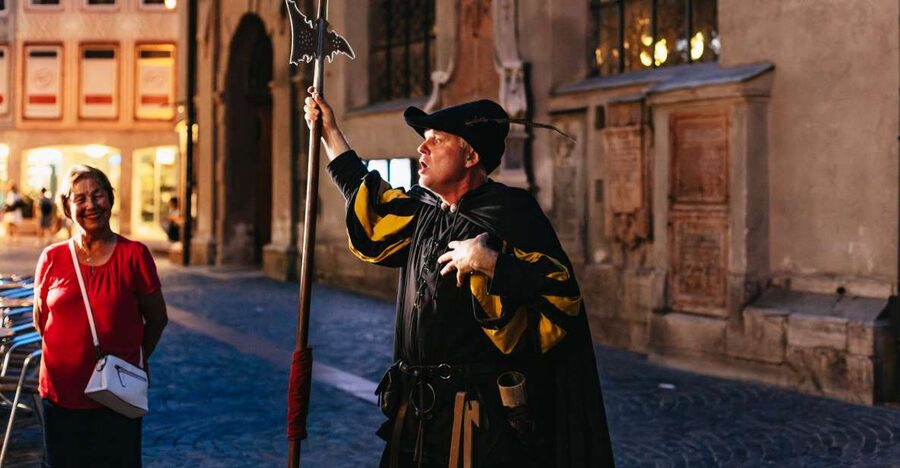
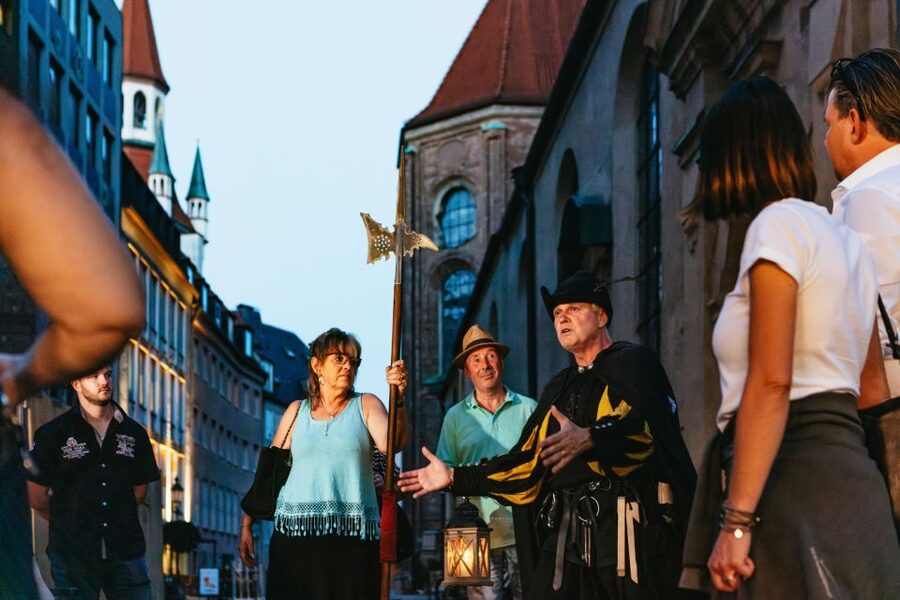
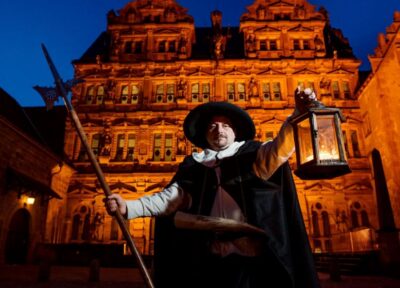
A lantern, a halberd, and a night watchman named Wolfram make a fine introduction to medieval Munich. Starting at Marienplatz, you follow old walls, gates, churches, markets, and castle sites while Wolfram explains the city’s harsher side: executions, prison torture, public punishments, and the rules that kept medieval citizens in line.
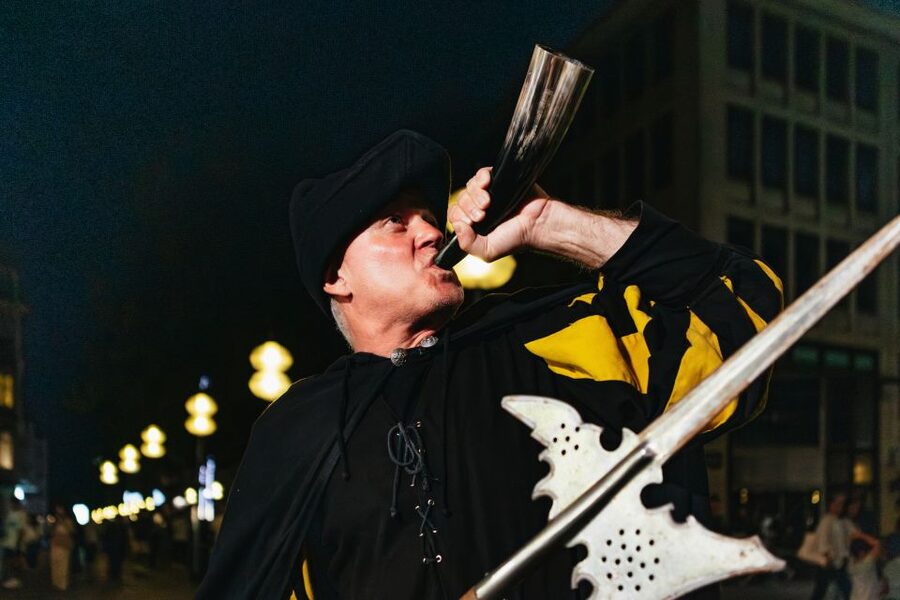
I like the strong storytelling and the way the walk uses real places rather than a museum room. I also like the small theatrical touches, including Wolfram’s clothing, horn, weapon, and the reenactment of a gate closing. The main drawback is simple: the tour is in German, and its grim material may not suit young children. Anyone under 12 is excluded.
Key points before you book
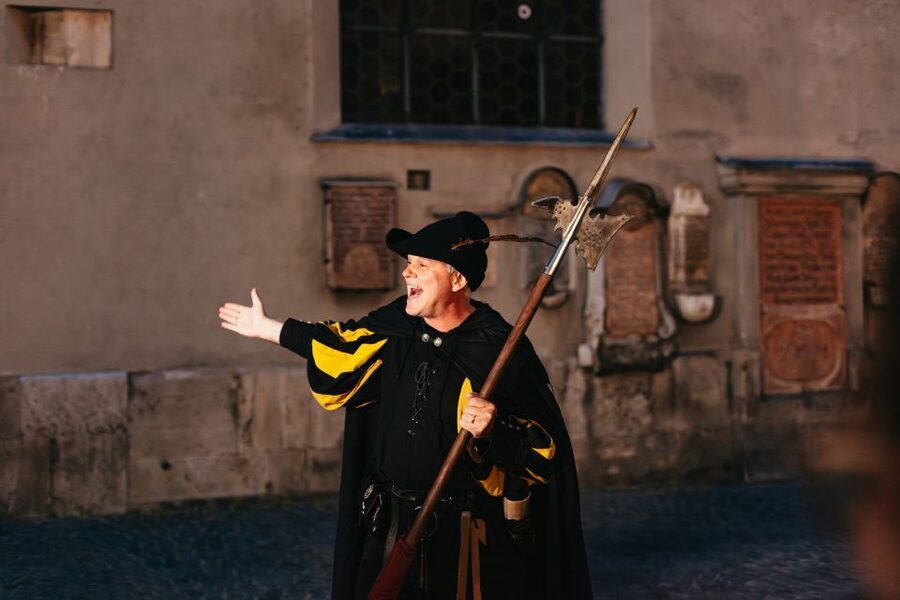
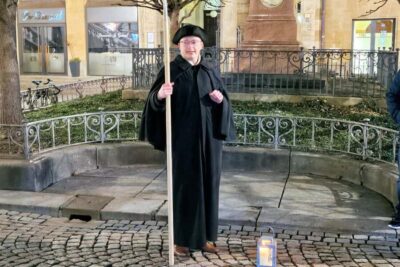
- Wolfram leads in medieval dress: He carries a lantern, halberd, and horn, giving the walk a clear character from the start.
- The subject matter is unusually dark: Expect executions, beheadings, torture, interrogations, cemeteries, and punishments for dishonest bakers.
- The route covers central Munich: Stops include St. Peter’s Church, Viktualienmarkt, the Old Town Hall, Alter Hof, Marienhof, Frauenkirche, and former city gates.
- The tour lasts 90 minutes: It begins and ends at Rathaus Apotheke beside Marienplatz, so it is easy to fit into an evening in the old town.
- It costs about $21 per person: That is a reasonable price for a private-feeling historical walk with a costumed guide, especially if you enjoy stories more than formal museum displays.
- German is the tour language: The activity is wheelchair accessible, takes place rain or shine, and private groups are available.
Meeting Wolfram beside Marienplatz
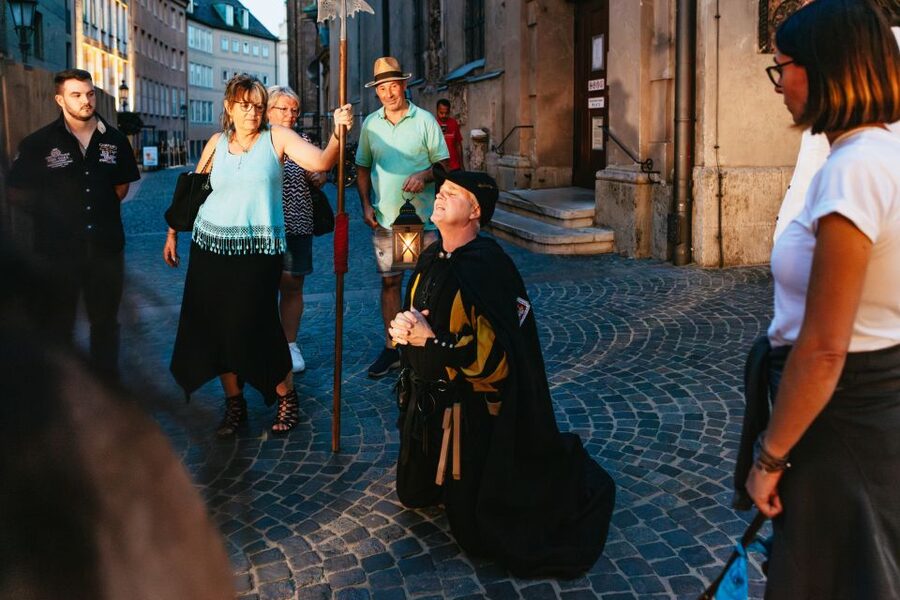
Your meeting point is in front of Rathaus Apotheke, about 25 meters to the left of number 8. The GPS position is 48.13737, 11.57588. Look for a man in typical medieval clothing, rather than relying only on a modern sign or vehicle.
This is a useful starting place because Marienplatz sits at the center of Munich’s old town. You can reach it easily on foot from many central sights, and the route returns to the same spot. That makes planning simple: you do not need to arrange a taxi or learn a second meeting point at the end.
Wolfram’s costume and equipment set the mood right away. The lantern is the most obvious visual prop, while the halberd gives the walk a more serious edge. The horn and weapon are not just decoration. They help explain how a night watchman might have announced trouble, guarded an entrance, or helped control movement after dark.
The presentation is theatrical, but the focus remains historical. You are not signing up for a full staged show with actors at every stop. Instead, Wolfram uses his appearance and manner to turn a city walk into a guided story. The strongest feedback about the experience focuses on this balance: the delivery is lively and funny, but still packed with information.
Other costumed walks near Munich:
- Munich: Night Watchman Walking Tour
★ 4.7 · 2,092 reviews - Munich: Night Watchman Torch Tour in German
★ 4.8 · 1,280 reviews - Dresden: The Original Night Watchman Tour in Lantern Light
★ 4.6 · 6,653 reviews
St. Peter’s Church and the smell of old Munich
The first major stop is St. Peter’s Church, where you spend about ten minutes with the guide. This is an important choice because the church connects the modern city with Munich’s medieval past. The route also takes you near ancient remains, where the scent of incense helps create a stronger sense of place.
The church stop is not simply a quick look at a famous building. It gives Wolfram a chance to talk about cemeteries, religious life, and the way medieval people understood death. In a period when churches and burial grounds were part of daily city life, sacred spaces were also tied to law, social rank, and public memory.
The reference to cemeteries and interrogations gives you an early warning about the tone. This is not a gentle architecture walk. You will hear about the systems used to question suspects and punish people, along with the beliefs that made public suffering part of civic life.
If you are sensitive to descriptions of executions or torture, pay attention to the tour’s subject matter before booking. The presentation can be entertaining, but the content is still grim.
Viktualienmarkt and punishment for bad bakers
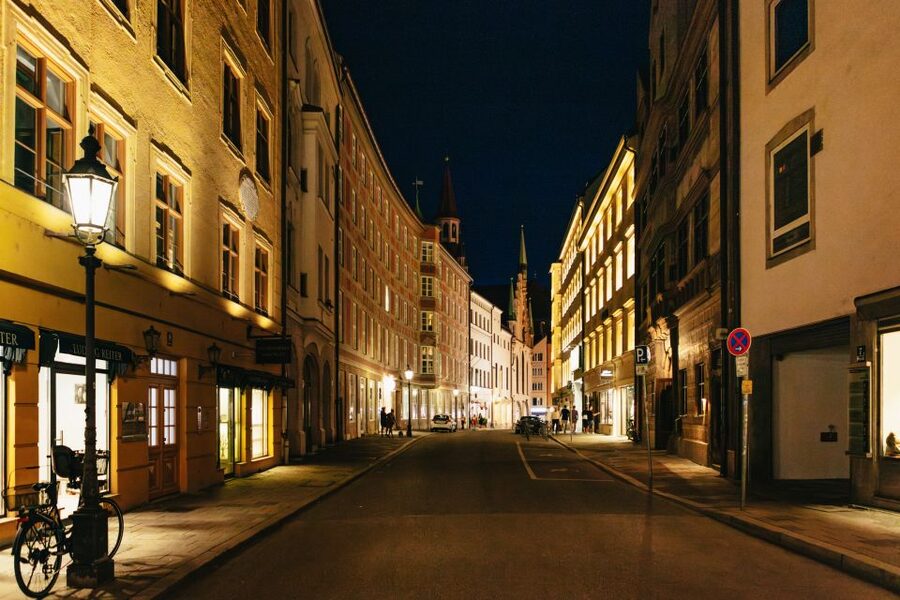
The walk continues toward Viktualienmarkt, where the medieval story shifts from churches and death to food regulation and public discipline. The market area is a useful place to hear how authorities dealt with tradespeople who broke the rules.
One memorable subject is the punishment of bad bakers at Metzgerzeile. Medieval cities depended on bakers, but bread was also a public concern. Poor weight, bad ingredients, or dishonest selling could affect an entire neighborhood. Punishment was meant not only to correct the baker but also to warn everyone watching.
This is one of the tour’s better details because it moves beyond kings, battles, and grand buildings. You get a look at ordinary city life and the strict controls placed on trades. Silver pennies, market rules, food quality, and public penalties help make the period feel practical rather than distant.
The market is also a lively modern setting for an old story. You may find the contrast striking: present-day stalls and shoppers occupy a place where earlier residents bought food under rules enforced by local authorities. Wolfram’s job is to connect those layers without turning the stop into a long lecture.
The Old Town Hall and medieval law
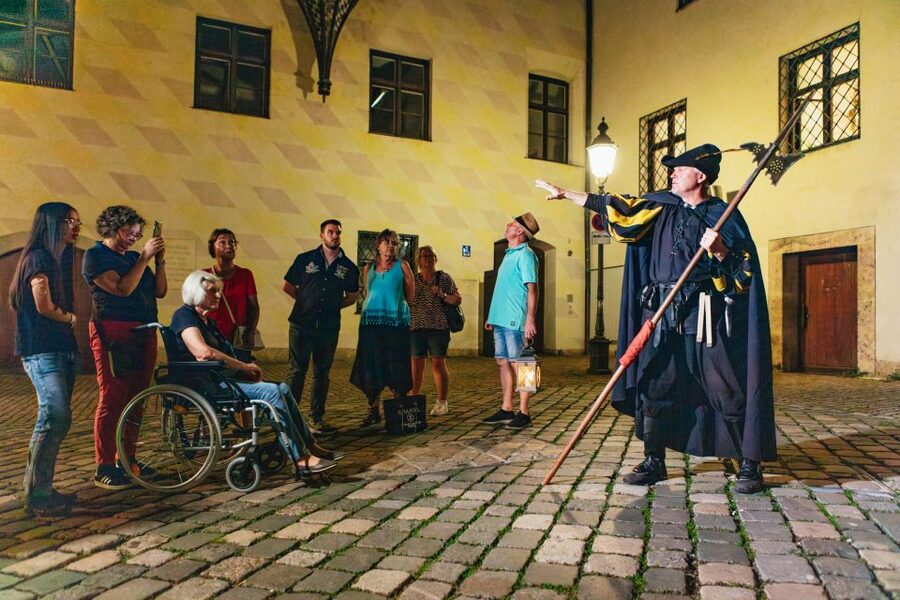
At the Old Town Hall, Wolfram continues with the civic side of medieval Munich. This is where ideas about authority, justice, and public order fit naturally into the route.
The tour’s discussion of executions and beheadings gives the Old Town Hall stop a darker purpose. Medieval justice was often public, and punishment could serve as both sentence and spectacle. A city did not hide every act of law enforcement behind closed doors. The crowd was part of the message.
That material may be uncomfortable, but it helps explain why a night watchman mattered. His work was tied to safety, curfews, gates, alarms, and the visible power of the city. You begin to see that medieval Munich was not only a collection of churches and trading streets. It was a controlled urban community with rules for movement and behavior.
The ten-minute stop length is helpful. You get the main idea without spending too long in one place, although people who want detailed architectural study may find the pace brisk.
Other trips that run after dark in Munich:
- Munich Ghosts and Spirits Evening Walking Tour
★ 5.0 · 1,900 reviews - Bavarian Beer and Food Evening Tour in Munich
★ 4.5 · 1,575 reviews - Hamburg: 90-Minute Evening Lights Harbor Cruise
★ 4.5 · 7,728 reviews - Hamburg: 1-Hour Harbor Evening Lights Cruise
★ 4.4 · 4,861 reviews
Alter Hof and the castle quarter
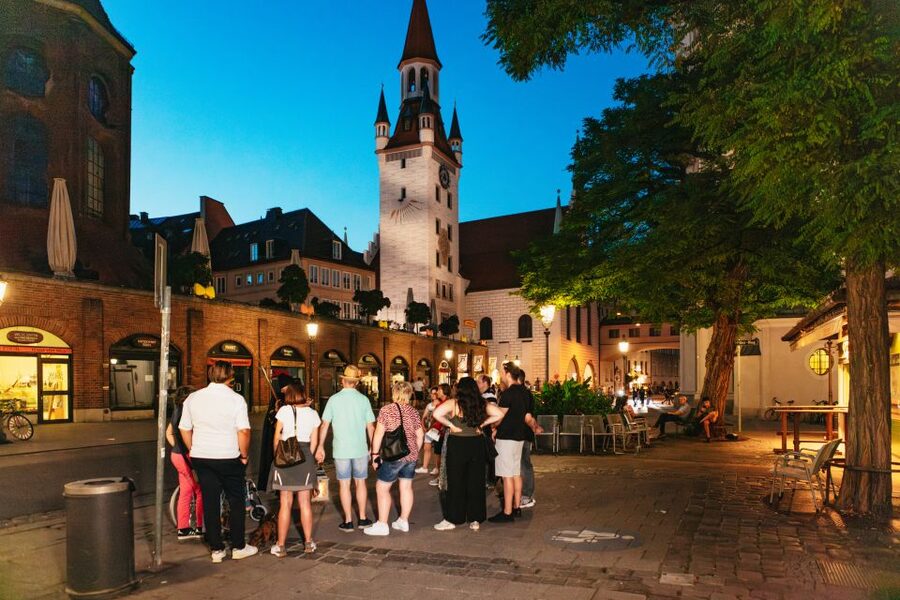
The walk then reaches Alter Hof, Munich’s old court and castle area. Here the focus shifts to the city’s ruling side, giving the route a useful change of scale.
After hearing about bakers and market rules, you encounter the world of princes, fortified buildings, and official power. The castle material helps show how Munich’s political center related to the streets where merchants, craftspeople, and ordinary families lived.
You should not expect access to a full medieval castle interior as part of this 90-minute walk. The value is in hearing how the site fits into the city’s story. Wolfram uses the location to explain the people who held authority and the systems that connected the castle to law, security, and public order.
This is also where the guide’s costume makes sense beyond simple atmosphere. A night watchman belongs to the space between ordinary residents and official power. He sees the streets, knows the rules, and helps enforce the boundaries of the city.
Marienhof and the old city walls
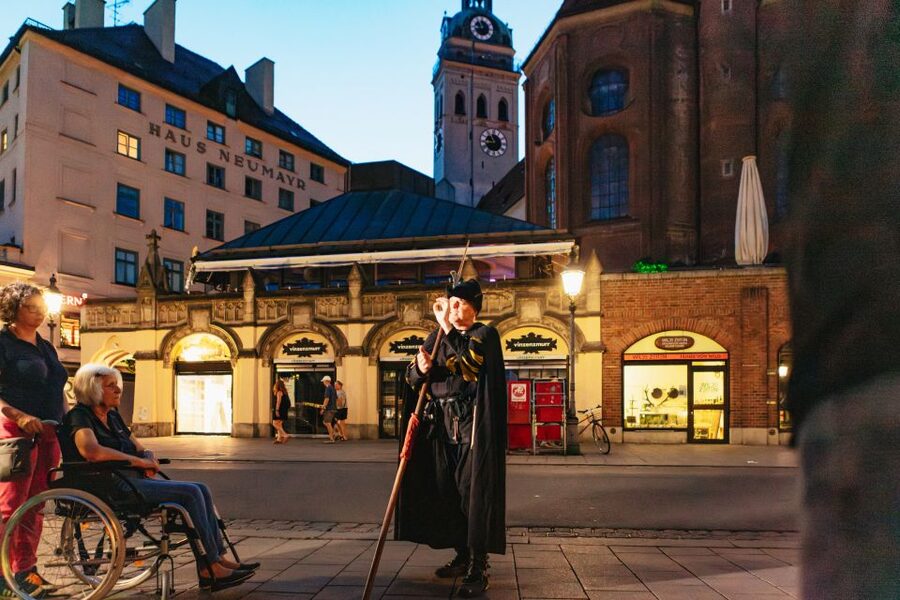
At Marienhof, the walk reaches one of its most atmospheric historical ideas: the medieval city wall. You learn about Munich’s 12th-century defenses and the way the city protected its people, property, and political center.
Walls are easy to overlook in a modern city because much of the original structure has disappeared or been absorbed into later buildings. A guide can make the lost fortifications easier to picture by explaining where they ran and what they controlled.
The subject quickly turns to executions and beheadings. That may sound like a sharp change, but walls, gates, prisons, and punishment all belonged to the same system. The city had to decide who could enter, who could leave, who could be detained, and how offenders would be dealt with.
This part of the tour rewards you if you enjoy reconstructing a vanished city from clues. You are not walking through a perfectly preserved medieval quarter. You are walking through modern Munich and using Wolfram’s stories to see the older structure below it.
Frauenkirche and the city gates
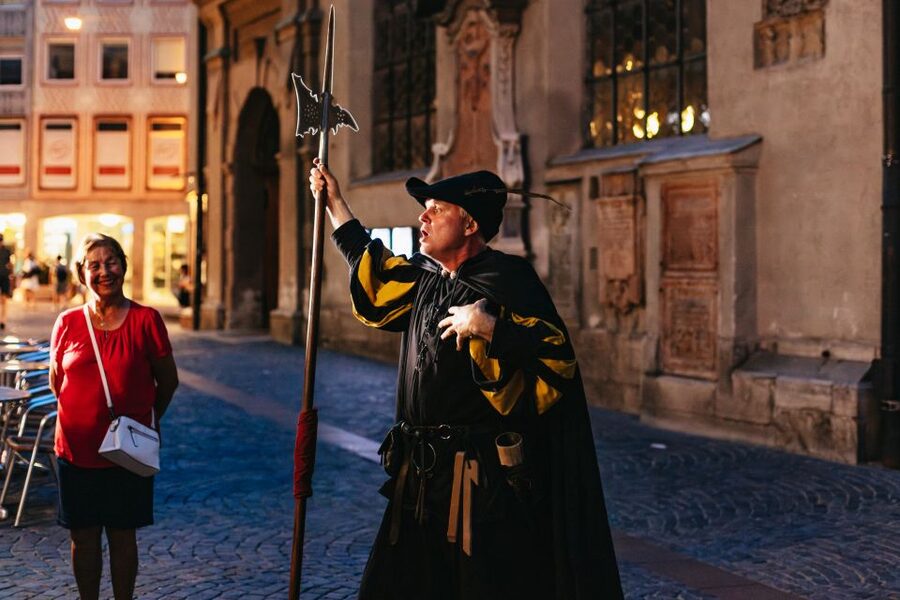
The route includes Frauenkirche and stories about the Schwabinger Gate and Talburg Gate. Gates were practical points of control, but they also carried symbolic weight. They marked the boundary between the protected city and the roads beyond it.
One of the walk’s most unusual moments is the account of the Talburg Gate closing, followed by a fight with a halberd. This gives the evening a short piece of physical theater and shows how a weapon like Wolfram’s could be used in a confrontation.
You also hear about the Schwabinger Gate as part of the old defensive system. These gates helped manage traffic, security, and nighttime movement. A night watchman’s duties become easier to understand when you picture the city as a walled place with limited entry points.
Frauenkirche adds a strong visual landmark near the end of the route. The church is familiar to many people visiting Munich, but the medieval framing changes how you see it. Instead of treating it only as a famous church, you consider its place in a city shaped by faith, fortification, trade, law, and fear.
Torture, prisons, and the limits of the performance
The tour does not avoid the most disturbing parts of medieval justice. Wolfram discusses torture techniques used in medieval prisons, along with interrogations and punishments.
This material is likely to be one of the main reasons to book the experience, or one of the main reasons to skip it. If you like social history and want to understand how courts operated, the subject adds useful depth. If you prefer a light evening walk, the descriptions may feel too heavy.
The guide’s style appears to be a major part of the experience. Wolfram tells the stories in a lively, entertaining way, with enough humor to keep the 90 minutes moving. At the same time, the strongest praise centers on how much information he fits into the walk and how well he handles questions.
That combination matters. Costumed tours can sometimes depend too much on gimmicks. Here, the costume, lantern, horn, and halberd support the historical role rather than replacing the content.
Is $21 a fair price?
At about $21 per person, the tour sits in an accessible price range for a central Munich activity. You get 90 minutes with a live guide, a route through several major old-town sites, and a presentation that includes historical interpretation and small reenactment touches.
The value is best if you want context. You could walk past Marienhof, Alter Hof, Frauenkirche, and the old market area on your own, but you would not automatically understand the vanished walls, gate system, punishments, or role of a night watchman.
Food and drinks are not included, though that is not a major concern for a short evening walk in central Munich. You can easily plan a meal before or after the activity, but you should not expect a tasting stop or refreshment break during the tour.
The route ends where it begins, which also adds value. You finish at Rathaus Apotheke by Marienplatz instead of having to find your way back from an unfamiliar neighborhood.
Practical details for a comfortable evening
The activity lasts 1.5 hours and takes place rain or shine. Wear shoes suited to walking on central city streets, and check the weather before you set out. The tour is wheelchair accessible, though the historical route includes old-city areas and public streets where conditions may vary.
The language is German. That is the single biggest booking consideration for many people. If you do not understand German well, the stories about medieval law, torture, and wordplay will be difficult to follow.
Flash photography and video recording are not allowed. You can take in the atmosphere and photograph appropriate public settings, but plan to keep the focus on the guide rather than recording the presentation.
Children under 12 are not permitted. Older children and teenagers who enjoy spooky history may like it, but the material is better suited to adults and mature young people than to families seeking a light sightseeing activity.
Free cancellation is available up to 24 hours before the start, and you can reserve while delaying payment. A private group option is also available if you want a more personal format.
Who should book this Munich walk?
I would choose this tour if you like dark social history, historic characters, and stories tied to exact city locations. It is especially useful early in a Munich visit because the route introduces several central landmarks while giving you a mental map of the medieval city.
It also suits anyone who finds standard sightseeing explanations too dry. Wolfram’s clothing and props provide a clear narrative thread, and the lantern-and-halberd setup makes the walk feel different from a normal daytime orientation tour.
I would skip it if you want a gentle family stroll, an English-language experience, or a detailed look inside monuments. The tour is in German, includes executions and torture, and moves through many subjects in a short time.
Should you book it?
Book it if you can follow German and want Munich’s old town explained through its rougher, stranger details. Wolfram’s lively delivery, medieval clothing, and memorable objects give the walk a strong sense of character, while the route covers walls, gates, churches, markets, the castle quarter, and civic buildings.
The best reason to go is the blend of fact and theater. You get real places, specific historical subjects, and enough performance to make the stories stick. At $21 for 90 minutes, it is a sensible choice for an adult evening activity, provided you are comfortable with grim material and a rain-or-shine walk.
FAQ
Where does the Munich Middle Ages Tour begin?
It begins in front of Rathaus Apotheke at Marienplatz, about 25 meters to the left of number 8. The GPS location is 48.13737, 11.57588.
How do I identify the guide?
Your guide will be wearing typical medieval clothing. Wolfram carries a lantern, halberd, and horn during the walk.
Who is the guide?
The guide named for this experience is Wolfram, who presents the tour as a medieval night watchman.
How long does the tour last?
The tour lasts 1.5 hours.
What language is the tour in?
The live tour guide speaks German.
Is the tour suitable for children?
Children under 12 are not permitted. The tour includes executions, beheadings, torture, interrogations, and other dark subjects.
Is the tour wheelchair accessible?
Yes, the activity is listed as wheelchair accessible.
Does the tour run in bad weather?
Yes. The tour takes place rain or shine.
What is included in the price?
A guide in medieval garb is included. Food and drinks are not included.
Just added in Munich
- 2 Hours Munich: VIP Private Segway Tour★ 4.9 · 5 reviews
- “Comedykills” – das Open Mic im Glockenbachviertel★ 4.1 · 51 reviews
- From Munich: Herrenchiemsee Palace and Boat Trip Day-Tour★ 4.8 · 129 reviews
- Munich: Classical Concert at the Residenz Palace★ 4.5 · 148 reviews
- Munich: City Highlights Guided Segway Tour★ 4.6 · 266 reviews
- Munich: Law Library Guided Visit with Entry Tickets★ 4.6 · 297 reviews
- From Munich: Guided Group Tour to Eagle’s Nest★ 4.8 · 303 reviews
- From Munich: Nuremberg Day Trip by Train★ 4.4 · 357 reviews
Night Watchman Tours, compared.
The Original Night Watchman Tour in Lantern Light
Read our review →
1.5-Hour Public Tour with Night Watchman Bremme
Read our review →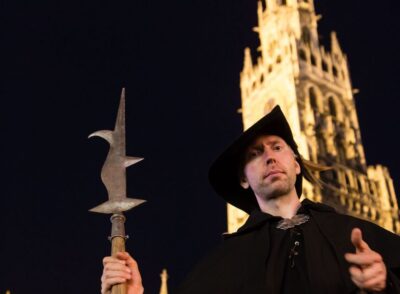

The Night Watchman Old Town Walking Tour in German
Read our review →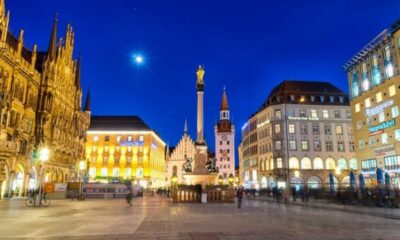
Browse the lists this tour appears in